Average Chief Marketing Officer Salary in 2026: US Guide

What does a Chief Marketing Officer actually earn in the US?
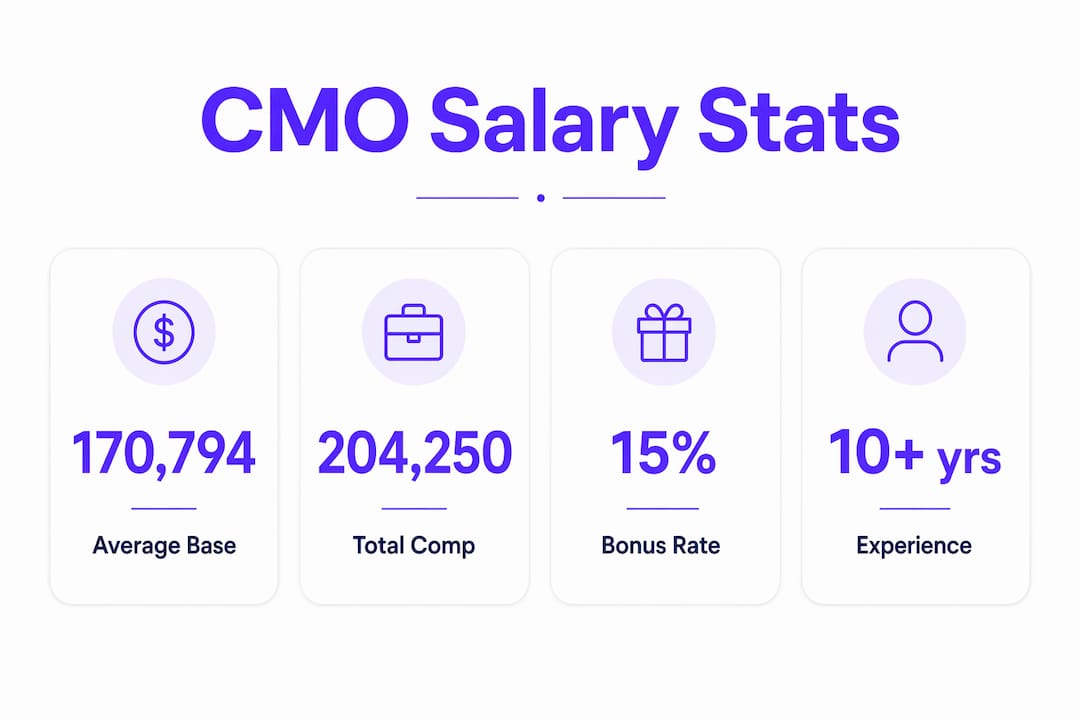
The average chief marketing officer salary in the United States sits at approximately $170,794 annually, based on 365 job postings tracked over the past 36 months. That figure is a starting point, not a ceiling. Robert Half's verified placement data puts the national salary range between $170,500 and $248,750, with a midpoint of $204,250.

| Percentile | Annual Salary |
|---|---|
| — | ~$170,500 |
| 50th percentile (midpoint) | ~$204,250 |
| — | ~$248,750 |
- Annual performance bonuses tied to revenue or marketing KPIs
- Stock options or equity grants, especially at growth-stage companies
- Profit sharing at mid-size and enterprise firms
- Commissions in revenue-accountable CMO structures
- Benefits packages covering health, retirement, and executive perks
What drives the wide range in chief marketing officer pay?
Company size is the single biggest lever. CMOs at companies with $20M–$50M in revenue typically see total packages of $210,000–$313,000, while those at billion-dollar firms earn significantly more. Startup CMOs often accept lower base salaries in exchange for higher equity stakes, whereas enterprise CMOs receive more stable cash compensation with lower equity upside.
- Company revenue and growth stage shape both base pay and equity allocation
- Industry sector plays a real role: B2C CMOs often earn higher base salaries than their B2B counterparts, correlated with firm size and product market scale
- Geographic location shifts the numbers meaningfully; California CMOs average $176,290 compared to the national average
- Bonus and equity structures vary by company stage, with profit sharing more common at established firms
Stat callout: According to Robert Half, the national midpoint for CMO compensation is $204,250, with the upper end of base salary at $248,750 for professionals placed at larger organizations.
Average salary figures can be misleading. CMOs at large corporations operate with full P&L accountability and global teams, while those at smaller companies may handle a narrower scope. The title is the same; the job often is not.
What does a Chief Marketing Officer actually do?
The CMO role spans far more than running ad campaigns. At its core, the position carries strategic marketing leadership, revenue growth responsibility, brand management, and oversight of the entire marketing organization.
Key duties and role characteristics include:
- Setting marketing strategy aligned with company revenue and growth goals
- Leading and scaling marketing teams, from brand to demand generation
- Owning brand positioning across all channels and markets
- Reporting to the CEO and collaborating with CFO, CRO, and product leadership
- Managing marketing budgets, which at large firms can run into the tens of millions
Role scope shifts dramatically by company size. A startup CMO might personally run paid acquisition and write copy. An enterprise CMO manages a department of hundreds and focuses on organizational design and board-level reporting. That difference in scope is exactly why compensation bands are so wide.
How Salary Atlas and the BLS keep CMO data honest
Salary data is only as good as its source. Salary Atlas links every figure directly to the U.S. Bureau of Labor Statistics, the most authoritative public source for US wage data, refreshed annually through the Occupational Employment and Wage Statistics program.
Transparency factors worth understanding:
- BLS OEWS data covers actual employer-reported wages across industries and geographies
- Annual refresh cycles mean figures reflect current market conditions, not outdated surveys
- Multiple source triangulation (BLS, verified placement firms, job posting aggregators) reduces single-source bias
- Original source links let you verify every figure independently
Pro Tip: When comparing CMO salary figures across sources, always check the sample size and collection method. A figure based on 365 verified postings carries more weight than one from a self-reported survey of 40 respondents.
Job title inflation is a real distortion in CMO salary data. Smaller companies sometimes label manager-level marketing roles as "Chief Marketing Officer," which pulls aggregated averages downward and creates unusual variance in reported ranges. When you see a CMO salary figure well below $150,000, that is usually the explanation.
What education and experience do CMOs typically have?
Most CMOs hold at least a bachelor's degree in business, marketing, or communications, and a large share also carry an MBA or equivalent graduate credential. The MBA is not a hard requirement, but it tends to accelerate advancement into C-suite roles and can support higher starting compensation.
Career milestones on a typical CMO path:
- Bachelor's degree in marketing, business, or a related field
- 5–10 years in mid-level marketing management, such as marketing manager or director roles
- VP of Marketing or equivalent senior leadership experience
- Demonstrated revenue impact, often measured in pipeline growth or market share gains
- Cross-functional leadership experience spanning product, sales, and finance
Education and experience together shape where a CMO lands in the salary range. An MBA from a top program combined with a decade of enterprise marketing leadership typically commands the upper quartile.
How CMO salaries compare across industries
Industry context changes the math considerably. Technology and financial services tend to offer the highest chief marketing officer pay, driven by large marketing budgets and intense competition for talent. Consumer goods and retail also pay well, particularly for B2C-focused roles where brand investment is central to revenue.
Healthcare and pharmaceutical marketing is another high-compensation sector. Marketing executives in pharma operate under strict regulatory constraints, and that specialized knowledge commands a premium. For context on how pharma marketing budgets translate into executive compensation, the sector consistently ranks among the top payers for senior marketing talent.
Nonprofit and education sector CMOs typically earn less than their private-sector counterparts, often significantly so. Government and public sector roles follow a similar pattern, with compensation capped by pay grade structures rather than market rates.
How has CMO compensation shifted in recent years?
The CMO role has grown more complex over the past several years, and pay has followed. Demand for executives who can own both brand and performance marketing, manage data infrastructure, and demonstrate measurable revenue contribution has pushed compensation upward at the top of the market.
At the same time, some organizations have restructured or eliminated the CMO title entirely, folding responsibilities into a Chief Revenue Officer or Chief Growth Officer role. Where the CMO title survives, it increasingly carries broader accountability, which justifies higher pay. The midpoint figure of $204,250 from Robert Half's 2026 data reflects this expanded scope compared to earlier benchmarks.
What is the hiring outlook for CMOs in 2026?
The Bureau of Labor Statistics projects employment for top executives, the category that includes CMOs, to grow at a rate consistent with the overall economy through the next decade. Demand is not uniform across sectors. Technology, healthcare, and consumer brands are actively hiring senior marketing leaders, while some traditional media and retail companies have reduced headcount at the executive level.
Competition for experienced CMOs remains intense. Companies increasingly want candidates who combine creative brand leadership with analytical fluency, a combination that was rare a decade ago and is now table stakes for the role.
How does salary grow as you advance toward the CMO level?
Career progression toward the CMO seat is gradual and experience-heavy. Most executives spend many years in marketing management before reaching the C-suite, with each step carrying a meaningful pay increase.
A typical progression looks like this: a marketing coordinator earns in the $45,000–$60,000 range, a marketing manager moves into the $80,000–$120,000 band, a director of marketing reaches $130,000–$180,000, and a VP of Marketing often lands between $180,000 and $250,000 before stepping into the CMO role. The jump from VP to CMO is not just a title change. It brings full organizational accountability, board exposure, and compensation that reflects both the risk and the scope of the position.
*Explore current, fully sourced salary data for marketing and executive roles at Salary Atlas, where every figure links back to its original BLS source with no paywall.
 *
*
Key Takeaways
The average chief marketing officer salary in the US is approximately $170,794, with total compensation often reaching $204,250 or higher depending on company size, industry, and location.
| Point | Details |
|---|---|
| National average base pay | The average CMO base salary is approximately $170,794 annually based on verified US job postings. |
| Compensation range | Robert Half places the national range at $170,500–$248,750, with a midpoint of $204,250. |
| Company size impact | Mid-size companies ($20M–$50M revenue) offer packages of $210,000–$313,000; larger firms pay more. |
| Geographic variation | California CMOs average $176,290, above the national average of $170,794. |
| Beyond base salary | At the national level, total compensation often reaches $204,250 or higher, with bonuses, stock options, and profit sharing sometimes exceeding base salary at large organizations. |
FAQ
Is a CMO higher than a VP of Marketing?
Yes. The CMO is a C-suite executive who typically oversees the VP of Marketing and carries full organizational accountability for marketing strategy and revenue contribution.
Is chief marketing officer a high-paying position?
It is one of the higher-paid roles in a company. With a national midpoint of $204,250 and the upper end of base salary at $248,750 according to Robert Half, the CMO ranks among the top earners in most organizations.
What kind of CMO makes the most money?
CMOs at large technology or financial services firms, particularly those with B2C revenue models and significant marketing budgets, consistently earn the highest total compensation packages.
What is the highest salary reported for a CMO?
Robert Half's verified placement data shows the upper end of the national range at $248,750 in base salary, with total compensation at billion-dollar firms running considerably higher when equity and bonuses are included.