Wage vs Salary: Key Differences and How to Compare Offers
 *
*
TL;DR:>
- Wages are paid based on hours worked or units produced, while salaries are fixed annual amounts regardless of hours. The choice depends on overtime availability, benefits, and work hours, with each having specific advantages and legal considerations. Understanding overtime rules and proper classification is essential for fair compensation and legal compliance.*
A wage is pay tied to hours worked or units produced; a salary is a fixed annual amount split into regular paychecks. Neither is automatically better. Hourly pay tends to win when overtime is realistic or the rate is substantially higher than the salary equivalent; salaried pay tends to win when you value predictable income, employer-sponsored benefits, and career stability. When you first look at any offer, check three things: how many hours are actually expected each week, whether overtime is paid, and what benefits are included.
Table of Contents
- What is the difference between a wage and a salary?
- How wages and salaries compare across what matters most
- What are the pros and cons of wages vs. salaries?
- What U.S. law says about overtime and exempt status
- What the U.S. workforce data shows
- How to choose between hourly and salaried pay
- How to convert between hourly and annual pay
- Key Takeaways
- The pay structure question most people ask too late
- Useful sources
- FAQ
What is the difference between a wage and a salary?
Wages are compensation calculated by time or output. You earn a set rate per hour, per piece, or per shift, and your paycheck reflects exactly how much you worked. Retail cashiers, warehouse workers, construction laborers, and gig delivery drivers are all paid this way. If you clock 32 hours one week and 48 the next, your gross pay changes accordingly. Salaries are fixed annual amounts divided into equal pay periods, regardless of how many hours you actually put in. A marketing manager earning $72,000 per year receives the same paycheck whether the week was 38 hours or 52. Salaried roles are common in professional, managerial, and administrative positions.
How pay frequency works
Both pay types are delivered on a schedule, but the mechanics differ slightly. Salaried employees are typically paid through the paycheck date because the fixed amount is straightforward to calculate. Hourly workers are often paid through an earlier date to give payroll time to process variable hours before the check goes out.
Common pay-period structures:
- Weekly: 52 paychecks per year (common in construction, manufacturing)
- Biweekly: 26 paychecks per year (most common across U.S. employers)
- Semimonthly: 24 paychecks per year (common for salaried office roles)
- Monthly: 12 paychecks per year (less common; used in some professional services)
Quick pay-period conversion examples
- Hourly $20, 40 hrs/week: $800/week → $1,600 biweekly → $41,600/year
- Salary $60,000/year: $2,307.69 biweekly → $5,000/month
- Salary $85,000/year: $3,269.23 biweekly → $7,083.33/month
How wages and salaries compare across what matters most
| Dimension | Hourly Wage | Annual Salary |
|---|---|---|
| Pay predictability | Variable; changes with hours worked | Fixed; same amount every pay period |
| Overtime eligibility | Nonexempt workers earn 1.5× after 40 hrs/week | Exempt salaried workers typically receive no overtime |
| Benefits and non-wage compensation | Less common; often limited or none | More common; health insurance, 401(k), PTO standard |
| Time tracking and admin burden | Required; hours must be logged accurately | Generally not required; output-based accountability |
| Employer cost behavior | Variable payroll; scales with demand | Fixed overhead; does not drop during slow periods |
| Typical industries and roles | Retail, hospitality, construction, manufacturing | Finance, tech, management, education, healthcare admin |
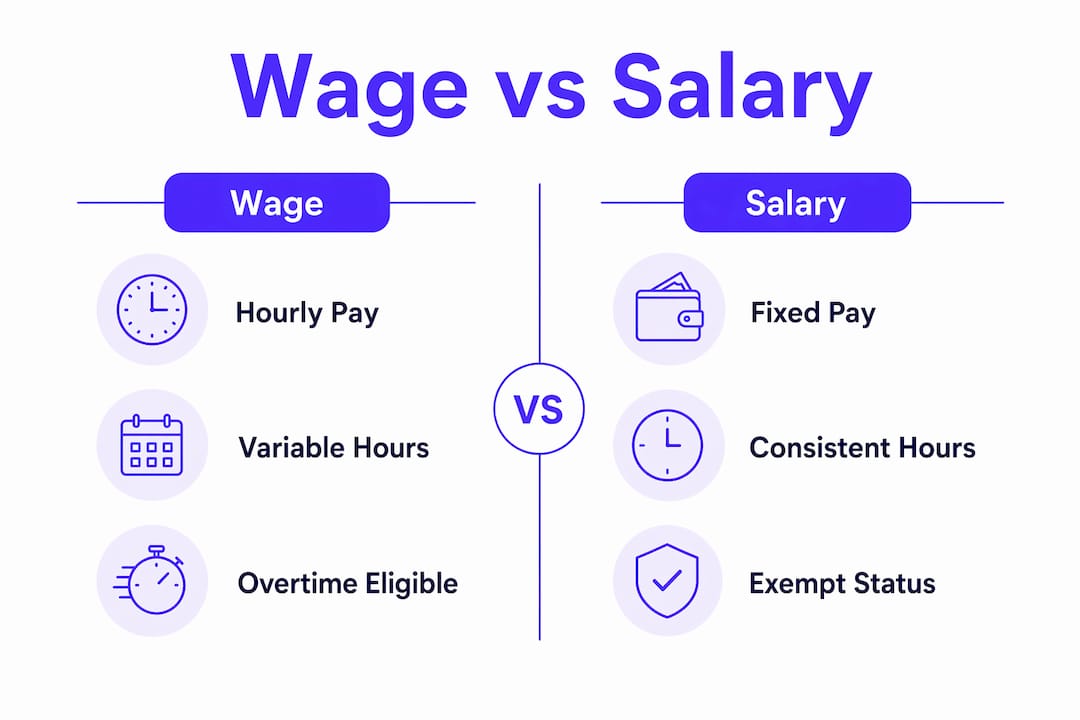
The overtime row is where the real money often hides. A nonexempt hourly worker who regularly pulls 45-hour weeks earns a meaningful premium over their base rate. A salaried exempt employee working the same schedule earns nothing extra for those five hours.

What are the pros and cons of wages vs. salaries?
For employees
Hourly wage advantages:- Every hour worked is compensated, including overtime at 1.5× the regular rate for hours beyond 40 per week under federal law
- Easier to set firm boundaries on work hours
- Flexibility to pick up extra shifts when you want more income
- Income fluctuates with scheduling, slow seasons, or illness
- Benefits are less common, which increases out-of-pocket costs for health coverage
- Time tracking is mandatory, which can feel intrusive
- Predictable income makes budgeting straightforward
- Salaried roles more frequently include health insurance, 401(k) matching, and paid time off, which can add roughly $15,000–$30,000 in effective annual value
- Often signals a path to advancement and professional development
- Exempt status means extra hours go unpaid, and work-life boundaries can blur without clear policies
- Harder to capture upside during busy periods
- Salary cuts are more visible and can feel more personal than reduced hours
For employers
Hourly wage advantages:- Labor costs scale with demand, making hourly pay a natural fit for seasonal retail, event staffing, or variable-demand operations
- Easier to reduce payroll during slow periods without layoffs
- Straightforward to staff up quickly for project-based work
- Overtime liability can spike unexpectedly during busy periods
- Time-tracking systems add administrative overhead
- Higher turnover is common in hourly roles, raising recruiting costs
- Predictable payroll simplifies budgeting and forecasting
- Salaried packages are a retention tool, particularly when benefits are strong
- Exempt employees can be asked to complete projects without triggering overtime calculations
- Fixed overhead that does not shrink when business slows
- Misclassifying an hourly worker as salaried-exempt creates serious legal exposure
- High-salary commitments can constrain hiring flexibility
What U.S. law says about overtime and exempt status
The Fair Labor Standards Act (FLSA) is the federal law that governs overtime. The core rule: nonexempt employees must receive overtime pay at 1.5 times their regular rate for every hour worked beyond 40 in a workweek. Most hourly workers are nonexempt by default.
Salaried employees can be either exempt or nonexempt. Exempt status requires meeting both a salary-basis test (currently a minimum weekly salary threshold set by the Department of Labor) and a duties test tied to executive, administrative, or professional responsibilities. Paying someone a salary does not automatically make them exempt. The duties test matters just as much as the pay level.
Pro Tip: Check the Department of Labor's overtime page before classifying any new role. Misclassifying a nonexempt worker as exempt is one of the most common and costly wage-and-hour violations employers face.State law can be stricter than federal law. California, for example, requires daily overtime for hours beyond eight in a single day, not just weekly. New York and Washington have their own salary thresholds that exceed the federal minimum. Always verify your state's labor department rules before finalizing a classification.
Misclassification red flags to watch for: a job title that sounds managerial but involves mostly routine tasks, a salary just above the federal threshold with no real supervisory duties, or a role where the employer discourages tracking hours at all.
What the U.S. workforce data shows
About 60% of U.S. workers are salaried, while roughly 40% are paid hourly wages. That split reflects the economy's tilt toward professional and service-sector jobs, but it also means tens of millions of workers are navigating hourly pay structures every day.
60% salaried, 40% hourly. For job seekers, that means the majority of posted positions will offer a fixed annual pay, but a large share of the workforce, particularly in trades, retail, and hospitality, still earns by the hour.
The table below shows how common annual salary figures translate to hourly equivalents at a standard 40-hour week (2,080 hours per year), alongside the effective hourly rate if actual hours average 50 per week (2,600 hours per year).
| Annual Salary | Hourly at 40 hrs/week | Effective Hourly at 50 hrs/week |
|---|---|---|
| $60,000 | $28.85 | — |
| $75,000 | $28.85 | $36.06 |
For occupation-level data across hundreds of job titles, Salary Atlas publishes BLS-sourced figures by role, percentile, and state, with no paywall.
How to choose between hourly and salaried pay
Neither pay type is inherently better. The right answer depends on overtime availability, benefits value, and actual hours. Work through this checklist before accepting or posting any position.
- Confirm the expected weekly hours. Ask directly: "What does a typical week look like?" If the honest answer is 50+ hours for a salaried role, recalculate the effective hourly rate before comparing it to an hourly offer.
- Check overtime eligibility. Ask whether the role is classified as exempt or nonexempt. If it is nonexempt, ask how frequently overtime is available and whether it is capped.
- Calculate total annual gross. For hourly roles, estimate annual pay including realistic overtime. For salaried roles, the number is fixed, but confirm whether bonuses are discretionary or guaranteed.
- Add benefits value. Health insurance, 401(k) matching, and paid time off can add significant effective annual value to a salaried offer. An hourly role without benefits requires you to fund those costs yourself.
- Evaluate PTO and scheduling predictability. Salaried roles typically offer defined PTO. Hourly roles may offer more flexibility to pick up or drop shifts, but scheduling can be unpredictable.
- Ask about the classification rationale. If a role is salaried-exempt, ask which duties test it meets. Vague answers are a red flag.
Red flags to watch for: a salaried offer with no mention of expected hours, an hourly role where overtime is "possible" but never guaranteed, a benefits package described as "competitive" with no specifics, and any employer who discourages asking about overtime policy. Negotiation levers: hourly workers can negotiate the base rate and overtime availability; salaried workers can negotiate base pay, signing bonus, PTO days, and 401(k) match percentage.
How to convert between hourly and annual pay
The math is simple. What trips people up is using 40 hours as the assumed weekly figure when the actual expectation is higher.
Core formulas:- Annual from hourly: Hourly rate × hours per week × 52
- Hourly from annual: Annual salary ÷ (expected hours per week × 52)
An hourly rate of $22 at 40 hours per week:
$22 × 40 × 52 = $45,760 per year
A $45,760 salary divided back out: $45,760 ÷ 2,080 = $22.00/hr
Worked example 2: High-hours salaried roleA $75,000 salary where the real expectation is 50 hours per week:
$75,000 ÷ (50 × 52) = $75,000 ÷ 2,600 = $28.85/hr effective rate
Compare that to an hourly offer of $32 at 40 hours per week: $32 × 2,080 = $66,560 base, plus any overtime. At just five overtime hours per week, that hourly worker earns $32 × 1.5 × 5 × 52 = $12,480 in overtime, bringing total gross to roughly $79,040, well above the $75,000 salary with its 50-hour expectation.
- Quick rule of thumb: If the hourly rate exceeds roughly 1.3 times the salary-equivalent hourly rate, or if you expect to regularly work more than 45 hours per week in a nonexempt role, hourly pay often comes out ahead.
- Tax note: The IRS treats both salary and hourly wages as ordinary income; federal income tax and FICA apply the same way at the same gross. Any take-home difference comes from overtime and benefits, not from differential tax treatment.
- For deeper benchmarks: Salary Atlas's data analyst page and similar occupation pages show median, range, and percentile breakdowns that make it easy to sanity-check whether a specific offer is competitive.
Pro Tip: Before accepting a salaried role, ask your future manager what a "normal" week looks like for the team, not just for the role. Culture drives actual hours more reliably than the job description does.
Key Takeaways
Wages and salaries are taxed identically at the same gross income; the real difference lies in overtime eligibility, benefits access, and how many hours you actually work.
| Point | Details |
|---|---|
| Wages are hourly; salaries are fixed | A wage changes with hours worked; a salary stays the same every pay period regardless of hours. |
| Overtime changes the math | Nonexempt hourly workers earn 1.5× after 40 hours per week; exempt salaried workers typically receive nothing extra. |
| Benefits add $15k–$30k in value | Salaried roles commonly include health insurance, 401(k) matching, and PTO that hourly roles often lack. |
| Calculate effective hourly rate | Divide annual salary by actual expected weekly hours × 52 to see what you really earn per hour. |
| Check exempt vs. nonexempt status | A salary does not automatically mean exempt; both a salary-basis test and a duties test must be met under the FLSA. |
The pay structure question most people ask too late
Most job seekers spend their negotiation energy on the base number and almost none on the hours assumption baked into it. A $70,000 salary sounds better than a $32/hour wage until you realize the salaried role expects 55-hour weeks and the hourly role caps at 40 with occasional overtime. The effective hourly rate calculation in this guide is the single most useful tool for cutting through that ambiguity.
There is also a benefits blind spot. Hourly workers who decline employer coverage because the premium feels high often underestimate what it costs to replace that coverage independently. Adding the realistic cost of individual health insurance, retirement contributions, and unpaid sick days back into the comparison frequently closes the gap between a "lower" salary and a "higher" hourly rate.
The exempt-versus-nonexempt distinction deserves more attention from job seekers than it typically gets. Employers sometimes use salaried-exempt classification as a way to extract more hours without additional cost. That is legal when the classification is correct. When it is not, it is a wage-and-hour violation. Knowing the FLSA basics puts you in a position to ask the right questions before you sign anything.
Useful sources
- Fair Labor Standards Act (FLSA): The primary federal law governing minimum wage, overtime, and exempt/nonexempt classification. Start here for any classification question.
- Department of Labor: Overtime Rules: Current salary thresholds and duties tests for exempt status, updated when federal rules change.
- Department of Labor: Minimum Wage: Federal and state minimum wage rates by jurisdiction.
- BLS Employer Costs for Employee Compensation: National data on how much employers spend on wages, salaries, and benefits, useful for benchmarking total compensation.
- BLS Minimum Wage Workers Report: Demographic and occupational breakdown of hourly workers at or below the federal minimum wage.
- Salary Atlas: BLS-sourced salary and wage data by occupation, percentile, and state, free and without a paywall.
- Salary Atlas Methodology: Explains how Salary Atlas sources, processes, and refreshes its occupational pay data.
- Hourly to Salary Conversion Guide (Coursera): Practical walkthrough of conversion formulas and considerations for switching pay types.
FAQ
Is a wage the same thing as a salary?
No. A wage is pay calculated by hours worked or units produced and varies with your schedule; a salary is a fixed annual amount divided into equal paychecks regardless of hours worked.
Is it better to be on salary or hourly pay?
Neither is universally better. Hourly pay wins when overtime is frequent or the rate is substantially higher than the salary equivalent; salary wins when benefits, predictability, and career advancement outweigh overtime potential.
Is $70,000 a year a good salary?
Whether $70,000 is competitive depends on the occupation, location, and experience level. You can check BLS-sourced median and percentile figures for your specific job title at Salary Atlas to see where $70,000 falls in the range.
Do salary and hourly workers pay different taxes?
No. The IRS treats both as ordinary income; federal income tax and FICA apply identically at the same gross earnings. Differences in take-home pay come from overtime opportunities and employer-provided benefits, not from the pay structure itself.
Can a salaried employee be nonexempt?
Yes. Salary alone does not determine exempt status under the FLSA. A salaried employee must also meet a specific duties test (executive, administrative, or professional) to qualify as exempt from overtime requirements.