What Is a Salary Range? A Clear Guide for Job Seekers
Discover what is a salary range and how it helps job seekers negotiate pay, assess offers, and benchmark their worth in the job market.
By the Salary Atlas editorial team · Published · Updated

TL;DR:
- A salary range includes the minimum, midpoint, and maximum pay for a role, guiding evaluation and negotiation. Understanding the structure helps job seekers and employers maintain internal equity, manage budgets, and comply with transparency laws. Most professionals misinterpret the range, assuming the maximum is their goal, but the midpoint represents fair market pay.
A salary range is defined as the minimum, midpoint, and maximum pay an employer allocates for a specific role. Understanding salary ranges gives you a concrete framework for evaluating job offers, negotiating compensation, and assessing whether an employer's pay reflects the market. The pay range definition goes beyond a single number. It captures the full span of what a role can pay, from the floor for a new hire to the ceiling for a top performer. Salary Atlas publishes this data directly from the U.S. Bureau of Labor Statistics so professionals can benchmark their pay without hitting a paywall.
What is a salary range and how is it structured?
A salary range is built around three key markers: minimum, midpoint, and maximum. Each marker serves a distinct purpose in how employers manage pay decisions.

The minimum is the lowest pay an employer will offer for a role. It typically applies to candidates with little direct experience or those entering a new field. The midpoint is the anchor. Employers use it for budgeting and merit-based increases, and it generally reflects the going market rate for a fully qualified person in that role. The maximum is the ceiling. Reaching it usually signals that a person has mastered the role and has limited room to grow within that pay band without a promotion.
The distance between minimum and maximum is called the range spread. Narrow spreads (around 20%–30%) are common in structured roles like government jobs or union positions. Wider spreads (50%–80%) appear in senior or technical roles where experience and performance vary significantly. That width tells you how much pay flexibility exists within the job.
Pro Tip: When you see a posted pay range, divide the midpoint by the maximum. If your target salary sits above 80% of the maximum, you are in the top tier of the range. That signals either strong leverage or a near-ceiling offer with little room to grow.How do organizations develop and structure salary ranges internally?
Every posted salary range traces back to an internal salary band. Salary bands are governance tools that include job evaluation scores, market benchmarks, and a company's pay positioning strategy. The posted range is a public-facing extract of that internal structure.
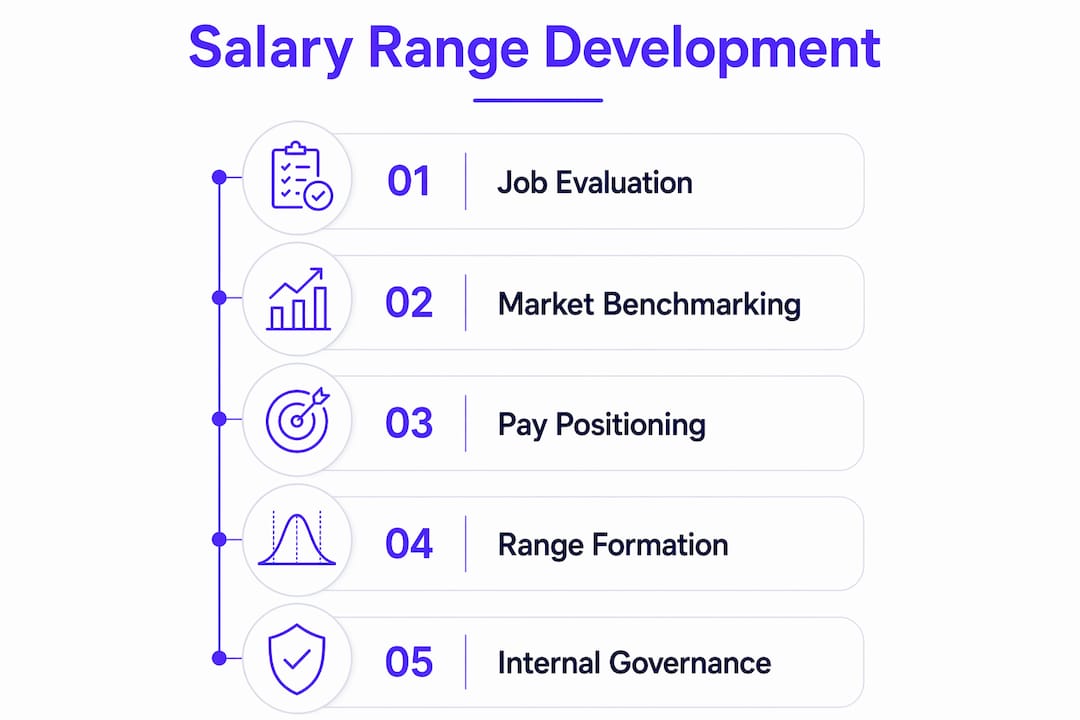
The role of job evaluation and market benchmarking
Job evaluation assigns a score to a role based on factors like decision-making authority, required skills, and scope of impact. That score places the role within a job grade. Each job grade maps to a salary band. Market benchmarking then calibrates that band against external pay data, typically sourced from surveys like those published by the U.S. Bureau of Labor Statistics or industry compensation surveys.
Pay positioning strategy determines where within the market a company wants to sit. A company that targets the 75th percentile of market pay will set its midpoints higher than a company targeting the 50th percentile. That choice reflects the employer's talent strategy and budget constraints.
| Component | What it does |
|---|---|
| Job evaluation score | Places the role in a grade based on complexity and scope |
| Market benchmark | Anchors the midpoint to external pay data |
| Pay positioning strategy | Sets whether the company leads, matches, or lags the market |
| Salary band | Internal governance structure containing min, mid, and max |
| Posted salary range | External communication of the approved pay span |
What strategic purposes do salary ranges serve for employers?
Salary ranges are core control mechanisms that give employers pay flexibility while protecting budget discipline. They allow managers to reward strong performers without creating chaos in the payroll.
Ranges also protect against pay compression. Pay compression happens when new hires earn close to or more than existing employees in the same role. It damages morale and increases turnover among experienced staff. A well-maintained salary range prevents this by capping new hire offers and creating a clear path for existing employees to grow their pay over time.
Pay transparency laws in 2026 add another layer of purpose. Transparency requirements now compel many employers to disclose salary ranges in job postings. That disclosure forces internal consistency. A company cannot post a range publicly and then make offers wildly outside it without creating legal and reputational risk.
Salary ranges help companies manage pay equity proactively in a competitive labor market while controlling long-term costs. When ranges are built on documented job evaluation and market data, they become a legal and ethical defense, not just a budgeting tool.
The strategic benefits of salary ranges for employers include:
- Budget control: Ranges cap total compensation spend per role and make payroll forecasting more predictable.
- Internal equity: Ranges create consistency across employees doing similar work, reducing discrimination risk.
- Talent planning: Ranges inform raise budgets, promotion timelines, and the cost of backfilling a role.
- Legal compliance: Documented ranges satisfy pay transparency laws and support equal pay audits.
How should employees and job seekers interpret salary ranges?
The pay range definition shifts slightly depending on which side of the table you sit on. For job seekers, the range is a negotiation map. For current employees, it shows where you stand and how far you can grow.
A common misconception is that the entire range is equally negotiable. Offers are typically anchored at the midpoint. Employers reserve the upper portion of a range for candidates with exceptional credentials or for current employees who have demonstrated sustained high performance. An offer above the maximum requires significant justification because it risks compressing the pay of existing staff.
Here is how to read a salary range as a job seeker:
- Minimum: This is the floor for someone entering the role with baseline qualifications. If an employer offers you the minimum, ask what milestones would move your pay toward the midpoint and over what timeline.
- Midpoint: This is the market rate for a fully qualified, productive person in the role. Targeting the midpoint in your negotiation is reasonable if your experience matches the job description closely.
- Maximum: This signals the ceiling for the role as currently defined. Reaching it typically means you have outgrown the position and need a promotion to access higher pay.
- Range width: A wide range signals that the employer values experience differences significantly. A narrow range signals that most people in the role are paid similarly regardless of tenure.
Salary range examples across occupations
Salary ranges vary significantly by occupation, industry, and geography. The table below illustrates how range widths and midpoints differ across representative roles, using data from the U.S. Bureau of Labor Statistics.
| Occupation | Approximate minimum | Approximate midpoint | Approximate maximum |
|---|---|---|---|
| Elementary teacher | $38,000 | $62,000 | $100,000 |
| Editor | $38,000 | $73,000 | $133,000 |
| Professor | $55,000 | $100,000 | $196,000 |
| Data scientist | $80,000 | $130,000 | $210,000 |
Range widths vary by role level and market demand. Roles with standardized duties and regulated pay structures tend to have narrow ranges. Roles where individual performance and specialized expertise create measurable business impact tend to have wide ones. Knowing which type of role you are in tells you how much negotiating room actually exists.
Key takeaways
A salary range is a structured pay span built on job evaluation, market data, and pay positioning strategy. It serves both employers and job seekers as a framework for fair, defensible compensation decisions.
| Point | Details |
|---|---|
| Three-marker structure | Every range has a minimum, midpoint, and maximum, each serving a distinct pay decision purpose. |
| Midpoint is the anchor | Employers budget and benchmark against the midpoint, making it the most useful number for negotiation. |
| Ranges prevent compression | Well-maintained ranges protect existing employees from being undercut by new hire offers. |
| Transparency laws matter | Pay transparency requirements in 2026 force internal consistency between posted ranges and actual offers. |
| Range width signals flexibility | Wide spreads mean more negotiating room; narrow spreads mean most employees earn similarly regardless of tenure. |
Why most professionals misread salary ranges
By Joelen ZyoktovaThe most common mistake I see professionals make is treating the posted maximum as their target. They anchor to the top of the range and then feel shortchanged when the offer comes in at the midpoint. That reaction misreads how ranges actually work.
The midpoint is not a low offer. It is the employer's definition of fair market pay for a fully qualified person. If you are new to the role or switching industries, the midpoint is often exactly where you belong. The real question is not whether you can negotiate to the maximum on day one. The question is whether the range has a clear path from midpoint to maximum and how long that path takes.
What I have found consistently is that professionals who understand the internal logic of salary bands negotiate better outcomes. They ask the right questions: What is the review cycle? What performance markers move pay within the range? Is there a promotion track above this band? Those questions signal sophistication and shift the conversation from "give me more" to "show me the system."
Pay transparency laws are changing this dynamic faster than most people realize. When ranges are posted publicly, the information asymmetry that once favored employers shrinks. Use that. Research salary data by state and by occupation before every negotiation. Walk in knowing where the midpoint sits relative to your market. That preparation alone separates the professionals who negotiate well from those who accept the first number they hear.
, Joelen Zyoktova
Salary Atlas: your starting point for salary range research
Knowing what a salary range means is the first step. Knowing the actual numbers for your occupation is what makes that knowledge useful.
Salary Atlas publishes median, minimum, and maximum salary data by job title, sourced directly from the U.S. Bureau of Labor Statistics and refreshed annually. Every figure links back to its original source. There are no paywalls and no fabricated trends. Whether you are preparing for a negotiation, evaluating a job offer, or benchmarking your current pay, Salary Atlas gives you the external data points you need to make the case for fair compensation. Search your job title and see exactly where the market sets the floor, midpoint, and ceiling for your role.
FAQ
What does a salary range mean for a job posting?
A salary range in a job posting shows the minimum and maximum pay an employer will offer for the role. It reflects the company's internal salary band and gives candidates a basis for assessing fit before applying.
Is the entire salary range negotiable?
Not typically. Offers anchor at the midpoint, and moving above it requires strong justification. Offers above the maximum are rare because they risk compressing the pay of existing employees in the same role.
What affects the width of a salary range?
Role level, market demand, and the degree of performance variance in the job all affect range width. Senior and technical roles carry wider spreads because individual expertise creates measurable differences in output and business value.
How do pay transparency laws affect salary ranges?
Transparency laws in 2026 require many employers to post salary ranges in job listings. This forces internal consistency and gives candidates the information they need to evaluate offers before the interview stage.
How do I find the salary range for my occupation?
Salary Atlas provides minimum, midpoint, and maximum pay data by job title using U.S. Bureau of Labor Statistics figures. Search your occupation on Salary Atlas to see the full pay span and how it has shifted over the past six years.
Recommended
Occupation wage figures on Salary Atlas come from the U.S. Bureau of Labor Statistics. Figures in this article that are not linked to a source are estimates. See our methodology.