Adobe Software Engineer Salary: 2026 Total Comp Guide

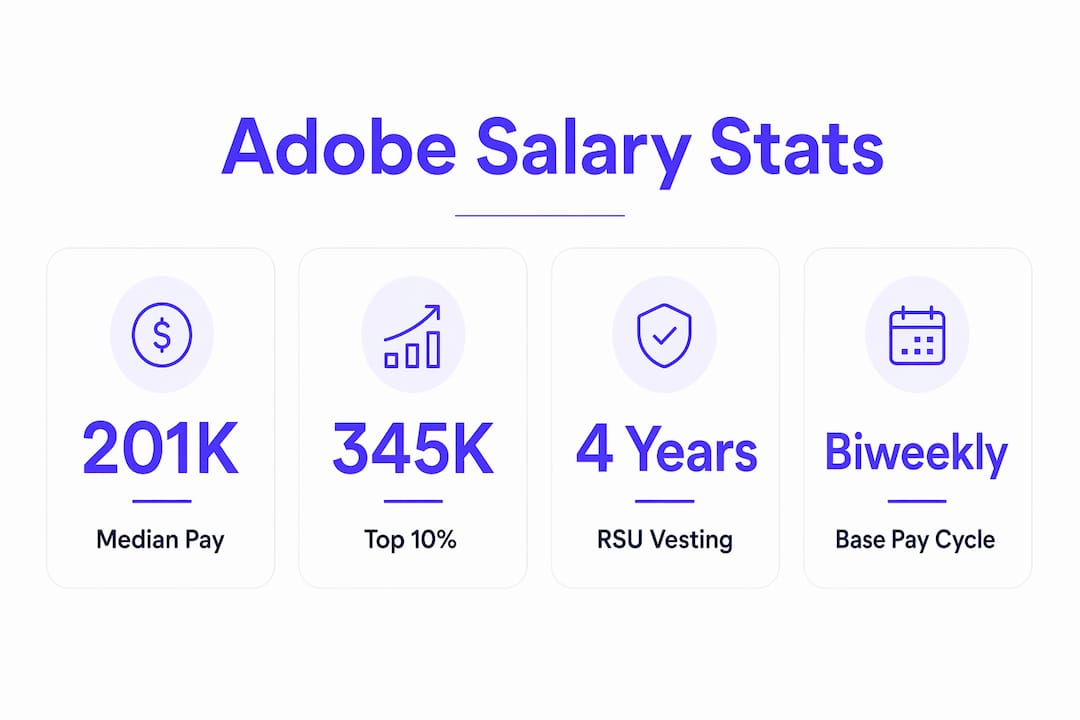
U.S.-based Adobe software engineers earn a median total compensation of roughly $201,474, with practical total-comp ranges running from about $130,330 at the 25th percentile to $345,000 at the 90th percentile, according to Blind's May 2025 aggregated data. That spread is wide enough to matter enormously when you're evaluating an offer or benchmarking a team's budget.
Three factors drive most of that variance:
- Level and seniority. Entry-level engineers sit near the bottom of the range; principal and staff engineers command the top.
- Location and team. San Jose and New York roles post higher bands than remote or lower-cost-of-living markets, and teams working on revenue-critical products tend to have more headroom.
- RSUs and negotiation. Stock grants, refresh cadence, and how hard you push at offer time can shift total comp by tens of thousands of dollars annually.
Data last checked: May 2025 (Blind); figures cross-referenced against Glassdoor, Indeed, and Levels.fyi community data. All figures are U.S.-based and annualized. *
Table of Contents
- Adobe software engineer salary by level: what each tier actually pays
- What each pay component actually means and how to annualize your offer
- How location and team shift your Adobe pay band
- What the percentile spread tells you and how to reach the top tier
- How to evaluate an Adobe offer step by step
- How these numbers were compiled and what their limits are
- Key Takeaways
- Adobe pay is more negotiable than most engineers realize
- Salary Atlas gives you the sourced data to negotiate with confidence
- Useful sources and further reading
- FAQ
Adobe software engineer salary by level: what each tier actually pays
The table below maps common Adobe engineering levels to their typical compensation components. RSU figures are annualized (grant value divided by four-year vesting period). Bonus figures reflect typical annual cash targets. All figures are approximate U.S. totals drawn from Levels.fyi community data and Blind aggregates.

| Level | Base Salary | Annualized RSUs | Annual Bonus | Total Comp (approx.) |
|---|---|---|---|---|
| Software Engineer I (entry) | $130K–$145K | $20K–$30K | $10K–$15K | $160K–$200K |
| Software Engineer II (mid) | $150K–$175K | $35K–$60K | $15K–$20K | $200K–$258K |
| Senior Software Engineer | $175K–$210K | $60K–$100K | $20K–$30K | $255K–$345K |
| Principal / Staff Engineer | $210K–$250K+ | $100K–$180K+ | $30K–$50K+ | $340K–$480K+ |
Statistic callout: Blind's May 2025 data puts the 70th-percentile total comp at roughly $258,000, which means a Senior Software Engineer negotiating well can realistically reach that mark without a promotion.Pro Tip: When you see an advertised base range, mentally add the annualized RSU value and target bonus before comparing. A role with a $160K base and a $60K annualized RSU grant beats a $185K base with a $20K grant by a meaningful margin over four years. *
What each pay component actually means and how to annualize your offer
Most engineers focus on base salary because it's the number on the offer letter. That's a mistake at Adobe, where stock often represents 25–40% of total compensation at mid-to-senior levels.
Base salary is straightforward: fixed annual cash, paid biweekly, and the foundation for bonus calculations. Annual bonus is typically a percentage of base (often 10–15% at target for engineers) and is paid out based on company and individual performance. Neither is guaranteed at full value every year. RSUs are where the math gets tricky. Adobe grants a dollar value of restricted stock units that vest over four years, typically with a one-year cliff and quarterly vesting thereafter. To annualize: divide the total grant value by four. A $200,000 RSU grant becomes $50,000 per year in steady state. But the realized value depends on Adobe's stock price at each vesting date, not the grant-date price. Sign-on bonuses are one-time cash payments, often structured to offset unvested equity you're leaving behind. They're not part of ongoing total comp. Prorating sign-on over two years gives a more honest picture of first-year vs. year-two cash.A worked example: base $175K + $160K RSU grant (annualized: $40K/yr) + $20K bonus + $30K sign-on. Year one total: $265K. Year two onward (no sign-on): $235K. That $30K gap matters when comparing offers.
Items to verify on your offer letter before signing:
- Vesting schedule (4-year with 1-year cliff is standard; confirm it)
- RSU refresh cadence (annual refreshes are common at Adobe; ask explicitly)
- Bonus target percentage and payout timing
- Tax withholding method for RSU vesting events (supplemental rate vs. aggregate)
- Whether sign-on has a clawback period if you leave within 12–24 months
Pro Tip: In a counteroffer, ask for RSU uplift or an additional sign-on rather than a base increase. Adobe's salary bands have ceilings; equity budgets are more flexible, and RSU increases compound if the stock appreciates. *
How location and team shift your Adobe pay band
Adobe posts roles with location-specific bands, and the difference between markets is not cosmetic. A San Jose posting for the Adobe Experience Platform and a New York posting for a comparable role will show different base ranges, reflecting both local labor market rates and cost-of-living adjustments Adobe builds into its compensation model.
Directional differences by market:
- San Jose / San Francisco: Highest bands; Adobe's headquarters market commands a premium.
- New York: Comparable to or slightly below Bay Area; strong for product and platform roles.
- Seattle / Austin / other tech hubs: Moderate bands; often 10–20% below Bay Area equivalents.
- Remote (non-hub): Typically the lowest bands; Adobe adjusts for the employee's location of record.
Team function matters just as much as geography. Machine learning and platform infrastructure engineers tend to attract higher RSU grants because the talent market for those skills is tighter. Front-end and product-facing roles are competitive but generally sit below ML and infra in total comp. Teams tied to Adobe's highest-revenue products (Creative Cloud, Document Cloud) often have more budget flexibility than newer or experimental product lines. Cost-of-living adjustment: A $250K total-comp offer in San Jose has less purchasing power than $210K in Austin. Use state-level salary data to factor in local costs before deciding which offer wins on real terms.
 *
*
What the percentile spread tells you and how to reach the top tier
The gap between the 25th and 90th percentile at Adobe is not a rounding error. Blind's aggregated data shows a spread of roughly $215,000 between those two markers, which means two engineers with the same title can have dramatically different take-home totals.
| Percentile | Approximate Total Comp |
|---|---|
| 25th | ~$130,330 |
| Median (50th) | ~$201,474 |
| 70th | ~$258,000 |
| 90th | ~$345,000 |
- Domain specialization. ML, distributed systems, and security engineers consistently attract higher grants than generalist roles.
- Competing offers. Engineers who arrive with a documented competing offer negotiate from a position of strength. Adobe's recruiters have room to move; they use it when pressed.
- Promotion timing. Pushing for a level-up before accepting (rather than after) locks in a higher band from day one.
- Refresh grants. High performers who receive above-target annual RSU refreshes compound their equity advantage over time.
How to evaluate an Adobe offer step by step
Before you respond to any offer, run through this checklist:
- Convert everything to annual total comp. Base + annualized RSUs (grant ÷ 4) + target bonus. Ignore sign-on for this calculation.
- Adjust for location. Use cost-of-living indices to compare offers across markets on equal footing.
- Compute first-year cash separately. Base + sign-on + first-year vested RSUs + first-year bonus. This is your actual year-one take-home before tax.
- Model year two onward. Drop the sign-on. Add expected refresh grants if the company has a track record of granting them.
- Check the vesting cliff. If you leave before 12 months, you may walk away with zero equity. Factor that into any competing-offer comparison.
- Benchmark the level. Confirm the level Adobe is offering matches your experience. A lower level means a lower band ceiling for years.
Worked comparison: Offer A: $170K base, $200K RSU grant ($50K/yr), $20K bonus = $240K total. Offer B: $155K base, $320K RSU grant ($80K/yr), $18K bonus = $253K total. Offer B wins by $13K annually in steady state, even though its base is $15K lower. Negotiation specifics for Adobe:
- Counter before you accept, not after. Post-accept adjustments are rare.
- Lead with competing offers or documented market data. Vague requests get smaller responses.
- Ask for RSU uplift first, sign-on second, base third. That's roughly the order of flexibility.
- New grads have less leverage on base but can often negotiate sign-on and starting RSU grant size.
- Senior hires with competing offers from other large tech companies have the most leverage and should use it explicitly.
How these numbers were compiled and what their limits are
The figures in this article draw from four primary sources, each with different strengths and blind spots:
- Blind (May 2025): Anonymous self-reported data from verified employees. Strong for percentile spreads and total-comp figures; skewed toward Bay Area and senior engineers who are more likely to post.
- Levels.fyi: Community-submitted comp data mapped to specific levels. Best for level-to-pay mapping; sample sizes vary by level and team.
- Glassdoor and Indeed: Employer- and employee-submitted averages. Useful for broad sample size; tend to under-represent RSU value and skew toward base salary.
- Adobe career postings: Official posted bands for specific roles and locations. Most reliable for current base ranges; do not reflect RSU or bonus.
RSUs throughout this article are annualized by dividing the total grant value by four (the standard vesting period). This matches the approach Salary Atlas uses in its compensation methodology. Actual realized value depends on stock price at vesting, which can be higher or lower than the grant-date figure.
Self-reported salary data has real limits: respondents skew toward higher earners, Bay Area locations, and engineers motivated to share after a strong negotiation. Treat every figure here as a directional range, not a guaranteed offer.Key limitations to keep in mind:
- Sample sizes at the principal/staff level are smaller, making those bands less reliable.
- Figures from different aggregators can diverge significantly because they use different normalization methods.
- Adobe's compensation bands are updated periodically; figures from 2023 or earlier may not reflect current market rates.
Key Takeaways
Adobe software engineers in the U.S. earn a median total compensation near $201,474, with the top 10% reaching $345,000, driven primarily by RSU grants, level, and negotiation skill.
| Point | Details |
|---|---|
| Median total comp | Blind's May 2025 data puts the U.S. median at roughly $201,474 across all levels. |
| RSUs drive the spread | The gap between the 25th percentile (~$130,330) and 90th percentile (~$345,000) is mostly equity, not base. |
| Location and team matter | San Jose and New York post the highest bands; ML and infra roles trend above front-end equivalents. |
| Negotiate before accepting | Counter pre-acceptance with RSU uplift or sign-on; post-accept adjustments are rare at Adobe. |
| Use Salary Atlas to benchmark | Salary Atlas publishes sourced software engineer pay data without paywalls, so you can verify figures before negotiating. |
Adobe pay is more negotiable than most engineers realize
Most candidates treat the first offer as a fixed number with a small buffer. At Adobe, that framing costs real money. The spread between the 25th and 90th percentile is large enough that two engineers hired into the same title in the same city can have a $200K+ gap in total comp over four years, based almost entirely on how they entered.
What the data actually shows is that Adobe's compensation structure rewards engineers who understand equity. The base salary bands are real ceilings; the RSU and sign-on components are where the negotiation lives. Engineers who push for a higher RSU grant rather than a higher base often end up better off, especially if Adobe's stock performs well over their vesting period.
For hiring managers, the implication runs the other way. If your team is consistently losing candidates to other offers, the fix is rarely a $10K base increase. It's usually a larger initial RSU grant or a more competitive sign-on, both of which are easier to justify to finance than a permanent base adjustment.
One more thing worth saying plainly: the aggregated figures here are useful inputs, not final answers. A candidate who walks into a negotiation armed with Blind percentiles and Levels.fyi level mappings is better positioned than one who doesn't. But the most important number is the one on your specific offer letter, benchmarked against your specific competing options.
*Salary Atlas gives you the sourced data to negotiate with confidence
Most salary sites make you sign up, pay, or wade through ads before you get to the number that matters. Salary Atlas works differently: every figure links directly to its source, and the U.S. software engineer salary data is free to access without a paywall or account.
For engineers preparing to negotiate an Adobe offer, Salary Atlas offers a clear picture of where Adobe pay sits relative to the broader U.S. software engineering market, with BLS-sourced benchmarks and a transparent methodology page that explains exactly how RSUs are annualized and how figures are normalized across sources. Use it alongside Blind and Levels.fyi to triangulate your number before you counter. Visit Salary Atlas to check current figures and run your offer against the market.
*Useful sources and further reading
- Adobe Software Engineer Salaries — Blind: Percentile breakdowns (25th, 70th, 90th) for U.S.-based Adobe SWEs. Self-reported; skews Bay Area and senior. Last checked: May 2025.
- Adobe Software Engineer Salary — Levels.fyi: Level-to-pay mapping with community-submitted total comp figures. Best for comparing specific levels. Check directly for current sample sizes.
- Adobe Software Engineer Salaries — Glassdoor: Broad sample of employee-submitted pay data; useful for base salary context. Tends to underweight RSUs.
- Software Engineer Salaries at Adobe — Indeed: Aggregated averages from job postings and employee submissions. Good for directional base ranges.
- Software Engineer — Adobe Experience Platform | Adobe Careers: Live San Jose posting; shows location-specific bands and role scope directly from Adobe. Check for current posting status.
- Software Development Engineer | Adobe Careers: New York posting for comparison against Bay Area bands.
- Salary Atlas Methodology: Explains RSU annualization, BLS source integration, and normalization approach used across Salary Atlas data.
- U.S. Software Engineer Salary Hub — Salary Atlas: Industry-wide benchmarks for software engineers across the U.S., sourced from BLS OEWS data. Useful for comparing Adobe pay to the broader market.
FAQ
How much do Adobe software engineers make in total compensation?
Blind's May 2025 data puts the U.S. median total compensation for Adobe software engineers at roughly $201,474, with the 25th percentile near $130,330 and the 90th percentile near $345,000.
Can you make $500,000 as a software engineer at Adobe?
Reaching very high total compensation at Adobe is possible but uncommon, typically requiring a principal or distinguished engineer title, a top-tier RSU grant, strong stock performance, and a high-cost market like San Jose. Most engineers at the senior level land well below those top compensation levels.
How much does an L7 (principal/staff) engineer make at Adobe?
Principal and staff engineers at Adobe typically see total compensation in the $340K–$480K+ range, driven largely by annualized RSU grants of $100K–$180K or more on top of a base salary above $210K.
Can a software engineer make $200K a year?
Yes. The median Adobe software engineer already sits near $201,474 in total comp, meaning a mid-level engineer who negotiates well and receives a standard RSU grant can clear $200K without reaching senior level.
What's the best way to verify Adobe salary figures before negotiating?
Cross-reference Blind's percentile data, Levels.fyi level mappings, and Adobe's own posted job bands, then use a transparent source like Salary Atlas to benchmark against broader U.S. software engineering market data before you counter.