Airbnb Levels.fyi: Pay Ranges & Negotiation Guide

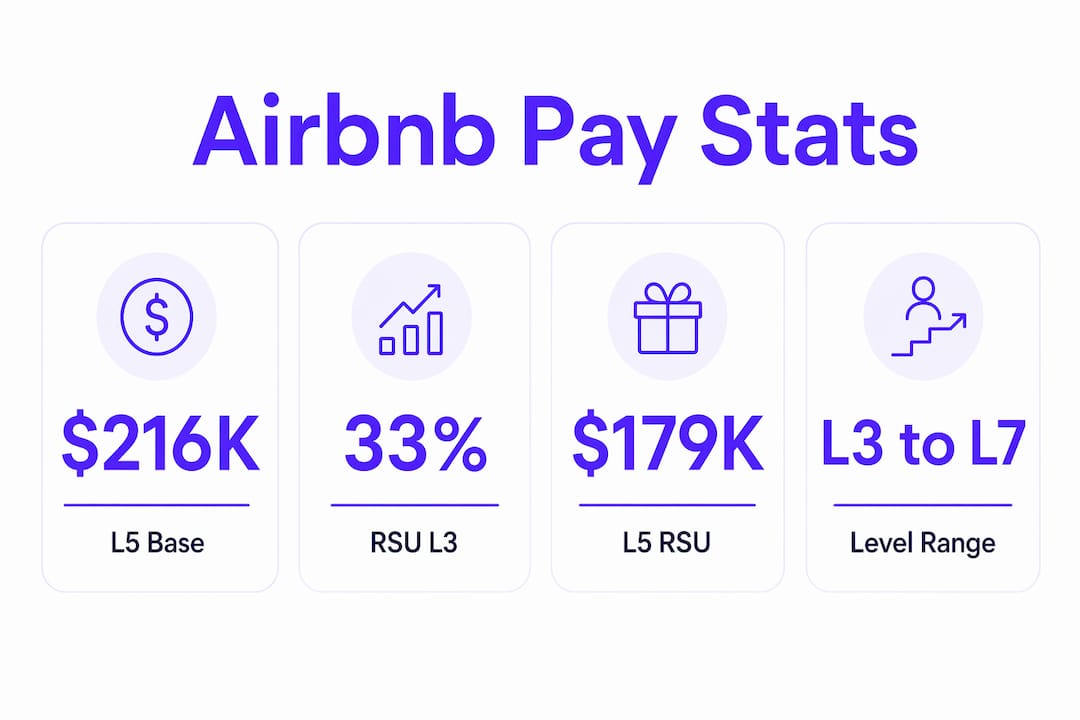
Airbnb uses a leveling system from L3 through L7 (with some public data using G-level shorthand like G9), and total compensation for US-based roles spans a wide range depending on level, with equity becoming the dominant pay component at L5 and above. If you're evaluating an offer or setting a hiring band, those numbers are the starting point — but the composition of that pay matters as much as the headline figure.
Where to find level-by-level numbers:
- Levels.fyi Airbnb salaries — crowdsourced self-reported submissions with role, level, base, bonus, and RSU fields; the most granular public source for level-specific total comp (TC)
- Glassdoor Airbnb salaries — broader submission base, useful for cross-checking base salary ranges and spotting outliers
- Airbnb's own pay-transparency pages — Airbnb publishes base hiring ranges on US job postings and has expanded transparency to include annual performance equity award targets, making it the most authoritative source for the company's published bands
The median software engineer TC at Airbnb is at a mid to high range, with lower quartile and top-level (L7) packages varying significantly. At L5 and above, RSUs typically represent about half of total compensation, which means ABNB stock performance directly shapes what you actually take home. *
Table of Contents
- What does Airbnb levels.fyi data show by role and level?
- What do Airbnb's L3–L7 and G-levels actually mean?
- How reliable is crowdsourced compensation data?
- How does ABNB stock volatility affect your actual pay?
- How to use level data to benchmark offers and negotiate
- Key Takeaways
- Why crowdsourced level data tells only half the story
- Salary Atlas gives you the BLS-sourced baseline crowdsourced tables can't
- Useful sources
- FAQ
What does Airbnb levels.fyi data show by role and level?
The tables below reflect estimates drawn from crowdsourced submissions and published analysis. Treat any cell with a small sample note as directional, not definitive. All figures are in USD, annualized, and represent US-based roles.
Software engineer compensation by level includes base salary, bonus, and RSU components that generally increase with seniority, though data samples vary in size and reliability.
 Sources: jobsbyculture.com analysis; Levels.fyi submissions. Last-updated context: 2025–2026 submission period. Sample sizes are largest at L4–L5 and thin at L6–L7.
Product manager compensation by level increases with seniority and typically includes base, bonus, and RSU components, though exact numbers vary due to limited sample sizes.
These PM figures are directional estimates based on available crowdsourced data. Cross-check against Airbnb's posted hiring ranges for the specific role.How compensation composition shifts by level
| Level | Base as % of TC | RSU as % of TC | Bonus as % of TC |
|---|---|---|---|
| L3 | — | ~33% | — |
| L5 | ~50% | ~50% | — |
| L6 | — | ~55% | — |
| L7 | — | ~57% | — |
What do Airbnb's L3–L7 and G-levels actually mean?
Airbnb's leveling system runs from L3 to L7+, with each step representing a meaningful jump in scope, autonomy, and pay. The G-level shorthand (e.g., G9 for senior software engineer) appears in some public data aggregators and internal references, but L-levels are the more commonly cited format in crowdsourced tables.
Level-to-seniority mapping
| Level | Common Title | Typical Experience | Scope |
|---|---|---|---|
| L3 | Software Engineer / Associate PM | Up to 3 years | Works within defined projects; guided by senior ICs |
| L4 | Software Engineer II / PM | 3–6 years | Owns features; some cross-functional coordination |
| L5 | Staff Engineer / PM | 6–10 years | Leads technical direction for a team or product area |
| L6 | Senior Staff Engineer / Senior PM | 10–15 years | Cross-org influence; sets technical or product strategy |
| L7 | Principal Engineer / Principal PM / Sr. EM | 15+ years | Company-wide impact; often manages managers or defines platform direction |

G9 in public data typically maps to L5 (Staff Software Engineer). If you see G-level references in older Levels.fyi submissions, treat G9 as roughly equivalent to L5 for compensation benchmarking purposes.
How to map your experience to a level — dos and don'ts:- Do focus on scope and impact: how many engineers or teams depended on your work? Did you set direction or execute it?
- Do look at the cross-functional reach of your projects, not just tenure
- Do consider the scale of systems you owned (millions of users vs. internal tooling)
- Don't assume your current job title maps directly to an Airbnb level — titles vary widely across companies
- Don't anchor on years of experience alone; a 5-year engineer with staff-level scope often targets L5, while a 10-year engineer in a narrow execution role may be L4
Similar level-mapping dynamics apply at other large tech firms. For a comparison, the Accenture career levels guide on Salary Atlas walks through how a different major employer structures its IC ladder — useful context if you're evaluating multiple offers.
*How reliable is crowdsourced compensation data?
Crowdsourced tables are the best public window into level-specific TC, but they carry real limitations. Understanding those limits is what separates a confident negotiation from one built on a shaky number.
The three main data sources and their trade-offs:- Self-reported submissions (Levels.fyi, Glassdoor): Voluntary, anonymous, and unverified. Strengths: granular level and role detail, large sample at common levels. Weaknesses: self-selection bias (higher earners tend to report more), no audit trail, and data can age quickly after pay cycles or market corrections.
- Company pay-transparency disclosures: Airbnb publishes base hiring ranges on US job postings and has expanded transparency to include equity award targets. This is the most authoritative source for the company's actual bands. Weakness: it shows the range, not where a specific candidate will land within it.
- Third-party analysis and aggregators: Sites that compile and analyze crowdsourced data add context but inherit the same submission-quality issues. Useful for trend direction, not precision.
- Sample size: Fewer than 10 submissions in a cell means the range is directional at best. Cells for L6–L7 or niche roles often fall here.
- Last-updated timestamp: Compensation data from 18+ months ago may not reflect current market conditions or Airbnb's most recent pay cycle.
- Role exactness: "Software Engineer" and "Staff Software Engineer" are different levels. Confirm the exact title matches.
- Location: A San Francisco submission and a remote submission can differ by 15–20% even within the same level.
- Outlier filtering: A single $1.2M TC report at L5 is almost certainly a sign-on-heavy outlier. Look at the median, not the max.
Crowdsourced figures are a starting point, not a closing argument. The most persuasive number in a negotiation is the one Airbnb itself published — their own hiring band for the role. Pair the crowdsourced median with the company's posted range, and you have a defensible position on both sides.
Airbnb has conducted annual pay-equity analyses since 2015 and reports no unexplained statistically significant gaps in salary and equity awards in its most recent review. That consistency means published bands tend to be reliable anchors, not aspirational figures.
Pro Tip: In a negotiation conversation, frame crowdsourced data as "market context" rather than a competing offer. Say: "Based on a sample of reported packages at this level, the median TC appears to be around X — does that align with your published band?" That positions you as informed without overstating the precision of the data.For a broader look at which salary research tools hold up under scrutiny, Salary Atlas's guide to reliable salary comparison tools covers the trade-offs across the main platforms.
*How does ABNB stock volatility affect your actual pay?
This is where the gap between "target total comp" and "realized total comp" gets real. Airbnb issues public RSUs traded on NASDAQ (ABNB), which means your equity is liquid at vest — but only worth what the stock is worth on that day.
Consider a representative L5 package: base of approximately $216K, annualized RSU target of $179K, and a bonus target of $38K, yielding a target TC of roughly $433K. That RSU figure is calculated at the grant-date stock price. If ABNB trades 20% lower at your one-year vest, the RSU component drops to roughly $143K, pulling your realized first-year TC closer to $397K. A 20% rally does the opposite.
At higher levels, the sensitivity is sharper. An L7 package with a $501K RSU target sees a $100K swing in realized pay for every 20% move in ABNB's price. That's not a rounding error — it's a material income difference.
RSU share of total comp by level (approximate):- L3: RSUs represent roughly 33% of target TC
- L5: RSUs represent about 50% of target TC
- L7: RSUs represent roughly 57% of target TC
- Ask for a higher base if you need income stability or have near-term financial obligations. Base salary is fixed; RSUs are not.
- Request a sign-on RSU grant to offset the unvested equity you're leaving behind at a prior employer. This is standard practice and recruiters expect the ask.
- Negotiate equity refreshers — annual refresh grants that vest on top of the original package. At L5+, refreshers can add $50K–$150K+ annually to realized TC over a multi-year tenure.
- Check the vesting schedule before signing. Airbnb typically uses a four-year vest with a one-year cliff, but confirm the exact schedule for your grant.
For context on how RSU-heavy packages compare to base-heavy roles, the US software engineer salary data on Salary Atlas shows BLS-sourced medians that reflect base-only compensation — a useful anchor when you're trying to separate the equity component from the underlying market wage.
*How to use level data to benchmark offers and negotiate
The data is only useful if you know how to apply it. Here's a practical sequence for turning level tables into a negotiation position.
Step-by-step benchmarking checklist:- Identify your target level. Use the seniority mapping above to determine whether you're an L4, L5, or L6 candidate. If you're unsure, ask the recruiter directly: "What level is this role benchmarked to?"
- Pull the median TC for that role and level from Levels.fyi submissions, noting the sample size and last-updated date.
- Check Airbnb's posted hiring range for the specific job posting. This is the company's published band — more authoritative than any crowdsourced figure.
- Adjust for your metro. If you're in San Francisco or New York, you're likely in the upper portion of the range. Remote or lower-cost markets may shift the offer 10–20% lower.
- Convert the RSU target to a present-day dollar estimate. Take the annualized grant target and apply a conservative stock-price assumption (e.g., current ABNB price, not a projected high) to get a realistic first-year vest value.
- Build your total offer range. Add base + expected bonus + realistic RSU vest value. Compare that to the crowdsourced median and the posted band.
- "What level is this role benchmarked to, and is there flexibility to adjust the level based on my experience?"
- "What is the annual performance equity award target for this level?"
- "Can you share the base salary hiring range for this role?" (Airbnb is required to post this for US roles.)
- "Is there a sign-on RSU grant available to offset unvested equity I'd be leaving behind?"
- "What does the annual equity refresh look like at this level?"
- On level: "I want to make sure we're aligned on level before we discuss numbers — can you confirm this is benchmarked to L5?"
- On base: "The posted range shows X to Y. Given my background in [scope/impact], I'm targeting the upper portion of that range."
- On bonus: "What's the target bonus percentage at this level, and is it discretionary or formula-based?"
- On equity: "What's the annualized RSU target for this level, and how are refreshes structured after year one?"
Key Takeaways
Airbnb's L3–L7 pay structure is equity-heavy at senior levels, and the most effective benchmarking combines Levels.fyi crowdsourced data with Airbnb's own published hiring bands and BLS-sourced medians from Salary Atlas.
| Point | Details |
|---|---|
| Level range and equity shift | Airbnb levels run L3–L7; RSUs grow from about 33% of TC at L3 to roughly 57% at L7. |
| Verify before you negotiate | Always check sample size and last-updated date; L6–L7 cells often have fewer than 10 submissions. |
| Use company-published bands | Airbnb posts base hiring ranges on US job postings and discloses equity award targets — cite these first in negotiation. |
| Adjust for location | High-cost metros (SF, NYC) land at the upper end of a level's range; remote roles may be 10–20% lower. |
| Salary Atlas as a complement | Salary Atlas provides BLS-sourced US wage medians by title and state — a verified baseline alongside level-specific TC tables. |
Why crowdsourced level data tells only half the story
Most candidates treat Levels.fyi as the final word on compensation, and that's a mistake worth naming directly. Crowdsourced tables are genuinely useful — they're the only public source with level-specific TC detail — but they measure what people reported, not what Airbnb actually pays. Those two things can diverge, especially after a down market cycle when fewer senior employees submit data, or after a pay restructuring that hasn't yet filtered into the submission pool.
The more interesting gap is between total-comp benchmarking and base-wage benchmarking. When you're evaluating an Airbnb offer, you need both. The crowdsourced tables tell you what the full package looks like at each level. BLS-sourced data tells you what the underlying labor market pays for the same skill set, stripped of equity. That second number matters because it's the floor — the wage you'd command if you left Airbnb and the RSUs went to zero.
Airbnb's pay-transparency expansion is genuinely good for candidates. Publishing equity award targets alongside base ranges closes the information gap that used to require three rounds of recruiter calls to navigate. But transparency doesn't eliminate the need for independent verification. A published band tells you the range; it doesn't tell you where you should land within it. That's where the combination of crowdsourced medians, BLS benchmarks, and a clear articulation of your scope and impact does the real work.
*Salary Atlas gives you the BLS-sourced baseline crowdsourced tables can't
Crowdsourced level tables show you what Airbnb candidates reported. Salary Atlas shows you what the US labor market actually pays for the same role, sourced directly from the Bureau of Labor Statistics, with no paywall and no guesswork.
For anyone benchmarking an Airbnb offer or setting a hiring band, the combination is straightforward: use Levels.fyi for level-specific TC detail, and use Salary Atlas for the verified US wage median that anchors the base-salary component. Every figure on Salary Atlas links back to its BLS source, updates annually, and covers state-level breakdowns so you can account for location adjustments without relying on recruiter estimates.
- Free access, no signup required
- BLS-sourced medians by job title and state
- Percentile breakdowns (10th through 90th) for precise benchmarking
- Methodology transparency — every figure traces back to its original source
Start with the US salary data by job title on Salary Atlas, or go straight to the methodology page if you want to understand exactly how the figures are calculated before you use them in a negotiation. *
Useful sources
The figures and analysis in this article draw from the following primary sources. Check each for the most current data, as crowdsourced submissions update continuously and company disclosures may change after pay cycles.
- Airbnb Salaries — Levels.fyi: The primary crowdsourced database for level-specific TC at Airbnb. Submissions include base, bonus, RSU, and total comp by role and level. Updated continuously as employees submit new data.
- Airbnb Salaries — Glassdoor: Broader submission base covering a wider range of roles; useful for cross-checking base salary ranges and spotting outliers. Updated as submissions arrive.
- Pay transparency expanded to total compensation — Airbnb Newsroom: Airbnb's official announcement of expanded pay transparency, including equity award targets. Primary source for company-published band information. Last checked: 2026.
- Airbnb Compensation 2026 — jobsbyculture.com: Compiled analysis of crowdsourced level data with role-level breakdowns and equity composition estimates. Last checked: 2026.
- Salary Atlas — US Salary Data by Job Title: BLS-sourced US wage medians by title and state; useful as a verified base-salary benchmark alongside level-specific TC tables.
- Salary Atlas Methodology: Explains data sources, calculation methods, and update cadence for all figures on Salary Atlas.
Crowdsourced compensation data is only as reliable as its last update and sample size. For any cell you plan to use in a negotiation, verify the submission count and timestamp before citing it. Company-published bands and BLS-sourced medians are more stable anchors.*
FAQ
What is Airbnb's level structure, and where does it start?
Airbnb uses a leveling system from L3 (early career) through L7 and above (principal and VP-level roles), with compensation accelerating sharply at L5 where equity grants begin to dominate total comp.
Does Airbnb pay employees well compared to other tech companies?
Airbnb compensation is competitive with major tech employers; median software engineer TC is approximately $500K, with senior levels reaching $765K–$876K+, placing it in the upper tier of US tech pay.
What is G9 at Airbnb?
G9 is a shorthand level designation that appears in some public data and typically maps to L5, the Staff Software Engineer level, with a target total comp in the range of approximately $433K based on available crowdsourced estimates.
What is the 80/20 rule for Airbnb compensation?
There is no formally published rule specific to Airbnb compensation. At senior levels (L6–L7), RSUs account for roughly 55–57% of total comp, meaning equity performance drives the majority of realized pay variation.
How do I negotiate an Airbnb salary offer using levels data?
Reference Airbnb's own posted hiring range for the role first, then use crowdsourced medians from Levels.fyi as market context, and ask the recruiter to confirm the level, bonus target, and annual equity refresh before accepting any offer.