Pay Bands Explained: What Every Job Seeker Should Know
Discover how pay bands impact job negotiations. Understand salary ranges and gain confidence in your career decisions. Learn more now!
By the Salary Atlas editorial team · Published

A pay band is a defined salary range assigned to a job or group of similar roles, setting minimum, midpoint, and maximum pay levels to promote fairness and transparency in compensation. Also called wage bands, salary bands, or comp bands, these structures give both employers and job seekers a clear framework for understanding where any given role fits in the broader pay picture. With more than a dozen states now requiring public salary range disclosure in job postings, understanding pay bands is no longer optional for professionals who want to negotiate with confidence.
What are pay bands and how are they structured?
Pay bands are structured compensation ranges built around three core values: a minimum, a midpoint, and a maximum. The minimum is the lowest pay the organization will offer for a role. The midpoint, sometimes called the target pay, represents what a fully competent employee in that role should earn. The maximum marks the ceiling, beyond which pay increases require a promotion or reclassification.
The range spread is the key calculation that defines how wide a band is. The formula is: (Maximum minus Minimum) divided by Minimum, multiplied by 100. A band with a $50,000 minimum and a $75,000 maximum has a range spread of 50%. Range spreads typically run 30%–50% for entry-level roles and exceed 100% for executive positions. Wider spreads at senior levels reflect the greater variation in skills, experience, and performance that exists at the top of an organization.

Compa-ratio: your position within the band
The compa-ratio measures where your salary sits relative to the band midpoint. A compa-ratio of 1.0 means you earn exactly the midpoint. A ratio between 90% and 110% signals market alignment. Below 90% may indicate underpayment. Above 110% means you are approaching or exceeding the band maximum, which limits future raises without a promotion.
| Job level | Typical range spread | Compa-ratio target |
|---|---|---|
| Entry-level | 30%–50% | 90%–100% |
| Professional | 50%–80% | 95%–105% |
| Manager | 70%–90% | 100%–110% |
| Executive | 100%+ | Varies by performance |
How do pay bands differ from pay scales?
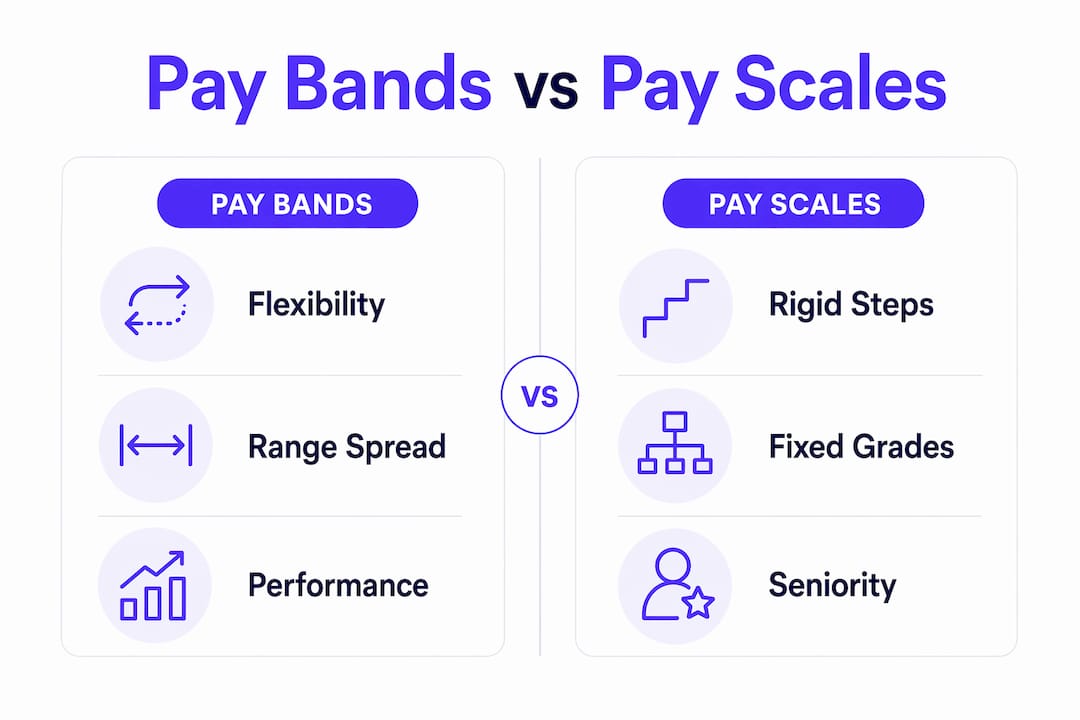
Pay bands and pay scales are not the same thing, and the difference has real consequences for your career. Pay bands offer flexible ranges that allow movement based on market conditions and individual performance. Pay scales, by contrast, are rigid structures where advancement follows fixed steps tied to tenure or seniority.
The U.S. General Schedule (GS) pay scale is the clearest example of a rigid pay scale in action. Federal employees move through 10 defined steps within each GS grade, and progression is largely time-based. A GS-9 employee at Step 1 earns a set amount and advances to Step 2 after a fixed waiting period, regardless of performance. Pay bands work differently. An employee in a professional band can move from $60,000 to $85,000 based on a strong performance review, a market adjustment, or a shift in responsibilities, without changing job titles.
Broadbanding: when bands get very wide
Broadbanding is a variation of pay banding where organizations collapse many narrow pay grades into a small number of very wide bands. A company might reduce 15 pay grades into 4 broad bands. This gives managers more flexibility to reward performance and lateral moves. The trade-off is that broadbanding can make it harder for employees to see a clear progression path, since the band itself spans such a large salary range.
| Feature | Pay bands | Pay scales |
|---|---|---|
| Flexibility | High, performance and market driven | Low, step-based and time-driven |
| Common in | Private sector, tech, finance | Government, unions, education |
| Salary movement | Based on performance and market | Based on tenure and fixed steps |
| Negotiation room | Significant within band | Minimal, steps are fixed |
How employers and employees use pay bands
Employers use pay bands to standardize job offers, control payroll budgets, and support pay equity audits. Pay bands group similar jobs by responsibility, skills, and scope rather than just job title. This means a "Senior Analyst" in marketing and a "Senior Analyst" in finance can sit in the same band if their roles carry comparable complexity. That grouping makes it easier to defend compensation decisions during audits and reduces the risk of pay discrimination claims.
For job seekers, pay bands reveal the full earning potential of a role before you accept an offer. If a company posts a band of $70,000 to $100,000 and offers you $72,000, you know you are near the floor. That context changes how you negotiate. Candidates offered pay near the band maximum should ask directly about promotion paths, since further increases typically require a role change rather than a merit raise.
Red-circling and green-circling
Two edge cases come up regularly in pay band management. Red-circling occurs when an employee's pay sits above the band maximum, often after a restructuring or market correction. The employer typically freezes that person's salary until the band catches up. Green-circling is the opposite: an employee earns below the band minimum, usually after a promotion into a new band. HR should correct green-circled salaries quickly, since paying below the band minimum signals a structural problem and creates legal exposure.
Key ways pay bands shape day-to-day compensation decisions:
- Hiring offers: Recruiters anchor initial offers to the band minimum or midpoint based on candidate experience.
- Merit increases: Annual raises move employees through the band based on performance ratings.
- Promotions: Moving to a higher band typically means a salary jump to at least the new band's minimum.
- Market adjustments: Bands are updated to reflect labor market shifts, keeping pay competitive.
Common challenges with pay band implementation
Pay compression is the most damaging problem in poorly managed pay band systems. Overlaps above 50% between adjacent bands frequently cause misclassification and compression, where new hires earn nearly as much as veterans with years of experience. This erodes morale and drives turnover among your most experienced staff.
Stale bands are a close second. Market shifts can lag 8%–12% within 18 months if organizations skip annual reviews. A band set in 2023 for a data analyst role may be significantly below market by 2025, making it impossible to hire or retain talent at the posted range. Regularly adjusting pay bands is the single most effective way to reduce turnover caused by salary dissatisfaction.
Common pitfalls to watch for:
- Pay compression: New hires earn close to or above tenured employees due to poor band calibration.
- Career plateau: Employees at the band maximum often feel stuck unless HR actively guides skill development and promotion planning.
- Overlapping bands: Excessive overlap between levels creates confusion about what a promotion actually means financially.
- Legal noncompliance: Federal and state laws in 2026 increasingly require public salary range disclosure, with penalties for noncompliance in more than a dozen states.
Key Takeaways
Pay bands are the most practical tool available for understanding your true earning potential in any role, and knowing how to read them gives you a concrete advantage in every salary conversation.
| Point | Details |
|---|---|
| Core structure | Every pay band has a minimum, midpoint, and maximum that define the full earning range for a role. |
| Range spread matters | Entry-level bands typically span 30%–50%; executive bands exceed 100%, reflecting greater performance variation. |
| Compa-ratio is your signal | A ratio of 90%–110% indicates market alignment; below 90% suggests underpayment worth addressing. |
| Bands vs. scales | Pay bands allow performance-based movement; pay scales like the GS system advance by tenure and fixed steps. |
| Legal stakes are rising | More than a dozen states now mandate salary range disclosure, making transparent pay bands a legal requirement. |
Pay bands are a career tool, not just an HR document
Most job seekers treat a salary band as background noise. I think that is a serious mistake. After years of watching compensation conversations play out, the professionals who negotiate best are the ones who understand exactly where they sit within a band and why.
The midpoint is the number that matters most. Midpoint anchors represent the pay target for a fully competent employee in that role. If you are hired below the midpoint, you have room to grow without needing a promotion. If you are hired above it, your employer has already made a bet on your potential, and you need to deliver quickly to justify it.
What I find most telling about an organization is how they respond when you ask about their pay band structure. Companies with mature, fair compensation systems answer that question directly. They will tell you the band, explain where the offer sits, and describe what it takes to move up. Companies that dodge the question or claim they "don't share that information" are often hiding compression problems or bands that have not been updated in years. That evasion is a red flag worth taking seriously.
Pay transparency laws are forcing this conversation into the open whether employers want it or not. For job seekers, that is good news. Use the posted range as your baseline. Research the salary range for your role before you walk into any negotiation. And if you are already employed, check whether your current pay aligns with what your employer is now required to post publicly for similar roles. The gap, if there is one, is your opening.
, Nkosi
Salary-atlas makes pay band research straightforward
Understanding where a salary band starts and ends is only useful if you have reliable market data to compare it against. Salary-atlas publishes U.S. salary data by job title sourced directly from the U.S. Bureau of Labor Statistics, with no paywall and no fabricated trends.
Whether you are benchmarking a job offer, preparing for a raise conversation, or evaluating a career move, Salary-atlas gives you the actual numbers behind the band. You can check median pay, six-year trends, and salary ranges by state to understand how geography shifts the picture. Every figure links back to its original BLS source, so you know exactly what you are working with.
FAQ
What is a pay band in simple terms?
A pay band is a salary range with a defined minimum, midpoint, and maximum assigned to a job or group of similar roles. It tells you the lowest and highest pay an employer will offer for that position.
How is a pay band different from a salary grade?
A salary grade is a single fixed pay point or narrow step, while a pay band is a wider range that allows movement based on performance and market conditions. Pay bands give employees more room to grow without changing roles.
What does it mean to be at the top of your pay band?
Reaching the band maximum means your salary has hit the ceiling for your current role. Further increases typically require a promotion to a higher band rather than a standard merit raise.
How often should pay bands be updated?
Pay bands should be reviewed at least annually. Market shifts can cause bands to lag behind real compensation levels by 8%–12% within 18 months, making regular updates critical for staying competitive.
Are employers required to share pay band information?
More than a dozen U.S. states now require employers to disclose salary ranges in job postings as of 2026. Requirements vary by state, but the trend toward mandatory pay transparency is accelerating nationwide.
Recommended
- Principal Salary
- Salary Atlas, US Salary Data by Job Title · Salary Atlas
- Judge Salary
- Professor Salary
Occupation wage figures on Salary Atlas come from the U.S. Bureau of Labor Statistics. Figures in this article that are not linked to a source are estimates. See our methodology.