Accenture Career Levels: Salaries and Job Titles Explained
 *
*
TL;DR:>
- Accenture's career system ranks levels from CL13 as entry to CL1 as senior leadership, with compensation varying by practice and geography. Promotion depends on performance reviews and can take over a decade to reach top executive levels, with pay significantly higher in strategy and consulting roles. Salary benchmarks reveal that Accenture's pay often exceeds broader market medians, especially for senior roles and in top metropolitan areas.*
What each Accenture level actually means for your salary
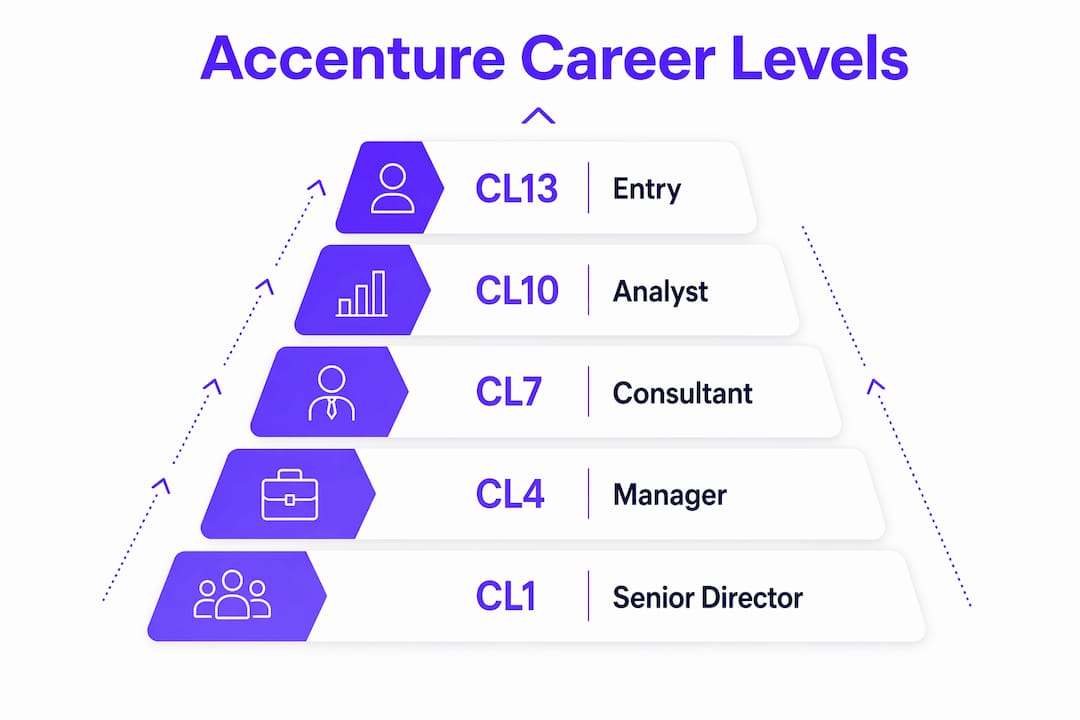
Accenture runs a 13-level numeric career structure where the numbering works in reverse: CL13 is the most junior position and CL1 is the most senior. That counterintuitive direction trips up a lot of candidates. A CL7 Manager outranks a CL9 Consultant, and a CL6 Senior Manager sits above both.
The five public-facing job titles map onto this numeric spine: Analyst, Consultant, Manager, Senior Manager, and Managing Director. These titles are used across all business groups, from Strategy & Consulting to Technology to Operations, though the salary attached to each title shifts considerably depending on which group you land in.
Here is the full level-to-title mapping with representative US salary ranges:
| Career level | Job title | Typical US salary range | Total compensation |
|---|---|---|---|
| CL13–CL11 | Analyst | Compensation varies by geography and role | Compensation varies |
| CL10 | Senior Analyst | Compensation varies by geography and role | Compensation varies |
| CL9 | Consultant | Compensation varies by geography and role | Compensation varies |
| CL7–CL8 | Manager | Compensation varies by geography and role | Compensation varies |
| CL6 | Senior Manager | Compensation varies by geography and role | Compensation varies |
| CL5 | Associate Director | Compensation varies by geography and role | Compensation varies |
| CL1–CL4 | Managing Director | Compensation highly variable and private | Compensation varies greatly |
 Salary figures are community-sourced from levels.fyi and MBB Prep; they are not official Accenture figures.
Key points at a glance:
- CL13 is the entry point; CL1 is Senior Managing Director
- Lower numbers always mean higher seniority
- The Analyst band floats across roughly CL10–CL12 depending on source; anchor on the title, not the number
- Managing Director spans CL1–CL4, with compensation that is not publicly transparent
- Associate Director (CL5) appears in some geographies as a pre-MD leadership rung.
Table of Contents
- How job titles map to responsibilities at each level
- How salary varies by practice area within Accenture
- How promotion works at Accenture
- Contextualizing Accenture pay against US market data
- How Accenture levels translate across business units and geographies
- Key Takeaways
- FAQ
How job titles map to responsibilities at each level
Every Accenture level carries a distinct scope of ownership, and the jump between titles is more than a pay bump.
- Analyst (CL13–CL11): Undergraduate entry. You execute defined workstreams, build models, prepare client decks, and support senior team members. Expect close supervision and structured feedback.
- Senior Analyst (CL10): A step up in independence. You begin owning discrete deliverables and may coordinate small work packages without a manager hovering over every output.
- Consultant (CL9): The level an MBA typically buys you on entry. You manage your own workstream, interface directly with clients, and are expected to bring analytical judgment, not just execution.
- Manager (CL7–CL8): You own teams and client relationships. Delivery accountability shifts to you, and you start contributing to proposals and business development conversations.
- Senior Manager (CL6): Portfolio ownership. You are accountable for sold and delivered work across a client account or capability area. Compensation starts reflecting what you personally bring in.
- Associate Director (CL5): Present in some practices and geographies. Functionally a bridge between Senior Manager and Managing Director, with expanded client and people leadership scope.
- Managing Director (CL1–CL4): You own a business, an industry vertical, or a major account. Reaching this level requires not just delivery skill but demonstrated business development and client franchise capabilities.
The responsibilities differ across Accenture's three main groups. In Strategy & Consulting, Consultants and Managers are expected to lead client-facing problem-solving from early on. In Technology, the same titles often carry a heavier emphasis on solution architecture and delivery management. Operations roles tend to focus on process execution and efficiency at the junior levels, with client management becoming prominent at Manager and above.
How salary varies by practice area within Accenture
The title is the same across groups; the paycheck is not. An Analyst in Strategy & Consulting typically earns more than an Analyst in Operations, reflecting both the complexity of the work and the market demand for those skills.
| Practice area | Analyst total comp | Consultant total comp | Manager total comp | Senior Manager total comp |
|---|---|---|---|---|
| Strategy & Consulting | Total compensation generally higher | Total compensation generally higher | Total compensation generally higher | Total compensation generally higher |
| Technology | Total compensation generally lower than Strategy & Consulting | Total compensation generally lower than Strategy & Consulting | Total compensation generally lower than Strategy & Consulting | Total compensation generally lower than Strategy & Consulting |
| Operations | Total compensation generally lower | Total compensation generally lower | Total compensation generally lower | Total compensation generally lower |
Geographic location adds another layer. Roles based in New York, San Francisco, or Chicago tend to skew toward the upper end of each band. Understanding salary range concepts helps you interpret these figures correctly rather than anchoring on a single midpoint number.
Managing Director compensation is a different animal entirely. There is no clean public median because pay at that level tracks the revenue and client relationships you personally control. Managing Director compensation at Accenture is not publicly transparent and varies widely based on sales targets and firm performance. The range is so broad that citing a single typical figure would be misleading.
Pro Tip: Before you benchmark your offer, confirm which Accenture business group the role sits in. A "Consultant" offer in Strategy & Consulting and a "Consultant" offer in Operations can differ by $30,000–$50,000 in total compensation for the same title.How promotion works at Accenture
Accenture's advancement is merit-based, not tenure-based. Sitting at a level for years without being pushed out is possible, but it does not guarantee a promotion cycle will move you forward. What matters is demonstrating readiness in formal performance reviews.
Typical progression timelines:
- Analyst to Consultant: usually after a few years, contingent on strong performance reviews
- Consultant to Manager: generally after several years; this is where many people plateau if client leadership skills are not evident
- Manager to Senior Manager: may take multiple years; business development contributions start to matter
- Senior Manager to Managing Director: highly variable, often several years or longer; the bottleneck is real
The fastest realistic path from Analyst to Managing Director typically spans over a decade, but this varies widely and is not guaranteed. Unlike McKinsey or Bain, Accenture is not a strict up-or-out firm, so people can remain at a level without pressure to exit. That flexibility cuts both ways: it reduces anxiety, but it also means promotion is never automatic.
Key promotion principles:
- Formal review cycles, not manager discretion alone, drive promotion decisions
- Demonstrating readiness before the cycle opens is critical; surprises rarely go in your favor
- The Managing Director step requires business development capability, not just delivery excellence
- Geographic and practice area factors can influence timing and visibility
Contextualizing Accenture pay against US market data
U.S. Bureau of Labor Statistics data provides the clearest external benchmark for Accenture salaries. Salary Atlas publishes BLS-sourced figures by job title, percentile, and experience level without paywalls, making it straightforward to compare what Accenture pays against what the broader US market pays for comparable roles.| Role comparison | Accenture total comp | BLS median (comparable US role) |
|---|---|---|
| Analyst (entry consulting) | $80,000 | Management Analysts, entry |
| Consultant | — | median Management Analysts |
| Manager | — | experienced Management Analysts |
| Senior Manager | — | 90th percentile Financial Managers |
The gap is widest at the senior end. A Senior Manager at Accenture earns total compensation that sits well above the 90th percentile for most comparable BLS occupational categories. For data analyst roles and adjacent technology positions, the BLS benchmarks tell a similar story: Accenture Technology pays above market median, though the premium is smaller than in the consulting track.
Geography matters here too. Salary Atlas's state-level salary data shows that BLS medians for management and consulting occupations in New York and California run 15%–25% above the national median, which aligns with where Accenture's upper-band offers tend to cluster.
How Accenture levels translate across business units and geographies
The numeric CL system is consistent across Accenture globally, but its practical expression varies. In the US, the five standard titles (Analyst through Managing Director) are the norm. In some international markets, "Associate Director" appears as a distinct title at CL5 rather than a geographic variant of Senior Manager. In practice, both sit in the same band.

Across business units, the title is the same but the experience requirements are not. For candidates exploring their options, exploring college admissions counselor options can provide useful insights into educational backgrounds that benefit entry-level consultant candidates. A CL9 Consultant in Strategy & Consulting is expected to arrive with sharper problem-structuring skills and often an MBA. A CL9 in Technology may have entered through a technical track without an MBA, with the emphasis on solution delivery rather than client advisory. The level number is identical; the profile and the paycheck differ.
For candidates moving between Accenture groups internally, level equivalency is generally preserved. A Manager in Operations who transfers to Technology stays at CL7, though compensation adjustments may apply depending on the destination group's pay bands. External hires negotiating their entry level should push for clarity on which CL maps to their offer, since the same title can carry different expectations and pay depending on the group.
Key Takeaways
Accenture's 13-level career system inversely ranks seniority from CL13 (entry Analyst) to CL1 (Senior Managing Director), with compensation varying significantly by practice area. Analyst compensation starts at around $80,000, while Managing Director pay is highly variable and not publicly transparent.
| Point | Details |
|---|---|
| Inverse numbering | CL13 is the most junior level; CL1 is the most senior — lower numbers mean higher seniority. |
| Salary by practice area | Strategy & Consulting pays more than Operations at every title; confirm your group before benchmarking. |
| Merit-based promotion | Advancement depends on formal review cycles, not tenure; the Analyst-to-MD path spans at least 12–14 years. |
| MD pay is opaque | Managing Director compensation is wide-ranging and not publicly transparent. |
| BLS context | Accenture Consultant total comp runs well above the BLS median for Management Analysts at comparable experience. |
FAQ
What is an Accenture career level?
An Accenture career level (CL) is a numeric rank from CL13 (most junior) to CL1 (most senior) that maps to five public job titles: Analyst, Consultant, Manager, Senior Manager, and Managing Director. Lower numbers always indicate higher seniority.
How many levels does Accenture have?
Accenture uses 13 career levels in its standard hierarchy, running from CL13 at entry to CL1 at the top of the Managing Director band, with C-suite roles sitting above CL1.
How long does it take to reach Managing Director at Accenture?
The fastest realistic path from Analyst to Managing Director is 12–14 years, with promotion at each step contingent on formal performance reviews rather than time served.
Does Accenture pay differently across business groups?
Yes. The same title earns different compensation depending on the business group. Strategy & Consulting roles pay more than comparable Operations titles, with differences of $30,000–$50,000 or more in total compensation at the Consultant level.
Where can I find reliable US salary data to benchmark an Accenture offer?
Salary Atlas publishes BLS-sourced salary data by job title, percentile, and experience level for free, making it a straightforward tool for comparing any Accenture offer against the broader US market.