Amazon Company Salary: What You Actually Earn in 2026
Discover the true amazon company salary in 2026. Understand how base pay, bonuses, and RSUs influence your total compensation. Learn more!
By the Salary Atlas editorial team · Published

Amazon company salary is defined as total compensation combining base pay, Restricted Stock Units (RSUs), and sign-on bonuses, with the mix varying significantly by role, level, and location. The median annual pay for a full-time U.S. Amazon worker reached $53,211 in 2026, up 10.9% from the prior year. That figure covers everyone from warehouse associates to senior engineers, which means it tells you very little on its own. What actually determines your take-home is how base salary, equity vesting, and bonuses combine over time. Salary-atlas breaks down each layer so you can evaluate any Amazon offer with clarity.
What components make up Amazon salary packages?
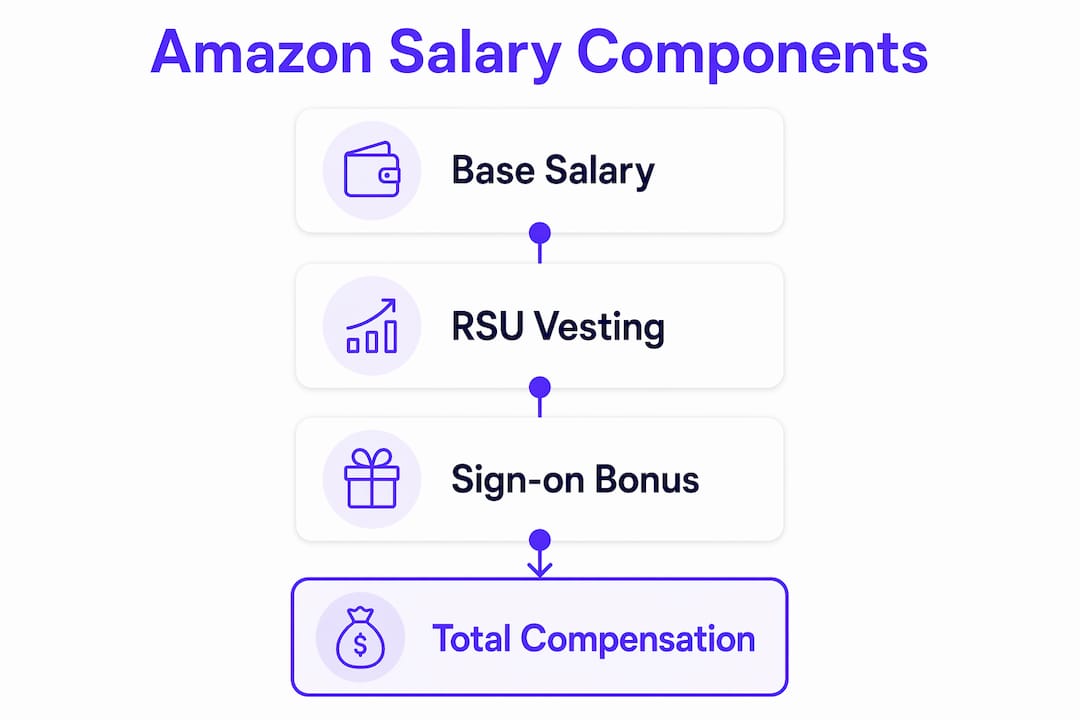
Amazon employee compensation has three main parts: base salary, RSUs, and sign-on bonuses. Each one works differently, and ignoring any of them gives you a distorted picture of what the job actually pays.
Base salary
Amazon base salaries for engineering roles are capped at roughly $185,000. That cap is lower than what Google or Meta offer at the base level, but Amazon offsets it with larger equity grants. For non-engineering corporate roles, base salaries scale with job level and geography, following a structured band system tied to Amazon's internal leveling framework (L4 through L10 for corporate staff).RSUs
RSUs are shares of Amazon stock granted at hire and vested over four years. The vesting schedule is back-loaded by design: 5% in year one, 15% in year two, 40% in year three, and 40% in year four. That structure means your equity payout is heavily weighted toward years three and four. Employees who leave before year three forfeit the bulk of their stock value.
Sign-on bonuses
Amazon does not pay recurring annual performance bonuses. What the company calls a "bonus" is almost always a sign-on payment, distributed across the first two years of employment. This structure exists specifically to compensate for the low equity payout in years one and two. Once those payments end, your total compensation shifts to depend almost entirely on RSU vesting.
| Compensation component | How it works | When you receive it |
|---|---|---|
| Base salary | Fixed annual pay, level-dependent | Every paycheck |
| RSUs | Stock grants vesting 5/15/40/40 | Years 1–4 |
| Sign-on bonus | One-time cash, split over two years | Years 1–2 |
| Annual performance bonus | Not offered at Amazon | N/A |
How do salaries differ across job roles and levels at Amazon?
Amazon job salaries span an enormous range depending on whether you work in a fulfillment center or a corporate office. The two tracks operate under completely different pay structures.
Software development engineers
SDE total compensation in 2026 breaks down by level as follows: SDE I earns $160,000–$220,000, SDE II earns $230,000–$370,000, SDE III earns $350,000–$530,000, and Principal engineers earn $500,000–$900,000 or more. These figures include base salary, RSUs, and sign-on bonuses. The jump from SDE II to SDE III is where equity grants grow most dramatically, making promotion timing a real financial decision.

Program managers and corporate roles
Program manager total compensation typically falls between $181,000 and $223,000. That range reflects mid-level corporate positions and includes equity. For product manager salary benchmarks across the broader tech industry, the range is comparable but varies by company size and specialization.Warehouse and fulfillment roles
Entry-level warehouse associates earn $18–$22 per hour, well above the $15 minimum wage Amazon set in 2018. Pay varies by location, shift type, and specific role within the facility. Overnight and weekend shifts typically carry a differential that raises effective hourly pay further.| Role | Level | Total compensation range |
|---|---|---|
| SDE I | Entry engineering | $160,000–$220,000 |
| SDE II | Mid-engineering | $230,000–$370,000 |
| SDE III | Senior engineering | $350,000–$530,000 |
| Principal SDE | Staff engineering | $500,000–$900,000+ |
| Program manager | Mid corporate | $181,000–$223,000 |
| Warehouse associate | Hourly | $18–$22/hr |
How does Amazon's RSU vesting schedule impact your total compensation over time?
The 5%/15%/40%/40% vesting schedule is the most misunderstood part of Amazon employment salary. Most job seekers see the four-year total and divide by four. That math is wrong.
The year-two cliff
Sign-on bonuses are timed to cover the gap created by low early equity vesting. In year one, you receive 5% of your RSU grant plus a portion of your sign-on bonus. In year two, you receive 15% of your RSUs plus the remaining sign-on payment. When year two ends, the sign-on money stops. Year three begins with 40% RSU vesting but no bonus cash to supplement it. For many employees, total cash compensation actually drops between year two and year three before the equity value catches up. This is the "year-two cliff" effect.
Year-by-year compensation pattern
The table below illustrates a sample SDE II offer with a $300,000 total package, $170,000 base, $100,000 RSU grant, and $30,000 sign-on bonus split evenly across two years.
| Year | Base salary | RSUs vested | Sign-on bonus | Total |
|---|---|---|---|---|
| Year 1 | $170,000 | $5,000 (5%) | $15,000 | $190,000 |
| Year 2 | $170,000 | $15,000 (15%) | $15,000 | $200,000 |
| Year 3 | $170,000 | $40,000 (40%) | $0 | $210,000 |
| Year 4 | $170,000 | $40,000 (40%) | $0 | $210,000 |
How do location and role type affect Amazon job salaries?
Geography is one of the strongest predictors of Amazon employee salaries, especially for hourly workers. The company uses a location premium model that adjusts wages above the $15 baseline to reflect local labor markets.
In high-cost states like California and New York, hourly wages at Amazon fulfillment centers reach $20–$22 or more. Facilities in lower-cost states pay closer to the $18 floor. That $4–$5 per hour difference compounds significantly over a full year of full-time work.
For corporate and remote roles, location affects pay differently. Amazon publishes salary ranges in job postings for many states, and those ranges reflect local cost-of-living adjustments. A software engineer hired for a Seattle-based role earns more in base salary than the same level hired for a remote position in a lower-cost state.
Key factors that drive pay variation by location:
- State minimum wage laws: Several states mandate wages above the federal minimum, pushing Amazon's floor higher.
- Local labor market competition: Facilities near other major employers compete for workers, raising effective wages.
- Cost-of-living adjustments: Corporate roles in high-cost metros carry higher base salaries to maintain purchasing power.
- Shift differentials: Overnight, weekend, and peak-season shifts add hourly premiums on top of base rates.
- Role category: Fulfillment, delivery, and corporate roles each follow separate pay structures even within the same city.
Key Takeaways
Amazon employee compensation is determined by the combination of base salary, back-loaded RSU vesting, and sign-on bonuses, and evaluating all three together is the only way to accurately assess total pay.
| Point | Details |
|---|---|
| Total comp, not just base | Amazon base pay is capped near $185K; RSUs and bonuses make up the majority of total compensation. |
| RSU vesting is back-loaded | The 5/15/40/40 schedule means most equity value arrives in years three and four. |
| Sign-on bonuses bridge early years | Sign-on payments offset low early RSU vesting but end after year two, creating a cash gap. |
| Location drives hourly pay | Warehouse wages range from $18 to $22+ per hour depending on state and facility. |
| Role level determines total range | SDE compensation spans $160K to $900K+ depending on level, while program managers earn $181K–$223K. |
What I've learned from watching candidates misread Amazon offers
The most common mistake I see is candidates treating Amazon's base salary as the headline number. They compare it to a Google offer at face value and conclude Amazon pays less. That comparison ignores the RSU structure entirely, and it leads people to turn down offers that would have paid more over four years.
The second mistake is underestimating the year-two cliff. Candidates accept an offer, feel comfortable in years one and two with the sign-on bonus supplementing their pay, and then get blindsided when that cash disappears. The RSU ramp in year three does compensate, but the transition feels like a pay cut even when it is not one.
My honest advice: model your compensation year by year before you sign anything. Use the actual vesting schedule, subtract the sign-on bonus from years three and four, and compare the four-year total against competing offers. Amazon's structure rewards patience. If you plan to stay through the full cycle, the back-loaded equity often outperforms what a higher base salary elsewhere would deliver.
One more thing worth saying directly. Salary averages published without filtering for role, level, and location are nearly useless. A single number that blends warehouse associates and principal engineers tells you nothing actionable. Always filter by your specific job title, level, and city before drawing any conclusions about what an offer is worth.
, Nkosi
Salary-atlas: benchmark any role before you negotiate
Knowing Amazon's pay structure is only half the work. The other half is understanding what the broader market pays for the same skills, so you can negotiate from a position of knowledge rather than guesswork.
Salary-atlas publishes verified salary data for hundreds of job titles across every U.S. state, sourced directly from the Bureau of Labor Statistics with no paywall and no fabricated trends. Whether you are benchmarking a data scientist salary against an Amazon offer or checking what data analyst roles pay in your state, the figures are updated annually and linked back to their original source. Visit Salary-atlas to look up any role and see exactly where an Amazon offer stands relative to the full market.
FAQ
What is the average Amazon employee salary in 2026?
The median annual pay for a full-time U.S. Amazon worker is $53,211 in 2026. That figure covers all roles, including hourly warehouse positions, so it is not representative of corporate or engineering pay.
Does Amazon pay annual performance bonuses?
Amazon does not offer recurring annual performance bonuses. What Amazon calls a bonus is a sign-on payment distributed across the first two years of employment.
How does Amazon's RSU vesting schedule work?
Amazon vests RSUs on a 5/15/40/40 schedule over four years. Employees receive 5% of their grant in year one, 15% in year two, and 40% in each of years three and four.
What do Amazon warehouse workers earn per hour?
Entry-level warehouse associates earn $18–$22 per hour depending on location, shift, and role. High-cost states like California and New York push wages toward the upper end of that range.
How do I compare an Amazon offer to other tech employers?
Model the full four-year compensation using base salary, RSU vesting by year, and sign-on bonus payments. Then compare the four-year total against competing offers rather than comparing base salaries alone.
Recommended
- Data Scientist Salary
- Data Analyst Salary
- Salary Atlas, US Salary Data by Job Title · Salary Atlas
- Product Manager Salary
Occupation wage figures on Salary Atlas come from the U.S. Bureau of Labor Statistics. Figures in this article that are not linked to a source are estimates. See our methodology.