Amazon Director Compensation: 2026 Salary Breakdown
 *
*
TL;DR:>
- Amazon director pay is mostly determined by stock grants and performance bonuses, which often surpass base salary. The average base salary is about $221,272 annually, but total compensation varies greatly based on business unit, revenue scale, and P&L responsibility. Negotiation should focus on RSU grant size and understanding vesting schedules for optimal earnings.*
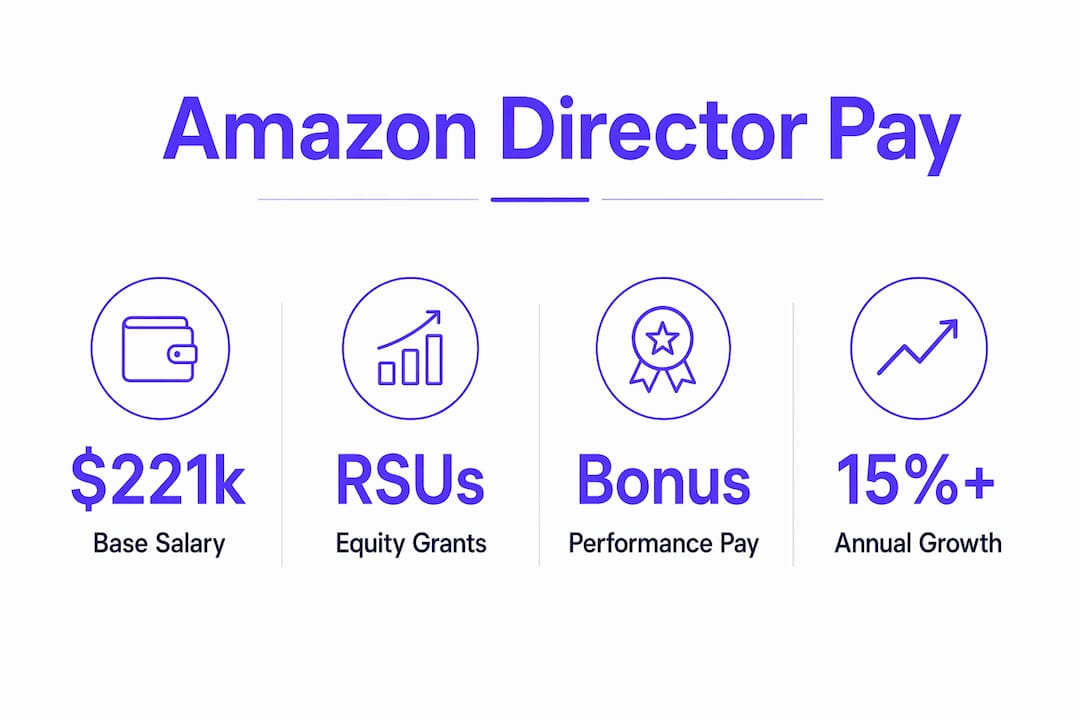
Amazon director compensation is defined as a multi-component pay structure combining base salary, performance bonuses, and equity awards that together reflect a director's business unit scale, geographic location, and individual performance record. The average base salary for Amazon directors in the US sits at approximately $221,272 annually, which is 112% above the national average for comparable director roles. That figure alone signals how seriously Amazon prices leadership talent. But base pay is only one piece. Bonuses and restricted stock units (RSUs) frequently eclipse base salary at this level, making total compensation the number that actually matters when evaluating an offer.
What is the typical base salary for Amazon directors?
The average Amazon director base salary is approximately $221,272 per year in the US, with Seattle averaging slightly lower at around $216,311. That geographic difference surprises many candidates who assume the company's home market pays the most. Seattle's cost of living premium is real, but Amazon's internal pay bands do not always track local housing costs the way smaller tech firms do.

Role responsibilities drive base pay variation more than location does. Directors with profit-and-loss (P&L) accountability for large business units consistently land at the top of the base salary range. A director overseeing a $200 million revenue line commands meaningfully more than a director in a staff or support function with no direct revenue ownership.
Specific business units also matter. Director of eCommerce roles, for example, range from $130,000 to $185,000 in base pay, with candidates who hold Amazon Marketing Services (AMS) or Demand-Side Platform (DSP) expertise and catalog management experience landing at the top of that band. That range sits below the broader Amazon director average, which reflects how much business unit context shapes the number.
Pro Tip: Before accepting any base salary figure at face value, ask the recruiter which internal pay band the role falls under and what the band ceiling is. Amazon's bands are fixed, and knowing the ceiling tells you exactly how much room exists for base negotiation.Geographic variation in director salary at Amazon is real but secondary to role scope. Professionals evaluating offers should weight P&L responsibility and business unit revenue scale above location when assessing whether a base salary is competitive.
How are bonuses and stock grants structured in Amazon director packages?
Bonuses and stock awards form a large part of total compensation at the director level, and they often eclipse base salary outright. That is not a figure of speech. A director earning $220,000 in base pay can receive an RSU grant that, when vested over four years, adds $150,000 or more per year to total compensation. The equity component is where the real wealth accumulates.
Amazon's RSU vesting schedule is not linear. The standard schedule front-loads vesting in years three and four, which means directors who leave before the three-year mark forfeit a disproportionate share of their equity. Understanding this schedule before signing is non-negotiable.
Performance bonuses operate separately from RSUs. They tie to individual achievement metrics and business unit results, with strict operational and revenue thresholds that Amazon does not always disclose in detail during the hiring process. Directors who miss those thresholds receive reduced or zero bonus payouts, regardless of how strong their base salary is.
Key structural points about Amazon director equity and bonuses:
- RSU grant size varies by business unit, with high-revenue units offering larger initial grants.
- Equity packages can double total pay for directors in top-performing business units.
- Bonus metrics include both individual performance ratings and business unit financial results.
- Negotiation on equity is more flexible than negotiation on base salary, which is largely fixed by band.
- Stock price fluctuation affects realized compensation, so grant size matters more than grant value at signing.
Pro Tip: Request the full RSU vesting schedule in writing before your offer deadline. Amazon's back-weighted vesting is a retention tool, and knowing the exact schedule helps you calculate your true year-one and year-two compensation accurately.
How do P&L responsibility and business unit scale affect director pay?
Directors managing significant P&L responsibility command premium compensation at Amazon. Candidates with proven experience overseeing $50 million or more in P&L receive notable pay premiums over peers in equivalent titles without that accountability. Amazon's Leadership Committee views P&L ownership as direct evidence of the results-driven mindset the company prizes.
Amazon director and VP compensation rose over 15% year-over-year according to 2026 recruitment analysis. That increase reflects competitive pressure from other large technology employers and Amazon's internal commitment to retaining directors who move the needle on revenue and shareholder value.
Business unit disparities create real compensation gaps between directors at the same title level. A director in AWS (Amazon Web Services) operates in a unit with different revenue scale and margin profile than a director in Amazon Fresh. Those differences translate directly into equity grant size and bonus potential, even when base salaries are similar.
"Executive pay at Amazon is strictly performance-tied, requiring alignment with shareholder value metrics. Directors who demonstrate delivery against those metrics gain the most leverage in compensation discussions, both at hire and during annual reviews.">
Source: Amazon 2026 Proxy Statement
The practical implication is clear. When evaluating an offer or preparing for a compensation review, directors should quantify their P&L impact in dollar terms. Vague claims about leadership or team growth carry far less weight than a specific revenue or margin improvement figure tied to your decisions. Amazon's compensation process rewards specificity.
- Identify the revenue or margin scale of the business unit you are joining or currently managing.
- Quantify your direct P&L contribution in dollar terms before any compensation discussion.
- Research the business unit's growth trajectory, since faster-growing units typically offer larger equity grants.
- Compare your offer against compensation analysis benchmarks for equivalent P&L scope, not just equivalent title.
- Prioritize equity negotiation over base salary negotiation, since base bands are fixed and equity is flexible.
What practical tips help you negotiate Amazon director compensation?
Negotiating Amazon director pay requires a different mindset than negotiating at most other companies. Equity negotiation is the primary lever for increasing total compensation at this level. Base salary sits inside a fixed band, and Amazon rarely moves it significantly. RSU grant size, however, is negotiable, and even a modest increase in grant size compounds significantly over a four-year vest.
Candidates who understand the business unit's performance evaluation criteria negotiate from a position of strength. Performance-based awards carry strict achievement thresholds, and directors who do not understand those thresholds cannot accurately value their offer. Ask the recruiter directly: what metrics determine bonus payout, and what percentage of directors in this unit hit full bonus in the last two years?
Practical negotiation guidance for director-level candidates:
- Never assume your compensation package mirrors another director's. Packages are not uniform and vary by candidate scarcity, business unit need, and negotiation approach.
- Focus your negotiation energy on RSU grant size and sign-on equity, not base salary.
- Verify the full bonus structure in writing, including the specific metrics and payout percentages.
- Research the business unit's recent financial performance before your final offer conversation.
- Use external salary benchmarks by location to anchor your equity ask to market data, not just Amazon's internal framing.
Pro Tip: If Amazon offers a sign-on bonus to offset unvested equity you are leaving behind at a current employer, negotiate for RSUs instead. Sign-on cash is taxed as ordinary income and does not compound. RSUs tied to Amazon's stock price carry upside that cash does not.
Understanding the full picture of Amazon leadership compensation also means looking at comparable roles. Reviewing Amazon L4 salary structures gives useful context for how Amazon builds compensation across levels, which helps directors understand the internal logic behind their own package.
Key Takeaways
Amazon director compensation is dominated by equity, not base salary, and directors who negotiate RSU grant size rather than base pay consistently achieve higher total compensation outcomes.
| Point | Details |
|---|---|
| Base salary benchmark | Amazon directors average $221,272 annually, which is 112% above the national average for comparable roles. |
| Equity drives total pay | RSU grants frequently exceed base salary and are the primary negotiation lever at the director level. |
| P&L responsibility commands premiums | Directors managing $50M+ P&L receive significant pay premiums over peers without direct revenue accountability. |
| Packages are not uniform | Compensation varies by business unit, candidate scarcity, and negotiation approach. Never assume parity with peers. |
| Performance thresholds are strict | Bonus payouts require meeting specific operational and revenue targets that Amazon does not always disclose upfront. |
What I have learned about Amazon director pay after years of watching it evolve
By Joelen ZyoktovaThe single biggest mistake I see director-level candidates make is treating Amazon's compensation like a standard corporate offer. They focus on base salary, accept the first RSU number they see, and walk away leaving real money on the table. Amazon's pay structure is deliberately weighted toward equity, and that weighting is intentional. It aligns director incentives with long-term shareholder outcomes. Once you understand that design principle, the negotiation strategy becomes obvious.
What has changed noticeably in recent years is the pace of compensation growth at the director level. A 15% year-over-year increase in director and VP pay is not a small adjustment. It reflects genuine competitive pressure from other large technology employers who are actively recruiting Amazon's leadership talent. Amazon responded by making equity packages more competitive, not by raising base salaries across the board.
The nuance that most candidates miss is the back-weighted RSU vesting schedule. Year one and year two feel thin. Year three and year four are where the compensation story gets interesting. Directors who leave before the three-year mark often feel underpaid in retrospect, not because the offer was bad, but because they did not stay long enough to realize the full value. That is not an accident. It is a retention mechanism built into the structure.
My advice to anyone entering a director-level compensation discussion with Amazon: come with numbers. Quantify your P&L impact. Know the business unit's revenue scale. Understand the vesting schedule before you sign. And push on equity, not base. The candidates who do that consistently outperform those who do not, sometimes by six figures over a four-year period.
— Joelen Zyoktova
Salary Atlas: your benchmark for director-level pay
Knowing the right number before you walk into a compensation discussion is the difference between a good offer and a great one. Salary Atlas provides free, transparent salary data sourced directly from the U.S. Bureau of Labor Statistics, covering hundreds of job titles and updated annually so the figures you use actually reflect current market conditions.
Whether you are benchmarking a director offer, preparing for an annual review, or advising a candidate on market rates, Salary Atlas salary data gives you the factual foundation to negotiate with confidence. Every figure links back to its original source, so you are never working from guesswork. Check salary variation by state to see how geographic location affects director-level pay across the US, and use that data to anchor your next compensation conversation.
FAQ
What is the average Amazon director salary in the US?
The average base salary for Amazon directors in the US is approximately $221,272 per year, which is 112% above the national average for comparable director roles.
How much do Amazon directors make in total compensation?
Total compensation for Amazon directors significantly exceeds base salary when RSU grants and performance bonuses are included. Equity packages can double total pay for directors in high-revenue business units.
Is Amazon director compensation negotiable?
Base salary is largely fixed within Amazon's internal pay bands, but RSU grant size and sign-on equity are negotiable. Equity is the primary lever for increasing total compensation at the director level.
How does P&L responsibility affect Amazon director pay?
Directors with proven experience managing $50 million or more in P&L command notable pay premiums over peers in equivalent titles without direct revenue accountability.
Do all Amazon directors receive the same compensation package?
Amazon director packages are not uniform. Compensation varies by business unit, candidate scarcity, individual negotiation, and performance against specific operational and revenue thresholds.