How to Do a Compensation Analysis: 2026 Guide
Learn how to do a compensation analysis effectively in 2026. Identify pay gaps, attract talent, and build equitable salary structures.
By the Salary Atlas editorial team · Published · Updated

TL;DR:
- A compensation analysis compares employee pay against market benchmarks and internal standards to identify gaps. It requires accurate internal data, aged external market data, and a clear scope to produce actionable results. Regular reviews and detailed remediation plans help maintain pay equity and market competitiveness.
A compensation analysis is a systematic evaluation of employee pay against both market benchmarks and internal equity standards. HR professionals use it to identify pay gaps, fix compression, and build salary structures that attract and retain talent. The process covers direct and indirect pay, including base salaries, bonuses, insurance, and retirement contributions. Two core techniques drive every sound analysis: compa-ratios and salary bands. Salary Atlas provides U.S. Bureau of Labor Statistics wage data by job title and location, giving HR teams a free, source-linked starting point for external benchmarking.
How to do a compensation analysis: what you need before you start

Preparation determines whether your analysis produces real answers or just a spreadsheet full of noise. Collect internal data first. You need base salary, bonuses, benefits costs, job grades, performance ratings, tenure, and workforce demographics for every role in scope. Missing any of these fields forces you to make assumptions later, and assumptions produce unreliable compa-ratios.
External market data is equally critical. Aging survey data to the current date is non-negotiable. Compensation surveys are typically published months after data collection ends. Using unadjusted figures from a survey conducted 12 months ago means your benchmarks already lag the market. Apply a standard aging factor, usually based on published wage growth indices, to bring every external figure to today's date.
| Data field | Source | Purpose |
|---|---|---|
| Base salary | HRIS | Compa-ratio calculation |
| Salary band midpoints | Internal pay structure | Market gap identification |
| Market reference points | BLS, Salary Atlas, surveys | External benchmarking |
| Performance ratings | Performance management system | Equity analysis controls |
| Tenure and demographics | HRIS | Pay equity regression inputs |
| Job descriptions | HR records + manager interviews | Role validation |
What are the steps for conducting a compensation analysis?
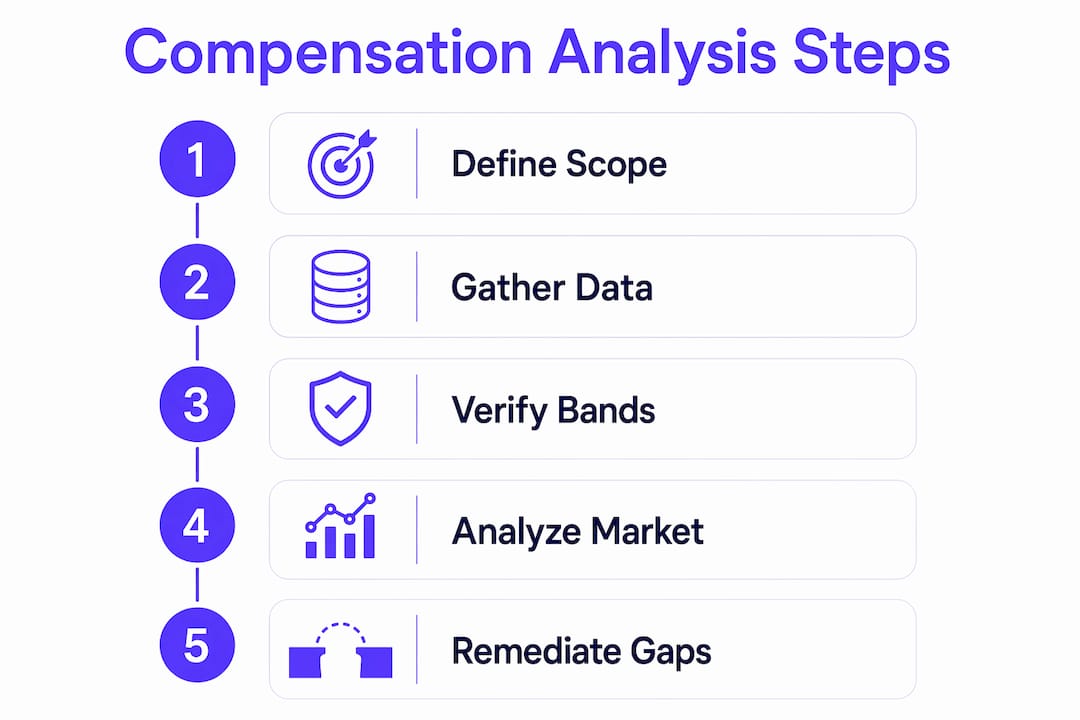
A structured process keeps the work focused and the findings defensible. Follow these six steps in order.
- Define scope and objectives. Write down exactly what you are measuring: market competitiveness, pay equity, compression, or a combination. Name the job families, business units, or locations in scope. Attach a deadline and identify who owns each deliverable.
- Audit and update salary bands. Pull your current band midpoints and compare them to your aged external market data. Job families with midpoints more than 8–10% below market need immediate band revisions before you calculate anything else. Updating bands first prevents you from flagging false positives in the next step.
- Calculate compa-ratios for every employee in scope. The formula is straightforward: divide the employee's current salary by the salary band midpoint, then multiply by 100. A result of 100 means the employee sits exactly at midpoint. Employees below 80% are flight risks. Employees above 120% represent pay compression or red-circle situations that need a different remediation path.
- Conduct an internal pay equity analysis. Group employees by job family, level, and location. Control for legitimate pay factors: tenure, performance rating, and relevant credentials. Pay equity gaps of 10–15% between employees with comparable experience and performance ratings signal a need for corrective action. Document every control variable you apply so the analysis holds up to scrutiny.
- Validate job descriptions against actual duties. Job titles alone are insufficient for accurate benchmarking. A "Senior Analyst" at one company may do the work of a "Manager" at another. Interview managers and employees to confirm that the duties in each job description match what people actually do. Reclassify roles before finalizing any market match.
- Build a prioritized remediation plan. List every identified gap with the employee name, correction type, dollar amount, timing, budget source, and required approvals. Without a documented plan specifying all of these details, compensation issues accumulate and the cost of fixing them grows each year.
Different analysis types serve different business questions. Market competitiveness analysis tells you whether your pay is above, at, or below the external market. Internal equity analysis tells you whether similar employees are paid consistently. Compression analysis tells you whether new hires are being brought in at rates that crowd out longer-tenured employees. Most organizations need all three, but the remediation actions and budget implications differ significantly across each type.
What mistakes should you avoid in a compensation analysis?
The most common failure in pay analysis is starting without a defined scope. HR teams pull every data field available, run dozens of cuts, and end up with findings that no one can act on. Scope definition is not a formality. It is the filter that makes the rest of the work useful.
A second critical mistake is using unaged external data. Stale salary bands cause systematic underpayment and produce compa-ratios that look healthy when employees are actually below market. Always document the aging methodology you used and include it in your final report.
Compensation analysis is a governance action, not a research project. Every finding must connect to a specific correction, a dollar amount, a timeline, and an approval. Analysis without remediation is just documentation of a problem you chose not to fix.
Relying on job titles without verifying actual duties is a third common error. Titles vary widely across companies and industries. An analyst at a technology firm and an analyst at a nonprofit may share a title but perform entirely different work at different market rates. Validation through manager interviews takes time, but it prevents costly mismatches.
Practical steps to avoid these errors:
- Write a one-page scope document before data collection begins.
- Apply and document an aging factor to all external survey data.
- Conduct manager and employee interviews for at least the top 20% of roles by headcount or budget impact.
- Run a pay equity regression, not just a descriptive comparison, to control for legitimate pay factors.
- Attach a cost estimate and approval chain to every remediation item before presenting findings to leadership.
- Schedule a follow-up review 90 days after remediation to confirm corrections were applied correctly.
How often should you conduct a compensation analysis?
Annual full compensation analyses are the standard practice for most organizations. A full review covers all job families, updates salary bands, recalculates compa-ratios, and includes a pay equity audit. Completing this once per year keeps your pay structure aligned with market movement and gives you a defensible record for compliance purposes.Quarterly targeted reviews make sense for roles with high turnover or acute talent shortages. If your time-to-fill for a specific role has increased significantly, or if exit interview data shows pay as a top reason for departure, a targeted review should not wait for the annual cycle. You can check salary by state to identify whether regional market shifts are driving the gap.
Regular pay equity audits are both a legal best practice and a reputational safeguard. Several U.S. states now require pay equity reporting, and the regulatory trend is toward greater transparency. Running a proactive audit annually gives you time to correct gaps before they become legal exposure.
Triggers that should prompt an off-cycle analysis:
- A significant acquisition or merger that brings in new job families at different pay levels.
- A major competitor raises wages publicly, signaling a market shift.
- Turnover in a specific department spikes above your organization's historical average.
- A new compensation philosophy or pay transparency policy is adopted.
- Leadership approves a new job level or career ladder that requires new salary bands.
Key Takeaways
A compensation analysis produces defensible, actionable results only when scope is defined first, external data is aged to the current date, and every finding connects to a documented remediation plan.
| Point | Details |
|---|---|
| Define scope before collecting data | Write down objectives and boundaries before pulling any figures to avoid wasted effort. |
| Age all external market data | Adjust survey figures to the current date to prevent stale benchmarks from distorting compa-ratios. |
| Use compa-ratios to flag risk | Employees below 80% of band midpoint are flight risks; those above 120% signal compression. |
| Validate roles beyond job titles | Interview managers and employees to confirm actual duties before matching roles to market benchmarks. |
| Remediation requires a full plan | Every gap needs a recipient, correction amount, timeline, budget source, and approval chain. |
What I've learned from doing this work the hard way
By Joelen ZyoktovaThe part of compensation analysis that most HR teams underinvest in is the remediation plan. I have seen organizations run technically excellent analyses, identify real gaps, present compelling findings to leadership, and then watch the whole effort stall because no one attached a dollar figure and an approval chain to the corrections. Leadership cannot approve what has not been quantified. Build the remediation plan as part of the analysis, not as a follow-up task.
The second thing I would push back on is the idea that compensation analysis is an annual event. It is a governance function. The annual cycle is the minimum. The real work is building the infrastructure: updated job descriptions, validated market matches, aged benchmarks, and a documented methodology that any auditor or regulator could follow. When that infrastructure exists, the annual cycle takes a fraction of the time and produces far more reliable results.
One overlooked step that consistently causes problems is job description validation. HR teams benchmark against titles because titles are fast. But titles lie. I have seen "Coordinator" roles paying at the "Manager" market rate because the actual duties were managerial, and the title was never updated. The fix is simple: build manager interviews into your standard process and document what you find. It adds a week to the timeline and saves months of rework.
Finally, communicate your findings and your remediation actions to employees. Pay transparency is no longer optional in many markets, and employees who understand how their pay is set are more likely to trust the process even when the answer is not what they hoped for.
, Joelen Zyoktova
Salary Atlas makes compensation benchmarking faster
Accurate external benchmarks are the foundation of any pay analysis. Salary Atlas publishes U.S. salary data by job title and location, sourced directly from the Bureau of Labor Statistics, with no paywall and every figure linked back to its original source.
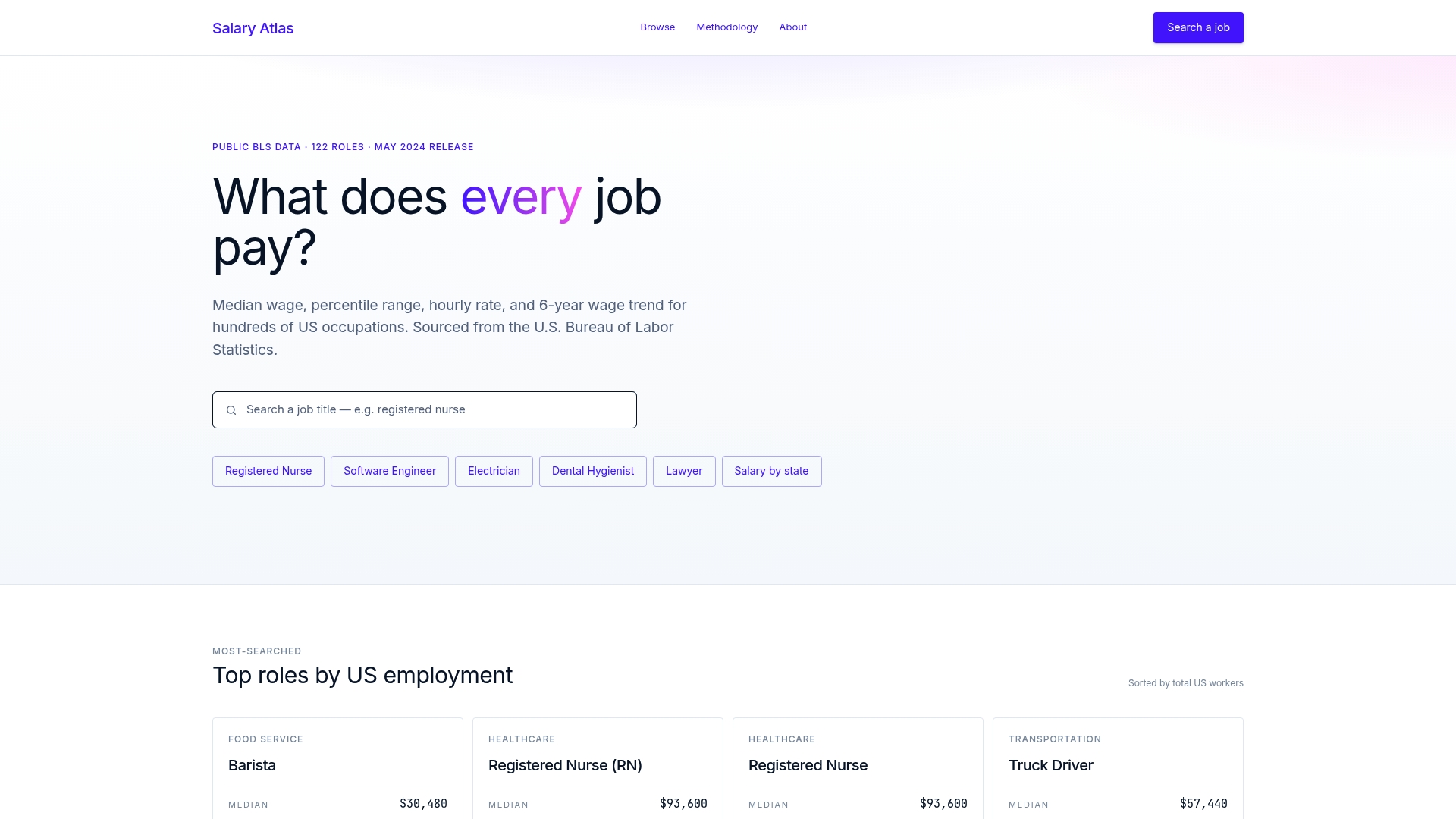
Whether you are setting band midpoints for a new job family, checking whether your financial analyst pay is competitive, or building a regional comparison for a distributed workforce, Salary Atlas gives you current, credible figures to anchor your analysis. The data refreshes annually and covers hundreds of occupations with median pay, full salary ranges, and multi-year trend lines. Visit Salary Atlas to access free, BLS-sourced salary data for your next compensation review.
FAQ
What is a compensation analysis?
A compensation analysis is a structured review of employee pay against external market benchmarks and internal equity standards. It covers base salary, bonuses, and benefits to identify gaps and guide corrective action.
How do you calculate a compa-ratio?
Divide the employee's current salary by the salary band midpoint, then multiply by 100. A result below 80 flags a flight risk; a result above 120 indicates pay compression.
How often should compensation analysis be conducted?
Annual full reviews are standard practice, with quarterly targeted reviews for high-turnover or hard-to-fill roles. Organizations in states with pay equity reporting requirements should run equity audits at least annually.
What is the threshold for a pay equity concern?
Pay equity gaps of 10–15% between employees in comparable roles with similar experience and performance ratings indicate a need for immediate corrective action.
Why is aging external salary data necessary?
Compensation surveys are published months after data collection ends. Using unadjusted figures means your benchmarks lag the current market, which produces inaccurate compa-ratios and can lead to systematic underpayment.
Recommended
Occupation wage figures on Salary Atlas come from the U.S. Bureau of Labor Statistics. Figures in this article that are not linked to a source are estimates. See our methodology.