Amazon L4 Salary in 2026: Total Comp Breakdown
 *
*
TL;DR:>
- Amazon L4's total compensation ranges from $160,000 to $220,000 annually, with significant increases in years three and four due to RSU vesting. The package includes a capped base salary of about $165,000, along with RSUs and sign-on bonuses, which are crucial negotiation levers beyond the salary cap. Your interview performance, especially in system design, greatly influences your final offer, with promotion timelines impacting future earnings.*
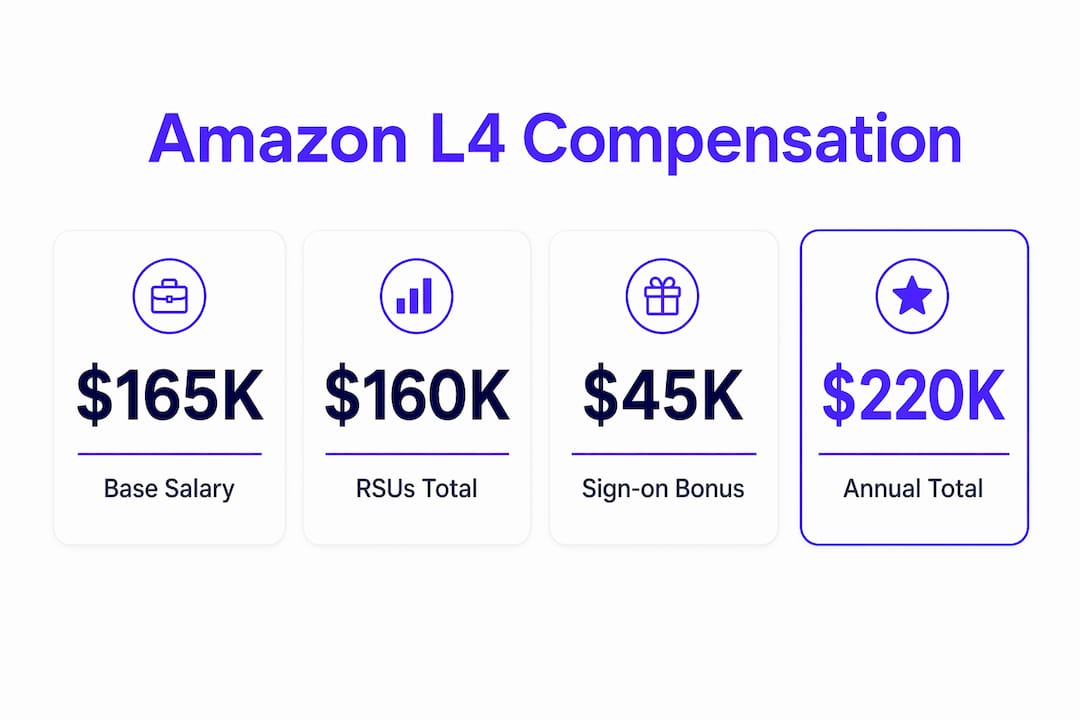
Amazon L4 salary is the total compensation package for entry-level software development engineers at Amazon, typically ranging from $160,000 to $220,000 annually. That figure covers base pay, restricted stock units (RSUs), and sign-on bonuses combined. Most job seekers focus only on base salary and leave significant money on the table during negotiations. Understanding how all three components work together is the difference between accepting a fair offer and walking away from a great one.
What are the components of an Amazon L4 salary package?
Amazon L4 total compensation has three distinct parts: base salary, RSUs, and sign-on bonuses. Each component behaves differently over time, and treating them as one lump sum leads to poor decisions.
Base salary
The base salary for an Amazon L4 role is capped near $165,000. Amazon applies this cap across most engineering roles regardless of location, which surprises candidates coming from firms that adjust base pay heavily by city. The cap exists because Amazon uses equity to drive long-term retention rather than front-loading cash.

RSU grants and vesting
RSU grants for L4 roles typically range from $60,000 to $160,000 over four years. The critical detail is the vesting schedule. Amazon follows a 5/15/40/40 vesting pattern, meaning you receive only 5% of your total grant in year one, 15% in year two, then 40% in each of years three and four. That structure makes early-year compensation look modest compared to what arrives later.
Sign-on bonuses
Sign-on bonuses for L4 positions run from $20,000 to $45,000 in year one. Amazon often provides a second-year bonus as well, specifically to offset the low RSU vests in years one and two. These bonuses are not salary. They do not compound, and they do not repeat in years three and four when RSUs take over as the primary compensation driver.
| Compensation Component | Typical Range | Timing |
|---|---|---|
| Base salary | Up to $165,000 | Annual, paid biweekly |
| RSU grant (total) | $60,000–$160,000 | 5/15/40/40 over 4 years |
| Year 1 sign-on bonus | $20,000–$45,000 | Paid in year 1 |
| Year 2 sign-on bonus | Varies | Paid in year 2 |
| Year 3–4 total comp | $180,000–$260,000 | As RSUs fully vest |
How does interview performance affect your L4 offer?
The Amazon L4 interview process directly shapes the offer you receive. A stronger performance across all rounds signals higher market value, which gives recruiters room to push toward the top of the compensation band.
The standard L4 process runs 4–8 weeks and includes five onsite loop interviews covering coding, system design, and behavioral rounds tied to Amazon's Leadership Principles. The most significant shift in 2026 is the weight placed on system design. System design rounds now appear in 60–70% of interview loops, up from 20–30% in 2023. Candidates who prepared only for coding problems are arriving underprepared.
Key factors that affect your offer outcome:
- System design depth: Interviewers assess whether you can scope a problem, identify trade-offs, and communicate decisions clearly.
- Leadership Principle alignment: Each behavioral round maps directly to Amazon's 16 Leadership Principles. Vague answers score poorly.
- Cross-functional impact: Demonstrating impact beyond your own team, such as unblocking other engineers or influencing product direction, separates strong candidates from average ones.
- Coding fluency: Clean, well-explained solutions still matter. Interviewers score both correctness and communication.
- Consistency across rounds: A single weak round can pull down an otherwise strong loop score.
Role type and location also affect the final number. L4 roles in Seattle and the San Francisco Bay Area tend to land at the higher end of the RSU range. Roles in lower-cost markets or in operations-adjacent functions, such as the Amazon L4 area manager track, carry different compensation structures than software engineering roles. Pro Tip: Prepare at least three Leadership Principle stories that each cover a different principle. Tag each story explicitly during the interview so the interviewer can score it cleanly.
How does Amazon L4 compensation compare across levels and the industry?
Amazon's initial offer often looks lower than competing big tech firms. That perception is accurate for years one and two. It becomes inaccurate by year three.
Year 3–4 total compensation for L4 employees reaches $180,000 to $260,000 as RSUs fully vest at the 40% rate. Candidates who leave before year three forfeit the majority of their equity value. This back-loaded structure is intentional. It rewards tenure and penalizes early exits.
The table below shows how compensation scales across adjacent Amazon levels:
| Amazon Level | Role Equivalent | Approximate Total Comp Range |
|---|---|---|
| L4 | Entry-level SDE / Associate PM | $160,000–$220,000 |
| L5 | Mid-level SDE / PM | $220,000–$340,000 |
| L6 | Senior SDE / Senior PM | $300,000–$500,000 |
| L6 Manager | Engineering Manager | $320,000–$520,000 |
Compared to the broader software developer salary market, Amazon L4 sits well above the national median for software engineers. The gap is largest in years three and four when equity vesting accelerates.
What strategies help you evaluate and negotiate an Amazon L4 offer?
Evaluating an Amazon L4 offer requires looking at four years of compensation, not just the number on page one of the offer letter.
- Calculate the four-year total. Add base salary times four, the full RSU grant at current Amazon stock price, and both sign-on bonuses. Divide by four for an annual average. This is your true annual compensation.
- Confirm your level before negotiating. Amazon does not list L-levels on job postings. Ask your recruiter directly which band the role falls into. Negotiating without knowing your level means you may be pushing against the wrong ceiling.
- Benchmark against verified data. Use Salary Atlas and community-sourced compensation data to understand where your offer sits within the L4 band. An offer at the low end of the range is negotiable. An offer at the top of the band has less room to move.
- Negotiate RSUs and sign-on bonuses, not just base. Since base salary is capped near $165,000, the real negotiation happens in equity and bonuses. Ask specifically whether the RSU grant can increase. Recruiters often have more flexibility there than on base pay.
- Prepare cross-functional impact stories for the negotiation conversation. If a recruiter asks why you deserve a higher offer, answer with evidence. Quantified examples of unblocking teams or driving measurable outcomes carry more weight than tenure or competing offers alone.
Pro Tip: Ask your recruiter: "Is there flexibility in the RSU grant?" and "Is a second-year sign-on bonus part of this offer?" Many candidates never ask and leave both on the table.
For product manager salary benchmarks at the L4 equivalent level, the same four-year calculation applies. The RSU structure is identical across engineering and PM tracks at Amazon.
What I've learned about Amazon L4 offers after years of tracking compensation data
I've reviewed hundreds of tech compensation packages, and Amazon L4 offers generate more confusion than almost any other. The reason is structural. The 5/15/40/40 RSU schedule makes year one look like a $185,000 job and year three look like a $240,000 job. Both numbers are accurate. Neither tells the full story on its own.
The candidates who negotiate best are the ones who walk in knowing their four-year number cold. They don't argue about base salary. They ask about RSU grant size, second-year bonuses, and refresh grants after strong performance reviews. Those levers move. The base salary cap does not.
One thing I'd push back on is the common advice to simply compare Amazon's offer to a competing offer and ask Amazon to match. That works sometimes. What works more reliably is demonstrating, with specifics, why you belong at the top of the L4 band. Amazon's Leadership Principles are not just interview theater. Recruiters and hiring managers use them as a genuine scoring rubric. Candidates who can articulate cross-functional impact tied to Customer Obsession or Deliver Results get better offers than those who can't.
The other piece most guides skip: the promotion clock starts at your hire date, not your first performance review. If you join at the bottom of the L4 band and take 2.5 years to reach L5, you've left real money behind. Negotiate hard at entry. The compounding effect of a higher starting RSU grant and a faster promotion timeline is worth far more than most candidates realize.
— Joelen Zyoktova
Salary Atlas has the data you need to negotiate with confidence
Knowing your market value before you sit down with a recruiter is the single best preparation you can do. Salary Atlas provides transparent, BLS-sourced salary data across hundreds of job titles and all 50 states, with no paywall and no guesswork.
Whether you're benchmarking an Amazon L4 offer against the broader tech market or comparing salary by state to weigh a relocation, Salary Atlas gives you the verified numbers to make that call. Every figure links directly to its original source. The data refreshes annually so you're never working from outdated figures. Start with the full US salary database and build your negotiation case from real data.
Key Takeaways
Amazon L4 total compensation averages $160,000–$220,000 annually but rises to $180,000–$260,000 in years three and four as RSUs vest at the 40% rate.
| Point | Details |
|---|---|
| Total comp range | Amazon L4 pays $160,000–$220,000 annually, rising sharply in years 3 and 4. |
| RSU vesting structure | The 5/15/40/40 schedule back-loads equity; leaving before year 3 forfeits most of it. |
| Negotiation target | RSU grants and sign-on bonuses are more flexible than the $165,000 base salary cap. |
| Interview shift in 2026 | System design now appears in 60–70% of loops, making it the top preparation priority. |
| Promotion timeline | L4 to L5 promotion takes 1.5–3 years and unlocks a significantly higher compensation band. |
FAQ
What is the total compensation for Amazon L4?
Amazon L4 total compensation ranges from $160,000 to $220,000 annually, combining base salary, RSUs, and sign-on bonuses. In years three and four, total compensation can reach $180,000 to $260,000 as RSUs vest at the 40% rate.
What is the base salary cap for Amazon L4?
The Amazon L4 base salary is capped near $165,000 regardless of location. Amazon uses RSU grants and sign-on bonuses to differentiate offers above that base ceiling.
How long does it take to get promoted from L4 to L5 at Amazon?
Promotion from L4 to L5 typically takes 1.5–3 years, depending on performance reviews and the scope of projects you own. Reaching L5 unlocks a higher RSU grant and a broader base salary band.
Does Amazon list L-levels on job postings?
Amazon does not publicly list L-levels on job postings. Candidates should ask their recruiter directly which band applies to their role before entering salary negotiations.
How important is system design for the Amazon L4 interview?
System design is now critical. It appears in 60–70% of Amazon L4 interview loops in 2026, up from 20–30% in 2023. Candidates who prepare only for coding rounds are at a significant disadvantage.