Amazon Intern Pay in 2026: Salaries by Role and Location
 *
*
TL;DR:>
- Amazon interns earn between $110,500 and $185,000 annually, depending on location and qualifications. Location and experience significantly influence pay, with benefits like mental health support and 401(k) matching added from day one. Adjusting for cost of living often makes lower headline salaries more valuable in real-world purchasing power.*
Amazon intern pay ranks among the highest in the technology sector, with annualized salaries for Software Development Engineer interns ranging from $110,500 to $185,000 depending on office location and individual qualifications. That ceiling is not a typo. For students and new graduates comparing internship offers, understanding what drives that range is the difference between negotiating confidently and leaving money on the table. Amazon offers intern roles across software engineering, area management, and corporate functions, each with its own pay scale. This article gives you the numbers, the logic behind them, and the tools to evaluate any offer you receive.
What is Amazon intern pay by role and location?

Amazon intern compensation varies more by geography than most students expect. The annualized salary range for a Software Development Engineer intern sits at $110,500–$160,000 in Seattle and Arlington, $121,600–$180,600 in New York, and $127,100–$185,000 in San Francisco. San Francisco consistently pays the highest. That gap reflects local cost-of-labor differences, not a difference in the work itself.
The table below summarizes those figures clearly.
| Office Location | Annualized Salary Range |
|---|---|
| Seattle / Arlington | $110,500–$160,000 |
| New York | $121,600–$180,600 |
| San Francisco | $127,100–$185,000 |
Hourly rates for tech interns at Amazon frequently exceed $50 per hour. That figure puts Amazon well above the national average for internships across all industries. For context, a software developer salary at the full-time level reflects similar geographic premiums, so the intern pay structure mirrors what you would see in a permanent role.
Pro Tip: If you receive an offer for a specific office location, look up that city's cost of living index before deciding whether the pay is genuinely competitive. A $185,000 annualized rate in San Francisco buys less than $160,000 in Seattle after housing costs.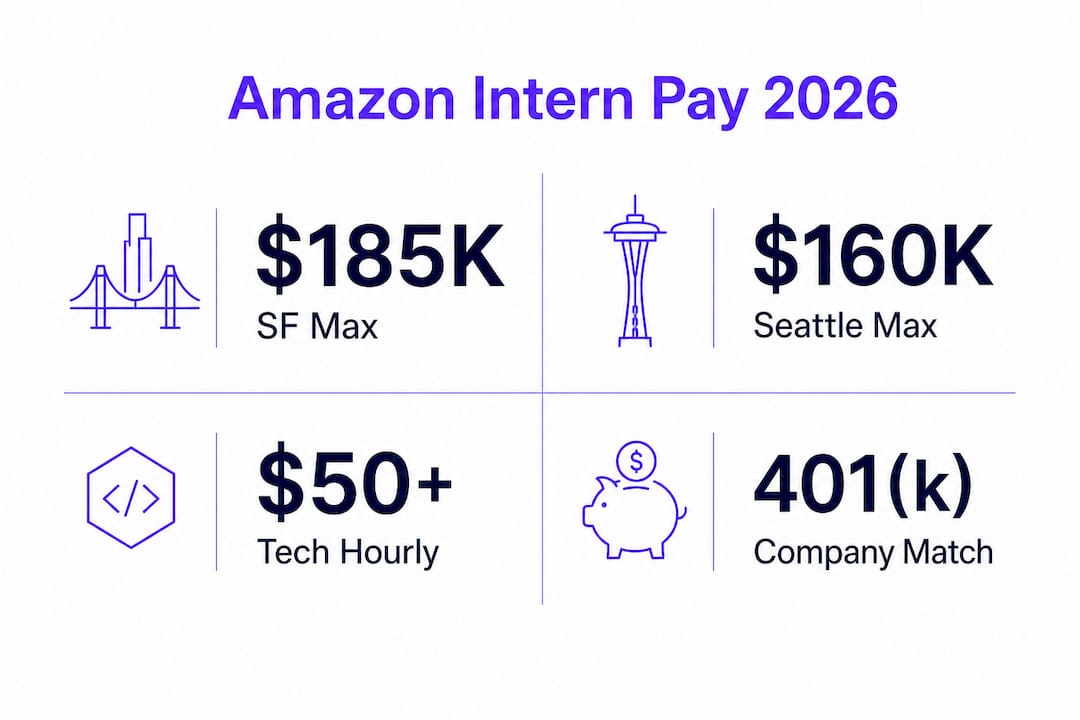
How does Amazon determine intern pay?
Amazon does not publish a single fixed rate for intern compensation. Final pay is determined by experience, qualifications, and cost-of-labor adjustments tied to the assigned office location. Two interns in the same role can receive meaningfully different offers based on their academic background, prior work experience, and the city where they will work.
Several factors shape where your offer lands within the published range:
- Prior experience. Interns with previous tech internships, open-source contributions, or relevant research tend to receive offers toward the upper end of the range.
- Academic standing and specialization. A candidate with a graduate-level background in machine learning or systems design typically commands a higher starting figure than an undergraduate with no specialization.
- Office location. Amazon applies cost-of-labor adjustments by geography. San Francisco and New York offices carry the highest adjustments. Smaller or lower-cost offices sit at the lower end.
- Role type. Software engineering roles carry the highest published pay ranges. Area management and corporate intern roles follow different scales.
- Market competition. Amazon emphasizes pay flexibility based on skill sets and location to stay competitive across diverse markets. When demand for a specific skill is high, offers reflect that pressure.
Pro Tip: Amazon recruiters typically have some flexibility within a band. If you have a competing offer from another major tech company, sharing it professionally during the offer stage can move your Amazon offer closer to the top of the range.
What benefits do Amazon interns receive beyond base pay?
Base salary is only part of the picture. Amazon interns receive day-one benefits that add real financial and personal value to the overall package. Many students overlook these when comparing offers, which leads to undervaluing what Amazon actually provides.
The core benefits available from the first day of an Amazon internship include:
- Employee Assistance Program (EAP). This program provides confidential counseling, legal advice, and financial guidance at no cost to the intern. Access to professional support during a high-pressure internship has tangible value.
- Mental health support. Amazon includes dedicated mental health resources as part of the intern package. For students navigating a demanding work environment for the first time, this is a meaningful addition.
- Medical advice line. Interns can access a nurse advice line for health questions without scheduling a full appointment. This reduces out-of-pocket costs for minor health concerns.
- 401(k) matching. Amazon offers 401(k) matching starting on day one. Most internships at other companies do not include retirement contributions at all. Even a short internship can generate matched contributions that compound over time.
These benefits matter most when you convert them to dollar equivalents. Mental health support, EAP access, and retirement matching collectively represent hundreds to thousands of dollars in value that do not appear in the headline salary figure. A candidate who compares only base pay is comparing incomplete numbers.
How should you evaluate an Amazon internship offer?
Evaluating an internship offer requires more than checking whether the number sounds high. A structured approach gives you a clearer picture of what you are actually being offered.
The most useful comparison framework considers four dimensions together: pay, benefits, cost of living, and career growth potential. Focusing on pay, benefits, and career growth together leads to better decisions than salary alone.
- Adjust for cost of living. An annualized salary of $127,100 in San Francisco and $110,500 in Seattle are not equivalent in purchasing power. Use a cost-of-living calculator to convert both figures to a common baseline before comparing.
- Convert to hourly and monthly figures. Internships vary in length. Divide the annualized figure by 2,080 hours to get an hourly rate, then multiply by your expected weekly hours and internship duration to get your actual take-home estimate.
- Benchmark against role-specific data. Salary Atlas publishes salary by state data that lets you compare Amazon's offer against local market rates for the same role type. A strong offer in one city may be average in another.
- Weigh professional development. Amazon's intern program includes structured mentorship, real project ownership, and exposure to large-scale systems. These experiences carry career value that does not show up in a pay stub.
- Factor in return offer probability. Amazon converts a meaningful share of strong interns to full-time offers. The internship is effectively a paid audition for a full-time role with a full-time Amazon salary attached.
The table below illustrates how the same annualized salary looks different once you apply a cost-of-living adjustment.
| Location | Annualized Salary | Estimated Cost-of-Living Adjustment | Effective Purchasing Power |
|---|---|---|---|
| Seattle | $110,500 | Moderate | High relative value |
| New York | $121,600 | High | Moderate relative value |
| San Francisco | $127,100 | Very high | Lower relative value |
Key Takeaways
Amazon intern compensation is highest in San Francisco at up to $185,000 annualized, but location-adjusted purchasing power often makes Seattle the strongest real-world offer.
| Point | Details |
|---|---|
| Pay range by location | Software engineering interns earn $110,500–$185,000 annualized depending on office city. |
| Pay is not fixed | Amazon sets final offers based on qualifications, experience, and geographic cost-of-labor adjustments. |
| Day-one benefits add value | EAP, mental health support, medical advice, and 401(k) matching begin on the first day of the internship. |
| Adjust for cost of living | A lower headline salary in Seattle often delivers more purchasing power than a higher figure in San Francisco. |
| Career growth matters | Role fit and professional development frequently produce better long-term returns than chasing the highest base pay. |
Why I think most students read Amazon intern pay data wrong
Most students I see evaluating Amazon offers fixate on the annualized number and stop there. That is the wrong move, and it leads to bad comparisons.
The annualized figure assumes a full year of work. An internship lasts 12–16 weeks. Your actual earnings are a fraction of that headline number. Run the math on your specific offer length before you celebrate or feel disappointed.
The second mistake is ignoring the 401(k) match. Most students in their early twenties assume retirement accounts are irrelevant right now. They are not. Matched contributions during an internship compound for decades. That is free money with a 40-year runway.
The third mistake is treating all Amazon offers as equivalent. An offer in Seattle and an offer in San Francisco are structurally different financial situations. I have seen students turn down the Seattle offer because the number was lower, then struggle with San Francisco rent for three months. The purchasing power math matters more than the headline.
My honest advice: take the role where you will learn the most and where the team's work genuinely interests you. Pay differences within the Amazon intern range are real but not life-changing at this stage. The return offer, the network, and the skills you build are the actual prize.
— Joelen Zyoktova
Salary Atlas has the data you need to compare offers
Knowing Amazon's intern pay range is a starting point. Knowing how it compares to market rates for your specific role and location is what gives you real negotiating power.
Salary Atlas publishes transparent salary data sourced directly from the U.S. Bureau of Labor Statistics, with no paywalls and no fabricated trends. Every figure links back to its original source. Students and new graduates use Salary Atlas to benchmark internship offers against full-time market rates, check state-level pay differences, and understand what a role actually pays before they walk into a negotiation. The data refreshes annually, so the numbers you see reflect current market conditions, not figures from three years ago.
FAQ
How much do Amazon interns make per hour?
Amazon tech interns frequently earn more than $50 per hour. Annualized figures for Software Development Engineer interns range from $110,500 to $185,000 depending on location and qualifications.
Does Amazon intern pay vary by location?
Yes. San Francisco offers the highest range at $127,100–$185,000 annualized, while Seattle and Arlington range from $110,500–$160,000. The difference reflects local cost-of-labor adjustments applied to each office.
What benefits do Amazon interns receive?
Amazon interns receive day-one access to an Employee Assistance Program, mental health support, a medical advice line, and 401(k) matching. These benefits begin on the first day of the internship.
Is Amazon intern pay negotiable?
Amazon sets pay based on qualifications, experience, and office location, and recruiters typically have some flexibility within a salary band. A competing offer from another major employer can support a negotiation toward the upper end of the range.
How does amazon area manager intern salary compare to tech intern pay?
Area manager intern pay follows a different scale than software engineering roles and is generally lower. Detailed public data focuses primarily on tech internships, but the same geographic adjustment principles apply to all Amazon intern roles.