Dallas Texas Job Market: 2026 Trends and Opportunities

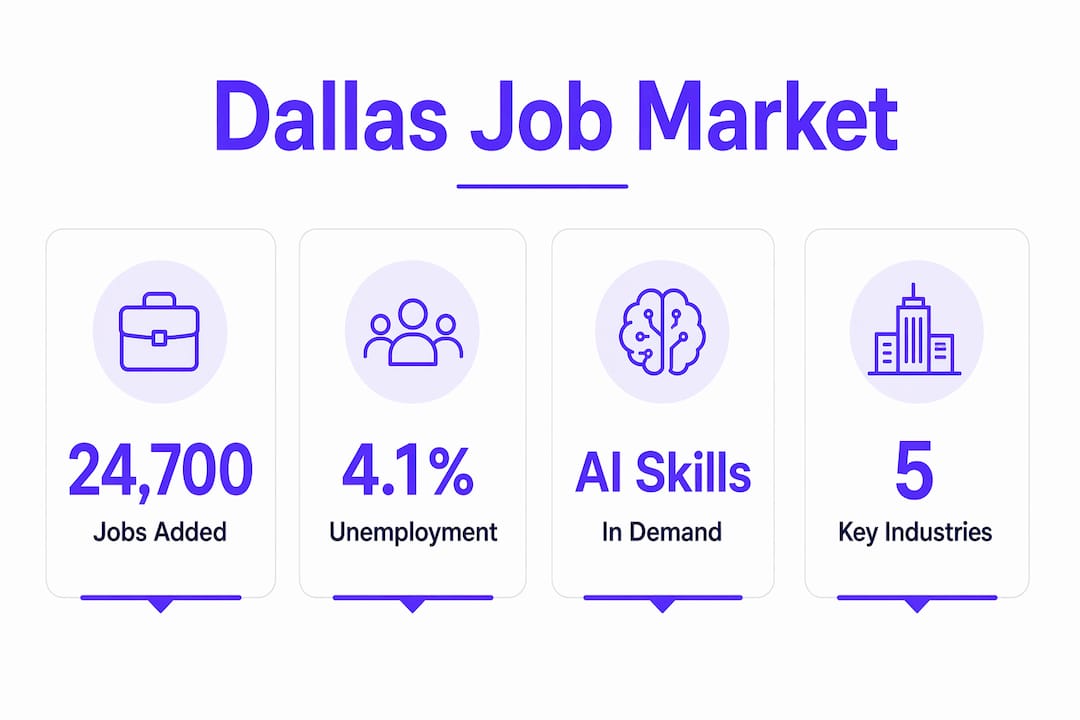
Dallas-Fort Worth added approximately 24,700 jobs in the year through May 2026, a 0.6% employment gain driven largely by Professional and Business Services. The local unemployment rate sits around 4.1%, below the national average, and employer confidence is running high heading into the second half of the year. Here is what that means for anyone planning a job search or career move in the Dallas metro right now.
At a glance:- Professional and Business Services led all sectors in job growth through mid-2026
- The DFW unemployment rate of 4.1% stays below the national average
- AI engineers and data center technicians rank among the fastest-growing roles in the region
- Wage growth slowed to 1.8% annually, well below the 3.4% national pace
- Nearly 80% of Dallas employers express confidence in their business outlook for 2026
How does the Dallas-Fort Worth job market break down by sector?
Professional and Business Services is the clear leader, but the picture across other sectors is more mixed. Construction is adding jobs, supported by affordable land and a deep pool of skilled trades workers. Healthcare continues its steady climb, driven by population growth across the metro. Manufacturing and information services, by contrast, are contracting, reflecting national trends in both industries.
Geographically, Dallas County tends to have higher candidate availability than more competitive suburban corridors, which matters if you are targeting specific employers or commute zones. Subregional differences are real enough that two job seekers pursuing the same title can face very different competition levels depending on where they focus.
The fastest-growing roles tell the clearest story about where the economy is heading. AI engineers, AI consultants, data center technicians, and construction inspectors are all seeing rapid demand growth tied directly to infrastructure investment and the region's push into AI-related industries. Data center technicians in particular link to the physical infrastructure that AI computing requires, making technical support skills unexpectedly valuable right now.
Sector snapshot: Professional and Business Services, construction, and healthcare are growing. Manufacturing and information are shrinking. AI-linked roles are the breakout category.*
What are the current wage trends for Dallas job seekers?
Wage growth in Dallas-Fort Worth has slowed considerably. Salary and wage growth came in at 1.8% annually, compared to the 3.4% national average. Total compensation costs rose 2.3%, which includes benefits, but the gap with national trends is hard to ignore.
This slowdown reflects wage compression: as the labor market cools from its post-pandemic highs, employers are finding they can fill roles at lower pay premiums than they offered in 2022 and 2023. For job seekers, that means the leverage you had two years ago has shrunk.
- Wage growth is running at roughly half the national rate
- Total compensation (wages plus benefits) rose 2.3%
- Roles requiring AI literacy still command premium pay despite the broader slowdown
- Negotiating above the posted range is harder now, but not impossible in high-demand fields
The practical takeaway: if you are in a field with genuine AI skill requirements, you are in a stronger negotiating position than the headline numbers suggest. If you are in a more commoditized role, expect employers to hold firm on compensation. Pro Tip: Before any salary negotiation, check current wage data by job title and percentile so you know exactly where the market sits, not where it was two years ago. *
How Salary Atlas helps you navigate Dallas salary data
Salary Atlas publishes wage data sourced directly from the U.S. Bureau of Labor Statistics, covering median pay, percentile ranges, and six-year trends by job title. Every figure links back to its original BLS source, and the data refreshes annually. There is no paywall, no signup required.
For Dallas job seekers, that transparency matters. When you are deciding whether to accept an offer or push back, you need numbers you can actually trust, not estimates from a platform with a financial interest in inflating them.
- Data sourced from the U.S. Bureau of Labor Statistics, the most authoritative wage source in the country
- Annual refreshes keep figures current as market conditions shift
- Covers hourly and annual rates, wage trends, and job outlook by occupation
- Free to access, with every figure linked to its original government source
Pro Tip: Use Salary Atlas to look up the median and 75th percentile for your target role before you apply. Knowing the 75th percentile gives you a defensible ceiling for negotiation. *
What is the hiring outlook for Dallas employers in 2026?
Employer confidence in Dallas is notably high. Nearly 80% of local employers express a positive business outlook, and over 50% plan to add permanent staff in early 2026 compared to their late-2025 headcount. That "pent-up demand" framing reflects easing inflation and a more stable economic environment after two years of uncertainty.
Temporary-to-permanent staffing is becoming a standard approach. Over 40% of employers plan to increase their use of short-term workers as a way to evaluate candidates before committing to permanent hires. For job seekers, that means contract and temp roles are increasingly a real path to full-time employment, not a consolation prize.
- Skills gaps affect around 50% of employer departments, driven by AI adoption
- AI literacy is the single most cited capability gap across industries
- Tech sector dependence introduces some vulnerability if AI investment cools
- Affordable housing and construction labor support continued economic expansion
The skills gap around AI is not limited to tech companies. Finance, healthcare, and professional services firms are all struggling to find workers who can operate AI tools effectively, which creates openings for candidates willing to build those skills now. *
What education and skills do growing Dallas sectors require?
The clearest divide in Dallas hiring right now runs between workers with AI-related skills and those without. Employers across finance, healthcare, and professional services are actively seeking candidates who can work with AI tools, interpret model outputs, and apply automation to real workflows. A formal AI certification from platforms like Coursera or Google helps, but demonstrated project experience often carries more weight.

Beyond AI, construction and infrastructure roles are growing fast and typically require trade certifications or associate degrees rather than four-year credentials. Data center technicians, for example, often enter through CompTIA A+ or network certifications. Healthcare roles from registered nursing to medical coding each carry their own licensing requirements, but the sector is actively hiring at every credential level.
For roles in Professional and Business Services, a bachelor's degree remains the standard floor, but employers increasingly weight specific tool proficiency, including Salesforce, Python, and data visualization platforms, alongside the degree itself.
*Who are the major employers and key industries in Dallas?
Dallas-Fort Worth hosts a dense cluster of Fortune 500 headquarters, including AT&T, American Airlines, and Texas Instruments. Financial services firms like Goldman Sachs and JPMorgan Chase have expanded their Dallas footprints significantly over the past five years. Toyota's North American headquarters in Plano brings automotive and supply chain employment to the northern suburbs.
Healthcare anchors a large share of local employment, with major systems like UT Southwestern Medical Center, Baylor Scott & White Health, and Texas Health Resources operating across the metro. The University of North Texas System, including UNT Dallas, contributes both direct employment and a pipeline of graduates entering the local workforce.
Technology and telecom, financial services, healthcare, logistics, and construction are the five industries that collectively define the Dallas employment base. Each is hiring in 2026, though at different rates and for different skill profiles.
*Where can you find jobs and build your network in Dallas?
LinkedIn remains the most effective single platform for professional roles in Dallas, particularly in finance, tech, and professional services. The Dallas Regional Chamber hosts regular networking events and publishes economic reports that help job seekers understand where hiring is concentrated. The North Texas Commission is another resource for tracking major employer expansions and relocations into the metro.
For trade and skilled labor roles, the Texas Workforce Commission operates local workforce centers across DFW that connect job seekers with employers and training programs. Staffing agencies with a Dallas presence are worth engaging directly, especially given that temp-to-permanent hiring is now a primary recruitment strategy for many employers.
University career centers, particularly through the UNT System, offer job boards and employer connections that extend beyond students to alumni. For salary benchmarking before any application or negotiation, Salary Atlas salary data by state and occupation gives you a grounded starting point.
*Key Takeaways
Dallas-Fort Worth's job market is growing steadily in 2026, with AI-linked roles and Professional and Business Services leading demand while wage growth trails the national average.
| Point | Details |
|---|---|
| Job growth is modest but positive | DFW added approximately 24,700 jobs through May 2026, a 0.6% gain. |
| Wage growth lags the nation | Local salary growth sits at 1.8% annually versus the 3.4% national average. |
| AI skills command a premium | Workers with AI literacy hold a clear advantage in salary negotiations across sectors. |
| Employer confidence is high | Nearly 80% of Dallas employers report a positive outlook, with over 50% planning permanent hires. |
| Temp-to-permanent is a real path | Over 40% of employers are increasing temporary staffing as a trial-before-hire strategy. |
FAQ
Does Dallas have a good job market?
Yes. Dallas-Fort Worth added approximately 24,700 jobs in the year through May 2026, and the unemployment rate of 4.1% sits below the national average, reflecting a healthy labor market with active hiring across multiple sectors.
Is it hard to find a job in Dallas, Texas?
It depends on your field. Professional and Business Services, healthcare, and construction are actively hiring, while manufacturing and information sectors are contracting. Dallas County also tends to have higher candidate availability than some suburban corridors, so competition varies by location.
What jobs are in demand in Dallas, TX?
AI engineers, AI consultants, data center technicians, and construction inspectors are among the fastest-growing roles in DFW right now. Healthcare positions and roles in Professional and Business Services also show consistent demand.
Is $80,000 a good salary in Dallas?
Dallas has no state income tax and relatively affordable housing compared to coastal metros, so a solid mid-level professional salary provides good purchasing power for most households. Whether it is competitive depends on the role: for many mid-level professional positions, salaries often sit near or above the median, but AI-specialized and senior finance roles typically pay well above that figure.