Recruiter Salary in 2026: What U.S. Job-Seekers Need to Know

The median advertised recruiter salary in the United States sits at $72,821, with the middle 50% of listings falling between $61,193 and $87,500. That range widens considerably once bonuses and commission hit the picture.
Three key factors move recruiter pay more than anything else:
- Experience and title level — senior recruiters typically earn significantly more than entry-level associates in the same market
- Industry — tech, finance, and life sciences pay meaningfully above the national median
- Location — metros like New York, San Francisco, and Seattle carry significant premiums over the national figure
Base salary is only part of the story. Agency recruiters often earn commission that can double their base. In-house recruiters typically get a smaller bonus, but equity and benefits close some of that gap. Keep both numbers in mind as you read.
Table of Contents
- What does the average recruiter salary look like across the full range?
- How does recruiter pay vary by experience and title?
- Which industries pay recruiters the most?
- How do you actually increase your recruiter pay?
- Where do these salary figures come from?
- Key Takeaways
- The number that matters most is the one you negotiate
- Salary Atlas gives you the data to negotiate with confidence
- FAQ
What does the average recruiter salary look like across the full range?
The median and the average tell different stories, and both matter. Indeed's aggregated data from thousands of reported salaries puts the average recruiter base pay at about $69,548, with a wide range of reported salaries. That wide spread reflects how much title, industry, and commission structure vary across the field.
Recruiter Roles' July 2026 report focuses on advertised listings rather than self-reported figures, which tends to produce a slightly higher median, with data showing a broad range across percentiles. Robert Half's guidance, based on actual placements and validated posting data, reports a national salary range that varies by experience and skill set.One important distinction: advertised salaries (what employers post) tend to run higher than incumbent salaries (what current employees actually earn). The Indeed figure reflects what people report earning; the Recruiter Roles figure reflects what employers are currently offering. Neither is wrong. They measure different things, and both are useful benchmarks.
How does recruiter pay vary by experience and title?
The gap between an entry-level recruiter and a senior one is not subtle. Here is how common titles map to typical base ranges:
| Title | Typical Base Range | Total Comp Notes |
|---|---|---|
| Associate / Entry-Level Recruiter | $45,000–$60,000 | Limited bonus; commission rare |
| Recruiter (mid-level) | $60,000–$78,000 | Small annual bonus; some commission in agency roles |
| Senior Recruiter | $78,000–$100,000 | Bonus common; commission possible |
| Technical Recruiter | $80,000–$110,000 | Premium for specialized pipelines |
| Recruiting Manager | $80,000–$105,000 | Overlaps with senior IC pay; team bonus typical |
| Executive / Executive Search Recruiter | $100,000–$150,000+ | Commission-heavy; retained search adds upside |
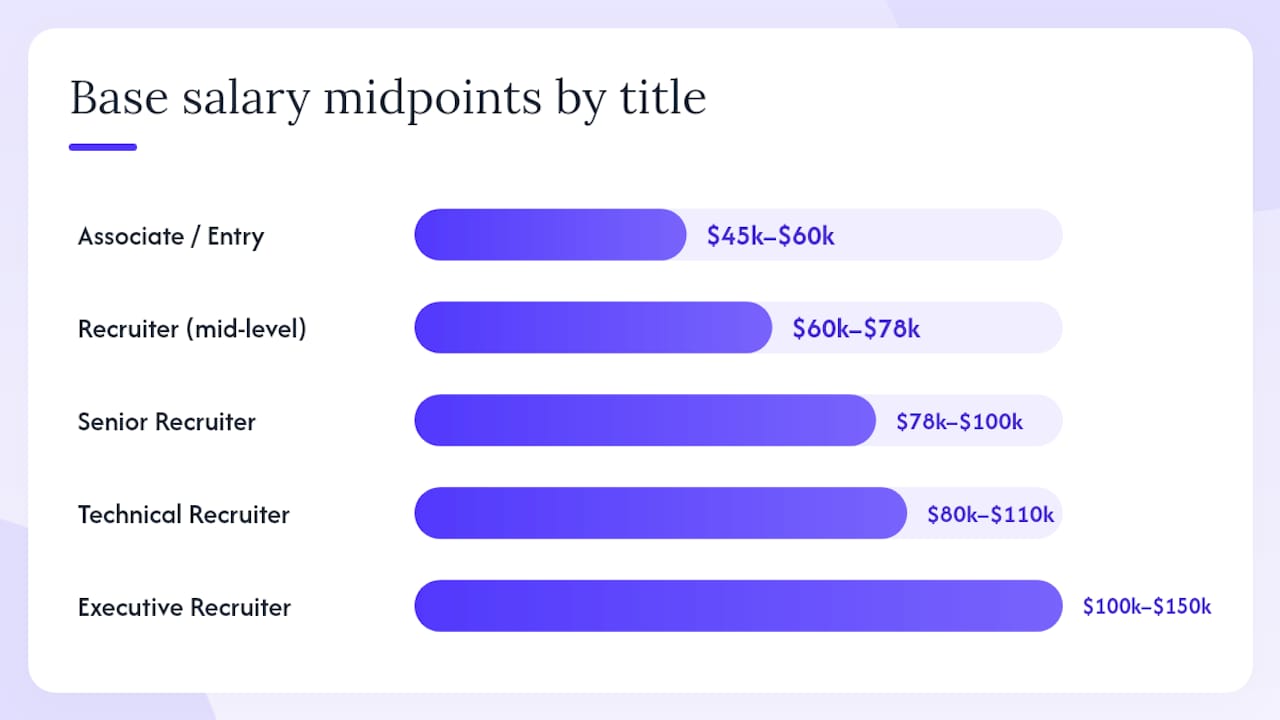
The Recruiter Roles report puts manager-level listings at a median salary that overlaps with strong senior individual-contributor pay. That overlap is worth knowing: a senior recruiter who fills a high-volume pipeline can out-earn a manager who spends most of their time in meetings.
Technical recruiters sit in a category of their own. Placing software engineers, data scientists, or security professionals requires domain fluency that most generalist recruiters lack, and employers pay for it. The base premium for technical specialization over a generalist recruiter role is typically meaningful, though the exact delta varies by market and company size.
Which industries pay recruiters the most?
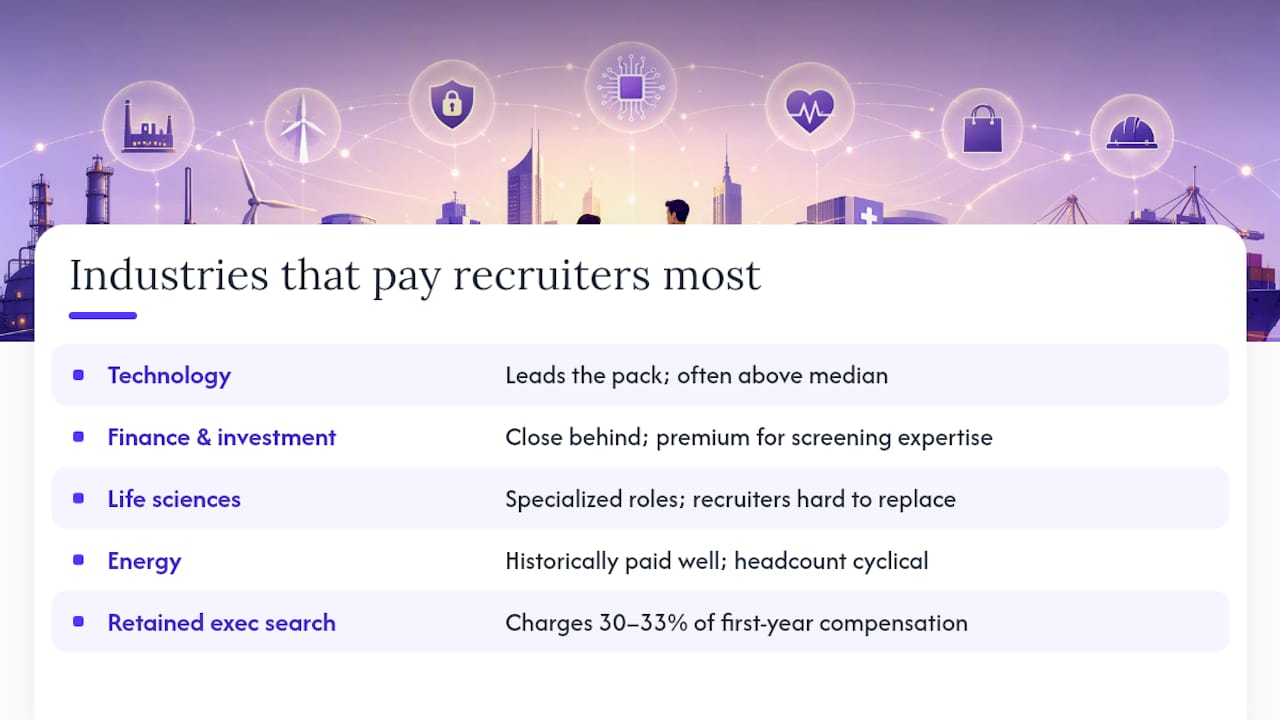
Industry is one of the clearest predictors of recruiter pay, and the logic is straightforward: the harder the role is to fill and the more revenue that hire generates, the more the employer will pay someone to fill it.
Technology leads the pack. Demand for software engineers, machine learning specialists, and product managers consistently outpaces supply, and tech companies have the margins to pay recruiters accordingly. In-house technical recruiters at enterprise tech firms and high-growth startups regularly earn above the national median, often with equity on top. Finance and investment management come close behind. Recruiting for trading desks, private equity, or quantitative research requires understanding the roles deeply enough to screen credibly. That expertise commands a premium. Life sciences and pharmaceuticals present a similar dynamic. Regulatory expertise, clinical trial knowledge, and the complexity of scientific roles make specialized recruiters genuinely hard to replace. Energy, particularly oil and gas, has historically paid well for technical recruiting, though market cycles affect headcount demand more than in other sectors. Retained executive search sits at the top of the pay scale across all industries. Firms that work on retained mandates for C-suite and VP-level placements typically charge 30–33% of first-year compensation. The recruiters running those searches earn accordingly.Levels.fyi tracks compensation at high-growth tech companies and often shows recruiter pay at the top end of the market, particularly for senior in-house roles at companies with aggressive hiring targets. That data is useful context for understanding the ceiling, even if it does not reflect the median.
How do you actually increase your recruiter pay?
Knowing the ranges is useful. Knowing how to move within them is better.
- Benchmark before you negotiate — Pull current figures from Indeed, Robert Half, and Salary Atlas before any conversation. Walk in with a specific number, not a vague sense that you deserve more.
Pro Tip: In a raise conversation, lead with revenue-per-hire or offer acceptance rate rather than years of experience. Tenure is a weak argument; measurable business impact is not.
Where do these salary figures come from?
Every figure in this article comes from a named, publicly accessible source. Here is what each one contributes and how to read it:
- Indeed aggregates self-reported salaries from current and former employees. Their recruiter figure ($69,548 average) reflects incumbent pay from roughly 16,800 submissions over 36 months, updated July 2026. It is the best proxy for what people are actually earning today.
- Recruiter Roles analyzes advertised job listings, not self-reports. Their July 2026 median of $72,821 reflects what employers are currently offering, which tends to run slightly higher than incumbent figures.
- Robert Half combines placement data with validated posting data to produce a national range ($66,000–$89,750 for 2026). Their methodology is grounded in actual hiring transactions, which gives it a different kind of validity.
- Coursera summarizes figures from multiple platforms and notes that Glassdoor's total-pay median (including bonuses and commissions) runs near $110,000, illustrating how much variable pay inflates platform figures.
- Glassdoor is a widely used crowdsourced platform that mixes base and total compensation in its medians. Useful for total-comp context, but always check whether a figure is base-only or all-in.
- Levels.fyi tracks compensation at high-growth tech companies and is most useful for understanding the top end of the market, particularly for in-house technical recruiters at major tech employers.
- Salary Atlas sources its figures from the Bureau of Labor Statistics Occupational Employment and Wage Statistics (OEWS) survey, supplemented by job-posting data. The Salary Atlas methodology page explains how BLS categories are mapped to job titles, which percentiles are reported, and how advertised and incumbent figures are treated separately. Every figure links back to its original source, and data is refreshed annually.
All figures in this article are base salary unless explicitly noted as total compensation.
Key Takeaways
U.S. recruiter pay centers on a median advertised base of $72,821, but total compensation regularly reaches between $87,200 and $110,000 once bonuses, commission, and equity are included.
| Point | Details |
|---|---|
| Median advertised base | $72,821 nationally (July 2026); middle 50% of listings fall between $61,193 and $87,500. |
| Experience drives the biggest jump | Entry-level roles start near $45,000–$60,000; senior and technical recruiters reach $78,000–$110,000. |
| Agency vs. in-house changes the ceiling | Commission-based agency roles can push total comp well above base; in-house roles trade upside for stability and equity. |
| Location adds a real premium | New York listings median $85,000; remote roles median $71,838 — geography still moves the number. |
| Salary Atlas for state-level detail | Salary Atlas provides BLS-backed, no-paywall state and title medians with transparent sourcing. |
The number that matters most is the one you negotiate
Most recruiter salary guides stop at the median and call it a day. The median is a starting point, not a destination. What strikes me about the 2026 data is how wide the spread actually is: Indeed's reported range runs from $32,717 to $147,839 for the same job title. That is not noise. That is the difference between a generalist coordinator at a small nonprofit and a technical recruiter closing software engineering roles at a Series B startup with equity.
The readers who get the most out of this data are the ones who treat it as a negotiation map, not a report card. If you are sitting at the 25th percentile, the question is not "is this normal?" It is "which of these factors can I change in the next 12 months?" Specialization, a move to a commission desk, or a geographic shift to a higher-paying market can each move you a full percentile band in a single job change.
Salary Atlas's BLS-backed data is particularly useful here because it separates advertised pay from incumbent pay and shows state-level medians without hiding them behind a paywall. When you are evaluating an offer, cross-reference the employer's number against the Salary Atlas state data for your market. The five minutes it takes can be worth thousands of dollars.
Salary Atlas gives you the data to negotiate with confidence
Recruiter pay varies by tens of thousands of dollars depending on where you work, what you specialize in, and whether you know what the market is actually paying. Salary Atlas gives you BLS-sourced salary data by job title, percentile, and state, with no paywall and no signup required. Every figure links back to its original source so you can verify it yourself.
Whether you are evaluating an offer, preparing for a raise conversation, or benchmarking a new hire, the Salary Atlas salary database gives you the numbers you need in under a minute. Check the current median, see the full percentile range, and walk into your next negotiation with a specific, sourced figure in hand.
FAQ
What type of recruiter makes the most money?
Executive search recruiters and technical recruiters in high-demand fields like software engineering, AI, and quantitative finance consistently earn the most. Retained executive search roles carry the highest commission potential, while in-house technical recruiters at major tech firms often add equity that pushes total compensation well above the national median.
Is recruiting a high-paying job?
It can be. The median advertised base sits at $72,821, but total compensation for experienced agency recruiters or technical specialists regularly reaches $110,000 or more once commissions, bonuses, and equity are included. Pay depends heavily on specialization, industry, and whether the role is commission-based.
Can recruiters make 7 figures?
A small number of top-performing retained executive search recruiters do reach seven-figure annual earnings, but it requires years of relationship-building, a strong track record in senior placements, and typically ownership or a senior partnership stake at a search firm. For most recruiters, the realistic ceiling is $150,000+ in total compensation.
What is the highest-paid recruiter title?
Executive recruiter or partner at a retained search firm sits at the top of the pay scale, followed by senior technical recruiters and recruiting directors at enterprise tech companies. The Salary Atlas HR Manager salary page shows how senior HR and talent leadership roles compare for additional context.
How do I find accurate recruiter salary data for my state?
Salary Atlas provides BLS-sourced salary medians by state and job title without a paywall. Cross-reference that with Indeed's self-reported averages and Robert Half's placement-based ranges to get a complete picture of what the market is paying in your specific location.