Software Developer Salary in 2026: What Pay Actually Looks Like
Explore the software developer salary landscape in 2026, with insights on medians, percentiles, and factors influencing pay. Get detailed data!
By the Salary Atlas editorial team · Published

The national median for software developers sits around $130,160 a year, according to BLS OEWS data, with the middle range spanning roughly $99,800 to $208,620 between the 10th and 90th percentiles. That's a wide spread, and it's wide on purpose. Experience level, metro area, industry, and how a company structures bonuses and equity all push individual pay far above or below that midpoint.
TL;DR:
- Developers in high-cost metros like San Jose, San Francisco, and Seattle can earn significantly more than the national median, often exceeding the 90th percentile.
- Location, industry, and specialization each contribute more to pay differences than programming language alone, with niche skills like machine learning commanding premiums.
- Total compensation can differ from base salary due to bonuses and equity, with stock options potentially increasing earnings substantially despite lower initial figures.
- When negotiating, verify your specific percentile based on role, experience, and location, and factor in taxes and cost of living to determine real take-home pay.
Table of Contents
- What Is the Average Software Developer Salary in the US?
- Software Developer Salary by Experience Level
- Which US Cities Pay Software Developers the Most?
- Which Industries and Specializations Pay Developers More?
- Base Salary vs. Total Compensation: What's the Real Number?
- How Do You Use Salary Data to Negotiate a Better Offer?
- Does a Degree or Certification Change Software Developer Pay?
- How Has Remote Work Changed Software Developer Salaries?
- How Much More Do Python, Java, or Go Developers Earn?
- Startup Pay vs. Big Tech: Which Pays More?
- What This Salary Data Actually Means for Your Next Move
- Sources
- FAQ
What Is the Average Software Developer Salary in the US?
The median software developer salary in the US lands at $130,160 annually, per BLS OEWS figures. US News reports a slightly higher median of about $133,080, while aggregator platforms tracking total pay, including bonuses, show a median closer to $123,000. The gap between these numbers isn't a contradiction. Each source measures something a little different: base salary alone, base plus reported bonuses, or self-submitted totals that skew toward certain company types.
The number that matters most for benchmarking: the 10th to 90th percentile range of $99,800 to $208,620 tells you more than any single average. A developer at the 25th percentile and one at the 75th percentile aren't in different professions, they're often in different cities or different years of experience.Quick takeaways:
- Median: ~$130,160 (BLS) to ~$133,080 (US News)
- 10th percentile: roughly $99,800
- 90th percentile: roughly $208,620
- Figures refresh annually as new wage surveys are published
Software Developer Salary by Experience Level
Years on the job move the needle more than almost any other factor early in a career, then the curve flattens once someone reaches senior status and other levers (company size, specialization, negotiation) take over.
- Entry level (0 to 1 year): Junior developers and new graduates typically land near or below the 10th percentile, often in the $70,000 to $95,000 range depending on region.
- Early career (1 to 4 years): Titles like software engineer II or associate developer usually track toward the 25th to 40th percentile, commonly $95,000 to $120,000.
- Mid career (5 to 9 years): This band roughly maps to the national median, often $125,000 to $150,000 for senior software engineer or lead developer titles.
- Senior and beyond (10+ years): Principal engineers, staff engineers, and engineering managers frequently sit at the 75th to 90th percentile, often $170,000 and up before equity.
Which US Cities Pay Software Developers the Most?
Location shifts a developer's paycheck more than almost anything short of a promotion. The Bay Area and Seattle metros report pay tens of thousands of dollars above the national median, and that gap holds up whether you're looking at entry-level offers or senior packages.
- San Jose and San Francisco: Consistently the highest-paying metros, driven by concentrated demand from large tech employers and venture-backed startups.
- Seattle: Anchored by major cloud and e-commerce employers, with pay that regularly outpaces the national median by a wide margin.
- New York City: Strong finance-sector demand for developers pushes pay above average, especially in fintech and trading firms.
- Boston: A mix of biotech, health tech, and established software firms keeps salaries competitive, if a notch below the West Coast hubs.
The 10th to 90th percentile bracket of roughly $99,800 to $208,620 nationally compresses or expands depending on where you're standing. In San Jose, even the lower end of that range often looks different than in a mid-sized Midwest city.

Which Industries and Specializations Pay Developers More?
Industry choice moves pay almost as much as location does, and it's a lever a lot of job seekers underuse. Streaming and media platforms, along with finance, consistently pay above the general average for developer roles, largely because these companies compete directly with each other for a small pool of engineers who can handle high-scale, high-stakes systems.
Specialization matters just as much as industry:
- Machine learning and AI: Demand has outpaced the supply of engineers who can build and deploy production ML systems, and pay reflects that scarcity.
- Cloud infrastructure: Engineers who can design and manage large-scale cloud systems command a premium, especially at companies migrating legacy systems.
- Security engineering: Specialized security roles routinely pay above general software development because the skill set is narrower and the stakes of getting it wrong are higher.
Base Salary vs. Total Compensation: What's the Real Number?
Base salary is only one piece of what shows up in a developer's bank account over a year. Total compensation typically includes base pay, an annual performance bonus, sometimes a signing bonus, equity in the form of RSUs or stock options, and benefits like health coverage and retirement matching. Bonuses and equity can materially change the total number, sometimes closing what looks like a big gap between two base salaries.
The number to watch: a $10,000 to $20,000 difference in base salary between two offers often matters less than how equity vests over four years.Here's a simplified comparison:
- Offer A: $135,000 base, $5,000 annual bonus, no equity. Predictable, easy to calculate, total comp of roughly $140,000 a year.
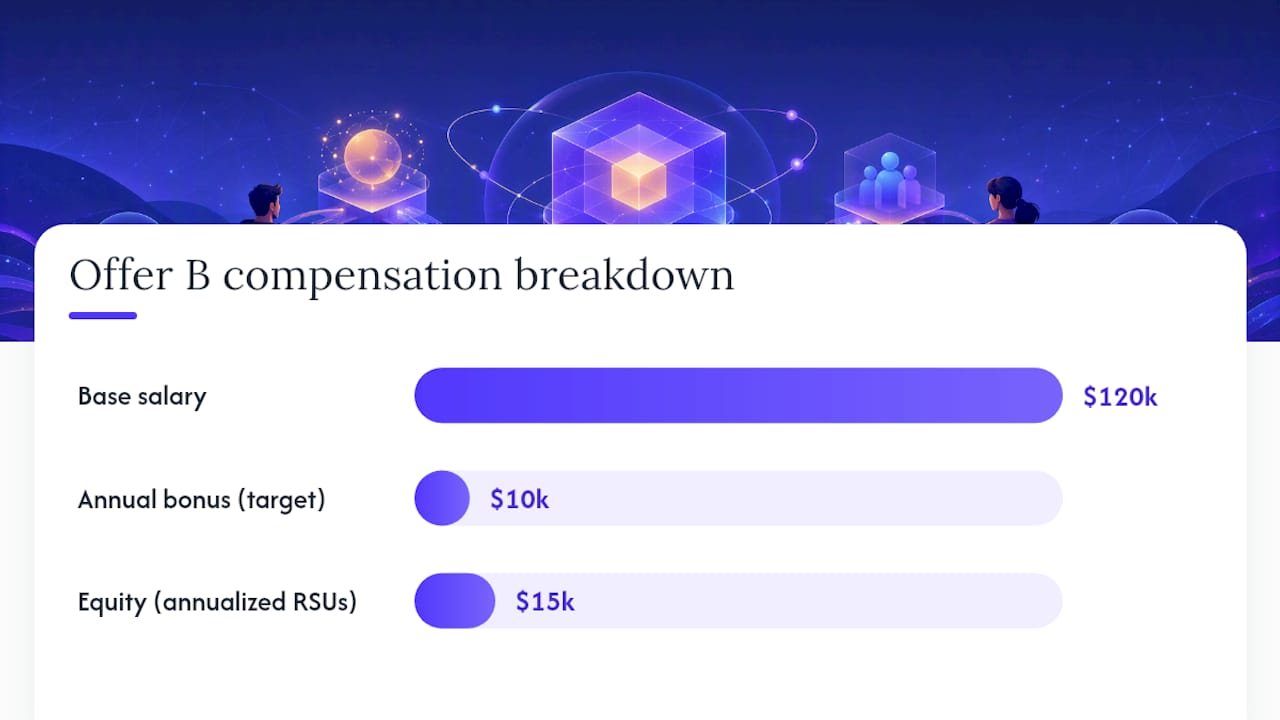
- Offer B: $120,000 base, $10,000 target bonus, $60,000 in RSUs vesting over four years. Annualized, that's roughly $145,000 in year one, assuming the bonus target is hit and the stock price holds steady.
How Do You Use Salary Data to Negotiate a Better Offer?
Benchmarking data only helps if you use it correctly during an actual negotiation. Here's the practical sequence:
- Verify the role and percentile. Match the job title and seniority level to the right percentile band, not just the national median. A "senior software engineer" title at a 200-person startup may map to a different percentile than the same title at a company with 50,000 employees.
- Convert to estimated take-home pay. Factor in state income tax, retirement contributions, and health premiums before comparing two offers with different base salaries.
- Prepare evidence and a specific ask. Bring a number, not a range. Recruiters respond better to "I'm looking for $145,000 based on market data for this role in this metro" than to a vague request for "more."
For developers actively job hunting, a resume that clears automated screening matters as much as the negotiation itself. ATS-optimized resume guidance can help make sure your application gets to a human in the first place.
Does a Degree or Certification Change Software Developer Pay?
A four-year computer science degree remains the most common credential among working developers, but it's no longer the only path that leads to a competitive salary. Bootcamp graduates and self-taught developers with a strong portfolio increasingly land roles at the same starting pay bands as CS grads, particularly at startups and mid-sized companies that weigh demonstrated skill over pedigree.
Where a degree still carries clear weight is at the extremes: large tech employers and some finance firms use degree requirements as an initial filter for entry-level roles, and a master's degree in computer science or a related field can help someone break into specialized areas like machine learning research faster than self-study alone. That said, a master's degree rarely commands a flat salary premium by itself. What raises pay is what the credential unlocks, whether that's an ML specialization, a research role, or eligibility for a company's more selective engineering track.
Certifications behave differently than degrees. Cloud certifications tied to specific platforms can nudge pay upward for infrastructure and DevOps roles because they signal a specific, verifiable skill set that hiring managers can map directly to a job requirement. Generic programming certifications carry far less weight. The pattern holds across most of the market: credentials that prove you can do a specific, in-demand task move the needle, while credentials that just prove general competence rarely do on their own. Experience and a working portfolio still outperform a stack of certificates when it comes to actual offer numbers.
How Has Remote Work Changed Software Developer Salaries?
Remote work reshuffled the geographic pay map rather than flattening it. In the years after fully remote hiring became normal, some companies adjusted salaries based on where an employee lived, paying San Francisco rates to someone in San Francisco and lower rates to someone in a cheaper metro doing the identical job. Other companies moved to a single national pay band regardless of location, which effectively raised pay for developers outside the traditional hubs and left hub-based salaries roughly flat.
Neither approach fully won out. Large tech employers still tend toward location-adjusted pay, while many mid-sized and remote-first companies have settled on national or regional bands that ignore your specific zip code. That split matters when you're evaluating a remote offer: ask directly whether the company adjusts pay by location, and if so, which cost-of-living index they use, since that answer changes what a "competitive" number looks like for your situation.
The bigger shift is on the demand side. Remote roles widened the applicant pool for any given opening, which increased competition for the most attractive remote positions, particularly ones with strong pay and flexible hours. That competition hasn't erased the salary premium in top metros, but it has made it easier for a developer in a lower cost-of-living area to access big-company pay without relocating, provided they can compete with a national, not just local, applicant pool.
How Much More Do Python, Java, or Go Developers Earn?
Programming language alone rarely sets someone's salary the way experience level or location does, but it correlates with pay in a real and fairly consistent way, because certain languages cluster around higher-paying specializations and industries.
Developers working primarily in Python often skew toward data science, machine learning, and backend infrastructure roles, which tend to pay at or above the median given how tightly Python is tied to AI-adjacent work right now. Go and Rust developers frequently work on infrastructure, cloud platforms, and performance-critical systems, areas that already command premiums for the specialized skill set involved rather than for the language itself. Java and C# remain common in large enterprise environments, including finance and insurance, where pay is steady and often above average but rarely at the very top of the range.
JavaScript and its frameworks sit at the center of front end developer salary and web developer salary conversations, since nearly every company building a web product needs someone who can work in that ecosystem. Pay here varies enormously by company type: a front end developer at a small agency earns meaningfully less than one on a product team at a well-funded tech company, even with identical language skills. For anyone weighing a front end versus backend or infrastructure path, comparing web developer pay directly against broader software developer salary trends is a useful gut check before committing to a specialization.
The honest takeaway: language choice is a proxy for the kind of work you'll do and the industry you'll likely end up in, not a direct salary lever on its own.
Startup Pay vs. Big Tech: Which Pays More?
Company size changes not just the number on the offer letter but the shape of the whole compensation package. Large, established tech employers typically offer higher base salaries, predictable bonus structures, and equity in the form of RSUs, which have real, liquid value tied to a public stock price. That predictability is a major reason experienced developers gravitate toward big tech once they have a mortgage or a family to plan around.

Startups often can't match that base salary, especially at the seed or Series A stage, but they compensate with stock options that carry significant upside if the company succeeds, along with faster promotion cycles since smaller teams create more visible opportunities to take on bigger responsibility early. The catch is real: most startup equity ends up worth far less than the paper value suggests, and some of it ends up worth nothing at all if the company doesn't reach a successful exit. A developer evaluating a startup offer should treat any equity number as a lottery ticket, not a guaranteed addition to base pay.
Mid-sized companies, meaning ones past the startup stage but not yet massive, often land in between: base pay that's competitive but not top-tier, plus equity that's harder to value than a public company's stock but generally less speculative than an early-stage startup's options. If predictable pay matters most to you right now, weight base salary and bonus heavily. If you can tolerate risk for a shot at bigger upside, a startup's total comp story looks different than its base salary alone would suggest, and it's worth pressure-testing the equity terms specifically, including strike price and vesting cliffs, before treating any number as real income.
What This Salary Data Actually Means for Your Next Move
The number most job seekers fixate on, the single national median, is the least useful figure in this entire article. It's a starting point for a conversation, not an answer. What the research behind this piece actually supports is a more layered read: your realistic pay band depends far more on the combination of metro area, years of experience, and industry than on any one of those factors alone.
Where conventional advice falls short is in treating salary data as static. Most guides quote a number and stop there, without acknowledging that the 10th to 90th percentile spread of roughly $99,800 to $208,620 exists precisely because those factors interact. A developer who specializes in cloud infrastructure and works in finance in New York isn't just adding three separate bonuses to a base number. They're stacking premiums that compound.
If you take one thing from this, prioritize verifying your actual percentile before you negotiate anything. Too many developers anchor to a national median that has nothing to do with their metro, their specialization, or their actual market value. Get specific first. Everything else, including the negotiation script, only works once that number is right.
, Joelen Zyoktova
Sources
Every figure in this article traces back to a named source, and that's deliberate. Salary Atlas builds its salary pages primarily on BLS Occupational Employment and Wage Statistics (OEWS) data, which measures wages across a large national sample and reports median, mean, and percentile breakdowns by occupation.
- Software Developer Salary 2026: What You Actually Keep | CalcFi
- Software Developer Salary | US News Best Jobs
- Software Developer Salary Guide (2026) | Coursera
FAQ
What Engineer Makes $500,000 a Year?
Engineers earning total compensation well above the 90th percentile national figure of roughly $208,620 are typically staff or principal engineers at large, publicly traded tech companies, where a big share of that total comes from vested RSUs rather than base salary alone. This reflects a rare combination of seniority, high-value equity grants, and a top-paying employer.
Is $75,000 a Good Salary for a Software Developer in the US?
A salary generally near or slightly below the 10th percentile for software developers nationally is typical for an entry-level role or a lower cost-of-living metro. Whether it's "good" depends heavily on your location and experience level, since take-home pay varies significantly based on state income tax and cost of living.
What Is the Salary of a Developer With 5 Years of Experience?
A developer with five years of experience typically lands near the national median, commonly in the $125,000 to $150,000 range depending on location and specialization. This period often maps to titles like senior software engineer, and it's also when switching employers tends to produce the largest single pay jump in a career.
Who Is the Highest-Paid Software Engineer?
There's no single publicly verified record for the single highest-paid software engineer, since most top compensation packages at large tech companies aren't disclosed individually. What's well documented is that the highest earners are almost always staff or principal-level engineers at major tech employers, where equity compounds base pay well beyond the 90th percentile bracket.
How Often Does This Salary Data Get Updated?
Salary Atlas refreshes its figures annually as new BLS OEWS survey data becomes available, and every number links back to its original source so you can verify it yourself.
Recommended
Occupation wage figures on Salary Atlas come from the U.S. Bureau of Labor Statistics. Figures in this article that are not linked to a source are estimates. See our methodology.