Boeing Executives Salaries: A 2026 Analyst's Guide
 *
*
TL;DR:>
- Boeing executive pay combines a modest base salary with large performance-based incentives, equity awards, and bonuses. In 2025, the CEO's total compensation increased 28% mainly due to stock awards and incentive pay, reflecting recovery efforts and retention strategies. Most of their pay consists of unvested equity, aligning leadership interests with shareholder value over several years.*
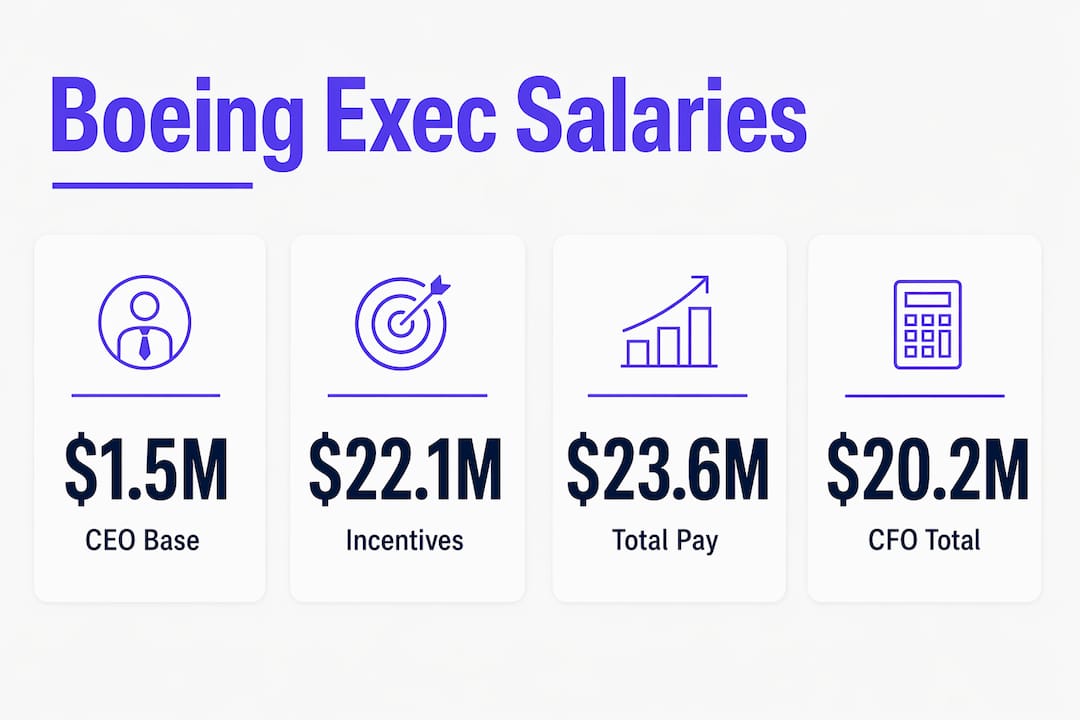
Boeing executive compensation is defined as a structured package combining a modest base salary with large performance-based incentives, equity awards, and retention bonuses. Boeing executives salaries are not simple fixed figures. CEO Kelly Ortberg received $23.6 million in total 2025 compensation, a 28% increase from 2024. That headline number reflects stock awards and incentive pay far more than base salary. For analysts and professionals studying corporate pay practices, Boeing's proxy statement is the authoritative source for understanding how leadership salaries are built, justified, and tied to shareholder value.
What are the key components of Boeing executives' total compensation?
Boeing executive pay is not a single salary line. It is a layered structure where base salary represents only a fraction of total reported compensation.
The 2025 CEO base salary was $1.5 million. The remaining $22.1 million came from incentive pay, performance stock units, and other compensation. That ratio tells you everything about Boeing's pay design philosophy.
The CFO's structure follows the same pattern. Boeing's CFO carried a base salary of $399,808 while total compensation reached approximately $20.2 million, driven by stock awards and a hiring bonus. The gap between base and total is not an anomaly. It is the intended design.
The main components of Boeing executive compensation packages include:
- Base salary: Fixed annual cash, ranging from roughly $400,000 for the CFO to $1.5 million for the CEO
- Annual incentive bonus: Cash bonus tied to short-term operational and financial targets
- Long-term equity awards: Performance stock units and restricted stock units that vest over multi-year schedules
- Other compensation: Security costs, retirement contributions, and benefits
| Executive Role | Base Salary | Total 2025 Compensation | Primary Driver |
|---|---|---|---|
| CEO (Kelly Ortberg) | $1,500,000 | $23,600,000 | Stock awards and incentive pay |
| CFO | $399,808 | $20,200,000 | Stock awards and hiring bonus |
| Other named executives | Not publicly listed | Varies | Equity and performance bonuses |
Pro Tip: When reviewing Boeing's Summary Compensation Table, always check the "Stock Awards" column separately. It typically accounts for the largest share of total reported pay and is the most variable component year to year.
How have Boeing executive salaries changed in recent years?
Boeing executive pay has risen sharply as the company moves through an operational recovery phase. The increases are not arbitrary. They reflect deliberate retention decisions tied to leadership milestones.

CEO Kelly Ortberg's total compensation rose 28% from 2024 to 2025, moving from $18.4 million to $23.6 million. That increase is significant even by large-cap aerospace standards. The board structured the increase around equity grants and incentive payouts that only materialize if performance targets are met.
Key compensation shifts across Boeing's leadership tier include:
- CEO total pay increased by approximately $5.2 million year over year, with most of the gain in stock awards
- CFO total compensation reached $20.2 million, heavily influenced by a hiring bonus designed to attract and retain finance leadership
- Pay increases across the named executive officer group reflect operational recovery and retention strategies during a period of significant aerospace industry pressure
The retention motive is real. Boeing faced labor disruptions, regulatory scrutiny, and production challenges in 2023 and 2024. Boards at companies in recovery mode routinely front-load equity grants to keep leadership stable. Boeing's compensation committee made the same calculation.
Statistic callout: Boeing CEO total compensation of $23.6 million in 2025 represents a 28% single-year increase, a figure that only makes sense when viewed against the backdrop of a company rebuilding production capacity and restoring investor confidence.
Analysts should resist reading these increases as simple salary inflation. Executive pay growth tied to operational recovery milestones is structurally different from a cost-of-living raise. The equity component only pays out if the company delivers.
What is Boeing's executive compensation philosophy?
Boeing's board designs executive pay to align leadership behavior with long-term shareholder value. The compensation committee ties incentive payouts to operational safety, quality improvements, and financial recovery metrics.
"Boeing's proxy statement emphasizes long-term equity compensation tied to operational safety, quality improvements, and financial recovery metrics. The compensation committee aligns pay to operational and financial goals that directly affect incentive payouts."
This equity-heavy design serves a specific purpose. When executives hold large unvested stock positions, their personal financial outcomes depend on the same metrics that matter to shareholders: stock price, earnings, and operational performance. Boeing's board uses this structure to ensure executives have skin in the game beyond their annual cash salary.
The performance metrics that affect incentive payouts at Boeing include production rate targets, safety and quality benchmarks, free cash flow generation, and customer delivery schedules. Missing any of these can reduce or eliminate variable pay. That creates a direct financial consequence for underperformance.
Pro Tip: The "Pay Versus Performance" section of Boeing's proxy is legally mandated and shows the relationship between compensation actually awarded and company financial results. Read it alongside the Summary Compensation Table to get a complete picture of how pay and performance correlate.The Pay Versus Performance disclosure is not optional. The SEC requires it. It shows whether the compensation committee's stated philosophy actually shows up in the numbers. For Boeing, this section is particularly telling during recovery years when reported pay rises while the company is still rebuilding profitability.
Boeing's equity-heavy compensation design aligns executive interests with shareholder value creation over multiple years. That is the stated goal. Whether it succeeds depends on how rigorously the board enforces performance conditions before vesting.
How can analysts interpret Boeing's proxy disclosures?
Boeing's proxy statement contains several distinct pay disclosures. Reading only the Summary Compensation Table gives you an incomplete picture of Boeing leadership salaries.
The most important distinction is between reported total compensation and realized pay. Reported compensation includes unvested equity at grant-date value. Realized pay reflects what executives actually received in cash and vested stock during the year. These two numbers can differ by millions of dollars. An executive can appear highly paid on paper while receiving far less in actual value if stock prices fall or performance conditions are not met.
Key proxy sections analysts should examine:
- Summary Compensation Table: Reports base salary, bonus, stock awards, option awards, and other compensation for named executive officers
- Pay Ratio disclosure: Compares CEO pay to median employee pay, a mandatory figure that reflects internal pay equity and governance priorities
- Pay Versus Performance section: Shows the relationship between executive pay and company metrics, required by SEC rules
- Grants of Plan-Based Awards table: Details the specific equity grants made during the year, including performance conditions and vesting schedules
| Proxy Section | What It Shows | Why It Matters |
|---|---|---|
| Summary Compensation Table | Reported total pay at grant-date value | Starting point, not the full picture |
| Pay Ratio | CEO pay versus median employee wage | Signals internal equity and governance stance |
| Pay Versus Performance | Correlation between pay and company results | Tests whether the philosophy holds in practice |
| Grants of Plan-Based Awards | Specific equity grants and conditions | Reveals actual performance hurdles for payout |
Analysts who rely on financial analyst salary benchmarks to contextualize their own compensation will recognize this framework. The same principle applies at the executive level: reported figures require context before they carry meaning. Pro Tip: Always cross-reference the Summary Compensation Table with the Grants of Plan-Based Awards table. The grant-date value of stock awards in the Summary Compensation Table assumes target performance. If Boeing misses its targets, actual payouts will be lowed.
Key Takeaways
Boeing executive compensation is dominated by equity and performance-based incentives, making base salary a poor proxy for actual total pay.
| Point | Details |
|---|---|
| Base salary is a small fraction | CEO base pay was $1.5 million versus $23.6 million in total 2025 compensation. |
| Equity drives total pay | Stock awards and performance units account for the majority of Boeing executive compensation. |
| Pay increased 28% in 2025 | CEO total compensation rose from $18.4 million to $23.6 million, tied to operational recovery. |
| Reported pay differs from realized pay | Unvested equity at grant-date value inflates reported figures; actual payouts depend on vesting and performance. |
| Proxy disclosures are the primary source | The Summary Compensation Table, Pay Ratio, and Pay Versus Performance sections provide the full analytical picture. |
Boeing's pay structure rewards patience, not just performance
The most common mistake analysts make with Boeing executive pay is treating the headline total compensation figure as equivalent to a salary. It is not. The $23.6 million reported for CEO Kelly Ortberg in 2025 includes equity that has not vested and may never fully vest if performance conditions are not met. I have reviewed enough proxy statements to know that the grant-date stock award value and the actual cash-equivalent value an executive walks away with can diverge significantly over a three-year vesting cycle.
What strikes me about Boeing's compensation structure is how deliberately the board has shifted risk onto the executives themselves. A CEO earning $1.5 million in base salary but holding $20-plus million in unvested performance stock units is financially exposed to the same outcomes as a long-term shareholder. That is the point. The board is not just paying for leadership. It is buying alignment.
For institutional investors and governance analysts, the Pay Versus Performance section is the most underread part of the proxy. It forces the board to show, in a standardized format, whether the pay decisions they made actually tracked company results. During Boeing's recovery years, this section will tell you more about compensation discipline than any headline figure.
My advice for analysts benchmarking Boeing leadership salaries against aerospace engineer salary data or broader industry pay ranges: always separate the base salary, the annual bonus, and the equity grant into three distinct analyses. Each component has different risk characteristics, different time horizons, and different implications for governance quality. Collapsing them into a single number produces a figure that is technically accurate and analytically useless.
— Joelen Zyoktova
Salary Atlas: your resource for executive pay benchmarks
Analysts comparing Boeing executive pay to broader market benchmarks need reliable, transparent salary data across industries and roles.
Salary Atlas publishes median, range, and trend data for hundreds of U.S. occupations, sourced directly from the Bureau of Labor Statistics with no paywall. Whether you are benchmarking financial advisor salary figures against executive compensation trends or tracking how aerospace pay compares to other sectors, Salary Atlas gives you the underlying data to make that comparison with confidence. Every figure links back to its original BLS source, so you can verify the methodology and cite it accurately in your own analysis. Visit Salary Atlas to access current salary data across the full U.S. labor market.
FAQ
What is Boeing CEO Kelly Ortberg's total salary?
Boeing CEO Kelly Ortberg's total 2025 compensation was $23.6 million, up 28% from $18.4 million in 2024. His base salary was $1.5 million; the remainder came from stock awards and incentive pay.
How much does Boeing's CFO make?
Boeing's CFO had a base salary of $399,808 and total 2025 compensation of approximately $20.2 million, driven primarily by stock awards and a hiring bonus.
What is the difference between reported pay and realized pay for Boeing executives?
Reported total compensation includes unvested equity valued at grant-date prices, while realized pay reflects only cash and vested stock actually received. These figures can differ by millions of dollars depending on stock performance and vesting outcomes.
Where can I find official Boeing executive compensation data?
Boeing's annual proxy statement, filed with the SEC, contains the Summary Compensation Table, Pay Ratio, and Pay Versus Performance disclosures. These are the authoritative sources for Boeing executive pay figures.
Why did Boeing executive pay increase in 2025?
Boeing executive pay increases in 2025 reflect operational recovery milestones and deliberate retention strategies during a period of aerospace industry challenges. The board structured increases through equity grants tied to performance conditions rather than fixed salary raises.