CFO New York Salary: 2026 Guide for Employers & Finance Leaders

In New York City, the average CFO salary is around the mid-$200,000s per year based on available salary reports, while experienced and senior-level CFOs at larger or public companies earn base salaries significantly higher according to Robert Half's 2026 data. Those figures are base salary only. Layer in profit sharing, bonuses, and equity, and total compensation for a mid-to-senior NYC CFO routinely clears $300,000.
Average base CFO salary in New York City is reported by Indeed as $220,564.
Table of Contents
- CFO New York salary: base pay, total comp, and percentiles
- How company size and revenue shape CFO pay
- Which industries pay CFOs the most in New York?
- How experience and title progression affect CFO pay
- Where to find high-paying CFO jobs in New York
- How these figures were compiled
- How to negotiate a CFO compensation package in New York
- Key Takeaways
- What the CFO pay data actually tells you
- Salary Atlas makes CFO benchmarking straightforward
- Useful sources
- FAQ
CFO New York salary: base pay, total comp, and percentiles
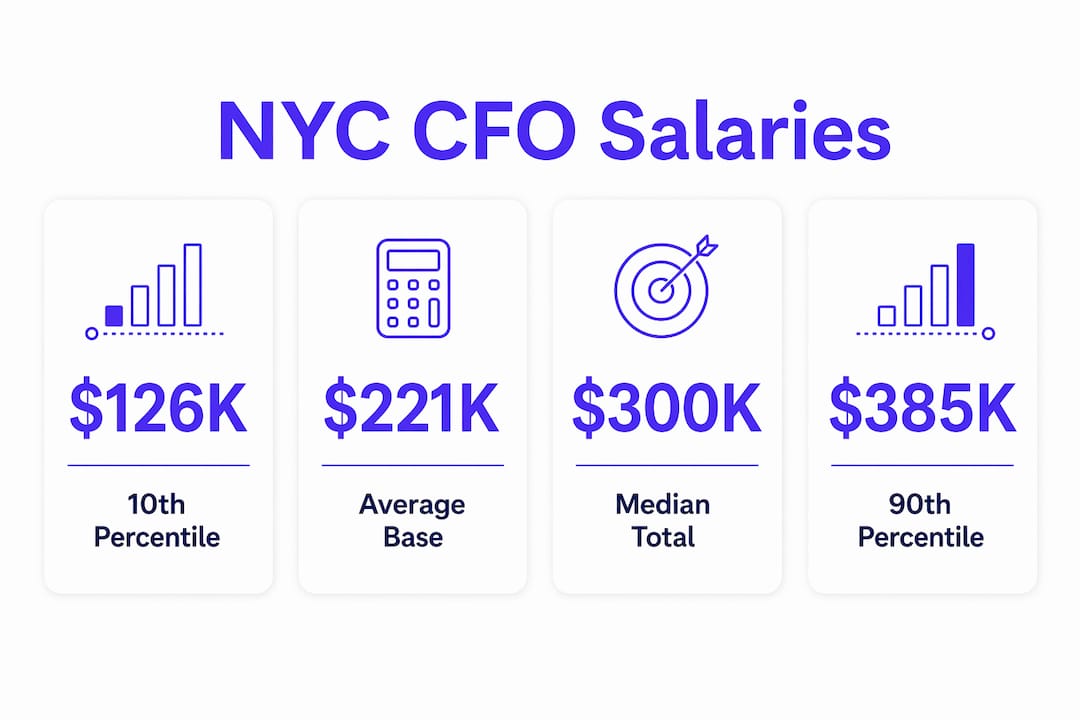
The spread between a 10th-percentile and 90th-percentile CFO salary in New York is enormous, which is why a single average number only tells part of the story.
| Percentile | Estimated Base Salary (NYC) |
|---|---|
| 10th | ~$126,520 |
| ~$160,000 | ~$160,000 |
| 50th (median) | $220,564 |
| 75th | ~$300,000 |
| 90th | ~$384,514 |
- Public-company experience, particularly SEC reporting and investor relations exposure
- Prior M&A transaction leadership or capital markets work
- Private equity or venture-backed employer with performance-tied equity
- Revenue accountability beyond pure finance (combined CFO/COO or CFO/President roles)
- CPA, CFA, or MBA from a top-tier program paired with 15+ years of progressive experience
How company size and revenue shape CFO pay
Company revenue is a major factor influencing CFO compensation in New York, often more than industry or location within the state.
Small companies (under $50M revenue)
CFOs at companies with revenues under $50 million, such as early-stage startups and owner-operated businesses, typically earn base salaries in a moderate range that reflects smaller company budgets. Cash is often constrained, so equity or profit-sharing arrangements substitute for higher base pay. The role frequently blends controller, treasurer, and strategic finance functions into one position.
Mid-market companies ($50M–$500M revenue)
This is where the New York market gets competitive. A CFO at a $300 million company in New York generally earns a base salary in the mid-to-high hundreds of thousands, with total compensation including bonuses and profit sharing considerably higher. The package tends to be cash-heavy rather than equity-heavy unless the company has a near-term liquidity event on the horizon. At this size, the CFO is genuinely a strategic partner to the CEO, not just a financial steward.

Large enterprise and public companies (over $500M revenue)
At companies with revenues over $500 million, CFO base salaries are typically higher, with total compensation packages often including various long-term incentives; Robert Half reports the upper salary band for this tier accordingly. Public-company CFOs in New York also carry a meaningful premium for the regulatory burden: SOX compliance, SEC filings, and earnings-call exposure all command higher pay.
CFOs holding dual titles at mid-market firms often earn significantly more than CFOs focused solely on finance, reflecting their broader scope of responsibility.
Which industries pay CFOs the most in New York?
New York's industry mix creates a wide pay hierarchy for CFO roles. Here is how the major sectors generally stack up, from highest to lowest total compensation:
- Private equity–backed and investment management firms: The top of the market. PE-backed CFOs benefit from carried interest, co-investment rights, and performance bonuses that can dwarf base salary. Total comp at this level is often not publicly reported.
- Large financial services and banking: Major banks and asset managers pay competitively, but bonus structures are heavily regulated post-2008. Base salaries are high; variable pay is real but capped relative to pre-crisis norms.
- Technology and fintech: Scale-up and late-stage tech companies in New York use equity aggressively. A CFO at a Series C or D fintech may take a lower base than a bank CFO but hold options worth multiples of annual salary if the company exits.
- Healthcare and life sciences: Solid mid-to-upper-market pay, particularly at hospital systems and specialty pharma. Bonus structures tend to be more conservative than finance or tech, but base salaries are competitive.
- Real estate and construction: Ranges vary widely. Large REITs pay well; smaller developers pay closer to the mid-market average.
- Nonprofit and higher education: Materially lower total compensation. CFOs at major New York nonprofits or universities earn well below their for-profit peers, though benefits packages are often stronger.
The employer-type effect matters as much as industry. A public company in any sector pays more than a private company of the same size, primarily because of equity compensation and the premium for public-market accountability.
How experience and title progression affect CFO pay
The path from VP of Finance to CFO in New York is not linear, and neither is the pay jump.
A Vice President of Finance or Finance Director at a mid-size New York company generally earns a base salary that is moderately lower than CFO-level roles; moving into Deputy CFO or Assistant CFO positions usually results in meaningful base pay increases and bonus opportunities. The title shift signals readiness for the top seat, and recruiters treat it as a meaningful credential.
The jump to CFO itself, particularly at a company with $100M or more in revenue, is where compensation accelerates sharply. Early-career CFOs at smaller New York companies start with base salaries generally below senior-level CFOs, who, with extensive experience and public-company exposure, command higher base salaries that can be substantially greater.
Interim CFO roles are a separate category. Interim or fractional CFOs in New York often work on day-rate or monthly retainer arrangements that annualize higher than a full-time equivalent, reflecting the premium for short-notice availability and the lack of benefits.
Key experience milestones that move pay upward in New York:
- First public-company CFO role (IPO or post-IPO)
- Leading a debt or equity capital raise above $50M
- Completing a major M&A transaction as the finance lead
- Implementing ERP systems (SAP, Oracle, Workday) at scale
- Building and managing a finance team of 20 or more people
Pro Tip: If you are negotiating your first CFO role, quantify your M&A or fundraising experience in dollar terms. "Led a $75M Series B" lands harder than "supported capital markets activity." Employers pay for specificity.
Where to find high-paying CFO jobs in New York
The best CFO openings in New York rarely appear on general job boards first. Here is where to look:
- Executive search firms: Retained search firms specializing in C-suite finance placements are the primary channel for roles above $250,000. Building relationships with two or three firms that focus on your target industry is worth more than any job board.
- LinkedIn: Still the most active public channel for CFO postings, particularly at mid-market and growth-stage companies. Set alerts for "Chief Financial Officer New York" and filter by company size.
- Company investor relations pages: Public companies post CFO openings on their own IR or careers pages before syndicating to boards. Checking directly saves time.
- Industry-specific boards: Finance-focused platforms and association job boards (CFA Institute, AICPA) surface roles that general boards miss.
- Salary research tools: Cross-referencing active postings with compensation benchmarking resources helps you spot whether a listed salary is at, above, or below current market.
Employer types that consistently top the pay tables in New York: PE-backed portfolio companies preparing for exit, large public financial services firms, late-stage funded tech companies, and major hospital systems with complex capital structures. Watching job postings from these categories over 60–90 days gives you a real-time read on where the market is moving.
How these figures were compiled
The salary figures in this article draw from multiple data streams, because no single source captures the full picture of CFO compensation in New York.
| Source | Data Type | Update Cadence |
|---|---|---|
| Indeed (June 2026) | Job-posting-based; 199 reported salaries | Ongoing; last updated June 14, 2026 |
| Robert Half (2026) | Staffing/employer-reported; tiered by experience | Annual |
| BLS/OEWS | Employer-reported survey; broad occupational coverage | Annual |
| Salary Atlas | BLS/OEWS-anchored; state- and title-level medians | Annual refresh |
- Equity compensation (RSUs, options, carried interest) is frequently underreported or excluded from base-salary datasets
- Bonus figures are often reported separately or not at all in job-posting data
- Niche industries with small sample sizes produce volatile percentile estimates; cross-check with compensation consultants for those sectors
- State-level figures blend NYC and upstate New York, which have meaningfully different pay levels
How to negotiate a CFO compensation package in New York
Whether you are a candidate or a hiring manager, the negotiation framework matters as much as the number you start with.
- Anchor to total compensation, not base salary. Present or evaluate offers in terms of total expected annual compensation: base plus target bonus plus equity value plus profit sharing. A $280,000 base with a 30% target bonus and RSUs is a different offer than $310,000 base with no variable pay.
- Use percentile data as your evidence. Citing the 75th-percentile base for a New York CFO at a company of comparable revenue is more persuasive than citing a competitor's rumored pay. Bring the data to the table.
- Time the conversation correctly. Raise compensation after an offer is extended, not before. For candidates, the strongest negotiating position is post-offer, pre-acceptance.
- Separate each element. Negotiate base, bonus target, equity, and benefits as distinct line items. Employers often have more flexibility on bonus structure or equity than on base salary, especially at PE-backed firms.
- Ask the right questions. Candidates should ask: What is the bonus target and what triggers it? What is the equity vesting schedule? Has the company completed a 409A valuation recently? Employers should confirm: What is the candidate's current total compensation? What is their equity situation (unvested grants that need to be replaced)?
- Build in a review trigger. For candidates joining at a lower base with upside equity, negotiate a 12-month compensation review tied to specific milestones rather than a standard annual cycle.
- Know your walk-away number. Calculate the minimum total compensation that makes the role worth taking, factoring in cost of living, career trajectory, and opportunity cost. New York's cost of living means a $220,000 base in NYC is not equivalent to the same figure in a lower-cost market.
Key Takeaways
New York City CFOs earn an average base salary of $220,564, with total compensation at mid-to-senior levels often substantially higher when bonuses, profit sharing, and equity are included.
| Point | Details |
|---|---|
| NYC average base salary | Indeed reports $220,564 average; experienced CFOs reach $266,858–$439,189 per Robert Half. |
| Total comp adds significantly | Profit sharing, bonuses, and equity routinely push total compensation well above base salary figures. |
| Company size is the biggest driver | CFOs at $300M+ companies typically earn $250,000–$350,000+ in base; public-company roles pay more. |
| Industry and employer type matter | PE-backed and public companies pay the most; nonprofits and education pay materially less. |
| Salary Atlas for deeper benchmarks | Salary Atlas provides BLS-anchored, state-level CFO pay data with no paywall and annual refresh. |
What the CFO pay data actually tells you
The gap between a $126,520 CFO and a $384,514 CFO in the same city is not random. It maps almost perfectly onto company size, public vs. private status, and whether the role carries real strategic authority or is essentially a senior controller with a better title. That distinction matters for both sides of the hiring table.
For candidates, the practical implication is that chasing a title without confirming the scope of the role is a compensation trap. A CFO title at a $20M private company in New York may pay less than a VP of Finance at a $200M company. The title alone does not move the needle; the revenue accountability, team size, and capital structure complexity do.
For employers, the data suggests that underpaying a CFO relative to market is a short-term saving with a long-term cost. CFO turnover at the wrong moment, particularly during a fundraise, audit cycle, or acquisition, is expensive in ways that do not show up in a salary line. Paying at or above the 75th percentile for a role with genuine strategic scope is usually the right call.
The other thing the data does not capture well is the value of a CFO who has done it before in your specific context. A CFO who has taken a company through an IPO, or navigated a distressed balance sheet, or built a finance function from scratch commands a premium that no percentile table fully reflects. That premium is real, and it is worth paying.
Salary Atlas makes CFO benchmarking straightforward
Salary data should not sit behind a paywall or require a vendor call to access. Salary Atlas publishes BLS-anchored salary figures by job title, state, and experience level, updated annually, with every figure linked back to its primary source.
For CFO compensation specifically, the salary by state tool lets you benchmark New York against other major markets, including California, Texas, and Illinois, using the same BLS/OEWS methodology so the comparisons are apples-to-apples. No signup, no subscription, no guesswork about where the numbers came from. Visit Salary Atlas to pull the current figures for your role, state, and experience level.
Useful sources
- Indeed — CFO Salary in New York, NY: Job-posting-based dataset of 199 reported salaries updated June 14, 2026; best for current market demand and active hiring ranges.
- Robert Half — CFO Salary in New York, NY: Staffing-firm data tiered by experience; reflects employer-reported ranges and skews toward placed candidates, making it useful for senior and experienced-hire benchmarks.
- Salary Atlas — Methodology: Explains the BLS/OEWS data sources, weighting approach, and annual update schedule behind Salary Atlas figures.
- Salary Atlas — Average Salary by State: State-level medians and BLS OEWS citations for cross-state CFO pay comparisons.
- Salary Atlas — Financial Analyst Salary: Useful for internal equity checks and benchmarking adjacent finance leadership roles.
FAQ
What does a CFO at a $300M company make in New York?
A CFO at a $300M revenue company in New York generally earns a base salary in the mid-to-high hundreds of thousands, with total compensation including bonuses and profit sharing considerably higher, varying by company type and equity arrangements.

Who gets paid more, a CEO or a CFO?
CEOs generally earn more than CFOs, particularly at large public companies where CEO pay includes larger equity grants and performance bonuses. At smaller private companies, the gap narrows considerably, and some CFOs with equity stakes earn comparably.
Is a CFO a high-paying job in New York?
Yes. With an average base salary of $220,564 in New York City and senior roles reaching $439,189 in base alone per Robert Half, CFO is among the highest-compensated executive positions in the market.
How much does a CFO at JPMorgan Chase make?
JPMorgan Chase does not publicly disclose individual CFO compensation outside of SEC filings. CFOs at major banks in New York typically earn total compensation packages well above the citywide average, including deferred and equity components.
How does New York CFO pay compare to other U.S. cities?
New York CFO salaries are consistently above the national median, reflecting the city's cost of living and concentration of large financial services, tech, and PE-backed employers. The BLS OEWS state data shows New York among the top-paying states for financial management roles nationally.