How to Negotiate Your Salary With Data: A US Guide
Learn how to use BLS wage data to build a target range, set a walk-away number and make a counteroffer that employers can answer with facts, not feelings.
By the Salary Atlas editorial team · Published

To negotiate your salary with data, match your job to the right occupation, pull the wage distribution for your state, pick a target near the upper-middle of that range, set a floor you will not go below, and present the numbers calmly as the basis for your counteroffer. The data does not win the negotiation by itself. It gives you a number you can defend, which is what most people lack when a recruiter asks what they expect.
This guide walks through each step in order: what to research, how to turn percentiles into a target and a minimum, how to word the counteroffer, and what to ask for if the base salary will not move.
TL;DR
- Start from a government wage distribution for your exact occupation and state, not a single "average" figure.
- Turn it into three numbers before any conversation: a target, a realistic middle, and a floor you will not accept below.
- Present data as context for your ask ("the market range for this role in our state is..."), then state one specific number.
- If the base is capped, negotiate other parts of the package, such as schedule, relocation help or review timing.
- Ask for time to think. A pause protects you from anchoring on the first offer.
Table of Contents
- What salary data to gather before you negotiate
- Turn percentiles into a target, a middle and a floor
- How to present the data and counter the offer
- What to ask for if the base salary cannot move
- If the employer says no
- Why transparent ranges make this easier
- Our perspective
- Check your numbers on Salary Atlas
- FAQ
- Sources
What salary data to gather before you negotiate
You need four things: the occupation, the location, the spread of wages and your own position inside that spread. A single average hides most of what you need.
Occupation. Job titles are slippery. A "Customer Success Associate" at one company is an "Account Coordinator" at another. Government wage data is organized by standardized occupation, so find the category that matches the duties in the offer letter, not the title on it. If two categories fit, check both and note the difference. Location. Pay for the same occupation can differ by tens of thousands of dollars across states. Our average salary by state page, built on Bureau of Labor Statistics data, shows how much geography alone moves a number. If the job is in a large metro area, note that state figures blend high-cost and low-cost areas, so treat them as a starting frame. The distribution. The median is the point where half of workers in an occupation earn less and half earn more, according to the technical notes on the federal wage survey. The mean, by contrast, is a simple average and gets pulled upward by a few very high earners. For a negotiation, the median and the percentiles around it (typically the 25th and 75th) are more honest anchors than the mean. What the figures include. Read what a wage number counts before you compare it with an offer. For example, CareerOneStop's industry wage estimates include base rate, cost-of-living allowances, guaranteed pay, hazardous-duty pay, incentive pay and on-call pay, but exclude back pay, overtime, shift differentials and nonproduction bonuses. If your offer leans on bonuses or overtime, you are comparing different things unless you separate them.If you want a fuller walkthrough of finding the right figures for a title, our guide to how much a job pays covers the lookup process, and our list of research tools and resources describes the types of sources worth checking side by side.
Choose sources you can defend
A hiring manager can wave away "I read online that this role pays more." They have a harder time dismissing a figure from a federal agency that publishes its method. Prefer data where:
- the publisher and survey method are named,
- the figure applies to your occupation and state,
- you can say when the data was collected,
- no one's self-reported or scraped guess is involved.
Turn percentiles into a target, a middle and a floor
After research you should hold a small set of numbers in your head. Here is a practical way to build them. The thresholds below are a working method, not a rule, so adjust them to your situation.
| Number | What it is | How to set it |
|---|---|---|
| Target | The figure you open with | Near the 75th percentile for your occupation and state, if your experience and skills justify it |
| Realistic middle | Where you expect to land | Between the median and the 75th percentile |
| Floor | Your walk-away number | The lowest pay you would accept, set by your budget and your best alternative, not by the data alone |
Place yourself in the range
Percentiles describe everyone in the occupation, from new entrants to veterans. Ask where you sit:
- Entry level or career change: the lower quartile to the median is a fair frame. Your argument is potential and specific skills.
- Solid experience, strong match to the posting: the median to the 75th percentile.
- Scarce skills, a track record of measurable results, or an employer who has struggled to fill the role: a case for the upper end. Be ready to name the specifics.
Know your best alternative
Negotiation researchers at Harvard Law School's Program on Negotiation advise that, to resist the pull of an initial offer, you should ask for time to think, know your BATNA and your target, and avoid accepting anything below your BATNA. BATNA means "best alternative to a negotiated agreement": your current job, another offer, or the cost of continuing to search. Your floor should reflect it. If your current job pays $62,000 and you have no other offers, a $58,000 offer is not something data can fix.
A worked example
Suppose you are offered a job in a state where your research shows a 25th percentile of $54,000, a median of $66,000 and a 75th percentile of $81,000. These numbers are illustrative, not drawn from a specific occupation.
- Offer on the table: $62,000.
- You have four years of directly relevant experience and a required certification.
- Your target is $78,000, a little under the 75th percentile.
- Your realistic middle is $72,000.
- Your floor is $66,000, because that is what you earn now and moving costs money.
How to present the data and counter the offer
Timing and tone decide whether the data helps or backfires.
Wait for the offer, then pause
If a recruiter asks for your number early, you can say you want to understand the role fully first and that you are confident you can agree on a fair figure for the market. Once an offer arrives, thank them and ask for a day or two. The Program on Negotiation guidance above lists asking for time as one of the ways to avoid being anchored by the first figure.
Use the data as context, not as a weapon
Compare two ways of making the same point:
- Weak: "Your offer is way below what the Bureau of Labor Statistics says I should earn."
- Stronger: "I'm excited about the role. Based on federal wage data for this occupation in our state, the median is around $66,000 and the upper quartile starts near $81,000. With my four years of experience and the certification you listed, I'm looking for $78,000."
A short script you can adapt
- Appreciate: "Thank you for the offer. I'm enthusiastic about joining the team."
- Frame: "I looked at published wage data for this occupation in [state]. The median is about [X], and the 75th percentile is [Y]."
- Connect: "Given [two concrete qualifications], I'd like to be closer to [target]."
- Ask: "Is there room to get to [target]?"
- Stop talking. Silence after a clear ask is normal. Let them respond.
Consider offering options
The Program on Negotiation also notes that proposing several packages you value about equally can show flexibility and help reveal which parts of compensation the employer can move. For example: Option A is $76,000 with the standard schedule; Option B is $73,000 with a signing bonus and a pay review at six months. You are signaling you want to make a deal, and you learn where their constraints are.
Get the final terms in writing
Once you agree, ask for an updated offer letter that states the base pay, any bonus, start date and review timeline. Verbal agreements are easy to misremember on both sides.
What to ask for if the base salary cannot move
Some employers have fixed pay bands, especially public institutions, school systems and unionized workplaces. In those cases, the data still helps: it tells you whether the band is low for your market, which informs whether you accept. University of Arizona HR guidance for hiring managers notes that when salary is not negotiable, candidates can consider whether a flexible schedule or relocation costs are available, if eligible.
Other items worth raising, depending on the employer:
- Start date or sign-on payment to cover a gap or lost bonus at your old job.
- An earlier compensation review, such as six months instead of twelve, with the criteria in writing.
- Title or level, which affects your next negotiation and which pay band you are in.
- Paid time off, remote or hybrid days, or professional development funds.
- Relocation or commuting support, when the job requires a move.
If the employer hires remotely across borders, pay may also be benchmarked against other countries' markets. For that situation, salary benchmarks for remote workers in other regions show how a distant employer might frame its numbers, though your own US state data remains the right anchor for a US-based role.
If the employer says no
A "no" is information, not an insult. Federal-wage data cannot force a budget to change, but you can still respond well.
- Ask what is fixed. "Is the base set, or is there flexibility elsewhere?"
- Ask what would change the answer. A review in six months, a stretch goal, a different level.
- Check the offer against your floor. If it is above your floor and the role is right, accepting is a reasonable decision. If it is below, you can decline politely and leave the door open.
Why transparent ranges make this easier

When employers publish a pay range, you start the conversation knowing the ceiling. Arizona's guidance takes the view that range transparency builds trust and encourages employers to discuss the total value of compensation rather than one number, though you should read the details of any posted range: it may be broad, and where you land depends on experience. Our article on what a salary range means explains how to read the minimum, midpoint and maximum, and our look at what the evidence shows on salary transparency covers the wider picture.
Our perspective
Most salary advice tells you to "know your worth" and then leaves you holding a guess. We think the missing piece is a number you can point to and a reader on the other side who can check it.
That is why we publish wage data from the U.S. Bureau of Labor Statistics, and only that. We do not estimate wages, we do not scrape listings, and we do not use self-reported figures. Every number links back to its origin, so when you quote it in a negotiation, you can say where it came from and the other person can look it up. We refresh the figures annually, and we show no values we cannot source.
We also think you should not have to pay or sign up to see what your own occupation earns. Percentiles by state and experience are the most useful part of the picture, and they are open to everyone. Our methodology page explains exactly how the data is organized.
Use the median as your reference point, the upper percentiles as the case for a stretch, and your own alternatives as your floor. A negotiation built on that is calmer, shorter and more likely to end in a number you are happy to sign.
Joelen Zyoktova
Check your numbers on Salary Atlas
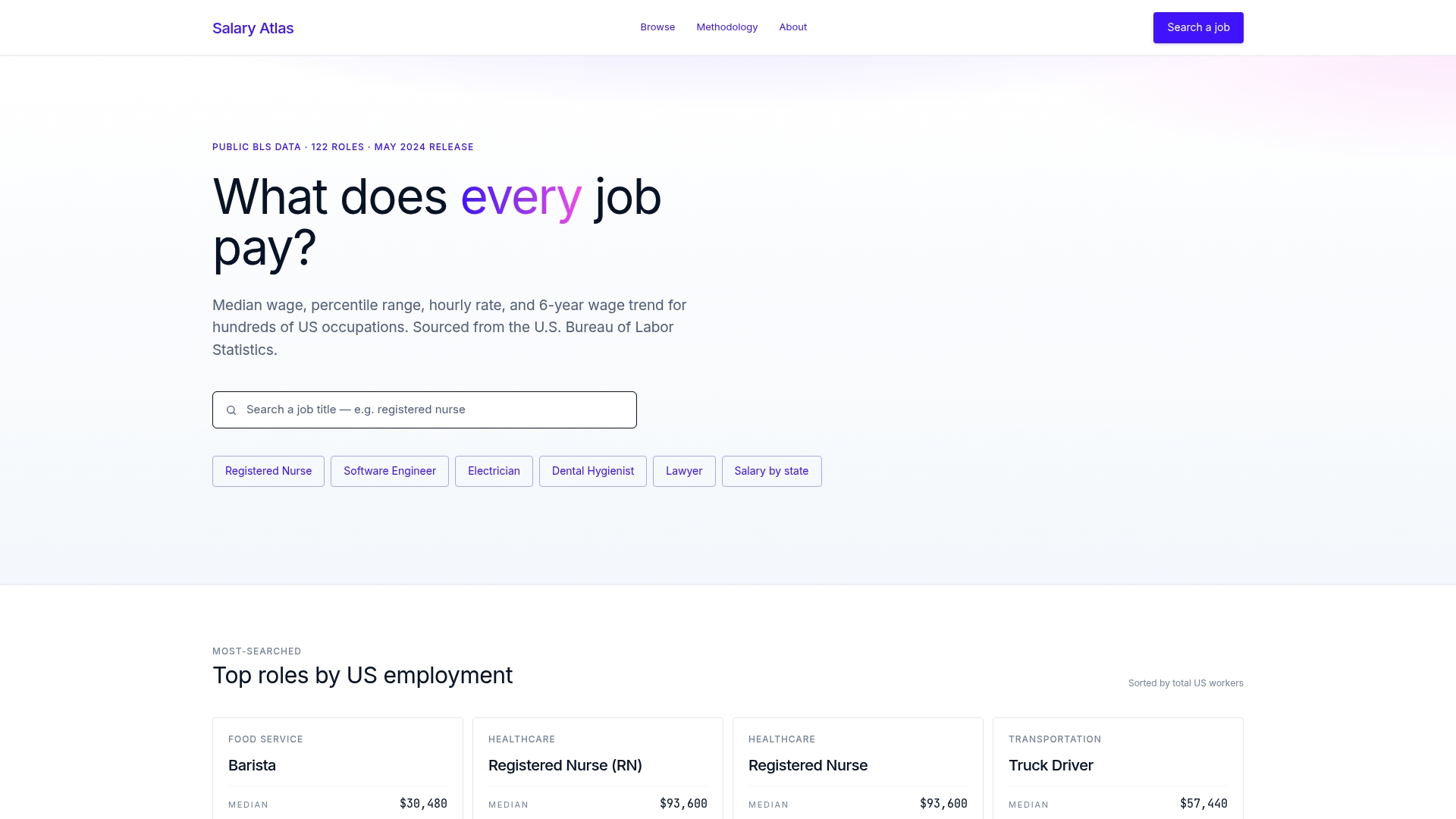
Before your next conversation, look up your occupation on Salary Atlas. You will find BLS-sourced wages by job title, percentile and state, with hourly and annual rates, and each figure linked to its original source. No signup, no paywall. If you want to understand how we handle the data first, read our methodology.
For a longer, step-by-step approach, see our data-driven salary negotiation guide, and for comparing providers by type, our guide to reliable salary comparison tools.
FAQ
Should I mention the data source in the negotiation?
Yes. Naming the publisher, such as a federal agency, makes your figure verifiable and harder to dismiss. Give the occupation, the state and the percentile you are quoting. Keep it to one or two numbers rather than reading out a table.
Is the median or the average better to quote?
Use the median as your main reference. It is the point where half of workers earn less and half earn more, so a few very high salaries do not distort it. Use the upper percentiles to support a stretch ask when your experience justifies it.
What if my job title does not match a standard occupation?
Match on duties, not on title. Read the offer's responsibilities and find the occupation whose description fits most closely. If two fit, compare both and use the one that matches the work you will actually do, then mention the match when you present the data.
How much higher than the offer should I ask?
There is no universal percentage. Anchor on your target from the data, which should be a specific number, and tie it to your qualifications. If the offer is already near your target, a smaller ask or a non-salary request may be more fitting. If it is below the median for your occupation and state, asking for movement toward the median is easy to justify.
Can I negotiate if I only have one offer?
Yes. A single offer is common, and a polite, prepared counter is a normal part of the process. Know your floor and your alternatives first, ask for time to think, and be ready to accept a package that improves other terms if the base does not move.
Sources
- How to Counteroffer in Business Negotiation, Program on Negotiation at Harvard Law School
- Best Practices: Candidate Negotiations, University of Arizona Human Resources
- Industry Reports Help, CareerOneStop
- Occupational Employment and Wage Statistics Technical Notes, New York State Department of Labor
Recommended
Occupation wage figures on Salary Atlas come from the U.S. Bureau of Labor Statistics. Figures in this article that are not linked to a source are estimates. See our methodology.