Data-Driven Salary Negotiation: A Step-by-Step Guide
Use BLS wage data to set a target, a range and a walk-away point, then make your counteroffer and confirm the deal in writing. A practical US guide.
By the Salary Atlas editorial team · Published

A data-driven salary negotiation replaces "I think I deserve more" with "workers in this occupation, in this state, earn this much at the 75th percentile, and here is why I belong there." You do it in four moves: pull official wage figures for your exact job, adjust them for place and experience, turn them into a target, a range and a walk-away number, and then present them calmly. This guide walks through each move with a worked example.
TL;DR
- Start from official wage data for your occupation and state, and read the percentiles, not just the average.
- Pick the measure that fits your question: occupational wage estimates for a job title, other official series for broad trends.
- Set three numbers before any conversation: a target, an acceptable range and a walk-away point.
- Make the first number yours when you can, anchor it on a high-but-defensible percentile, and justify it with your scope and results.
- Price the whole package, then get the final terms in writing before you resign or decline anything.
Table of Contents
- Why data changes the conversation
- Step 1: Choose the right wage source and measure
- Step 2: Match the benchmark to your actual job
- Step 3: Set your target, range and walk-away point
- Step 4: Present your evidence and make the ask
- Step 5: Weigh the whole package
- Step 6: Get the final agreement in writing
- Our perspective: why we only trust the numbers we can trace
- Find your numbers
- Common mistakes to avoid
- FAQ
- Sources
Why data changes the conversation
Most pay disagreements are really disagreements about uncertainty. Neither side knows exactly what comparable employers pay, so each guesses. An NBER working paper, revised in August 2024, found that access to market salary benchmarks reduced salary dispersion by 25% in the studied firms. The authors read that as evidence that uncertainty about other firms' pay drives part of the differences between workers.
For you, the lesson is practical. If employers who see benchmarks end up paying more consistently, then walking in with the same benchmarks puts you on equal footing. You are not asking for a favor. You are pointing at a shared reference.
If you want the broader evidence on how pay openness changes outcomes, we cover it in our piece on the impact of salary transparency.
Step 1: Choose the right wage source and measure
Not every pay number means the same thing. A Congressional Research Service comparison notes that official wage measures differ in source, methodology, frequency, coverage and purpose, and that statistical agencies distinguish between wages, earnings and compensation. The same report suggests choosing the measure that fits the question: CPS usual weekly earnings for quarterly wage distributions, CES averages for monthly industry data, and QCEW average weekly wages for quarterly locality and industry detail.

For negotiating a specific job, you usually want something narrower than all of those: wages by occupation. The Bureau of Labor Statistics publishes these through its Occupational Employment and Wage Statistics program. Its estimates come from employer surveys, and the agency explains that a percentile wage estimate shows what share of workers in an occupation earn less than a given wage. A 75th percentile figure means 75 percent of workers in that occupation earn less and 25 percent earn more.
That is also the reason to prefer employer-reported government data over self-reported salary posts. Anonymous submissions skew toward people with strong feelings, unusual employers or inflated titles. Survey data from employers has a method you can read.
What to look at for each job title
| Figure | What it tells you | How to use it |
|---|---|---|
| Median | The midpoint: half earn less, half earn more | Your baseline for "typical" |
| Mean | The average, pulled up by high earners | A sanity check, not an anchor |
| 25th percentile | Where entry-level or lower-scope roles tend to sit | Your floor if you are early in the role |
| 75th percentile | Where experienced or high-scope workers tend to sit | Your opening anchor if you can show the scope |
| 90th percentile | The top of the range | Only for rare, well-documented cases |
Step 2: Match the benchmark to your actual job
A raw number is useless until it describes the right job. Four adjustments matter most.
Job duties, not job titles
Titles are unreliable. A "senior analyst" at one employer does what an "analyst II" does at another. Match on what you do: the decisions you own, the people you manage, the systems you run. Find the occupation whose description fits most of your week, and if two fit, look at both. A tool that helps you compare career paths and the value of additional education, such as an education ROI calculator, can help when the question is whether a credential would move you into a higher-paying occupation.
Location
A state figure is a better starting point than a national one, because wages in the same occupation vary a great deal by state and metro area. Use your state, or the state where the employer hires. If the job is remote, the employer may set pay by your location, by theirs, or by a national band. We explain the common approaches in how location-based pay works, and it is worth asking which one applies before you quote a number.
Experience
Percentiles are the closest proxy for experience in public wage data. A reasonable rule of thumb, which is our reading and not a BLS rule:
- Under two years in the field: anchor between the 25th percentile and the median.
- Three to eight years with solid results: anchor near the median to the 75th percentile.
- Deep specialization, leadership scope or scarce skills: the 75th percentile and above, if you can document it.
Industry and employer size
The same occupation can pay differently in different industries. Check whether industry-specific figures exist for your job, and read how pay has moved in your sector in our guide on wage growth by industry. Larger employers often have formal pay bands. Small employers may have a budget and nothing else, which affects how much room you have.
Step 3: Set your target, range and walk-away point
This is where most people skip ahead and regret it. Decide three numbers before you speak to anyone.
- Target: the figure you would be genuinely pleased to receive. Usually near the 75th percentile for your state if your experience supports it.
- Range: the band you would accept. The bottom should be above your walk-away point, and the top should be your opening ask or slightly above it.
- Walk-away point: the number below which you decline, based on your current pay, your living costs and your other options.
A worked example
Say you are a software developer with six years of experience. You pull the occupation's wage data for your state. Suppose the median is $135,980, the national median figure we show on our software developer salary page, and your state's 75th percentile is higher. Your numbers might look like this:
| Number | Logic |
|---|---|
| Walk-away | Your current pay plus enough to offset the extra commuting cost and the risk of changing jobs |
| Range bottom | The median for your state |
| Target | Midway between the state median and the 75th percentile |
| Opening ask | The 75th percentile, justified by the scope of your work |
We go deeper on the top-of-range anchor in our guide to negotiating with the 75th percentile salary.
Step 4: Present your evidence and make the ask
Go first when you can
Negotiation research consistently finds that the first number tends to set the frame. The Program on Negotiation at Harvard Law School describes this as the anchoring effect: people lean heavily on the first figure introduced, and the person who makes the first offer typically comes out ahead on price. If a recruiter asks for your expectations early, give a researched range whose lower end you would actually accept, or turn the question back to the posted range if one exists.
Say the data, then say yourself
A good counteroffer has two parts: what the market pays, and why you belong where you are asking. For example:
"Based on federal wage data for this occupation in our state, the 75th percentile is around $X. In my current role I lead [specific scope] and delivered [specific result]. Given that, I'm looking for a base salary of $Y."
Notice what this does not do. It does not cite your rent, your loans or a friend's salary. It does not claim the number is a rule. It offers a reference and ties it to evidence of your own.
Keep the tone collaborative
You are trying to solve a shared problem: the employer wants you, and you want a number that works. Phrases like "I'm excited about this role, and I'd like to get the compensation to a place where I can say yes" keep the conversation open. Then stop talking. Silence after a number is uncomfortable and effective.
When they come back lower
- Ask what the constraint is: a salary band, a budget, a level.
- If the band is the constraint, ask whether a higher level or title is possible.
- If base is truly capped, move to other parts of the package (below).
- Revisit your walk-away point honestly. If the offer is under it, a polite no is a legitimate outcome.
Step 5: Weigh the whole package
Base salary is one piece of compensation. Official statistics treat wages and total compensation as different things, which is the same distinction the CRS report above draws. When you compare offers, line up:
- Base pay and how often it is reviewed
- Bonus or commission, and whether it is guaranteed, target or discretionary
- Equity, including vesting schedule and what happens if you leave
- Health insurance: premiums, deductibles and whether dependents are covered
- Retirement: employer match and when it vests
- Paid time off, parental leave and holidays
- Flexibility: remote or hybrid terms, schedule, travel
- Signing bonus and relocation, including any repayment clause if you leave early
- Learning budget and title, which affect your next negotiation
A useful habit: write both offers on one page with annual dollar values, then mark what you would pay for out of your own pocket if the employer did not. That tells you which benefits are real to you.
Step 6: Get the final agreement in writing
A verbal "we can do that" is not an offer. Before you resign from your current job or turn down another, confirm the following in a written offer letter or contract:
- Job title and level, and your reporting line
- Base salary, pay frequency and the next review date
- Bonus terms, including how it is calculated and when it is paid
- Equity details: number of shares or units, vesting schedule, and any cliff
- Start date and work location, including remote or hybrid terms
- Signing or relocation payments and any clawback conditions
- Benefits eligibility dates, since some start after a waiting period
- Anything that was promised verbally in the negotiation
Our perspective: why we only trust the numbers we can trace
At Salary Atlas we have one rule: every wage figure on the site comes from the U.S. Bureau of Labor Statistics and links back to its source. We do not estimate, we do not scrape, and we do not use self-reported salaries. We refresh the figures annually, and we would rather show you an honest range than a precise-looking number that nobody can verify.
That rule matters most in negotiation. When you say a number out loud to someone who controls your pay, you need to be able to show where it came from. A figure from a government survey with a published method survives a skeptical "where did you get that?" A screenshot of an anonymous post usually does not.

We also think job seekers over-focus on the average. The median tells you what is typical, and the percentiles tell you what is possible, and that second piece is what you negotiate with. Use the percentile that matches your documented scope, not the one you wish matched it.
One caution from experience: public data describes occupations, not your employer's budget. Use it to anchor and to check that an offer is reasonable, then listen for the real constraints in the room.
, Joelen Zyoktova
Find your numbers
If you work in or are moving into software, start with our software developer salary page, which shows the BLS median and links every figure back to its source. For any other occupation, our salary data hub lets you look up wages by job title, percentile and state, with no paywall and no signup.
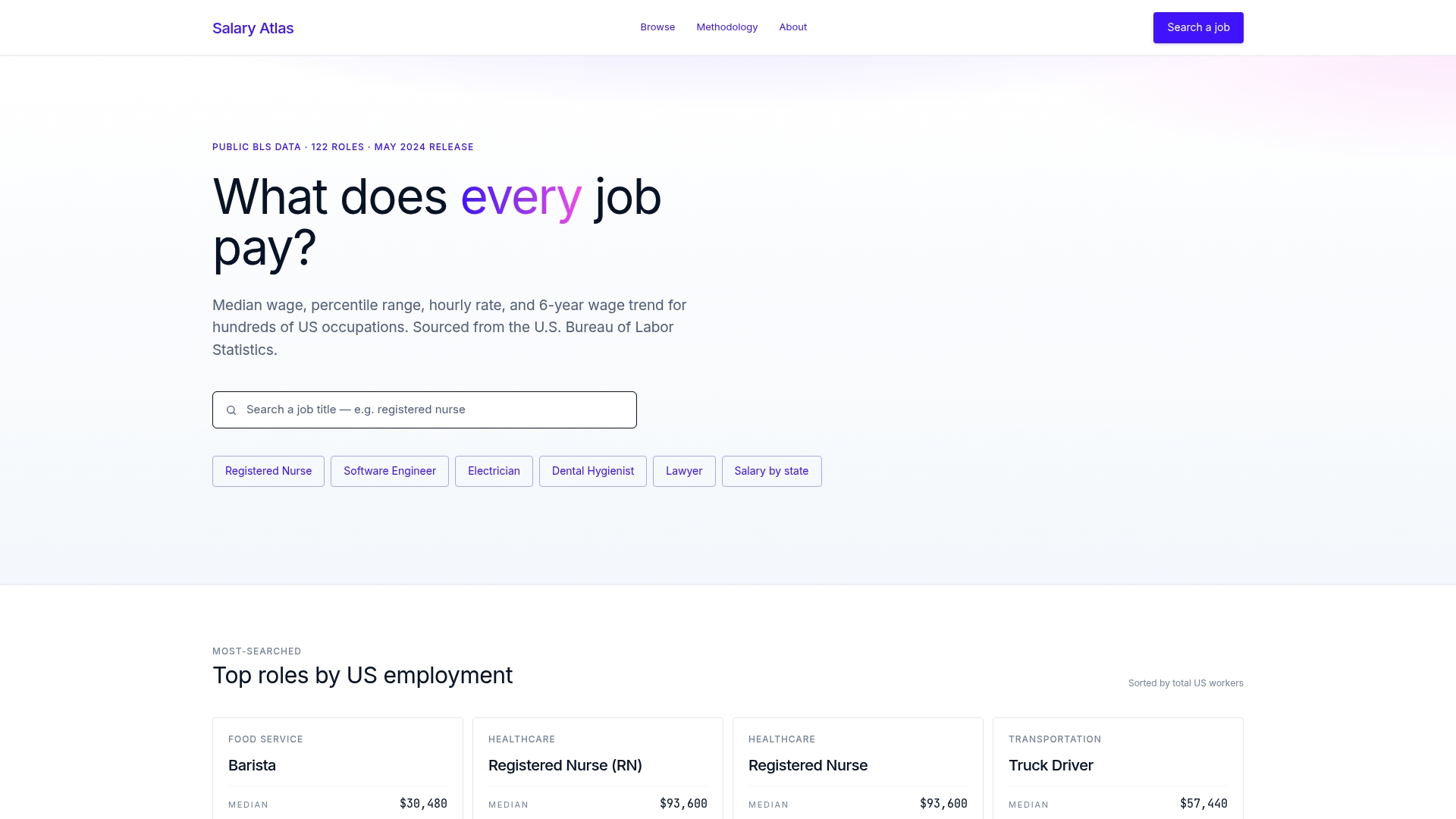
Bring the percentile figures for your state into your next conversation, and open the data source link if anyone asks where they came from.
Common mistakes to avoid
- Quoting the national average for a local job. Use your state or the employer's hiring state.
- Comparing different measures. An hourly occupational wage, a weekly earnings figure and a total compensation figure are not interchangeable.
- Anchoring too low. If you name a number near the median when your scope warrants the 75th percentile, you have negotiated against yourself.
- Using data you cannot source. If you cannot say where a number comes from, leave it out.
- Negotiating only base pay. If the band is fixed, other terms may still move.
- Treating a trend as a promise. Wage movement across the economy tells you about the market, not about what this employer will pay. Our overview of 2026 wage trends gives context without overpromising.
FAQ
What is data-driven salary negotiation?
It means basing your pay request on verifiable wage data for your occupation, location and experience level, plus evidence of your own results. You set a target, a range and a walk-away point before you talk, and you present numbers with their source instead of relying on feelings or comparisons with colleagues.
Which percentile should I ask for?
It depends on your documented scope and experience. Earlier in your career, the 25th percentile to the median is a realistic zone, while experienced workers with strong results can reasonably anchor near the 75th percentile. Go higher only when you can point to specific, measurable reasons.
Should I give my salary expectation first?
Often, yes, if you have done the research. The anchoring research from the Program on Negotiation suggests the first figure tends to shape the discussion. If you are not ready, or the posted range already exists, ask about the range for the role and respond with a number inside it that you would be happy to accept.
Can I negotiate if the employer has a fixed salary band?
Yes, in several ways. You can ask about a higher level or title that sits in a higher band, and you can negotiate bonus, equity, signing payment, review timing, paid time off or flexibility. Get any agreed change in the written offer.
Sources
- NBER working paper on market salary benchmarks and pay dispersion
- CRS comparison of selected official wage measures
- BLS Occupational Employment and Wage Statistics, May 2024 estimates
- Program on Negotiation, Harvard Law School: the anchoring effect
Recommended
Occupation wage figures on Salary Atlas come from the U.S. Bureau of Labor Statistics. Figures in this article that are not linked to a source are estimates. See our methodology.