Calculate Your Real Wage in Minutes: CPI Method for U.S. Workers
Convert nominal pay to real pay using CPI and BLS AHE data. A step-by-step, data-driven method you can run in minutes to see if your raise beat inflation.
By the Salary Atlas editorial team · Published

Your nominal wage is the dollar figure on your pay stub. Your real wage is that same number adjusted for price changes, and it tells you what your paycheck can actually buy. The test is simple: if your raise outpaced inflation, your purchasing power grew; if inflation ran hotter, you effectively took a pay cut even though your paycheck got bigger. Calculate both before you celebrate a raise.
TL;DR:
- Raises that do not outpace inflation effectively result in a decreased real wage and eroded purchasing power, even if nominal wages increase.
- During periods of high inflation, the difference between nominal and real wages becomes significant, with real wages often declining despite nominal pay raises.
- To accurately assess your financial progress, compare your nominal wage growth with the inflation rate, using CPI data or the simple subtraction method.
- Personal inflation rates may differ from the headline CPI, especially if your spending includes categories like housing or healthcare that are weighted differently than the average basket.
- Employers' cost-of-living adjustments or indexation clauses may not fully offset inflation, making it essential to track real wages independently.
Table of Contents
- What Is a Nominal Wage?
- What Does Real Wage Mean, and Why Do Economists Track It?
- How to Calculate Your Real Wage
- What Positive or Negative Real Wage Growth Actually Means
- Common Pitfalls When Measuring Real Wages
- How to Check Your Real Wage Using Public Data
- Headline Inflation vs Core Inflation: Which One Should You Use?
- When a Raise Isn't Really a Raise
- Wage Indexation: How Some Pay Is Protected From Inflation
- Why Real Compensation Should Drive Your Next Pay Conversation
- Look Up Real BLS Wage Data Before You Run the Numbers
- Where These Numbers Actually Come From
- Sources
- FAQ
What Is a Nominal Wage?
Your nominal wage is the actual dollar amount on your pay stub, your offer letter, or your hourly contract. It is not adjusted for anything. If your employer pays you $22 an hour this year versus $20 last year, that $22 is your nominal wage, full stop.
Nominal pay shows up in a few common forms:
- Hourly wage: the rate you're paid per hour worked, common in retail, food service, and skilled trades.
- Salaried pay: a fixed annual figure, usually divided into biweekly or monthly paychecks.
- Minimum wage: the legal floor set by federal or state law, stated in nominal dollars.
- Contract rates: project-based or freelance pay, often quoted as a flat nominal fee.
What Does Real Wage Mean, and Why Do Economists Track It?
Real wage measures what your paycheck can actually purchase after adjusting for changes in prices. It strips out the effect of inflation so you can compare your buying power across different points in time, not just the dollar figure your employer writes on the check.
The concept rests on a straightforward idea: a dollar today doesn't buy what a dollar bought five years ago. Economists convert nominal wages into real wages using a price index, most commonly the Consumer Price Index (CPI), so that a $30/hour wage in 2020 and a $30/hour wage in 2026 can be compared on equal footing.
A few things follow from this:
- Real wages are the metric that actually reflects living standards, not nominal wages.
- Two workers with identical nominal raises can have very different real outcomes if they face different local inflation.
- Real wage comparisons only make sense within a consistent base year or index method.
How to Calculate Your Real Wage
The core formula is simple, and you can run it in under a minute once you have two numbers: your nominal wage and a price index value.
Formula: Real wage = (Nominal wage ÷ Price index) × 100You can also use a faster approximation for quick checks: Real wage growth ≈ Nominal wage growth (%) − Inflation rate (%). This shortcut, confirmed by economics reference sources, won't be perfectly precise, but it's close enough for a gut check on whether you're gaining or losing ground.
Here's how to work through it:
- Pick your nominal wage figures for two points in time (say, your hourly rate last year and this year).
- Get the corresponding CPI values for those same two periods from the Bureau of Labor Statistics.
- Divide and scale. Using the EconLearn formula, divide your nominal wage by the CPI value for that period, then multiply by 100 to put it in comparable index terms.
- Compare the two real wage figures to see whether your purchasing power rose or fell.
What Positive or Negative Real Wage Growth Actually Means
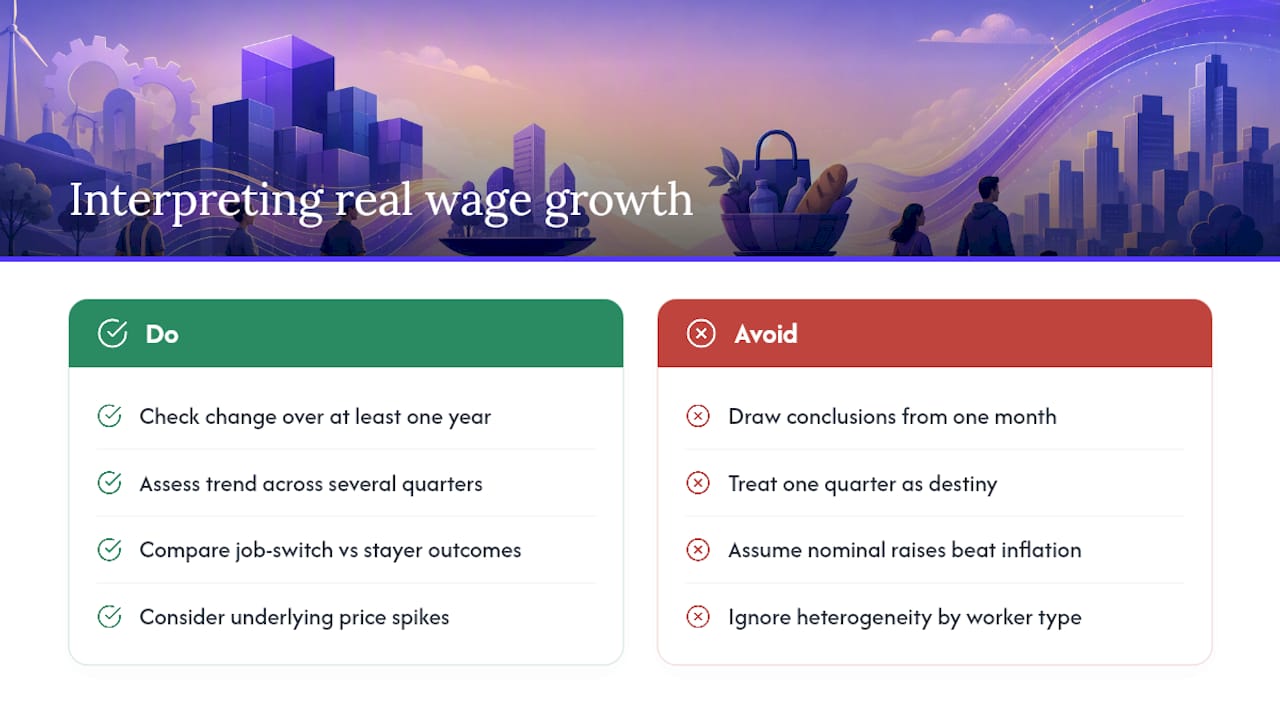
Real wage growth is the number that tells you whether your standard of living is improving or eroding. A positive figure means your earnings are outpacing prices; a negative one means they aren't, regardless of how large your nominal raise felt.
This isn't evenly distributed. Analysis from the St. Louis Fed points to real heterogeneity in outcomes: younger workers and people who switch jobs tend to see stronger real wage gains than those who stay put in the same role for years. Job switchers often negotiate a fresh nominal rate that better reflects current market conditions, while long-tenured employees frequently rely on annual raises that lag behind actual price increases.
There's also a timing trap worth knowing about. Real wage growth is noisy month to month. A single quarter of negative real growth doesn't necessarily mean your long-term trajectory is bad, and one strong month doesn't mean you're set. What matters is the trend over several quarters or years, not any single data point.
If you're evaluating your own situation, look at your real wage change over at least a full year, and ideally longer, before drawing conclusions. Short-term inflation spikes (like a temporary jump in gas or grocery prices) can distort a single month's reading without reflecting your underlying financial trajectory.
Common Pitfalls When Measuring Real Wages
Real wage numbers aren't as clean as they look, and a few measurement choices can quietly skew your results.
- CPI is an average, not your budget. The Consumer Price Index reflects a broad national basket of goods and services. If you spend a larger share of income on housing or childcare than the average household, your personal inflation rate could run meaningfully higher or lower than headline CPI.
- Composition effects distort aggregates. Changes in average hours worked, bonus structures, and benefits packages can shift wage statistics without reflecting what any individual worker actually experienced.
- Some series exclude key groups. Real wage calculations frequently leave out the self-employed and don't fully capture nonwage benefits, which can misstate purchasing-power changes for people who freelance or recently changed job status.
How to Check Your Real Wage Using Public Data
You don't need a spreadsheet degree to verify your own real wage. The process breaks down into three steps, using free, government-sourced data.
- Pick your period and your nominal number. Use your own pay stubs for a personal check, or reference the BLS Average Hourly Earnings (AHE) series if you want a benchmark for your occupation broadly.
- Choose your deflator and pull the index. CPI-U is the standard choice for most individual comparisons. Grab the relevant CPI values directly from BLS or from FRED, which hosts CPIAUCSL as a monthly series.
- Run the math and read the sign. Apply the formula from the calculation section above, or use the year-over-year subtraction shortcut. A positive result means gained purchasing power; negative means lost ground.
Before you run the numbers, get your nominal baseline right. Salary Atlas publishes job-level wage figures sourced directly from the BLS, which gives you a solid nominal starting point if you want to compare your own pay against your occupation's typical range before adjusting for inflation. Understanding the difference between wage and salary structures also helps you make sure you're comparing apples to apples.
Headline Inflation vs Core Inflation: Which One Should You Use?
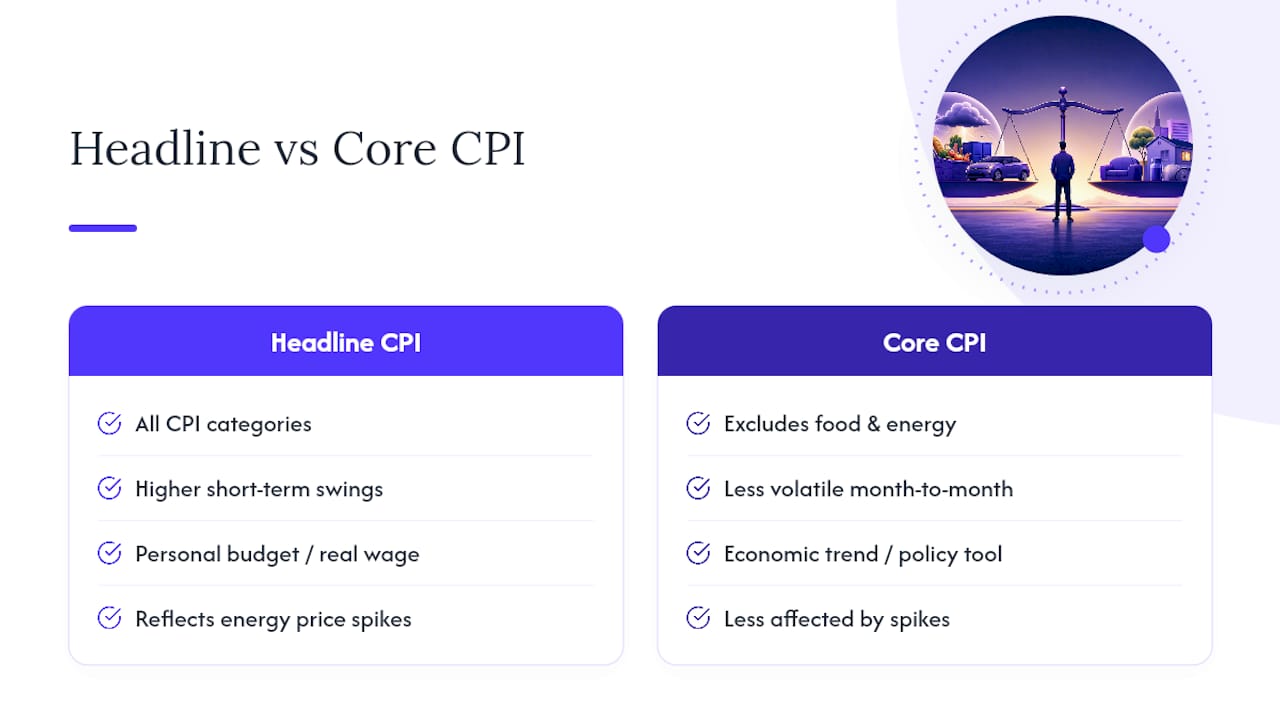
Headline inflation includes everything in the CPI basket: food, energy, housing, medical care, all of it. Core inflation strips out food and energy prices specifically, because those categories swing wildly from month to month due to factors like weather and geopolitical events that have nothing to do with underlying economic trends.
For most personal real-wage checks, headline CPI is the better choice. You actually buy groceries and put gas in your car, so excluding those categories would understate how inflation hits your real budget. Core inflation exists mainly as a tool for economists and the Federal Reserve to gauge underlying inflation trends without noise from volatile categories, which matters for setting interest rate policy but matters less for your household budget.
That said, the gap between headline and core numbers can meaningfully change your real wage result in certain periods. When energy prices spike, headline inflation can run well above core inflation, meaning a wage adjustment calculated against core CPI would look rosier than your actual experience at the pump and grocery store. If you're trying to understand why your paycheck feels tighter than the official inflation narrative suggests, checking whether headline or core numbers are being quoted is often the answer.
For a personal check, use headline CPI-U. Save core inflation comparisons for understanding broader monetary policy discussions, not your own budget.
When a Raise Isn't Really a Raise
This happens because nominal raises and real purchasing power aren't the same thing, and the gap between them can be significant during inflationary stretches.
Your paycheck grew. Your ability to buy the same basket of groceries, gas, and rent did not; it actually shrank by roughly 3 percentage points in real terms. Multiply that across several years of raises that consistently lag inflation, and workers can lose meaningful ground on their standard of living without a single paycheck ever going down in nominal terms.
The practical implication is that a nominal raise is not the finish line. Before you compare job offers, evaluate a raise, or feel good about a bump in pay, check the corresponding inflation rate for that same period. This is also why understanding the gap between cost-of-living adjustments and actual living costs matters so much when your employer frames a raise as "keeping up."
Wage Indexation: How Some Pay Is Protected From Inflation
Wage indexation ties pay increases directly to a price index, usually CPI, so that nominal wages automatically rise alongside the cost of living. It's a mechanism designed specifically to preserve real wages without requiring a fresh negotiation every time prices move.
You see this most clearly in cost-of-living adjustments, or COLAs, which many union contracts, government pensions, and Social Security benefits build in as an automatic annual feature.
The catch is that indexation formulas vary, and the index chosen matters. Some contracts use CPI-W (a narrower index tracking urban wage earners) rather than the broader CPI-U, and the two can diverge in a given year. Others cap the adjustment at a maximum percentage regardless of how high inflation runs, which means indexation protects you up to a point but not necessarily fully during an unusually sharp inflationary spike.
For most workers without a formal indexation clause, the practical takeaway is that COLAs and raises negotiated informally by managers often lag actual inflation more than a strict CPI-indexed adjustment would. That's a strong argument for tracking the real wage math yourself rather than assuming your employer's annual raise cycle is doing that job for you.
Why Real Compensation Should Drive Your Next Pay Conversation
When you sit down for a raise conversation, lead with real compensation, not the nominal number your manager offers.
A useful script: "My current raise doesn't cover the CPI increase in our area over the past 12 months. I'd like this adjustment to at least match inflation, plus a merit increase reflecting my performance." That framing shifts the conversation from "did I get a number" to "did I actually gain ground."
If your employer consistently offers raises below inflation while similar roles elsewhere show positive real wage growth, that's a signal worth acting on. Job switching, even within the same company, frequently resets your nominal wage closer to current market rates. Track your real wage every year, not just your raise percentage, and let the math drive the decision.
, Joelen Zyoktova
Look Up Real BLS Wage Data Before You Run the Numbers
Salary Atlas gives you the nominal wage side of this equation without a paywall, a signup wall, or a sales pitch. Every figure on the site traces back directly to the Bureau of Labor Statistics, refreshed annually, so you're not guessing at a starting number before you adjust it for inflation.

Once you know CPI has moved a certain amount over the past year, pair that with Salary Atlas's job-level wage data to see what your occupation actually pays right now, nominally, before you run it through the real-wage formula. If you want to compare your own state or region, the state-by-state wage breakdown uses the same BLS OEWS figures the government itself publishes, so there's no fabricated benchmark sitting between you and the raw number. Pull your occupation's current nominal wage, plug it into the calculation above, and see exactly where you stand.
Where These Numbers Actually Come From
Every figure in this guide traces back to a public source you can check yourself.
- Bureau of Labor Statistics: home of the CPI series and Average Hourly Earnings data used to calculate nominal and real wage changes.
- FRED (Federal Reserve Bank of St. Louis): hosts monthly series like CPIAUCSL and CES0500000003, useful for building your own real wage growth series.
- St. Louis Fed's Timely Topics: detailed analysis of real versus nominal wage growth patterns across different worker groups.
- EconLearn: plain-language formulas and glossary explanations for converting nominal figures into real terms.
Sources
- EconLearn, Real vs. nominal wage formula
- Real vs. nominal wage growth | St. Louis Fed
- How the government measures inflation | Brookings
- Eco3min, US real wage growth dataset (method and inputs)
FAQ
What is the difference between nominal and real income?
Nominal income is the actual dollar amount you receive; real income adjusts that figure for inflation to show what it can actually purchase. The gap between the two grows during high-inflation periods.
What is the difference between nominal and real terms?
"Nominal terms" means the raw dollar figure with no adjustment; "real terms" means that figure has been adjusted using a price index like CPI to reflect actual purchasing power at a given point in time.
What are the three types of wages?
Wages are commonly categorized as hourly wages, salaried pay, and piece-rate or contract pay, though minimum wage is often discussed as a fourth, legally-set category layered on top of these.
What does nominal wages mean?
Nominal wages refer to the actual dollar amount paid to a worker, without any adjustment for inflation or changes in the cost of living. It's the number printed directly on a pay stub or stated in a job contract.
Recommended
Occupation wage figures on Salary Atlas come from the U.S. Bureau of Labor Statistics. Figures in this article that are not linked to a source are estimates. See our methodology.