HR: Use BLS Benchmarks to Fix Salary Compression at Compa Ratio 0.80
Diagnose and fix salary compression with compa ratio and range penetration audits and BLS (Salary Atlas) benchmarks. Prioritize high risk roles.
By the Salary Atlas editorial team · Published

Salary compression happens when new hires start close to what your tenured employees earn, flattening the pay curve until experience stops paying off. The fix starts with a compa-ratio audit across every role and tenure band, not a blanket raise. Left alone, compression drives your best people out the door faster than almost any other pay problem.
TL;DR:
- Salary compression often originates from rising market rates for new hires and inconsistent pay practices, leading to higher turnover risk among experienced staff.
- Regularly analyzing compa-ratios and range penetration, especially by tenure, helps identify and address hidden pay gaps before they cause significant retention issues.
- Fixing compression effectively requires targeted, phased adjustments for high-risk roles, coupled with long-term structural policies like narrower pay bands and clear progression rules.
- BLS-sourced, state-specific wage benchmarks ensure accurate market comparisons, preventing future compression caused by outdated or generic salary data.
- Addressing pay compression is critical for maintaining diversity and inclusion, as disparities in salary growth can disproportionately affect underrepresented employees' career advancement.
Table of Contents
- What Is Salary Compression, and How Does It Differ From Pay Inversion?
- What Causes Salary Compression?
- Why Salary Compression Matters: Business Impact and Legal Risk
- How to Identify Compression: Compa-Ratios and Range Penetration
- How to Fix Pay Compression: A Prioritized Action Plan
- Fixing Compression on a Limited Budget
- Using BLS-Sourced Benchmarks to Quantify Market Gaps
- What Salary Compression Means for Diversity and Inclusion Goals
- How Should HR Communicate About Pay Compression?
- Preventing Salary Compression for Good
- What One HR Leader Learned Fixing Pay Compression
- Where to Find Reliable Benchmark Data for Your Next Pay Audit
- Sources
- FAQ
What Is Salary Compression, and How Does It Differ From Pay Inversion?
Salary compression is the narrowing gap between what your longest-tenured employees earn and what you pay new hires or junior staff for comparable work. It happens gradually, one hiring cycle at a time, until a five-year veteran and a six-month hire sit within a few thousand dollars of each other despite very different experience and output.
Pay inversion is the more severe cousin: new hires actually out-earn the people who trained them. A software company that raises entry-level offers by 15% to match a hot labor market, without touching existing salaries, can slide from compression into inversion within a single hiring season.
Certain groups feel this fastest:
- New supervisors promoted from hourly roles, whose raises often lag behind the overtime pay they gave up.
- Long-tenured specialists whose merit increases have compounded slowly while market rates for the same job jumped.
- Mid-career employees stuck between entry-level market corrections above them and senior pay bands they haven't reached yet.
What Causes Salary Compression?
Compression rarely comes from one bad decision. It builds from several ordinary practices that quietly stack on top of each other over a few budget cycles.
- Market rates for new hires rise faster than internal raises. When a role's external market value jumps 8 to 10% in a year but your merit budget caps increases at 3%, every new hire lands closer to your veterans' pay.
- Minimum-wage and overtime-threshold changes shift the floor. State minimum-wage increases push entry-level pay up automatically, but employers rarely adjust the tiers above it in step.
- Fragmented hiring decisions create inconsistency. When department managers negotiate offers independently from separate budgets, central HR often doesn't see the compression until payroll data gets aggregated months later.
- Poorly designed pay ranges compress promotion value. If a pay band is too narrow, an employee promoted into it can land only slightly above what a new hire earns in the same seat.
- Ad-hoc merit adjustments replace a real system. One-off raises approved to retain a specific employee, without touching the surrounding pay structure, create new compression points somewhere else.
Why Salary Compression Matters: Business Impact and Legal Risk
Compression is a retention problem before it's anything else. Employees who discover a newer, less experienced colleague earns close to their own salary tend to disengage first and look for other jobs second. Research on workplace fairness from MIT Sloan Management Review ties perceived pay fairness directly to employee commitment. When that perception breaks, commitment drops with it, often among your highest performers, since they have the most external options.
Statistic to watch: Turnover cost estimates commonly run to a substantial multiple of the departing employee's salary once you factor in recruiting, onboarding, and lost productivity. That math changes fast when compression pushes out a senior employee whose institutional knowledge took years to build.The business effects show up in three places:
- Higher turnover among tenured, higher-skilled staff who feel their experience isn't being paid for.
- Promotion resistance: employees decline stretch roles when the raise attached to them doesn't clear the gap left by compression.
- Productivity drag, since disengaged senior staff tend to do less mentoring and knowledge transfer.
How to Identify Compression: Compa-Ratios and Range Penetration
Two numbers do most of the diagnostic work here: compa-ratio and range penetration. Compa-ratio measures an individual's pay against the midpoint of their salary range. Range penetration tells you where they sit across the entire band, from minimum to maximum.
Here's the calculation, step by step:
- Find the range midpoint. If a role's pay band runs from $60,000 to $90,000, the midpoint is $75,000.
- Divide actual salary by midpoint. An employee earning $70,000 has a compa-ratio of 0.93 ($70,000 ÷ $75,000). One earning $78,000 sits at 1.04.
- Read the zones. A compa-ratio below 0.80 to 0.85 is typically a red flag for underpayment relative to the role; 0.90 to 1.10 is generally the healthy amber-to-green zone; above 1.15 can signal overpayment or a role that's outgrown its band.
- Calculate range penetration by dividing (salary minus range minimum) by (range maximum minus range minimum). In the same example, the $70,000 earner sits at 33% penetration [($70,000 − $60,000) ÷ ($90,000 − $60,000)]. A five-year veteran sitting at 20% penetration next to a new hire at 15% is the numeric fingerprint of compression.
Pull the data from your payroll system, your job description library for accurate leveling, and external benchmarks like Bureau of Labor Statistics occupational wage data to confirm whether your ranges reflect the current market or a market that existed three years ago. A methodology grounded in structured compensation analysis keeps this repeatable instead of a one-time fire drill.
Pro Tip: Run the compa-ratio calculation by tenure band, not just by role. A role can look healthy on average while your five-plus-year employees sit dangerously close to your one-year employees underneath that average.How to Fix Pay Compression: A Prioritized Action Plan
Fixing compression well means triage first, structure second. Don't spread a limited budget evenly across everyone with a low compa-ratio; start with roles carrying the highest retention risk or the clearest legal exposure, then work outward.
Immediate actions, in rough priority order:
- Target critical, hard-to-replace roles first. A senior engineer with a 0.82 compa-ratio and three competing offers outranks a stable administrative role at the same ratio.
- Use market-level adjustments for structural gaps. When the whole band has fallen behind, move the range itself, not just individual salaries.
- Deploy one-time retention bonuses for near-term risk. They buy time to fund a permanent base increase in the next budget cycle.
- Reallocate merit budget toward compressed employees rather than spreading standard percentage raises evenly across the team.
| Remediation Step | Typical Timeline | Budget Impact |
|---|---|---|
| Retention bonus for flight-risk roles | Immediate | Low, one-time |
| Targeted base increase for underpaid incumbents | 1 to 2 quarters | Moderate, recurring |
| Full market-band adjustment | 1 fiscal year | High, recurring |
| Pay philosophy and progression rule rollout | 1 to 2 years | Low, mostly process |
Fixing Compression on a Limited Budget
Smaller employers rarely have room to give across-the-board raises, and they shouldn't try to. Prioritize the two or three roles carrying the most retention risk for actual base-pay dollars, and lean on non-cash tools everywhere else: extra PTO days, flexible or remote schedules, funded certifications, and small spot bonuses for standout work.
Phase base-pay corrections across fiscal years instead of attempting one expensive true-up. A three-year plan that closes a third of the gap annually is more sustainable than a single budget-busting adjustment that gets reversed the next time revenue dips.
- Communicate the plan honestly: employees tolerate a phased timeline far better than silence.
- Put progress in writing, even informally, so the correction doesn't read as a vague promise.
- Escalate to finance for a formal market adjustment once a role's compa-ratio drops below 0.80 or a specific resignation risk becomes concrete.
Using BLS-Sourced Benchmarks to Quantify Market Gaps
Every compa-ratio calculation is only as good as the market midpoint feeding it. If your salary range was built on outdated or generic salary data, your compa-ratio tells you where you sit against a number that's already wrong.
Salary Atlas publishes its methodology openly, linking every occupation-level median and percentile back to the original Bureau of Labor Statistics OEWS source data. That transparency matters when you need to defend a market adjustment to your CFO or in an internal pay-equity audit; a number you can trace to its federal source holds up better than one pulled from a vendor's proprietary index.
- Pull the occupation's 25th, 50th, and 75th percentile from BLS-sourced data to set your red/amber/green compa-ratio thresholds.
- Cross-check state-level percentiles, not just the national median, since regional cost-of-labor swings compression math significantly.
- Rebuild pay ranges around current percentiles rather than last year's, especially in roles where market rates moved fast.
What Salary Compression Means for Diversity and Inclusion Goals
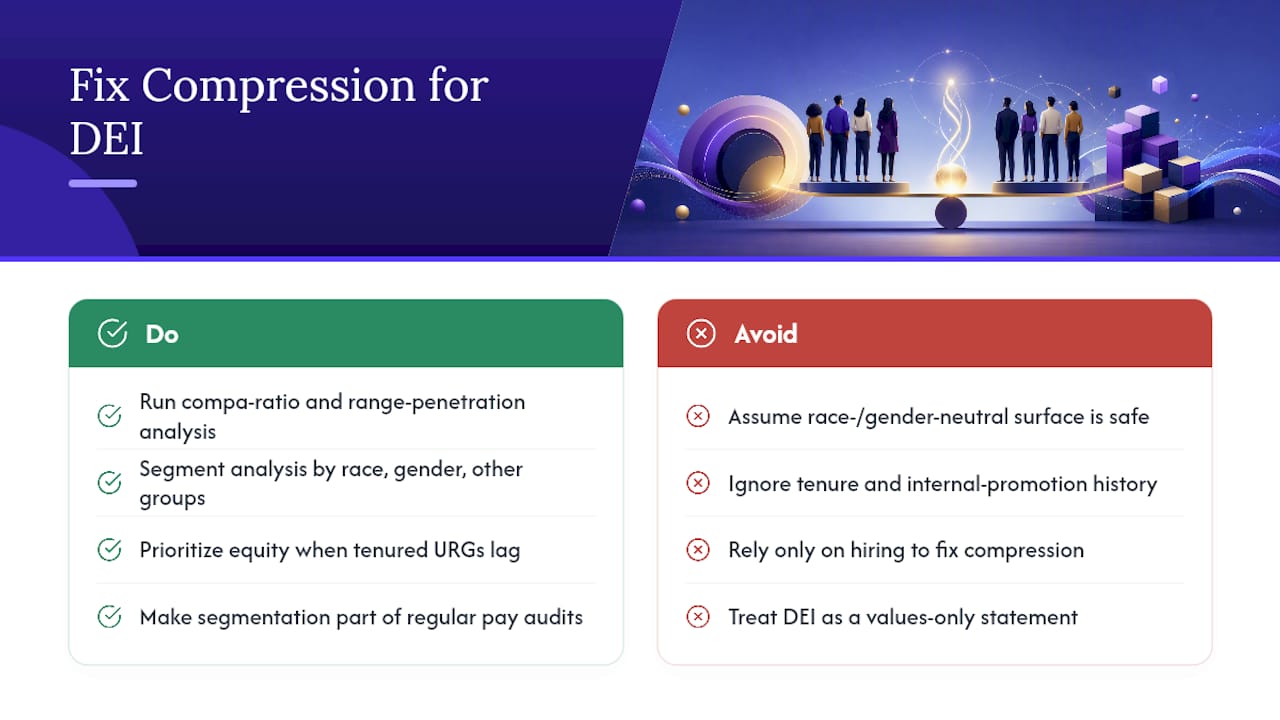
Compression can quietly undo diversity, equity, and inclusion progress that took years to build. When new-hire pay rises faster than internal raises, and hiring pools have grown more diverse over that same period, the employees who benefit from market corrections skew toward recent hires, while longer-tenured women and employees of color, who are statistically more likely to have joined earlier and advanced through internal promotion rather than external hiring, can end up anchored to older, lower pay bands.
This creates a pattern that looks race- or gender-neutral on the surface but produces a disparate outcome: newer, often more diverse hires earn close to what senior employees from historically underrepresented groups earn, even though the senior employees have more tenure and typically stronger performance records. The EEOC's guidance on protected-class pay differences applies directly here. A compensation structure doesn't need discriminatory intent to produce a discriminatory result, and disparate-impact claims focus on outcomes, not motive.
Run your compa-ratio and range-penetration analysis segmented by race, gender, and other protected characteristics, not just by tenure or department. If tenured employees from underrepresented groups cluster at lower compa-ratios than tenured employees overall, that's a signal your compression fix needs to prioritize equity, not just seniority. Building this segmentation into your regular pay audit turns DEI commitments from a values statement into something you can actually measure and correct.
How Should HR Communicate About Pay Compression?
Silence is the worst response to compression, and it's also the most common one. Employees usually sense pay compression before HR confirms it. They compare notes, they see job postings for their own role advertising higher starting pay, and they draw conclusions long before a formal correction happens.
Transparency doesn't mean publishing everyone's exact salary. It means explaining, in plain terms, how pay ranges are set, how progression works within them, and what triggers a market adjustment. The MIT Sloan research on workplace fairness and commitment found that perceived fairness, not just objective pay levels, drives whether employees stay engaged. A defensible, explainable process changes that perception even before the dollars move.
Practical communication steps that hold up in practice:
- Share the methodology behind your pay ranges (market percentile targets, review cadence) at a company level, even if individual figures stay private.
- Train managers to answer "why does the new hire make close to what I make" honestly, pointing to the market data driving both numbers.
- Announce phased correction plans with real dates attached, not vague commitments to "look into it."
- Give managers a script for the conversation before compression becomes a resignation letter.
Preventing Salary Compression for Good
A one-time correction fixes today's compression. It does nothing to stop next year's. The employers who avoid recurring compression treat pay structure as an ongoing discipline, not an annual scramble triggered by a resignation.
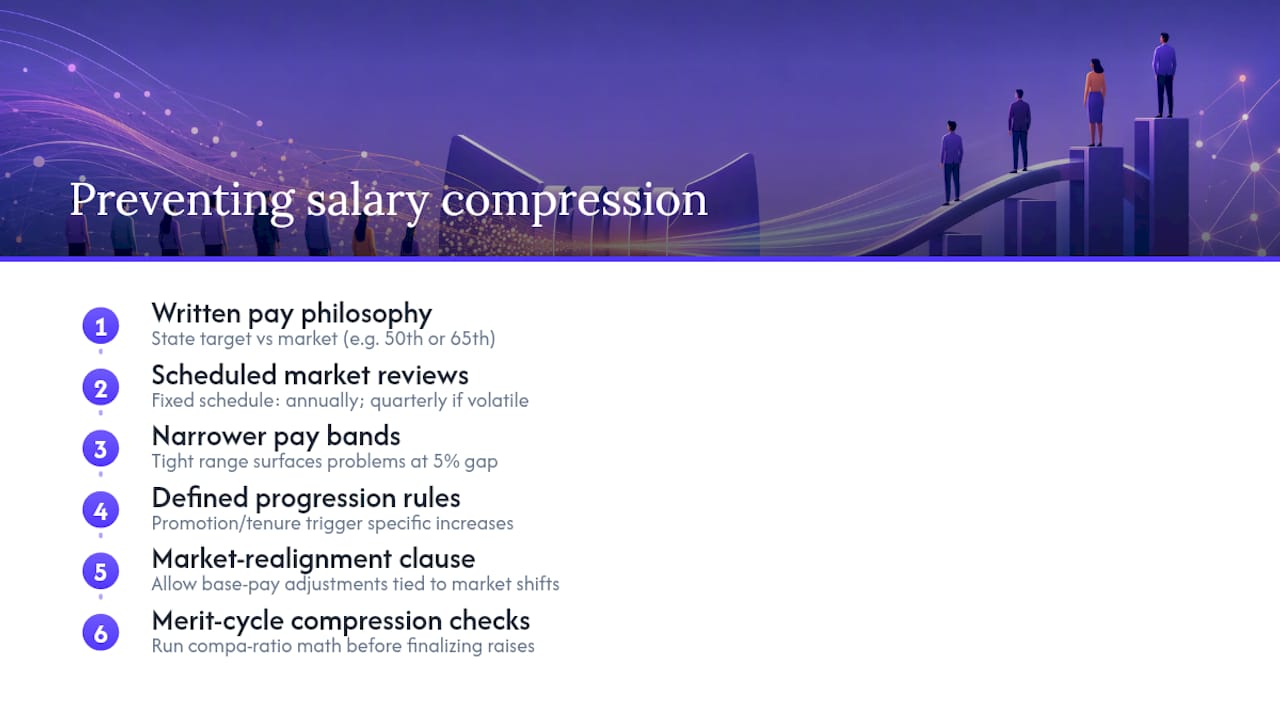
That starts with a written pay philosophy stating explicitly where the organization aims to sit against market, whether that's the 50th percentile for most roles or the 65th for hard-to-fill technical positions. Without that anchor, every pay decision becomes a one-off negotiation rather than a consistent policy.
Build market-rate reviews into the budget calendar the same way you budget for benefits renewal: annually at minimum, quarterly for roles in volatile markets like software engineering or skilled healthcare trades. A structured market compensation analysis run on a fixed schedule catches drift before it becomes a crisis.
Narrower pay bands limit how far compression can spread before it becomes visible, since a tight range surfaces problems at a 5% gap instead of hiding them inside a 20% spread. Pair that with defined progression rules, so a promotion or tenure milestone triggers a specific, calculable increase instead of a manager's best guess.
One underused tool: build a market-realignment clause into offer letters from the start, allowing base-pay adjustments tied to market shifts without labeling them merit increases. That gives you a contractual path to correct compression later without the awkward conversation about why someone's raise doesn't look like a performance reward.
Finally, treat every merit cycle as a compression check, not just a raise distribution. Run the compa-ratio math before finalizing increases, so the loudest voice in the room doesn't determine who gets fixed first.
What One HR Leader Learned Fixing Pay Compression
The pattern usually starts small: an exit interview mentions pay, and a quick compa-ratio pull reveals half the engineering team sitting under 0.85. Prioritizing the retention-risk roles first, funding those with a mix of retention bonuses and phased base increases, buys the runway needed for a full range rebuild.
The real lesson: compression rarely gets fixed once. It reappears every time hiring outpaces internal reviews. Building the audit into a recurring calendar item, not a reaction to a crisis, is what actually holds.
, Joelen Zyoktova
Where to Find Reliable Benchmark Data for Your Next Pay Audit
Every fix described here depends on one thing: knowing what the market actually pays for a given role, in a given state, right now. Guessing at that number, or relying on outdated survey data, is how compression sneaks back in a year after you thought you'd fixed it.
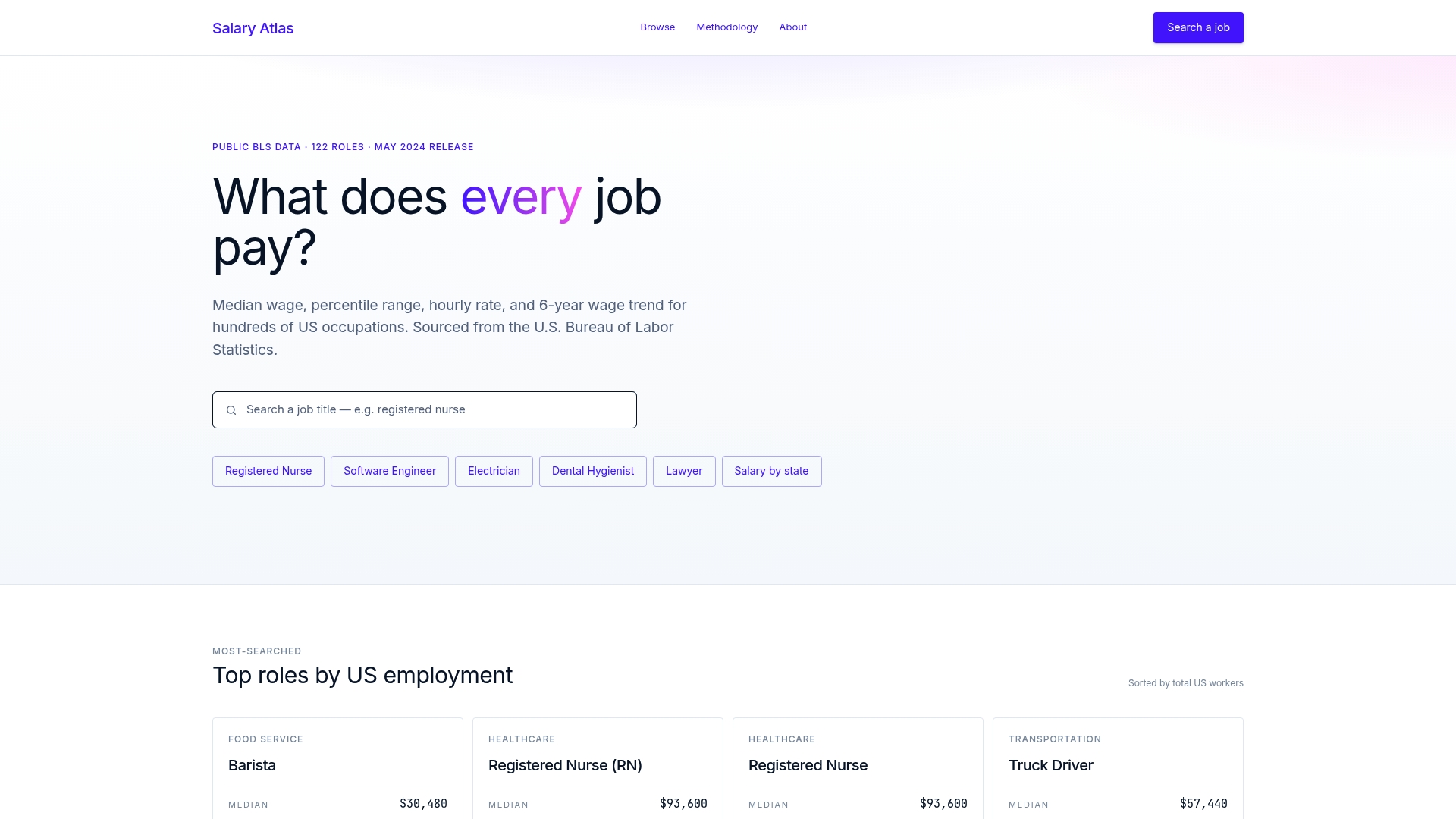
Salary Atlas publishes occupation-level medians, percentiles, and state-by-state breakdowns sourced directly from Bureau of Labor Statistics OEWS data, with every figure linked back to its federal source. No paywall, no signup, no smoothed-over numbers designed to look tidier than reality. That means when you're setting compa-ratio thresholds or building a case for a market adjustment, you can hand finance a number they can independently verify instead of asking them to trust a vendor's black-box index.
Start by pulling the state-level salary data for your affected roles to see how your current ranges compare against current federal benchmarks, and review the full methodology if you need to document your sourcing for an internal audit or legal review.
Sources
- Who is protected by the federal employment discrimination laws? | EEOC
- How workplace fairness affects employee commitment | MIT Sloan Management Review
- Salary Compression | How to Avoid and Fix It | ADP
- Pay Compression: When Staying Doesn't Pay | Paylocity
FAQ
Is Wage Compression Illegal?
Compression itself is not automatically illegal, but pay disparities that correlate with race, sex, age, or another protected class can trigger discrimination liability under EEOC guidance, even when the gap originated from ordinary market drift rather than intent.
How Do You Avoid Salary Compression?
Run regular compa-ratio and range-penetration audits, tied to current market benchmarks like BLS-sourced occupational wage data, and adopt a written pay philosophy with defined progression rules so raises follow a consistent policy instead of ad-hoc decisions.
Is a 3% Raise Enough in 2026?
A flat 3% increase rarely closes a compression gap on its own, since it typically tracks general cost-of-living movement rather than the market-rate jumps that cause compression in the first place; a targeted market adjustment on top of standard merit increases is usually needed for genuinely underpaid roles.
What Is the Difference Between Salary Compression and Salary Inversion?
Salary compression means pay gaps between tenure levels have narrowed but senior employees still earn more; salary inversion is the more severe case where newer hires actually out-earn the longer-tenured employees who trained them.
What Is Range Penetration, and Why Does It Matter?
Range penetration measures where an employee's salary sits within their full pay band, from minimum to maximum, and it helps identify compression when employees at very different tenure levels show nearly identical penetration percentages.
Recommended
Occupation wage figures on Salary Atlas come from the U.S. Bureau of Labor Statistics. Figures in this article that are not linked to a source are estimates. See our methodology.