Annualized Salary: How to Calculate and Check Market Rates
Learn how to calculate your annualized salary easily and understand market rates. Make informed financial decisions about your earnings!
By the Salary Atlas editorial team · Published

An annualized salary is a projection of what you'd earn in a full year at your current pay rate, expressed as a gross figure before taxes or deductions. It is not necessarily what you're guaranteed to receive. The core formula is simple:
- Hourly workers: hourly rate × 2,080 hours (40 hrs/week × 52 weeks)
- Pay-period workers: gross pay per period × number of periods per year (weekly × 52, biweekly × 26, semi-monthly × 24, monthly × 12)
- Quick example: $40/hr × 2,080 = $83,200 annualized salary
Key Takeaways
An annualized salary is a gross projection of full-year earnings at your current pay rate, not a payment guarantee, and the primary formula for U.S. full-time workers is hourly rate × 2,080 hours.
| Point | Details |
|---|---|
| Core definition | Annualized salary = projected gross yearly earnings at your current pay rate, before taxes. |
| Primary formula | Hourly rate × 2,080 hours gives the full-time annual equivalent for most U.S. jobs. |
| Projection, not a promise | At-will employment means an annualized figure does not guarantee 12 months of pay. |
| Paycheck reality | Gross annualized pay typically nets roughly 60–70 cents on the dollar after taxes and deductions. |
| Salary Atlas | Use Salary Atlas to compare your annualized offer against BLS-sourced percentile data by job title and state, free of charge. |
Table of Contents
- How do you calculate annualized salary from any pay basis?
- Quick salary conversions you can use right now
- What's the difference between an annualized salary and an annual salary?
- How does annualized salary affect your paycheck and budget?
- When and why do employers use annualized figures?
- Where can you verify whether your salary is competitive?
- How to evaluate an offer and negotiate using your annualized number
- Salary formula cheat sheet
- Salary Atlas makes market-rate verification fast and free
- The number on the offer letter is a starting point, not a verdict
- Sources
- FAQ
How do you calculate annualized salary from any pay basis?
The math changes depending on how your employer pays you, but the logic stays the same: find your rate, multiply by how many times that rate repeats in a year.
Hourly to annual
The standard full-time baseline is 2,080 hours (40 hours × 52 weeks). Multiply your hourly rate by that figure for a full-time equivalent. If your schedule differs, say, 32 hours per week, use your actual expected hours instead: 32 × 52 = 1,664 hours.
| Pay Basis | Formula | Example |
|---|---|---|
| Hourly | Rate × hours/week × 52 | $25 × 40 × 52 = $52,000 |
| Weekly | Weekly pay × 52 | $1,000 × 52 = $52,000 |
| Biweekly | Biweekly pay × 26 | $2,000 × 26 = $52,000 |
| Semi-monthly | Semi-monthly pay × 24 | $2,166.67 × 24 = $52,000 |
| Monthly | Monthly pay × 12 | $4,333.33 × 12 = $52,000 |
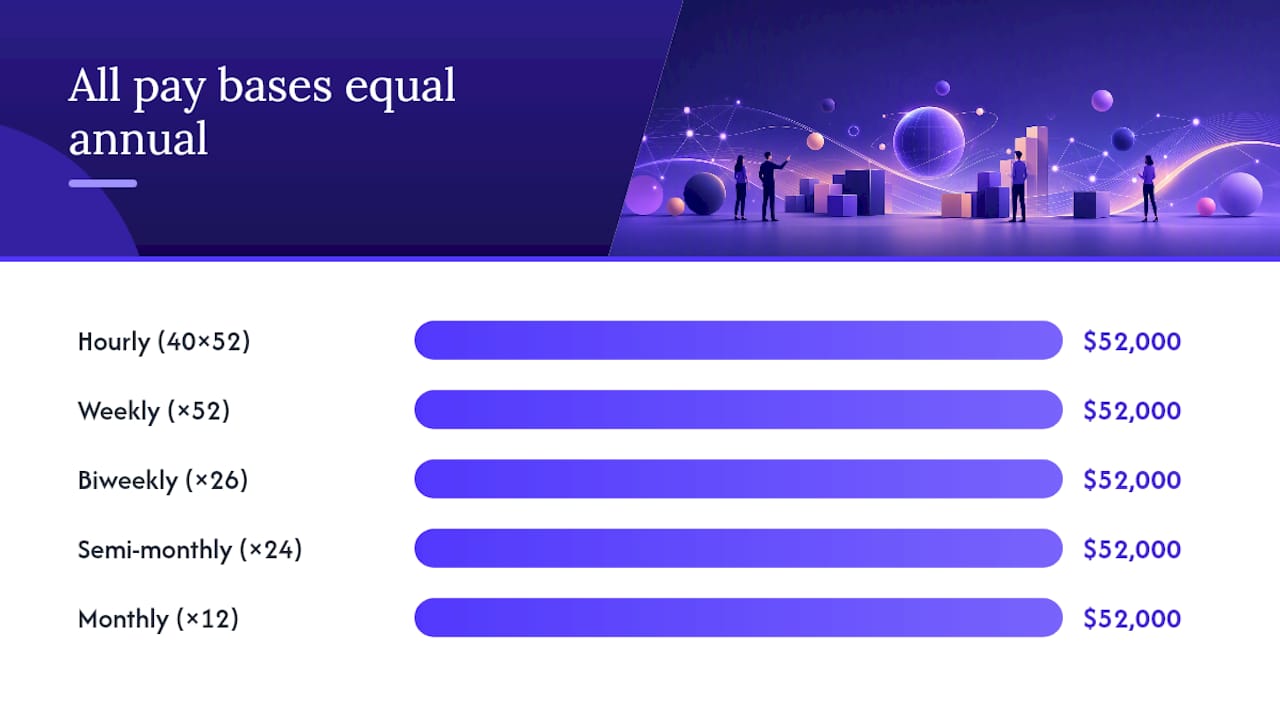
All five rows produce the same annualized figure when the underlying rate is constant. The ADP paycheck calculator uses exactly this logic: multiply a single period's gross pay by the number of pay periods per year to arrive at the annual income figure.
Prorating for mid-year starts
When someone joins or leaves partway through the year, employers prorate. The cleanest method:
- Daily-average method: (annual salary ÷ 365) × days employed
- Payroll-period method: count the actual pay periods worked and multiply by the per-period rate
When to include overtime, commissions, and bonuses
- Base annualized salary: exclude variable pay. This is the figure most offer letters state.
- Total annualized compensation: add expected bonuses, commissions, and regular overtime. Useful for budgeting but harder to guarantee.
Quick salary conversions you can use right now
The most common search people run is a single hourly rate converted to a yearly number. Here are the most-searched conversions using the 2,080-hour full-time baseline:
- $20/hr → $41,600/year
- $25/hr → $52,000/year
- $30/hr → $62,400/year
- $40/hr → $83,200/year
- $50/hr → $104,000/year
- $75/hr → $156,000/year
| Hourly Rate | Annual (2,080 hrs) | Monthly Equivalent | Biweekly Paycheck (gross) |
|---|---|---|---|
| $20.00 | $41,600 | $3,467 | $1,600 |
| $25.00 | $52,000 | $4,333 | $2,000 |
| $30.00 | $62,400 | $5,200 | $2,400 |
| $40.00 | $83,200 | $6,933 | $3,200 |
| $50.00 | $104,000 | $8,667 | $4,000 |
| $75.00 | $156,000 | $13,000 | $6,000 |
What's the difference between an annualized salary and an annual salary?
These two terms get used interchangeably in offer letters, and that's a problem. They mean different things.
- Annualized salary: a projection. It says, "If you work at this rate for a full year, you'd earn X." It does not guarantee X.
- Annual salary: typically the contractual stated pay for the employment term. In a fixed-term contract, this is what the employer has committed to pay.
That sentence is what a well-drafted offer letter looks like. If yours doesn't include language like it, ask HR to clarify in writing before you sign.
HR note on exempt vs. non-exempt status: presenting an annualized dollar figure does not make someone exempt under the FLSA. Exemption depends on job duties and meeting the DOL's salary-level threshold, not on how the pay is expressed. An annualized hourly rate that clears the threshold still requires a duties test to pass.How does annualized salary affect your paycheck and budget?
Gross annualized pay and take-home pay are two very different numbers. Here's how to get from one to the other.

Per-paycheck gross amounts
Divide your annualized salary by the number of pay periods your employer uses:
Biweekly and semi-monthly schedules produce different per-check amounts even though both result in 24 or 26 checks per year. Two months per year, biweekly employees receive three paychecks instead of two. That extra check can temporarily push withholding higher if your employer uses a per-period annualization method to calculate federal income tax.
What comes out of each check
The IRS distinguishes taxable from nontaxable income when determining what employers must withhold. Pre-tax deductions reduce your taxable wages before withholding is calculated.
Common deductions that reduce gross pay to net take-home:
- Federal income tax (withheld using IRS tables based on your W-4)
- State income tax (varies by state; nine states have none)
- FICA: Social Security (6.2% of wages up to the annual wage base) and Medicare (1.45%)
- Pre-tax retirement contributions (401(k), 403(b)), reduce taxable income
- Pre-tax health, dental, and vision premiums, reduce taxable income
- Post-tax deductions (Roth 401(k), garnishments), do not reduce taxable income
Sample paycheck breakdown ($72,000 annualized, biweekly, single filer, no state tax)
| Line Item | Amount |
|---|---|
| Gross pay | $2,769.23 |
| Pre-tax 401(k) (6%) | ($166.15) |
| Pre-tax health premium | ($120.00) |
| Taxable wages | $2,483.08 |
| Federal income tax (est.) | ($298.00) |
| Social Security (6.2%) | ($154.00) |
| Medicare (1.45%) | ($36.00) |
| Net take-home | $1,795.08 |
When and why do employers use annualized figures?
Annualized salary is a communication and budgeting tool. Employers use it to put different pay arrangements on the same scale.
- Offer letters for part-time or seasonal hires: stating an annualized rate lets HR compare a 20-hour-per-week hire to a full-time role without doing the math in the letter itself.
- Headcount budgeting: finance teams project labor costs using annualized figures per FTE, then adjust for expected vacancies and turnover.
- FTE calculations: the IRS uses hours-based thresholds for ACA full-time employee identification. Employees averaging 30 or more hours per week (or 130 hours per month) qualify as full-time for benefits eligibility purposes.
- Pay equity analysis: HR teams annualize all pay to compare across employees with different schedules, hire dates, and pay frequencies.
- An annualized figure presented without specifying expected hours per week
- No mention of whether the role is seasonal or year-round
- A total compensation figure that blends base pay with variable bonuses as if both are guaranteed
Where can you verify whether your salary is competitive?
Knowing your annualized figure is only half the job. The other half is knowing where it sits in the market.
Step-by-step verification checklist:- Identify your exact job title and the metropolitan area or state where the role is located.
- Look up the BLS Occupational Employment and Wage Statistics (OEWS) data for that title and geography.
- Find the median (50th percentile) and 75th-percentile annual wage for your occupation.
- Compare your annualized offer to those benchmarks.
- Adjust for cost of living if you're comparing across states.
- Your annualized base salary vs. the BLS median for your title
- Your total compensation (base + bonus + benefits) vs. the 75th percentile
- Local vs. national figures, since wages for the same title can vary by 40% or more across states
For SHRM members, the SHRM compensation benchmarking tools add survey-based data that complements BLS figures, particularly for specialized or senior roles where OEWS samples can be thin.
How to evaluate an offer and negotiate using your annualized number
Once you have your annualized figure and a market benchmark, negotiation becomes a numbers conversation rather than a feelings conversation.
Negotiation checklist:- Confirm the expected hours per week and pay frequency in writing.
- Ask whether the annualized figure is base only or includes variable pay.
- Request written clarification of benefit eligibility criteria (start date, hours threshold).
- Pull the BLS or Salary Atlas percentile for your title and location.
- Calculate the gap between the offer and the 75th-percentile benchmark.
- Prepare a counter with a specific number, not a range.
- "Is this annualized salary guaranteed for 12 months, or is it a rate expression?"
- "What pay frequency will you use, and how many pay periods does that mean per year?"
- "Does this figure include any variable compensation, or is it base only?"
- "At what point does benefits eligibility begin, and what hours threshold applies?"
Salary formula cheat sheet
Keep these conversions handy for quick calculations:
- Hourly → annual (full-time): hourly rate × 2,080
- Hourly → annual (custom hours): hourly rate × (hours/week × 52)
- Weekly → annual: weekly gross × 52
- Biweekly → annual: biweekly gross × 26
- Semi-monthly → annual: semi-monthly gross × 24
- Monthly → annual: monthly gross × 12
- Annual → per-paycheck (biweekly): annual ÷ 26
- Annual → per-paycheck (semi-monthly): annual ÷ 24
- Prorate (daily method): (annual salary ÷ 365) × days employed
- Prorate (high precision, partial periods): (actual gross ÷ days worked) × 365
Salary Atlas makes market-rate verification fast and free
You've done the math on your annualized salary. Now the real question is whether that number is competitive for your title, your state, and your experience level. Salary Atlas gives you that answer in two steps: search your job title, select your state, and read the percentile bands pulled directly from BLS OEWS data. No subscription, no paywall, no figures that can't be traced back to a government source.
A teacher checking an offer in Ohio, for example, can pull up the high school teacher salary page and see exactly where that annualized offer lands relative to the state median and 75th percentile. The same logic applies to any occupation. Every data point on Salary Atlas links back to its original BLS source, so you can verify the methodology yourself at Salary-atlas.
Start your lookup at Salary Atlas and know within minutes whether your offer is worth negotiating.
The number on the offer letter is a starting point, not a verdict
Most people treat the annualized salary in an offer letter as a fixed fact. It isn't. It's a rate expressed as a yearly equivalent, and the actual money you receive depends on hours worked, pay frequency, tax elections, and benefit deductions that nobody hands you a summary of upfront.
The more useful habit is to treat the annualized figure as a planning input, not a conclusion. Run it through the per-paycheck math. Check it against BLS percentiles for your title and state. Ask HR the four questions listed in the negotiation section above. The readers who do that work before signing consistently end up with better offers and fewer surprises on their first paycheck.
One thing the market-rate data consistently shows: the gap between the median and the 75th percentile for most occupations is larger than people expect. Knowing which side of that gap your offer sits on is worth ten minutes of research.
Sources
These are the primary U.S. resources to consult when you need authoritative definitions, rules, or wage data:
One practical caution: treat any annualized figure as a projection when applying for loans, leases, or benefits. Lenders and landlords often want documentation that matches prior-year W-2 totals. If your annualized income differs from last year's actual earnings, be prepared to explain the gap.FAQ
What does it mean when your salary is annualized?
An annualized salary is a projection of what you'd earn over a full year at your current pay rate. It's a gross figure before taxes and deductions, and in at-will employment it does not guarantee 12 months of pay.
How much is $40 an hour annualized?
At the standard full-time baseline of 2,080 hours (40 hours × 52 weeks), $40/hr annualizes to an estimated $83,200. If your actual schedule differs, multiply your hourly rate by your real expected annual hours instead.
Is $70,000 a good annual salary?
It depends on your occupation, location, and experience level. The BLS OEWS data shows wide variation by title and state. Use Salary Atlas to check where $70,000 falls relative to the median and 75th percentile for your specific job title and state.
Is a 4% annual salary increase good?
Wage growth in most years, but whether it's "good" depends on your starting point relative to market.
Recommended
Occupation wage figures on Salary Atlas come from the U.S. Bureau of Labor Statistics. Figures in this article that are not linked to a source are estimates. See our methodology.