Speech Language Pathologist Salary: What US SLPs Earn in 2026

The median speech language pathologist salary in the United States sits near $95,410 a year, based on the most recent federal wage data. That number moves a lot depending on where you work. A school-based SLP on a 9-month contract often earns tens of thousands less on paper than a hospital-based clinician, even though the hourly math can land closer than you'd expect. Before you accept or reject an offer based on a headline figure, check it against the source.
- National median: roughly $95,410 annually
- Biggest swing factor: work setting and contract length (9 vs. 12 months)
- Verify against: BLS Occupational Employment and Wage Statistics and ASHA's annual salary surveys
Quick stat: The 10th to 90th percentile range for SLPs spans from entry-level pay in the $60,000s to senior clinical and administrative roles well above $120,000.
Key Takeaways
Speech language pathologist salary depends more on work setting and contract length than on years of experience alone, though both matter.
| Point | Details |
|---|---|
| National median | Roughly $95,410 annually, with hospital and SNF settings often paying above that figure. |
| Setting drives pay | School contracts run 9 to 10 months and annualize differently than 12-month clinical roles. |
| Certification pays off | CCC-SLP supplements average near $750 to $1,250 and often gate access to higher-paying roles. |
| Leadership multiplies pay | Administrator-only roles reach medians of $114,000 versus $85,900 for clinical-only positions. |
| Verify locally | Use Salary Atlas to check state and metro medians against BLS source data before negotiating. |
Where to Verify These Numbers Yourself
- BLS OEWS: best for national percentile and wage data
- ASHA Health Care and Schools Surveys: best for setting-specific medians
- Salary Atlas state pages: best for local, sourced comparisons
Table of Contents
- Speech Language Pathologist Salary: National Median, Mean, and Percentiles
- How SLP Pay Differs By Work Setting
- Which States and Cities Pay SLPs the Most?
- Does Experience or Certification Raise Your Salary More?
- What Should SLPs Negotiate Beyond Base Salary?
- Is Demand For Speech Language Pathologists Growing?
- How These Salary Figures Were Compiled
- Sources
- FAQ
Speech Language Pathologist Salary: National Median, Mean, and Percentiles
Two numbers get thrown around interchangeably in salary discussions, and they shouldn't be. The median is the midpoint, half of SLPs earn more, half earn less, and it's the number you should anchor to when sizing up an offer. The mean gets pulled upward by high earners in supervisory and administrative roles, which is why it often reads higher than what a typical clinician actually takes home.
The national median annual salary lands around $95,410, according to BLS-derived reporting. ASHA's own health care survey data puts the median full-time salary in health care facilities at $90,000, a useful cross-check since it comes from a different survey population.
| Percentile | Approximate Annual Salary |
|---|---|
| 10th | $60,000s |
| 25th | $74,000 |
| median | ~$95,410 |
| 75th | $104,000 |
| 90th | above $120,000 |
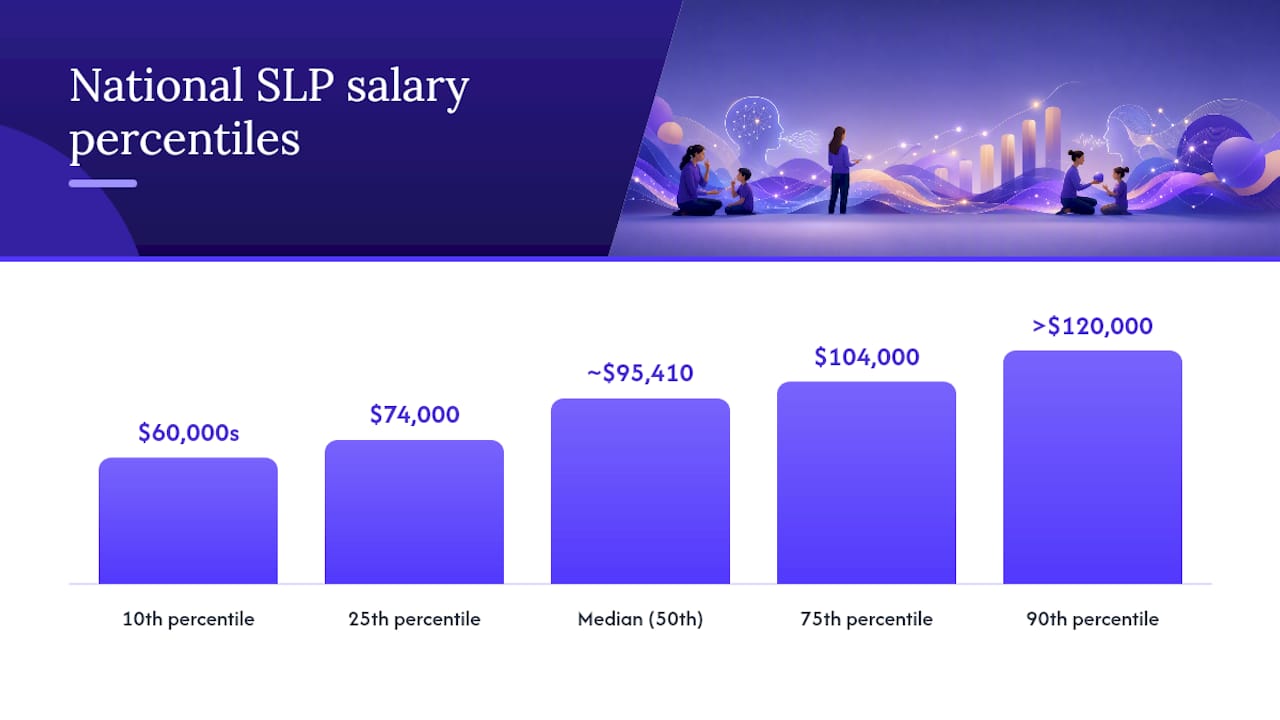
If you're a new grad, the 10th to 25th percentile band is your realistic starting range. If you've got a decade of experience and a specialty, you should be pushing toward the 75th percentile or higher, not settling for the median.
How SLP Pay Differs By Work Setting
Where you work changes your paycheck as much as how long you've worked. Skilled nursing facilities and hospitals tend to post the highest mean salaries among common SLP settings, often because of higher acuity caseloads and more billable service hours. Private practice can rival or beat those numbers, especially for SLPs who own their caseload or take on administrative duties.
- Hospitals and SNFs: Frequently among the top-paying settings, with six-figure salaries common for experienced clinicians.
- Private practice and outpatient clinics: Pay varies widely, but ownership or leadership tracks often outpace clinical-only roles.
- K-12 schools: Academic-year median around $74,849, tied to a 9 to 10 month contract.
- Early intervention and home health: Often pays less per year but offers flexible scheduling.
- Telepractice: Rates vary by platform and caseload, sometimes paid hourly rather than salaried.
Pro Tip: A school-based salary of $74,849 for 9 to 10 months annualizes to a rate comparable with many 12-month clinical roles once you divide it across actual working months, not calendar months. Do that math before assuming schools underpay.
Which States and Cities Pay SLPs the Most?
Geography changes your speech language pathologist salary more than almost any other factor besides work setting. States like California, New York, and New Jersey consistently show higher median SLP pay, largely driven by cost of living, dense healthcare markets, and, in some cases, stronger public school funding formulas. The Pacific and West regions as a whole tend to outpace the national median.
Higher pay doesn't always mean higher purchasing power. A salary that looks impressive in a coastal metro can stretch less far than a more modest number in a lower-cost state. The smart move is comparing your offer against the median for that specific state or metro, not the national figure, using a tool like Salary Atlas's state-by-state salary data.
Quick stat: SLPs in top-paying states can out-earn the national median by $15,000 to $20,000 annually, before adjusting for local cost of living.Does Experience or Certification Raise Your Salary More?
Experience builds your salary steadily rather than in dramatic jumps. ASHA survey data shows early-career SLPs with under 3 years of experience earning medians near $74,000, while those with 28 to 30 years in the field approach or exceed $104,000.

The bigger lever is often the move from clinician to administrator. ASHA's health care survey found administrators who still see patients earn a median of $100,000, while administrator-only roles reach $114,000, well above the $85,900 median for clinical-only providers.
Pro Tip: If your goal is maximum earning potential, plan your CCC-SLP certification early and start angling toward supervisory responsibilities by year five or six. Waiting until year fifteen to pursue leadership costs you a decade of higher pay.What Should SLPs Negotiate Beyond Base Salary?
Base salary is only part of the offer. ASHA's own guidance pushes candidates to look at total compensation, not just the number on the offer letter, since supplements and contract structure can swing your effective pay by thousands of dollars.
- CCC-SLP supplements, typically a median around $750 with means near $1,250 in school settings
- Sign-on and relocation bonuses, common in high-demand rural and hospital settings
- Retirement match, loan repayment assistance, and PTO structure
- Caseload size and travel reimbursement, both of which affect real hourly workload
Before comparing two offers, confirm whether the salary is academic-year or calendar-year and annualize accordingly. A red flag worth watching: offers that bundle "competitive salary" language with vague caseload numbers, ask for the caseload cap in writing before you sign. Pro Tip: Ask directly: "Is this salary based on a 9-month or 12-month contract, and what's the maximum caseload per week?" Vague answers to either question are a warning sign.
Is Demand For Speech Language Pathologists Growing?
Demand for SLPs stays strong, driven by an aging population and steady clinical need tied to speech, language, and swallowing disorders documented by federal health data. That demand gives working SLPs real leverage, especially in rural areas and skilled nursing facilities where staffing shortages are common.
Strong demand means more room to negotiate salary, signing bonuses, and flexible scheduling, particularly if you're willing to relocate. Check current projections directly through the Bureau of Labor Statistics before finalizing a move, since regional demand shifts year to year.
How These Salary Figures Were Compiled
These figures combine BLS occupational wage data with ASHA's annual health care and schools salary surveys, the two most reliable recurring sources for SLP compensation in the US. Percentile breakdowns come from BLS reporting; setting-specific medians come from ASHA survey respondents.
State-level and small-sample data can be noisy. Where sample sizes are small, treat state medians as directional rather than exact, and always confirm figures against source data before making a job decision.
- BLS Occupational Employment and Wage Statistics (most recent reference year)
- ASHA 2025 Health Care Survey and 2024 Schools Survey
- U.S. Department of Labor resources for broader labor market context
A Note on Trusting Salary Data
Salary numbers get repeated so often across job boards that the original source gets lost. Every figure in this guide traces back to a named survey or federal dataset, not a scraped estimate, because a speech language pathologist salary figure is only useful if you can verify where it came from.
Check Your Exact Number With Salary Atlas
Averages only get you so far. If you want to know what SLPs actually earn in your state or metro, not just the national figure, Salary Atlas's state salary pages break down BLS wage data by location with no paywall and no sign-up wall. Every figure links straight back to its federal source, so you can check it yourself before walking into a salary conversation.
If you're comparing an SLP offer against other allied health or education roles, Salary Atlas also tracks pay for related therapy professions and school-based roles side by side. Start by pulling up your state's page and lining up the median against your offer before you counter.
Sources
- Speech-Language Pathologist Salary Guide (2026) | Ithaca College
- 2025 SLP Health Care Survey: Annual Salary Report
- SLP Salary Guide 2026: Average Pay by State & Setting
FAQ
Who Earns More, an OT or an SLP?
Occupational therapists and speech language pathologists earn similar national medians, though OT pay tends to run slightly higher in hospital and outpatient settings, while SLP pay in schools and early intervention can trail both professions.
Which SLP Specialty Pays the Most?
Administrative and supervisory roles, along with hospital and skilled nursing facility positions, tend to pay the most, with administrator-only roles reaching medians near $114,000 compared to $85,900 for clinical-only providers.
Is Speech Pathology a Hard Career?
Speech pathology demands strong clinical judgment, ongoing continuing education, and often high caseloads, particularly in schools and skilled nursing facilities, but it offers steady demand and clear paths to higher pay through certification and leadership roles.
Do SLPs Get Paid More Than Nurses?
Pay comparisons between SLPs and nurses vary widely by nursing specialty and setting; rather than a blanket answer, compare specific roles and settings directly using sourced data like Salary Atlas's state-by-state figures for an accurate local comparison.