CEO Jamie Dimon Salary: Full 2025 Breakdown
 *
*
TL;DR:>
- Jamie Dimon's 2025 total compensation is $43 million, mostly from performance-based incentives and equity awards. His pay exceeds the median S&P 500 CEO salary and reflects a high pay ratio compared to typical employees. Most of his incentives depend on JPMorgan's long-term financial performance, emphasizing relatively at-risk compensation.*
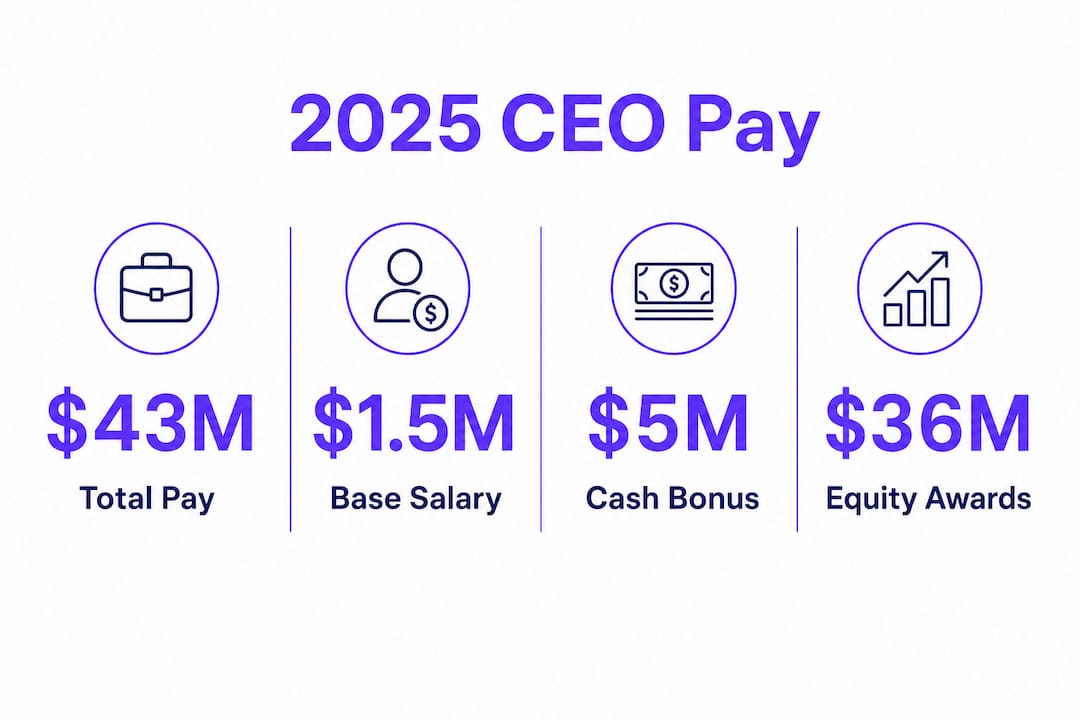
Jamie Dimon's total CEO compensation at JPMorgan Chase reached $43 million in 2025, a 10.3% increase from $39 million in 2024. That figure places him well above the median S&P 500 CEO pay of $17.7 million, making his package one of the most closely watched in American finance. The CEO Jamie Dimon salary is not primarily cash. More than 96% of his total pay comes from performance-based incentives and equity awards tied to measurable financial outcomes. Understanding how that package is built, and what it signals about executive compensation trends, tells you far more than the headline number alone.
What components make up Jamie Dimon's CEO salary package?
Dimon's $43 million total compensation breaks down into two distinct parts. His base salary is $1.5 million, which is modest by Fortune 500 standards. The remaining $41.5 million is variable incentive compensation tied directly to JPMorgan Chase's performance.
That $41.5 million incentive package splits further into two components:
- $5 million in cash: A direct performance bonus paid out based on annual results.
- $36.5 million in Performance Share Units (PSUs): Equity awards that vest only when the company hits specific financial targets.
PSUs are the core of Dimon's pay structure. 88% of his variable incentive pay is granted as at-risk PSUs tied to Return on Tangible Common Equity (ROTCE), a key banking profitability metric. If JPMorgan misses its ROTCE targets, Dimon receives fewer shares or none at all.
PSUs also carry vesting schedules and hold requirements, meaning Dimon cannot immediately sell shares once they are granted. SEC disclosure rules require companies to report the grant-date fair market value of stock awards, not the amount Dimon actually pockets in a given year. Clawback provisions allow JPMorgan to reclaim awards if performance targets are later missed or if misconduct is found.
 Pro Tip: When you read a CEO's reported compensation, check how much is base salary versus at-risk equity. A $43 million figure that is 85% PSUs tells a very different story than $43 million in guaranteed cash.
How does Jamie Dimon's pay compare with other top CEOs?
Dimon's $43 million sits well above the broader S&P 500 CEO average but aligns closely with the elite tier of the highest-paid executives in the country.
| Benchmark | Compensation |
|---|---|
| Jamie Dimon, JPMorgan Chase (2025) | $43 million |
| Median S&P 500 CEO pay (2025) | $17.7 million |
| Median pay, top 100 highest-paid CEOs (2026) | $39.4 million |
| Median employee pay, S&P 500 (2025) | $89,744 |
The CEO-to-worker pay ratio sharpens the picture further. The median CEO-to-worker ratio across the S&P 500 stands at 200:1. JPMorgan's ratio is 625:1, meaning Dimon earns 625 times the pay of a typical JPMorgan employee. That gap is more than three times the S&P 500 median ratio and reflects the scale of JPMorgan's operations as the largest U.S. bank by assets.
A few additional points put the comparison in context:
- A financial analyst at a major bank earns a median salary that represents a fraction of a single percentage point of Dimon's total package.
- The median teacher salary in the U.S. illustrates how far the CEO-to-worker gap extends beyond the financial sector.
- Pay-performance alignment grades from CEOPayWatch show about 8% of S&P 500 companies earn poor grades, though JPMorgan rates well on this measure.
Why does JPMorgan's board defend Dimon's high pay?
JPMorgan's board grounds its justification in one principle: pay must reflect results. The board's pay-for-performance framework ties Dimon's compensation directly to firm stewardship, market-leading financial results, and balance sheet strength. JPMorgan has consistently ranked as the most profitable major U.S. bank, and the board argues that retaining Dimon requires compensation competitive with the broader market for elite executive talent.
"The board's strong pay-for-performance rationale illustrates how JPMorgan aligns Dimon's rewards with shareholder interests and company results. When the firm delivers record profits, the compensation structure is designed to reflect that outcome rather than guarantee it in advance."
Critics push back on this logic. The widening CEO-to-worker pay gap remains a contentious issue in corporate governance and ESG evaluations. Institutional investors and proxy advisory firms increasingly scrutinize whether executive pay growth outpaces shareholder returns. Pay-performance misalignment grades show that while some CEOs earn their packages, others benefit disproportionately without equivalent returns to shareholders.
JPMorgan's case is stronger than most. The bank's ROTCE has consistently exceeded peer benchmarks, and Dimon's PSU structure means his awards are genuinely at risk. Still, governance analysts note that a 625:1 pay ratio creates reputational pressure, particularly as employee wages grow far more slowly than executive compensation.
Pro Tip: When evaluating any CEO's pay package, look up the company's pay-for-performance grade from a third-party source like CEOPayWatch. A strong grade means the board has tied pay to outcomes. A poor grade is a governance red flag.What do Jamie Dimon's earnings reveal about executive pay trends?
Dimon's compensation package is a case study in how modern executive pay actually works. Several structural features define the current era of CEO compensation.
- Base salary is a footnote. Dimon's $1.5 million base represents just 3.5% of his total pay. Across the S&P 500, base salaries have remained relatively flat while equity and incentive pay have grown sharply. The headline number you see in news coverage is almost always dominated by stock awards.
- At-risk equity aligns CEO and shareholder interests. PSUs tied to ROTCE mean Dimon only receives full value if JPMorgan hits its targets. This structure reduces the risk of executives collecting large paydays while shareholders lose money. It is the primary argument boards use to justify large packages.
- Reported pay is not take-home pay. SEC disclosure requirements mandate that companies report the grant-date fair value of stock awards. That number can differ significantly from what a CEO actually receives in a given year, since awards vest over time and values fluctuate with the stock price.
- Pay ratios benchmark internal equity. The 200:1 median CEO-to-worker ratio across the S&P 500 gives investors and employees a concrete way to measure how pay is distributed inside a company. JPMorgan's 625:1 ratio is a data point that governance advocates use to argue for faster wage growth at lower levels.
- Executive pay growth is accelerating. The 35.8% jump in median pay for the top 100 highest-paid CEOs between 2025 and 2026 signals that the gap between elite executive compensation and typical worker wages is widening, not narrowing. Regulatory scrutiny and shareholder activism have slowed this trend at some firms but have not reversed it broadly.
Understanding these five dynamics gives you a framework for reading any CEO compensation disclosure, not just Dimon's.
Key Takeaways
Jamie Dimon's $43 million 2025 compensation is defined by at-risk equity, not guaranteed cash, placing him near the top tier of U.S. CEO pay while JPMorgan's board ties every dollar to measurable financial performance.
| Point | Details |
|---|---|
| Total 2025 compensation | Dimon earned $43 million, a 10.3% increase from $39 million in 2024. |
| Pay structure | 88% of variable pay is at-risk PSUs tied to ROTCE, not guaranteed cash. |
| CEO pay comparison | Dimon earns more than twice the $17.7 million median S&P 500 CEO pay. |
| Pay ratio context | JPMorgan's 625:1 CEO-to-worker ratio is three times the S&P 500 median of 200:1. |
| Reported vs. realized pay | SEC rules require grant-date valuations, so headline figures differ from actual cash received. |
The number that actually matters is not $43 million
By Joelen ZyoktovaEvery year, the headline number lands and the conversation goes in the same direction: is it too much? That framing misses the more interesting question. The number that actually matters is the percentage of Dimon's pay that he has not yet earned and may never receive.
When 88% of your variable pay is tied to ROTCE targets and subject to clawback, your incentives are structurally different from a CEO collecting a guaranteed bonus. I have spent years reading executive compensation disclosures, and the PSU structure at JPMorgan is genuinely more rigorous than most. The board is not simply rewarding Dimon for showing up. They are betting that tying his wealth to the bank's long-term performance produces better decisions than a flat salary ever would.
What concerns me more is the 625:1 pay ratio. Not because Dimon's pay is unjustified on its own terms, but because that ratio reflects a broader pattern where the gains from productivity and profit flow almost entirely to the top. A financial advisor or analyst at JPMorgan contributes to the same results that justify Dimon's PSU payouts. The governance question worth asking is not whether Dimon deserves $43 million. It is whether the workers whose labor generates those ROTCE numbers are seeing proportional gains. The data suggests they are not.
Transparency helps. SEC disclosure rules force companies to publish pay ratios and grant-date valuations. Investors and employees who read those disclosures carefully are better positioned to hold boards accountable. The problem is that most people stop at the headline number and never look at the structure behind it.
— Joelen Zyoktova
Salary Atlas: your source for real compensation data
Dimon's $43 million package sits at the extreme end of the pay spectrum. Most professionals want to know where their own role fits in the broader picture.
Salary Atlas publishes free, transparent salary data sourced directly from the U.S. Bureau of Labor Statistics, covering hundreds of occupations with no paywall and no guesswork. Whether you are benchmarking a financial analyst role, researching salary trends by state, or simply trying to understand where your compensation stands relative to the market, Salary Atlas gives you the numbers with full source attribution. Every figure links back to its original BLS data, so you can verify what you are reading. Explore the full salary database at Salary Atlas and see exactly where your occupation falls on the pay spectrum.
FAQ
What is Jamie Dimon's total salary in 2025?
Jamie Dimon's total compensation for 2025 was $43 million, including a $1.5 million base salary and $41.5 million in performance-based incentives.
How much of Jamie Dimon's pay is cash?
Only $6.5 million of Dimon's 2025 compensation is cash ($1.5 million base plus $5 million cash bonus). The remaining $36.5 million is in Performance Share Units.
How does Jamie Dimon's salary compare to the average CEO?
Dimon's $43 million is more than twice the $17.7 million median S&P 500 CEO compensation, placing him near the top 100 highest-paid U.S. executives.
What is JPMorgan's CEO-to-worker pay ratio?
JPMorgan's CEO-to-median-worker pay ratio is 625:1, compared to the S&P 500 median of 200:1, reflecting the bank's scale and Dimon's large equity awards.
Does Jamie Dimon actually receive $43 million in cash each year?
No. SEC rules require companies to report the grant-date fair value of stock awards, so the $43 million figure includes equity that vests over time and may be clawed back if performance targets are missed.