U.S. Cloud Engineer Salary 2026: Base Around $140,000, BLS Linked

Base pay for U.S. cloud engineers clusters between roughly $135,000 and $152,000 in 2026, with total compensation for experienced specialists often topping $175,000. Location, seniority, and specialty area move that number more than anything else. Target the 50th percentile if you're new to the field, the 75th if you have leverage or a niche skill, and the 90th only if you're a staff-level architect fielding competing offers.
*TL;DR:>
- Cloud engineer base pay is typically between $135,000 and $152,000 in 2026, with total compensation often exceeding $175,000 for experienced specialists.*
- Salary varies significantly by location, with San Francisco and Seattle paying 20% to 30% above the national median, while remote roles are increasingly paid on a national scale.
- Specializations such as cloud security, Kubernetes, AI infrastructure, and multi-cloud skills can significantly boost earning potential, especially at senior levels.
- Entry-level cloud engineers earn about $85,000 to $105,000, mid-levels range from $110,000 to $135,000, and senior roles can surpass $160,000 with equity.
- Employers should set pay bands based on role scope and target different percentiles for roles, with total compensation including bonuses and equity to attract top talent.
Table of Contents
- What Do Cloud Engineers Actually Make? National Benchmarks Explained
- How Much Should You Expect at Each Experience Level?
- Does Location Still Matter for Cloud Engineer Pay?
- Which Skills Push Cloud Engineer Pay Higher?
- How Do You Turn a Benchmark Into a Better Offer?
- How Should Employers Set Competitive Pay Bands?
- Where Do These Numbers Actually Come From?
- Does the Industry You Work In Change Your Pay?
- Cloud Engineer vs. DevOps Engineer vs. Software Engineer: Who Gets Paid More?
- Author Perspective: What the Numbers Actually Mean for You
- Get the Sourced Salary Data Behind This Entire Article
- Sources
- FAQ
What Do Cloud Engineers Actually Make? National Benchmarks Explained
Ask five salary sites for the average cloud engineer salary and you'll get five different numbers, and none of them are lying. They're just measuring different things. Kore1's 2026 guide lands in that mid-$130K to low-$150K base band, while H-1B filing data aggregated by H1Bgrader tends to run higher, since it reflects what sponsoring employers actually pay on paper rather than self-reported figures. Meanwhile, aggregators pulling from H-1B disclosures have published figures north of $200,000 for verified reports, which sounds implausible until you realize those datasets skew toward large tech employers and senior specialists rather than the full market.
Here's the practical breakdown of what drives the spread:
- Crowdsourced platforms (self-reported): tend to run lower and noisier, since anyone can submit a number.
- Job-posting aggregators: reflect advertised ranges, which employers often lowball to leave negotiating room.
- Employer-filed data (H-1B/DOL): the most verifiable, but skewed toward companies that sponsor visas, typically larger firms with richer budgets.
The honest range: If you triangulate across sources, a defensible national base sits around $140,000, with total compensation frequently clearing $175,000 once bonus and equity are factored in. Growing enterprise cloud budgets, projected by Gartner to reach $723 billion in global public cloud spending in 2025, keep demand, and pay, elevated heading into 2026.
How Much Should You Expect at Each Experience Level?
Titles lie more than salary bands do. A "senior cloud engineer" at one company might own production architecture; at another, it's a title bump with no added scope. Base pay tends to track actual responsibility, not years on a resume.
- Entry level (0-2 years): roughly $85,000 to $105,000. Expect scripted deployments, ticket-driven work, and heavy supervision.
- Mid level (3-5 years): roughly $110,000 to $135,000. You're now trusted with independent design decisions and likely carry on-call duties.
- Senior (6-9 years): roughly $135,000 to $160,000, matching the national consensus band closely.
- Staff / architect (10+ years): $160,000 to $200,000+, often with equity attached, especially at product companies.
The jump between mid and senior rarely comes from tenure alone. It comes from taking ownership of architecture decisions, leading incident response, and being the person a director calls at 2 a.m. Titles like DevOps engineer, site reliability engineer, and cloud engineer overlap heavily in job postings; pay usually follows the actual duties listed, not the label on the door.
Does Location Still Matter for Cloud Engineer Pay?
Yes, though remote work has flattened the curve compared to five years ago. Metro premiums still exist, they're just smaller and less predictable than they used to be.
- San Francisco Bay Area and Seattle: typically 20% to 30% above the national median, driven by big tech headquarters and dense competition for senior talent.
- New York City and Boston: roughly 10% to 20% above median, with strong demand from finance and healthcare tech.
- Austin, Denver, and Raleigh: modest premiums of 5% to 10%, reflecting growing but less saturated tech scenes.
- Fully remote roles: increasingly paid on a national band rather than adjusted by ZIP code, though some employers still apply regional pay tiers.
The decision rule is simple: if a company pays a location-adjusted rate, a move to a lower cost-of-living metro can still net you more real income even at reduced nominal pay. If they pay a flat national band, geography stops mattering financially and becomes purely a lifestyle choice.
Which Skills Push Cloud Engineer Pay Higher?
Specialization is where the real money shows up. Generalist cloud engineers plateau faster than those who build a niche around a high-demand problem.
- Cloud security: engineers who can own identity management, compliance controls, and threat detection pull higher offers, and SANS notes that security-focused roles carry clearer senior-track expectations.
- Infrastructure as Code (Terraform, Pulumi, CloudFormation): table stakes for mid-level roles now, but deep expertise still commands a premium.
- Kubernetes and container orchestration: consistently one of the highest-demand skill clusters in job postings.
- AI infrastructure: engineers who can support GPU clusters, model-serving pipelines, and vector databases are pulling some of the sharpest premiums in the current market.
- Multi-cloud fluency: less common than AWS-only or Azure-only skillsets, and rarer skills get paid for.
Certifications still matter at the margins. Coursera's research on AWS Cloud Practitioner holders shows certified candidates reporting higher salaries in employer surveys, though a certification alone rarely beats demonstrated project experience. Pro Tip: If you can only learn one thing this year, learn Kubernetes deeply enough to debug it under pressure, not just deploy a cluster. That's the skill hiring managers test for and rarely find.
How Do You Turn a Benchmark Into a Better Offer?
Base salary is the easiest number to compare and the least complete picture of your actual pay. Bonuses at many cloud engineering employers run 5% to 15% of base, equity grants are common at product companies and startups, and sign-on bonuses have become a standard lever for closing candidates who are weighing multiple offers.
Multiple competing offers are the single biggest lever you have. Recruiters and compensation experts commonly cite a noticeable uplift for candidates who negotiate with a competing bid in hand rather than negotiating alone.
Here's the order of operations that actually works:
- Collect at least one competing offer before you negotiate anything. A number on paper beats a hypothetical every time.
- Separate the base-salary conversation from the equity conversation. Recruiters have more flexibility on one-time bonuses and equity than on base bands tied to internal pay scales.
- Ask for a sign-on bonus explicitly if the base won't move. It's often the easiest concession for a recruiter to make.
- Get the vesting schedule in writing before you compare two equity offers head to head. A four-year cliff versus a monthly vest changes the real value substantially.
How Should Employers Set Competitive Pay Bands?
Hiring managers who anchor a job posting to a single average number usually lose candidates who've done their homework. Better practice is to band by role scope, then decide deliberately where in that band to compete.
- Target the 50th percentile for standardized, lower-risk roles with well-documented processes.
- Target the 75th percentile for roles where you need someone productive fast, with no ramp-up runway.
- Target the 90th percentile only for architect-level hires where a bad decision costs more than the salary difference.
- Budget for total comp, not just base. Sign-on bonuses and equity refreshers are now standard tools for closing senior candidates, not exceptions.
- State the band range in the posting. Vague listings filter out candidates who could actually command the top of your range.
Where Do These Numbers Actually Come From?
Salary Atlas builds its figures from the Bureau of Labor Statistics' Occupational Employment and Wage Statistics program, cross-checked against employer-filed data like DOL/H-1B disclosures when they add useful transparency for a specific role. That combination matters because BLS data reflects broad occupational categories accurately, while employer filings show what specific companies actually pay for specialized titles.
The gap between a self-reported salary platform and a government wage survey is not noise. It's two different measurement methods answering two different questions, and confusing them is how "average salary" articles mislead readers year after year.
- Refresh cadence: figures update annually as BLS releases new OEWS data.
- Percentile reporting: Salary Atlas shows the wage distribution, not just a single average, so readers can see where the 10th, 50th, and 90th percentiles actually sit.
- Verification: every figure links back to its original government or filing source, so readers can check the math themselves rather than trust a claim on faith.
Does the Industry You Work In Change Your Pay?
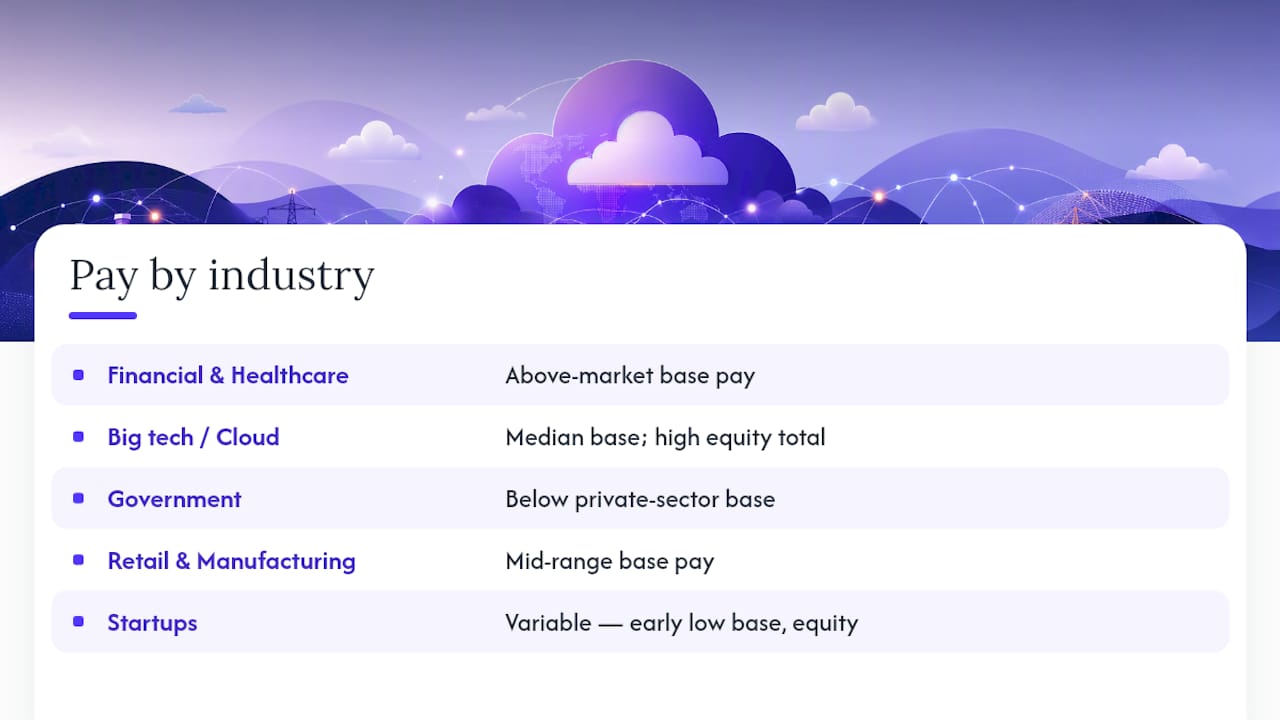
It does, and the gap between sectors can be wider than the gap between cities. Financial services and healthcare technology companies routinely pay above the general market rate for cloud engineers, largely because compliance requirements (SOC 2, HIPAA, PCI DSS) demand engineers who understand both infrastructure and regulatory risk simultaneously. That combination is rare enough that these industries compete aggressively for it.
Big tech and cloud-native product companies (the AWS, Microsoft, and Google ecosystem plus their software vendors) tend to pay near the top of the market too, but through a different mechanism: heavy equity components rather than higher base alone. A cloud engineer at a public cloud vendor may see a base salary similar to the national median while total compensation runs well above it once stock grants vest.
Government and public-sector cloud roles typically sit below private-sector averages in base pay, though they often make up ground with more predictable schedules, pension benefits, and less on-call burden. Retail, manufacturing, and traditional enterprise IT departments tend to land in the middle of the pack. They need cloud infrastructure but aren't competing for the same bleeding-edge talent that AI infrastructure teams are chasing.
Startups are the wildcard. Early-stage companies frequently pay below-market base salaries in exchange for equity that may or may not ever be worth anything, while well-funded, later-stage startups can match or exceed big tech comp to win talent away from more stable employers. If you're evaluating a startup offer, weigh the equity skeptically and negotiate the base as if the equity were worth zero, because for a meaningful share of startups, it eventually is.
Cloud Engineer vs. DevOps Engineer vs. Software Engineer: Who Gets Paid More?
The honest answer is that these roles overlap so much in modern job postings that comparing them by title alone is close to meaningless. DevOps engineer pay tracks very closely with cloud engineer pay, often within a few thousand dollars nationally, because the day-to-day work frequently blurs together: pipeline automation, infrastructure provisioning, monitoring, and incident response. Where they diverge is emphasis. DevOps roles lean harder into CI/CD tooling and deployment automation, while cloud engineer roles lean harder into infrastructure architecture and platform design.
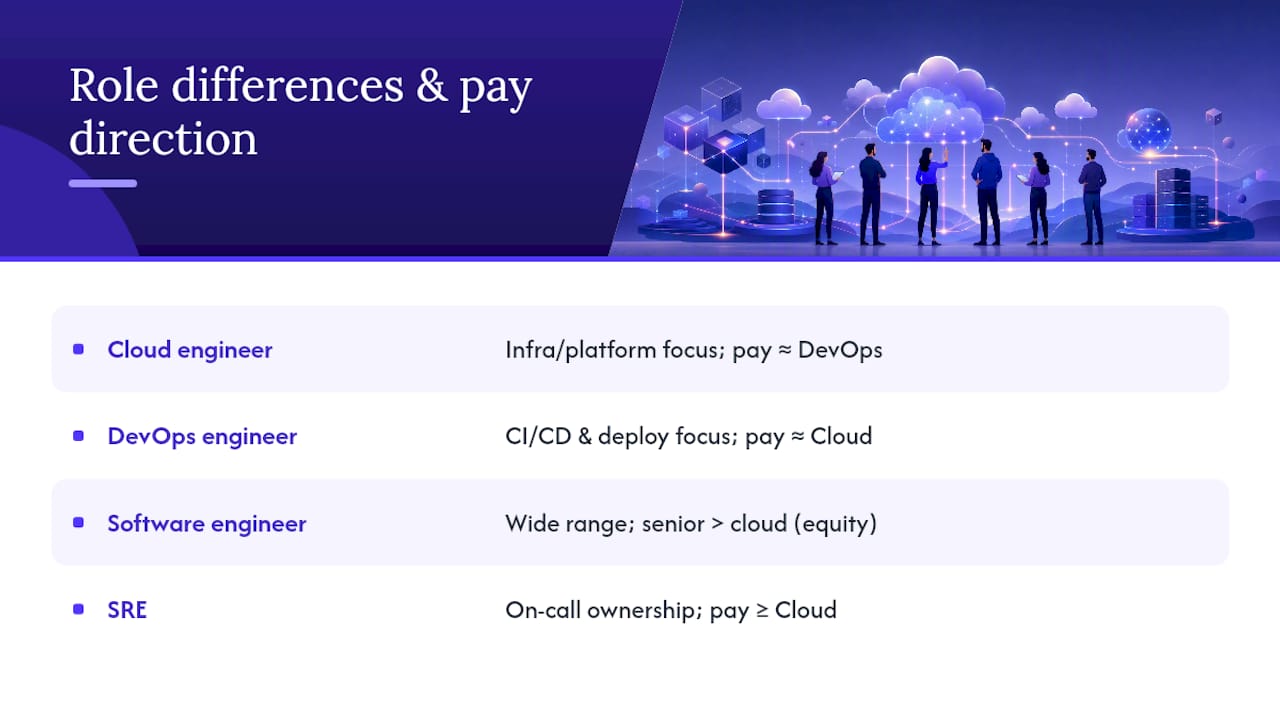
Software engineers show a wider range, partly because "software engineer" covers everyone from junior web developers to principal engineers at trillion-dollar companies. At the senior and staff levels, software engineers at major product companies often out-earn cloud engineers at the same seniority, largely due to richer equity packages; Adobe's software engineering compensation illustrates how much stock grants can widen total comp at established product companies. At the entry and mid level, though, cloud engineers frequently match or beat generalist software engineers, because cloud infrastructure skills remain harder to hire for than general application development.
Site reliability engineer (SRE) pay tends to sit at or slightly above cloud engineer pay at the same seniority, reflecting the on-call intensity and production-ownership expectations baked into most SRE roles. If you're choosing between titles for career strategy rather than just chasing a number, know that the skill overlap means you can move between these lanes more easily than the job titles suggest.
Author Perspective: What the Numbers Actually Mean for You
If you're job hunting, stop asking "what's the average" and start asking "what does my actual scope of work justify." If you're hiring, the same rule applies in reverse: band the role honestly, then decide which percentile you're willing to pay for. Either way, collect competing data points before you commit to a number, and check the state-by-state breakdowns before assuming your local market matches the national figure.
— Joelen Zyoktova
Get the Sourced Salary Data Behind This Entire Article
Every figure in this guide traces back to a government or employer-filed source, reflecting an approach to building salary numbers that emphasizes transparency. No paywall, no email capture, no fabricated "average" pulled from a small self-reported sample.
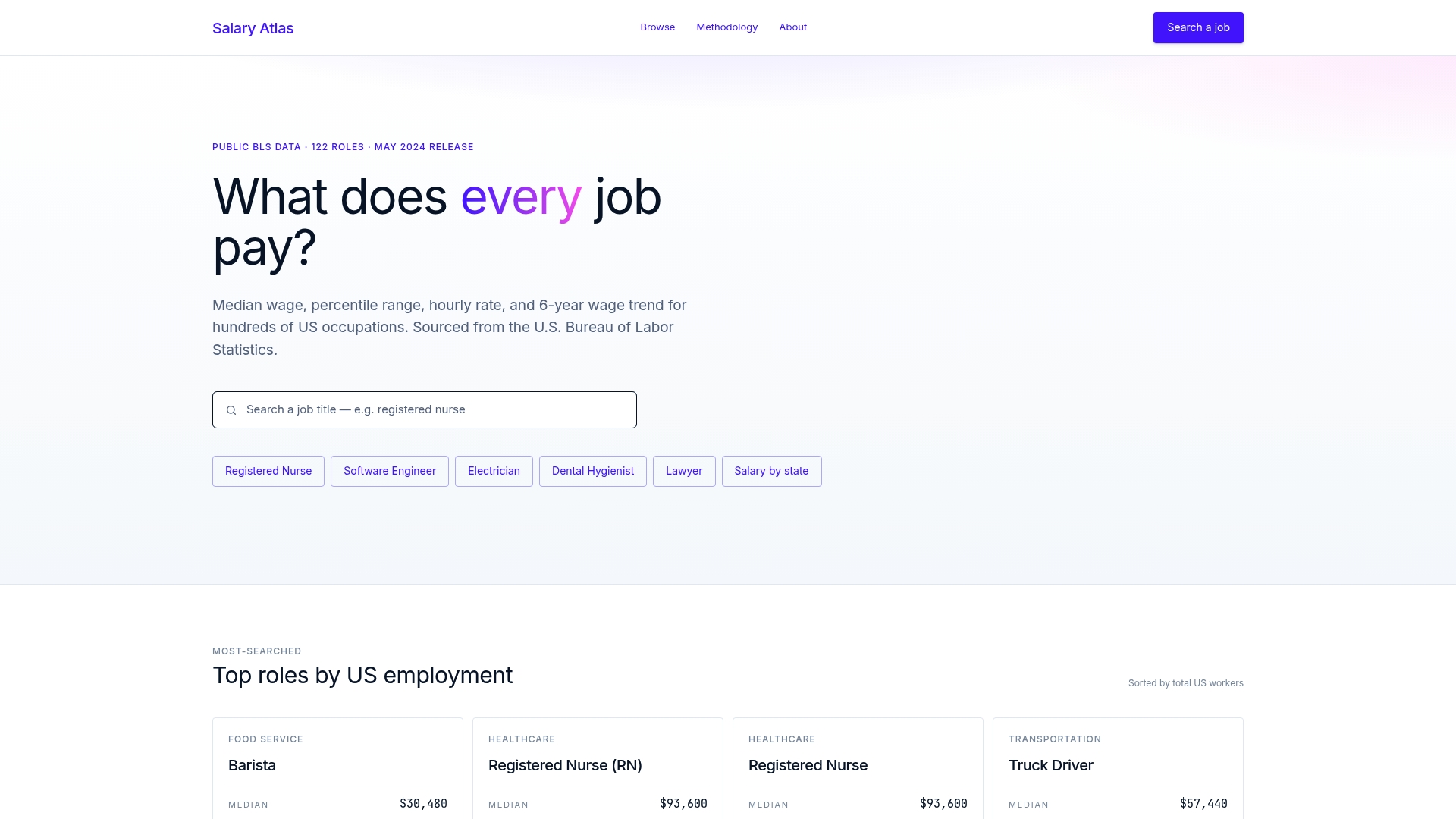
If you want to go deeper than the national picture, Salary Atlas breaks cloud engineering pay down by state using BLS OEWS linkage, so you can see exactly how your local market compares to the national bands covered here. Hiring managers building comp bands can use the same state-level data to justify offers internally, and the methodology page walks through exactly how each figure gets sourced and refreshed. Start with your state's page, cross-reference it against the national bands above, and you'll walk into your next negotiation or hiring decision with numbers you can actually defend.
Sources
- Cloud Engineer Salary Guide 2026 | U.S. Pay Benchmarks
- Cloud Engineer Salary, Skills, and Career Path
- Gartner forecasts worldwide public cloud end-user spending to total $723 billion in 2025
- Cloud Engineer salaries (H1Bgrader)
FAQ
Is a Cloud Engineer a Good Career?
Yes. Base pay generally starts above $85,000 even at entry level, and sustained enterprise cloud spending, projected at $723 billion globally in 2025, keeps demand strong heading into 2026.
Is a Cloud Engineer a High-Paying Job?
Compared to most tech roles, yes. Base pay clusters in the mid-$130K to low-$150K range nationally, with total compensation often exceeding $175,000 for engineers with security or AI infrastructure specialties.
Which Engineer Makes $500,000 a Year?
That level of total compensation is typically reserved for principal or distinguished engineers at large public companies, where the bulk of the number comes from equity grants rather than base salary. It is not representative of typical cloud engineer pay at any experience tier.
Is AI Replacing Cloud Engineers?
No current evidence supports that. AI infrastructure work, supporting model-serving pipelines and GPU clusters, has actually created a new high-paying specialty within cloud engineering rather than eliminating the role.
How Much Do Cloud Engineers Make at the Senior Level?
Senior cloud engineers generally earn between $135,000 and $160,000 in base pay, with architects and staff-level engineers reaching $160,000 to $200,000 or more once equity is included.