Highest Paying Jobs in the U.S. for 2026: Full Rankings
Discover the highest paying jobs in the U.S. for 2026, featuring top earners like anesthesiologists and airline pilots. Explore now!
By the Salary Atlas editorial team · Published

The top five occupations by median annual pay are:
- Anesthesiologists, median at or above the BLS/OES wage ceiling for reporting
- Oral and Maxillofacial Surgeons, median at or above the BLS/OES wage ceiling
- Obstetricians and Gynecologists, median at or above the BLS/OES wage ceiling
- Surgeons (general and specialist categories), median at or above the BLS/OES wage ceiling
- Airline Pilots, Copilots, and Flight Engineers, median just above $210,000 per year
Key Takeaways
Physician and dental specialties hold 19 of the top 20 highest-paying U.S. occupations by BLS/OES median, with airline pilots and CEOs as the only non-healthcare roles in the top 15.
| Point | Details |
|---|---|
| Healthcare dominates top pay | 19 of the top 20 highest-paying U.S. occupations are physician or dentist roles, per BLS/OES data. |
| Medians are top-coded at $239,200 | Most physician specialties hit the BLS reporting ceiling; real medians are higher, often $300k–$450k. |
| Training takes 10–15 years for physicians | Factor in deferred earnings and $200,000+ in student debt when evaluating the financial case for medicine. |
| Six figures without a degree is possible but narrow | Air traffic controllers, elevator installers, and senior pilots can reach six figures without a bachelor's degree. |
| Salary Atlas for state-level data | Use Salary Atlas's salary-by-state pages to compare your target role's local median against the national figure. |
Table of Contents
- What are the highest paying jobs in the U.S. right now?
- How is occupational pay actually measured?
- How long does it take to qualify for these top-paying roles?
- How do you read and compare these salary numbers?
- Which jobs can realistically reach $400k or even $1M+?
- Can you earn six figures without a four-year degree?
- Why do healthcare specialists dominate the top-paying occupations?
- How to use these rankings to plan your next career move
- The trade-offs these rankings don't show you
- Salary Atlas gives you the data behind these rankings
- Sources
- FAQ
What are the highest paying jobs in the U.S. right now?
USA Today's analysis of BLS data found that 19 of the top 20 highest-paying U.S. occupations are physician or dentist roles. The lone exception: airline pilots. Below is the ranked top 20, drawn from BLS/OES medians cross-checked against Investopedia's compilation and US News's 2026 rankings.Pediatric surgeons represent one of the narrowest and most demanding specialties in medicine. The combination of a general surgery residency (5 years) plus a pediatric surgery fellowship (2 years) limits supply severely, which is a direct driver of their position near the top of every ranking.
Cardiologists add an interventional or electrophysiology fellowship on top of internal medicine residency, meaning the path from medical school entry to independent practice can stretch to 14 years or more. The cardiologist salary page on Salary Atlas shows how median pay and percentile ranges shift across states and practice settings.
Airline pilots are the most striking non-healthcare entry. The ATP (Airline Transport Pilot) certificate requires 1,500 flight hours, and major-carrier captains routinely earn above $300,000 in total compensation once seniority and per-diem pay are included. Visual Capitalist's ranked list places pilots firmly in the top 15 across all occupations.
How is occupational pay actually measured?
The BLS/OES program surveys roughly 1.1 million employer establishments annually and publishes wage estimates for over 800 occupations. The data year used throughout this article is the most recent BLS/OES release available as of 2026. Every median figure cited here reflects that release.
Median vs. mean. The median is the midpoint wage: half of workers in that occupation earn above it, half below. The mean (average) is pulled upward by a small number of very high earners, which makes it a misleading benchmark for most career planners. A neurosurgeon earning $2 million in private practice raises the mean for all surgeons without moving the median much. That is why BLS/OES publishes medians as the standard reference, and why this article uses them. The BLS ceiling problem. BLS/OES top-codes wages at $239,200 annually. Any occupation where the median itself hits that ceiling is reported as "$239,200+" rather than the true median. Most physician specialties in the top 10 are top-coded, which means their real medians are higher than the table shows. Secondary sources like Investopedia's rankings and US News use survey data from specialty medical associations to estimate true medians, often in the $300,000–$450,000 range for top specialties. Catchall categories. BLS/OES includes broad residual categories like "Physicians and Surgeons, All Other." Business Insider's analysis makes the case clearly: excluding these catchall buckets produces a more actionable list because they aggregate wildly different roles under one label. Salary Atlas follows the same logic, mapping each occupation to its narrowest BLS title.- Median: the 50th percentile wage (half earn more, half earn less)
- 75th percentile: the wage that 75% of workers fall below
- 90th percentile: the wage that 90% of workers fall below (the "top earner" benchmark)
How long does it take to qualify for these top-paying roles?
Time-to-qualify is the variable most career guides skip. The salary is real; so is the decade-plus of training that precedes it.
Medical specialties (10–15 years post-high school)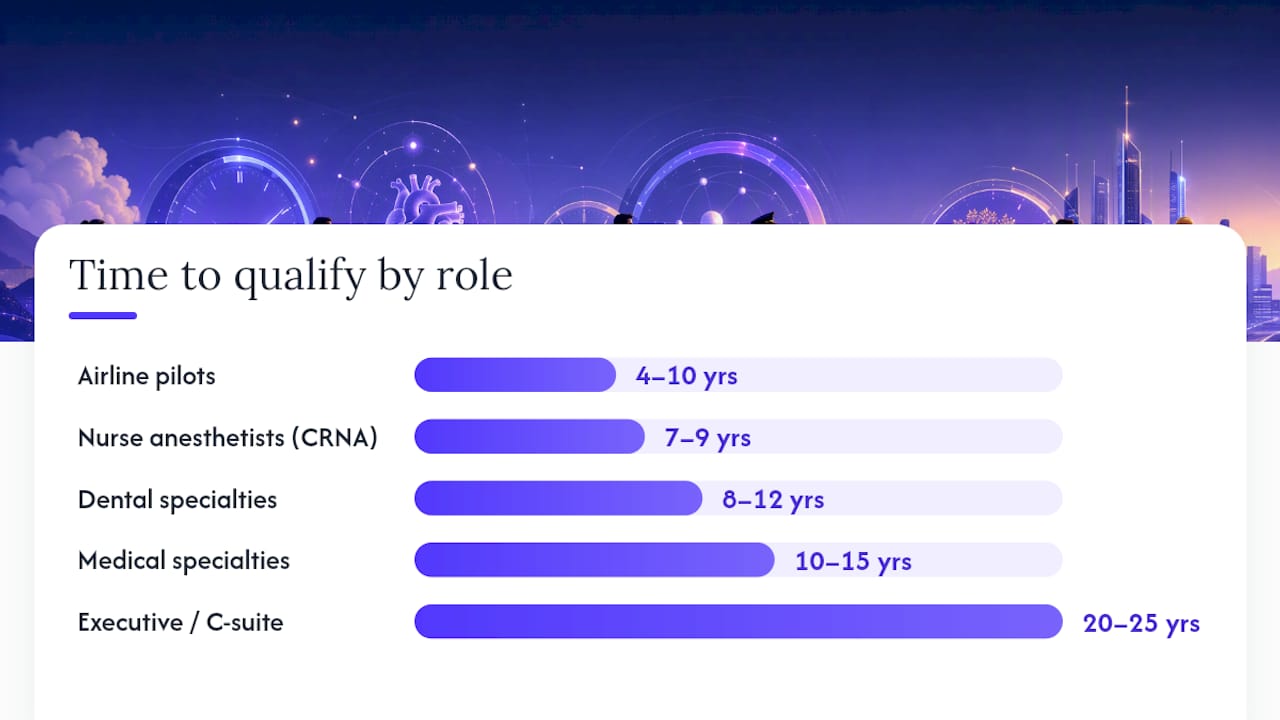
Most physician specialties require 4 years of undergraduate study, 4 years of medical school, and then a residency of 3–7 years depending on specialty. Subspecialty fellowships add another 1–3 years. A cardiologist completing an interventional fellowship may not start independent practice until age 34–36. An anesthesiologist typically completes a 4-year residency after medical school, landing around age 32–33. Pediatric surgeons and oral and maxillofacial surgeons often finish training closer to 35–38.
Dental specialties (8–12 years post-high school)Orthodontists, prosthodontists, and oral surgeons complete 4 years of dental school after a bachelor's degree, then 2–3 years of specialty residency. Oral and maxillofacial surgeons who pursue the dual MD/DDS path add another 4 years of medical school plus a surgical internship, pushing total training to 12+ years.
Nurse anesthetists / CRNAs (7–9 years post-high school)The CRNA path requires a bachelor's in nursing, at least 1 year of acute-care ICU experience, and a 3-year doctoral-level nurse anesthesia program (DNP or DNAP). Total time from high school to independent practice: roughly 8–9 years, with significantly lower student debt than the physician path.
Airline pilots (4–10 years post-high school)The ATP certificate requires 1,500 flight hours (reduced to 1,000 for military or certain aviation degree graduates). Regional carriers typically hire pilots with 1,500 hours; major carriers promote from within based on seniority. The gap between first officer at a regional airline and captain at a major carrier can span 8–12 years. A career transition timeline resource from ResumeMatch offers a useful framework for mapping these multi-year pathways.
Executive / C-suite (highly variable)CEOs rarely follow a single credential path. Most hold a bachelor's degree; many have an MBA. The real credential is a track record: P&L ownership, functional leadership, and board relationships. Median time from first job to CEO is typically 20–25 years, though tech and startup environments compress this significantly.
Pro Tip: Medical graduates commonly carry $200,000 or more in student debt, according to Investopedia's analysis. Model debt service across the full training period, not just the first attending year, when calculating whether a specialty's lifetime earnings justify the investment. Peak physician earnings typically occur between ages 40–55, which shortens the high-earning window more than most prospective students expect.How do you read and compare these salary numbers?
A median is a starting point, not a ceiling or a guarantee. Here is what the number actually tells you and what it leaves out.
For most physician specialties, the gap between the median and the 90th percentile is enormous. A general surgeon at the median earns above $239,200 (BLS top-coded); at the 90th percentile, survey data from specialty associations puts earnings above $500,000 in many markets. For a data scientist, the spread is narrower: median around $108,000 versus a 90th percentile closer to $185,000. Same concept, very different magnitude.
Bonuses, equity, and private practice income. Base salary is only part of total compensation for most high-earning roles. CEOs at public companies receive stock options and annual bonuses that routinely exceed base pay by a factor of 3–10. Surgeons in private practice own their revenue stream directly, which means procedure volume and payer mix determine income far more than any BLS median. CRNAs in independent or group practice settings earn substantially more than hospital-employed peers. A concrete example. Consider an emergency medicine physician. The BLS/OES median is top-coded at $239,200+. At the 75th percentile, specialty survey data suggests earnings around $350,000. At the 90th percentile, physicians in high-volume urban trauma centers or those working locum tenens contracts can exceed $450,000. The median alone understates the realistic upside for a high-performing practitioner.- Geographic variation is substantial: California, New York, and Massachusetts consistently pay above national medians for most physician and CRNA roles.
- Industry variation matters too: hospital-employed physicians typically earn less than those in private practice or ambulatory surgical centers.
- Cost of living cuts both ways: a $300,000 salary in rural Mississippi has very different purchasing power than the same figure in San Francisco.
Statistic callout: For most top-paying occupations, the 90th percentile wage is 40–80% above the median. That gap is where private practice, equity, and specialization premiums live.
Which jobs can realistically reach $400k or even $1M+?
The $400,000 threshold sits at or above the 90th percentile for most occupations, including most physician specialties. Getting there requires more than picking the right career; it usually requires a specific combination of practice setting, geography, and procedure volume.
Roles with documented $400k+ potential:- Neurosurgeons and orthopedic surgeons in private practice or high-volume hospital systems, where procedure-based billing drives income well above the BLS median
- Cardiologists performing interventional procedures (stenting, catheterization), where per-procedure fees compound over a full schedule
- Anesthesiologists in private practice or independent groups, where billing is separate from hospital employment
- Oral and maxillofacial surgeons with high-volume implant or reconstructive practices
- Airline captains at major carriers (United, Delta, American) with top seniority, where total compensation including per diem and profit sharing can exceed $400,000
- CEOs of mid-to-large public companies, where equity grants and annual bonuses routinely push total compensation past $1 million
Statistic callout: Top salary figures for pediatric surgeons average above $450,000 in some datasets, but those figures reflect a small, specialized subset of practitioners, not the median for all surgeons in a broad category, as Business Insider's analysis notes.The $1M+ reality. Seven-figure annual income exists in medicine and executive roles, but it is genuinely exceptional. A neurosurgeon owning a private practice with high procedure volume and favorable payer mix can reach $1M+. A Fortune 500 CEO almost certainly does, once equity vests. For everyone else, $1M+ is a function of ownership, equity, or elite procedural volume, not simply occupational choice. The Visual Capitalist ranking confirms that even among the top 30 highest-paid occupations, most medians fall well below $400,000.
Can you earn six figures without a four-year degree?
Yes, but the realistic options are narrower than most career content suggests, and the ceilings are lower.
Realistic high-pay paths without a bachelor's degree:- Commercial pilots (regional carriers): Some aviation programs offer associate degrees or certificates combined with flight training. The ATP certificate is the credential that matters; a bachelor's is preferred but not universally required at regional carriers. Starting pay at regionals is modest; the six-figure income comes after years of seniority.
- Air traffic controllers: Hired through the FAA Academy; a bachelor's degree is one path, but relevant work experience can substitute. Median pay exceeds $132,000.
- Elevator installers and repairers: A union apprenticeship (no degree required) leads to median pay around $99,000, with experienced workers in high-cost markets earning above $130,000.
- Radiation therapists: An associate degree plus licensure is the typical path; median pay is around $89,000, with experienced practitioners in specialized settings earning more.
- Medical coders and health information specialists: Certifications like the CPC (Certified Professional Coder) from AAPC can lead to medical coding roles paying $55,000–$80,000 without a four-year degree, though advancement to management typically requires more education.
Why do healthcare specialists dominate the top-paying occupations?
The answer is structural, not coincidental. USA Today's reporting on BLS data found that 19 of the top 20 highest-paying U.S. occupations are physician or dentist roles. Three interlocking forces explain why that number has stayed stable for decades.
 Federal pricing creates a wage floor. Medicare and Medicaid set reimbursement rates for medical procedures, and private insurers typically negotiate rates as a multiple of Medicare. This means physician income is partially insulated from market competition in ways that most other professions are not. A neurosurgeon's procedure fee is set by a federal schedule, not by what a patient can negotiate.
Training barriers limit supply. The HRSA's health workforce projections consistently show physician supply constraints in high-demand specialties. Medical school seats are limited by accreditation and funding; residency slots are capped by federal GME (Graduate Medical Education) funding. When supply is structurally constrained and demand grows with an aging population, wages stay high.
Procedure-based billing compounds earnings. Unlike salaried professionals, many physicians bill per procedure. A high-volume orthopedic surgeon performing 400+ procedures annually generates revenue that a salaried employee simply cannot replicate. Private practice ownership amplifies this further by capturing the facility fee in addition to the professional fee.
Federal pricing creates a wage floor. Medicare and Medicaid set reimbursement rates for medical procedures, and private insurers typically negotiate rates as a multiple of Medicare. This means physician income is partially insulated from market competition in ways that most other professions are not. A neurosurgeon's procedure fee is set by a federal schedule, not by what a patient can negotiate.
Training barriers limit supply. The HRSA's health workforce projections consistently show physician supply constraints in high-demand specialties. Medical school seats are limited by accreditation and funding; residency slots are capped by federal GME (Graduate Medical Education) funding. When supply is structurally constrained and demand grows with an aging population, wages stay high.
Procedure-based billing compounds earnings. Unlike salaried professionals, many physicians bill per procedure. A high-volume orthopedic surgeon performing 400+ procedures annually generates revenue that a salaried employee simply cannot replicate. Private practice ownership amplifies this further by capturing the facility fee in addition to the professional fee.
- Specialization premium: Narrower specialties with longer training (neurosurgery, pediatric surgery, interventional cardiology) command higher fees because fewer practitioners can perform those procedures.
- Malpractice and overhead: High-risk specialties carry malpractice premiums of $50,000–$200,000+ annually, which are factored into billing rates and partly explain why gross revenue looks higher than net income.
- Licensing scarcity: State medical boards, DEA registration, and specialty board certification create multiple gatekeeping layers that limit who can practice, sustaining the wage premium.
Statistic callout: Physician training commonly spans 10–15 years from medical school entry to independent practice. That timeline, combined with student debt commonly exceeding $200,000, means the financial case for medicine depends heavily on specialty choice, practice setting, and peak-earning years between ages 40–55.
How to use these rankings to plan your next career move
Rankings are only useful if you act on them. Here is a short, practical sequence for turning this data into a real plan.
- Pick 2–3 target roles from the top 20. Don't anchor on just one. Identify roles that match both your income target and your realistic tolerance for training length and work environment.
- Map the education and certification timeline. Write out the full credential path: undergraduate, graduate or professional school, residency or certification, licensure. Assign realistic years to each stage.
- Model the financial trade-off. Calculate deferred earnings (what you would have earned in a different career during training years) plus student debt service. Compare that to the projected lifetime earnings of your target role. For physician paths, this math often doesn't favor medicine until the mid-40s.
- Build a 5-year action plan with concrete milestones. Year 1 might be completing prerequisites or flight hours. Year 3 might be professional school admission. Year 5 might be residency match. Concrete milestones beat vague intentions every time.
- Licensure boards in your target state for credential requirements
- Professional associations (AMA, ADA, AANA, ALPA) for specialty-specific salary surveys
- BLS/OES occupation profiles for job outlook and projected growth
- Salary Atlas role pages for percentile breakdowns and multi-year trends
- ResumeMatch's job-search workflow guide for structuring the transition from planning to active job hunting
The trade-offs these rankings don't show you
The salary rankings are accurate. What they don't capture is everything that sits alongside the number: the years of deferred life, the debt, the malpractice stress, the call schedules, and the very real possibility that a career you chose at 22 feels different at 45.

Chasing the highest median without accounting for those variables is how people end up in the right specialty and the wrong life. The most financially rational choice is the one that maximizes lifetime earnings net of training costs, debt, and opportunity cost, and that calculation looks different for every person depending on when they start, where they live, and what they're willing to sustain for decades.
The data in this article gives you the inputs. What you do with them is the actual decision. Use the BLS figures and Salary Atlas tools as a floor for your research, not a ceiling, and verify every number against your specific state and practice setting before committing to a path.
Salary Atlas gives you the data behind these rankings
The rankings in this article are built on BLS/OES medians, the same data that powers Salary Atlas. The difference is what Salary Atlas does with that data: every role page shows median pay, percentile breakdowns (25th, 50th, 75th, 90th), a six-year wage trend, and state-level comparisons, all without a paywall or a signup form.
If you're planning a career move based on these rankings, the next step is drilling into the specific role and state that match your situation. Start with the Salary Atlas salary database to pull up your target occupation, then use the salary-by-state pages to see how your local market compares to the national median. Every figure links back to its BLS source so you can verify it yourself.
Sources
- How much do doctors make? Why it's America's highest-paying job.
- Highest Paying Careers | Careers | CareerOneStop
This article is general information, not a substitute for advice from a qualified financial advisor. Consult a qualified financial professional about your own circumstances before acting on anything here.
FAQ
What is the highest-paid career in the USA?
Anesthesiology, oral and maxillofacial surgery, and obstetrics/gynecology consistently top BLS/OES rankings, with medians above the $239,200 reporting ceiling. Real medians for these specialties, drawn from specialty association surveys, typically fall in the $300,000–$450,000 range.
What jobs pay $500,000 a year in the U.S.?
Neurosurgeons, orthopedic surgeons, and interventional cardiologists in private practice or high-volume hospital systems can reach $500,000 or more, though that figure sits at or above the 90th percentile for those specialties. Major-carrier airline captains with top seniority and Fortune 500 CEOs also reach this level when equity and bonuses are included.
What job pays $400,000 a year without a degree?
No occupation reliably pays $400,000 without an advanced degree or equivalent credential. The closest realistic path is a major-carrier airline captain with 15–20 years of seniority, where total compensation including profit sharing can approach or exceed $400,000, though most pilots require at least some college coursework and an ATP certificate.
What jobs make $1,000,000 per year?
Seven-figure annual income is documented for Fortune 500 CEOs (where equity grants drive total compensation), neurosurgeons and orthopedic surgeons with high-volume private practices, and a small number of elite specialists in procedure-heavy subspecialties. These outcomes depend on ownership, equity, or exceptional procedural volume rather than occupational title alone.
How do I find state-level salary data for these occupations?
CareerOneStop offers a state filter on its highest-paying careers tool, drawing directly from BLS/OES. Salary Atlas's salary-by-state pages provide the same BLS-sourced medians with percentile breakdowns and multi-year trends, without requiring a login.
Recommended
Occupation wage figures on Salary Atlas come from the U.S. Bureau of Labor Statistics. Figures in this article that are not linked to a source are estimates. See our methodology.