Nurse Practitioner Salary: Pay by State & Specialty (2026)
Discover how nurse practitioner salaries vary by state and specialty in 2026, revealing potential earnings from $107,000 to over $155,000.
By the Salary Atlas editorial team · Published

Nurse practitioners in the United States earn a median annual salary of roughly $129,000 to $136,900, depending on which dataset you check. That's the headline. The real story is the spread underneath it: the 25th to 75th percentile range runs from about $107,000 to $155,000, and state, specialty, and setting can shift your actual paycheck by tens of thousands of dollars in either direction.
Quick numbers: national median around $129,210–$136,864 (BLS/aggregator estimates), with top-paying states reaching six figures and above.Before you take any single number at face value, check three things:
- Your state's median and cost-of-living index
- Your specialty's typical pay range
- Total compensation, not just base salary
Key Takeaways
Nurse practitioner pay in the U.S. centers on a national median near $129,000 to $137,000, but state, specialty, and total compensation can shift real earnings by $50,000 or more.
| Point | Details |
|---|---|
| National median range | Expect $129,210 to $136,864 depending on BLS versus projected estimates. |
| State gap is significant | California's $166,610 median dwarfs Tennessee's roughly $103,720. |
| Specialty drives pay most | Psychiatric, neonatal, and acute care roles often add $30,000 or more over lower-paying specialties. |
| Total comp beats base salary | Benefits, bonuses, and loan repayment often add 15% to 30% in real value. |
| Salary Atlas for personalized data | Use Salary Atlas's free state and specialty tools to pull current medians without paywalls. |
Table of Contents
- What Does the National Nurse Practitioner Salary Data Actually Show?
- How Much Does State Location Change Nurse Practitioner Pay?
- Which NP Specialties and Work Settings Pay the Most?
- How Does Experience Level Change Nurse Practitioner Earning Potential?
- What Factors Drive Nurse Practitioner Pay, and How Do You Negotiate It?
- What Should You Count as Total Nurse Practitioner Compensation?
- Where Does This Nurse Practitioner Salary Data Come From?
- Sources
- FAQ
What Does the National Nurse Practitioner Salary Data Actually Show?
The Bureau of Labor Statistics OEWS survey anchors most reliable estimates, putting the national median near $129,210. A separate industry projection, adjusting BLS data forward with a modest growth rate, lands closer to $136,864 for 2026. Both numbers describe the same market. They just use slightly different math.
| Percentile | Approximate Annual Salary |
|---|---|
| 25th | ~$107,000 |
| 50th (median) | ~$129,000–$137,000 |
| 75th | ~$155,000 |
| 90th | ~$180,000+ |
- BLS OEWS counts salaried and hourly employees together, converting hourly rates to annual figures using a standard 2,080-hour year.
- Aggregator sites like Indeed and ZipRecruiter pull from self-reported listings and user submissions, which skew toward higher-paying urban job postings.
- The NP Compensation Benchmark Report blends employer-reported data with survey responses, giving a fuller picture of total pay structures.
How Much Does State Location Change Nurse Practitioner Pay?
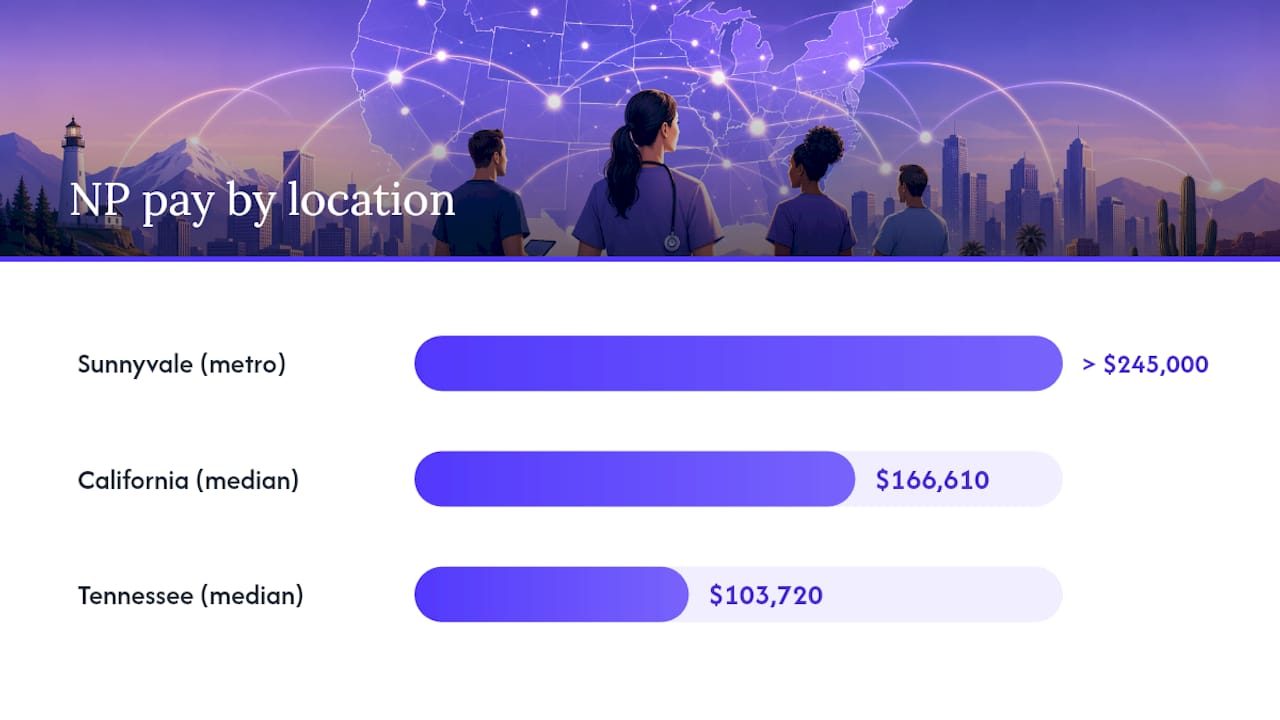
California tops the list with a median around $166,610, and some metro areas within the state, like Sunnyvale, push past $245,000. Tennessee sits near the bottom at roughly $103,720. That's a $63,000 gap between the highest and lowest paying states, before you even factor in cost of living.
Highest-paying states (median):- California, around $166,610
- Nevada and Washington, typically in the $150,000s
- New Jersey and New York, generally in the $140,000s to $150,000s
- Tennessee, around $103,720
- Alabama, Mississippi, and several other Southeastern states in a similar range
- Some Midwestern states with lower cost-of-living offsets
Which NP Specialties and Work Settings Pay the Most?
Specialty is the single biggest lever on your paycheck, according to the NP Compensation Benchmark Report, which identifies it as a stronger predictor of pay than years of experience alone. Gaps between the highest and lowest paying specialties can exceed $30,000 annually.
Highest-paying specialties tend to include:
- Neonatal NP roles, often exceeding $135,000 due to acuity and specialized training
- Psychiatric mental health NP (PMHNP), frequently landing in the $130,000 to $150,000 range given high demand
- Acute care and emergency NP roles, which carry pay premiums for shift work and complexity
- Aesthetic and dermatology NP roles, where some employers offer productivity-based bonuses tied to procedure volume
How Does Experience Level Change Nurse Practitioner Earning Potential?

New NP graduates typically start between $95,000 and $115,000, depending on state and specialty. Mid-career NPs with five to ten years of experience often move into the $125,000 to $150,000 range, especially if they've picked up procedural skills or specialty certifications along the way.
Leadership and DNP-track roles push higher still. Clinical lead, director of advanced practice, or NP program coordinator positions frequently clear $160,000, particularly in hospital systems with formal advancement ladders.
The fastest pay jumps tend to happen in the first three to five years:
- Negotiating aggressively at each job change rather than accepting the first offer
- Adding a specialty certification that opens higher-paying clinical tracks
- Picking up moonlighting shifts in urgent care or telehealth
What Factors Drive Nurse Practitioner Pay, and How Do You Negotiate It?
Employers set NP pay based on a fairly predictable set of variables: geographic location, specialty, years of experience, state practice authority, employer type (hospital versus private practice versus FQHC), and whether the role is salaried, hourly, or contract-based.
When you're evaluating or negotiating an offer, work through this checklist:
- Pull the current market median for your specialty and state before the interview.
- Quantify any measurable results from your current role (patient volume, procedure counts, quality metrics).
- Ask specifically about total compensation, not just base salary.
- Request details on sign-on bonuses, loan repayment programs, or productivity-based pay structures.
- Clarify whether overtime or call pay is built into the offer or handled separately.
What Should You Count as Total Nurse Practitioner Compensation?
Base salary is only part of the equation. Total compensation often runs meaningfully higher once you add in the rest of the package, including health insurance, retirement contributions, and education allowances that can add real annual value beyond the paycheck itself.
Common components to factor in:
- Base salary or hourly rate
- Shift differentials and overtime, governed in part by Department of Labor wage rules
- Sign-on and productivity bonuses
- Retirement match (401k or 403b)
- Health insurance value
- Loan repayment or tuition assistance
- CME (continuing medical education) stipends
Where Does This Nurse Practitioner Salary Data Come From?
Salary Atlas draws from the Bureau of Labor Statistics OEWS survey, the primary government source for occupational wage data, supplemented by the 2026 NP Compensation Benchmark Report and aggregator listings from sites like Indeed and ZipRecruiter for real-time market color.
- BLS OEWS: annual government survey, updated once per year, most reliable for state and national medians
- NP Compensation Benchmark Report: employer and survey-based data, strong for specialty and practice-authority breakdowns
- Aggregator samples (Indeed, ZipRecruiter): faster-moving but skew toward active job postings, not full workforce averages
A Data-Driven Approach to Career Planning
The numbers only help if you use them before you negotiate, not after you've already signed. Compare your state's median, your specialty's range, and total compensation together, and lean on primary sources like Salary Atlas and BLS rather than a single job posting.
Get Your Personalized Nurse Practitioner Salary Breakdown
National medians are a starting point, not your answer. Your real number depends on your state, your specialty, and how your employer structures bonuses and benefits. Salary Atlas pulls that detail directly from BLS OEWS data, without paywalls or signups, so you can check your exact state and percentile range in a few clicks.
Head to the Salary Atlas state salary tool to see how your state compares, or browse nurse practitioner data on Salary Atlas directly to line up your specialty against national percentiles before your next offer conversation.
Sources
- Nurse Practitioner Salaries by State | 2026
- Nurse practitioner salary, Nightingale College blog
- Nurse Practitioner Salary (2026): How Much Do Nurse Practitioners Make?
FAQ
Can You Make $500,000 as a Nurse Practitioner?
It's extremely rare and not representative of typical NP pay, which tops out around $180,000 to $200,000 even at the 90th percentile in most specialties and states. Earnings anywhere near $500,000 would require ownership stakes, extensive locum work, or unusual procedural volume well outside standard employment.
Who Is Higher Paid, an NP or a PA?
Nurse practitioner and physician assistant salary figures land in a similar range nationally, though specialty and setting matter more than the credential itself. Both professions see the biggest pay jumps in acute care, emergency medicine, and dermatology.
How Do You Reach $200,000 as a Nurse Practitioner?
Combining a high-paying specialty (psychiatric, neonatal, or acute care), a high-paying state like California, and a productivity-based bonus structure helps some NPs reach high earnings levels. Leadership roles and heavy overtime or moonlighting can push total compensation even higher in mid-range specialties.
What Pays More, an RN or an NP?
Nurse practitioners consistently out-earn registered nurses, often by $50,000 or more annually, reflecting the added graduate education, prescriptive authority, and clinical autonomy NPs carry.
Recommended
Occupation wage figures on Salary Atlas come from the U.S. Bureau of Labor Statistics. Figures in this article that are not linked to a source are estimates. See our methodology.