What Is the Average Teacher Salary in New York?
Discover the average teacher salary in New York, including starting pay and how experience boosts earnings in NYC's competitive market.
By the Salary Atlas editorial team · Published

The average public school teacher in New York State earns roughly $92,000, and NYC teachers alone can push well past that once step and longevity pay kick in. New York consistently ranks among the top states for teacher pay nationally, and the reason is a union-negotiated system, not a scattered mix of district offers.
Here's the quick version:
- NYC starting salary, bachelor's degree, no prior experience: $68,902
- NYC starting salary, master's degree, no prior experience: $77,455
- Top of the NYC scale: teachers with extensive experience and a master's plus additional credits can reach six-figure salaries well above typical mid-career levels
Key Takeaways
New York teacher pay runs on negotiated salary schedules where degree, step, and district location determine take-home pay far more than any single "average" figure can capture.
| Point | Details |
|---|---|
| NYC starting pay varies by degree | Bachelor's starts at $68,902; master's starts at $77,455, both with no prior experience. |
| Steps drive long-term growth | Annual step movement plus contract-wide raises push veteran NYC teachers with master's degrees past $130,000. |
| Verify your exact placement | Contact your district's Office of Salary Services with transcripts and employment verification before assuming a step. |
| Benefits add real value | TRS pension contributions, strong health coverage, and tenure protections supplement the base salary meaningfully. |
| Loan forgiveness has two paths | Teacher Loan Forgiveness caps at $17,500 for shortage-area teachers; PSLF forgives remaining balances after 120 qualifying payments. |
Table of Contents
- Teacher Salary New York: NYC vs. State Averages at a Glance
- How New York Teacher Pay Is Structured: Steps, Differentials, and the Master's Bump
- Sample Salary Growth Over a Teaching Career in New York
- Benefits and Total Compensation Beyond the Paycheck
- Where to Find District-Level Pay Data and Salary Schedules
- How Salary Atlas Verifies and Reports Teacher Pay Data
- Loan Forgiveness and Public Service Forgiveness Options for New York Teachers
- What the Numbers Actually Tell You About Teaching in New York
- Sources
- FAQ
Teacher Salary New York: NYC vs. State Averages at a Glance
The gap between New York City and the rest of the state is real, and it's driven mostly by cost of living and the size of the city's tax base. NYC's teacher salary schedule sits on top of a $68,902 to $77,455 starting range depending on degree, while the statewide picture blends high-paying downstate suburbs with lower upstate figures.
A few numbers worth anchoring on:
- New York State average teacher pay: relatively high compared to many other states
- National average teacher salary: $74,495 in 2024–25, up about 3.5% year over year
- Regional spread: NYC and Long Island suburbs post the highest raw numbers; many upstate counties pay less in dollar terms but stretch further given lower cost of living
How New York Teacher Pay Is Structured: Steps, Differentials, and the Master's Bump
Every unionized New York district runs on a step-and-column salary schedule. Steps represent years of service; columns represent education level and credits earned beyond your base degree. Move down a step each year you stay, and move across a column each time you complete qualifying coursework.
The UFT-negotiated schedule for NYC covering 2022 through 2027 lays this out in exact dollar figures, with published effective dates tied to each contract increase.
Three things determine where you actually land on that grid:
- Base placement, your degree (bachelor's, master's, or master's plus additional credits) sets your starting column.
- Step credit for prior experience, qualifying teaching experience at another school, and in some cases documented trade or CTE work, can move you several steps up rather than starting at zero.
- Ongoing differentials, additional graduate credits, National Board Certification, or specific endorsements add incremental pay on top of your base step.
It's worth separating two kinds of raises that often get confused. Annual step movement happens automatically as you complete another year of service. Contract-wide increases, negotiated by the UFT or a local union, raise the entire schedule at once, including for teachers who aren't moving steps that year. If your paycheck jumped but you didn't change columns, that's the second kind. Confirming step credit for prior experience, especially anything outside a traditional classroom role, means contacting the Office of Salary Services directly, since documentation rules for "full-time" and "paid" work vary by case.
Sample Salary Growth Over a Teaching Career in New York
Assuming standard step progression and no interruptions in service, here's roughly how a New York City teacher's pay trajectory tends to look using bachelor's and master's placements on the UFT schedule.
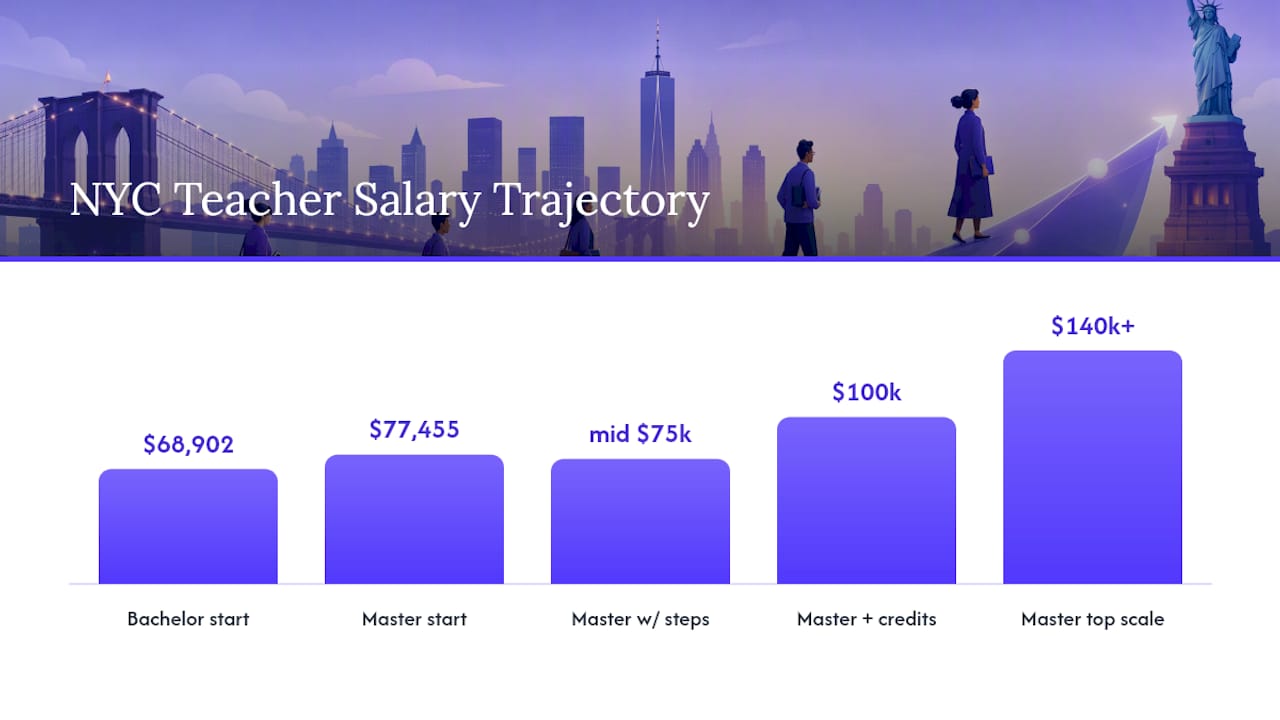
| Career Stage | Degree/Assumptions | Approximate Annual Salary |
|---|---|---|
| , | Bachelor's, no prior experience | $68,902 |
| , | Master's, no prior experience | $77,455 |
| , | Master's, standard step credit | Mid $70,000s to low $80,000s |
| , | Master's plus additional credits | Low $100,000s |
| , | Master's plus additional credits, top of scale | $130,000 to $150,000+ |
Benefits and Total Compensation Beyond the Paycheck
Salary is only part of the picture, and in New York, the non-salary compensation is unusually strong compared to most private-sector jobs. Health insurance for NYC and most New York State teachers typically comes with the employer covering the large majority of premium costs, often leaving the teacher's share in the single digits to low double digits percentage-wise depending on the plan tier and district.

Retirement runs through the Teachers' Retirement System (TRS), a defined-benefit pension rather than a 401(k)-style account. Contributions get deducted from every paycheck, which lowers take-home pay now in exchange for a guaranteed pension calculated on your final average salary and years of service later. That's a trade-off worth understanding rather than resenting: the reduced current paycheck funds long-term retirement security that most private-sector workers no longer have access to.
Other components that add real value:
- Paid leave covering sick days, personal days, and often extended parental leave depending on the contract
- Tenure protections after a probationary period, which most districts set around three to four years
- Tuition reimbursement or PD credit stipends for continuing education toward that next salary column
- Shortage-area differentials, with many districts offering extra pay for special education, bilingual education, and certain STEM certifications
Where to Find District-Level Pay Data and Salary Schedules
Reading a salary schedule PDF isn't complicated once you know what to look for: find your degree column across the top, find your years-of-service step down the side, and check the effective date printed near the header, since contracts often stagger increases across multiple years.
Start with these sources, in this order:
- NYC DOE and UFT schedules for the exact step/column dollar values and effective dates on the current 2022–27 contract
- SeeThroughNY's teacher pay database to look up actual reported salaries by district, filterable by county
- State union contract pages through GOER for districts outside NYC that bargain separately
- Your district's HR office or Office of Salary Services to confirm exactly which step you'll be placed on
- Never assume a raise took effect just because a new school year started. Collective-bargaining agreements set specific effective dates, and some increases land mid-year.
How Salary Atlas Verifies and Reports Teacher Pay Data
Salary Atlas builds its teacher pay figures from Bureau of Labor Statistics OEWS data, then links every number back to its original government source instead of hiding it behind a login or a paywall. For New York specifically, that means combining state and metro-level BLS aggregates with the district-level detail found in official schedules.
What Salary Atlas adds on top of a raw schedule PDF is context: percentile ranges showing where a given salary falls among all New York teachers, year-over-year trend data, and comparisons against national averages like the $74,495 figure NEA reported for 2024–25.
Pro Tip: Use Salary Atlas's state salary data to sanity-check how New York stacks up nationally, then cross-reference the specific step figure against your district's own published schedule. The two sources answer different questions, and you want both.If you're weighing grade-level differences, the elementary teacher salary breakdown and general high school teacher salary trends pages fill in detail that a single statewide average can't capture.
Loan Forgiveness and Public Service Forgiveness Options for New York Teachers
New York teachers carrying student debt have access to two major federal programs worth understanding before you assume you're stuck paying full freight for a decade.
Teacher Loan Forgiveness (TLF) forgives up to $17,500 in federal Direct or Stafford loans for teachers who work full-time for five consecutive academic years in a low-income school or educational service agency, teaching in a designated shortage area like special education, math, or science. It's a one-time benefit, and eligibility rules are specific enough that you should read the Federal Student Aid teacher loan forgiveness page directly rather than relying on secondhand summaries. Public Service Loan Forgiveness (PSLF) works differently and covers more teachers overall. It forgives the remaining balance on Direct Loans after 120 qualifying monthly payments made while working full-time for a qualifying public employer, which includes virtually every NYC and New York State public school district. Unlike TLF, PSLF has no dollar cap and doesn't require teaching in a shortage subject.You can't double-dip both programs for the same period of loan payments, so if you're eligible for both, run the math on which one clears your specific balance faster. Federal Student Aid's site includes an employer certification tool that tracks your qualifying payments as you go, which saves you from reconstructing years of payment history right before you expect forgiveness to kick in.
What the Numbers Actually Tell You About Teaching in New York
The conventional advice tells prospective teachers to look up "the average salary" and plan around it. That's backwards. Averages blend a first-year Buffalo teacher with a 25-year Scarsdale veteran, and neither number tells you what you'll actually earn.
What the research here supports is narrower and more useful: your pay in New York is a function of three decisions you control (which degree you hold, which district you choose, and how much prior experience you can document for step credit) and one you don't (which contract year you're hired under). Career changers coming from other states or from trade backgrounds consistently underestimate how much documented prior experience is worth in step placement, and they leave money on the table by not pushing HR for full credit.
The overrated piece of advice is chasing the highest posted starting salary. A district with a strong step schedule and fast movement into higher columns often outperforms a slightly higher starting number over a ten-year horizon. Read the whole schedule, not just row one.
Sources
- Teacher salary schedule (2022–27), UFT
- Teacher loan forgiveness, Federal Student Aid
- Educator pay and student spending, NEA
FAQ
What State Pays Teachers the Most?
New York consistently ranks at or near the top nationally for average teacher pay, driven largely by NYC and downstate suburban salaries that sit well above the national average of $74,495.
Will NYC DOE Teachers Get a Raise in 2026?
Raises follow the effective dates written into the current UFT contract for 2022 through 2027, so any increase depends on that schedule's negotiated dates rather than a separate annual decision.

Can You Make $100,000 as a Teacher in New York?
Yes. Teachers in NYC and many downstate districts with a master's degree and roughly 15 or more years of service, plus additional graduate credits, regularly cross $100,000 on the standard salary schedule.
Where in New York Do Teachers Get Paid the Most?
New York City and Long Island suburban districts post the highest raw salary figures statewide, while some upstate counties pay less in dollar terms but offer a lower cost of living in exchange.
Recommended
Occupation wage figures on Salary Atlas come from the U.S. Bureau of Labor Statistics. Figures in this article that are not linked to a source are estimates. See our methodology.