Coding Bootcamp Salary: What Graduates Actually Earn in 2026
Discover what coding bootcamp graduates earn in 2026. Learn about average salaries, payback timelines, and employment rates in tech.
By the Salary Atlas editorial team · Published

The average coding bootcamp graduate lands a first tech job around $70,000 and often recovers tuition costs within about a year. Course Report's alumni outcomes survey puts the average first job salary at $70,698, with 79% of graduates employed full time within one to six months. Cross-check that against Bureau of Labor Statistics occupation data and Salary Atlas's state-level breakdowns, and the number holds up as a realistic national baseline, not marketing spin.
- Salary uplift: typical jump of roughly $24,000 to $25,000 from pre-bootcamp income, a 50% to 56% raise for most graduates.
- Payback window: commonly 12 to 18 months, depending on tuition paid (usually $12,000 to $14,200) and how fast you land a job.
Key Takeaways
Bootcamp graduates who verify their program's CIRR audit status and cross-check salary claims against BLS data make better-informed enrollment decisions than those relying on marketing pages alone.
| Point | Details |
|---|---|
| First-job baseline | Expect roughly $70,000 on average, with a realistic range of $58,000 to $82,000 depending on role and location. |
| Specialization drives pay | Security and DevOps tracks often start $10,000 to $20,000 higher than general web development. |
| Location changes everything | Coastal hubs pay $85,000 to $110,000; remote roles can narrow that gap for candidates elsewhere. |
| Payback math depends on job search speed | A three-month search typically recoups tuition in 12 to 14 months versus much longer for slower searches. |
| Verify before you enroll | Salary Atlas provides BLS-sourced, unpaywalled salary data by role and state to check any bootcamp's salary claims. |
Table of Contents
- Coding Bootcamp Salary Data: Medians, Means, and Percentiles
- Salary Ranges by Role and Specialization
- How Location and Remote Work Change Your Bootcamp Salary
- Coding Bootcamp ROI: Doing the Payback Math Yourself
- What Actually Improves Your Starting Salary
- Model Your Own Coding Bootcamp Salary Expectations
- Sources
- FAQ
Coding Bootcamp Salary Data: Medians, Means, and Percentiles
Averages hide a lot. The $70,698 figure from Course Report is a mean pulled from thousands of self-reported alumni salaries, and it sits close to what most graduates actually see. But means get skewed upward by a handful of high earners landing FAANG-adjacent roles straight out of a program. The median, the number where half of grads earn more and half earn less, typically runs a few thousand dollars lower.
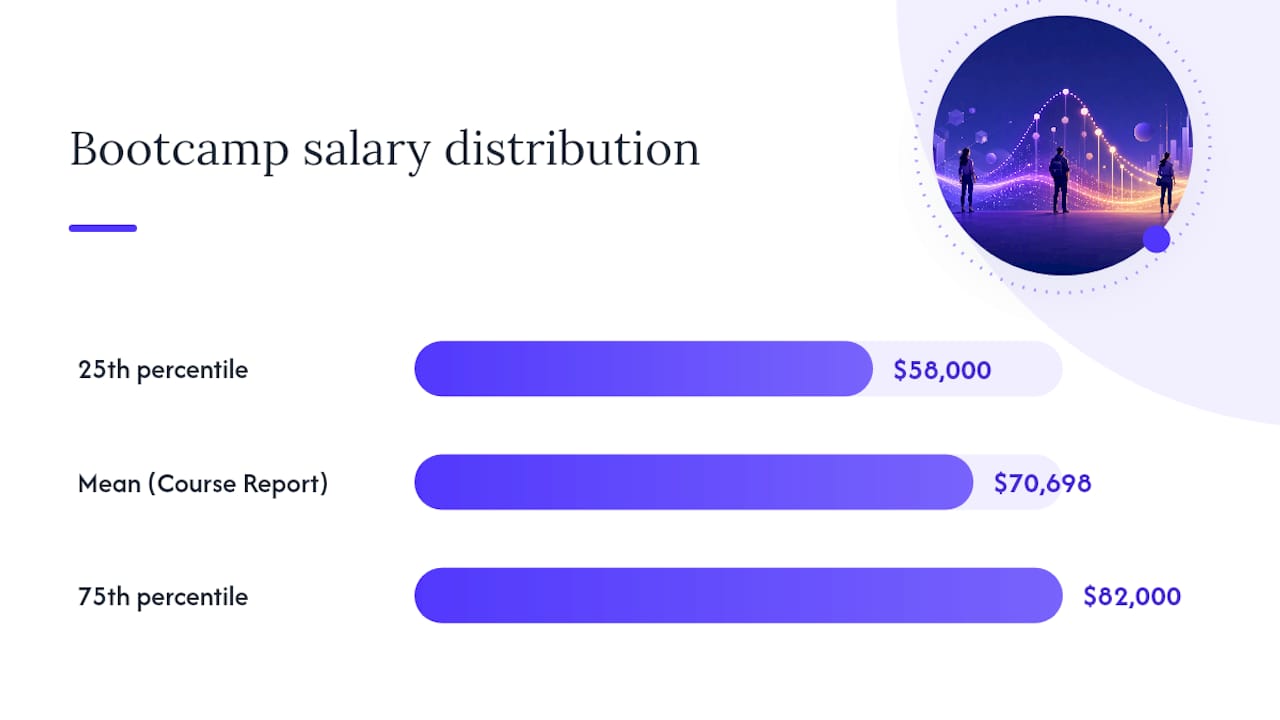
Percentiles matter more than either. A realistic 25th to 75th percentile band for first-job bootcamp salaries lands somewhere between $58,000 and $82,000, based on the regional and role variance reported across Metana's 2025-2026 tuition and outcomes analysis. If your offer sits in that range, you're not underperforming. You're typical.
Two data sources tell two different stories, and you need both:
- Alumni surveys (Course Report, individual bootcamp self-reports) capture what actual graduates say they earned, but response rates skew toward people willing to share good news.
- BLS occupation medians for software developers and related roles show what the broader labor market pays once someone has a year or two of tenure, which is where bootcamp grads eventually land.
Salary Ranges by Role and Specialization
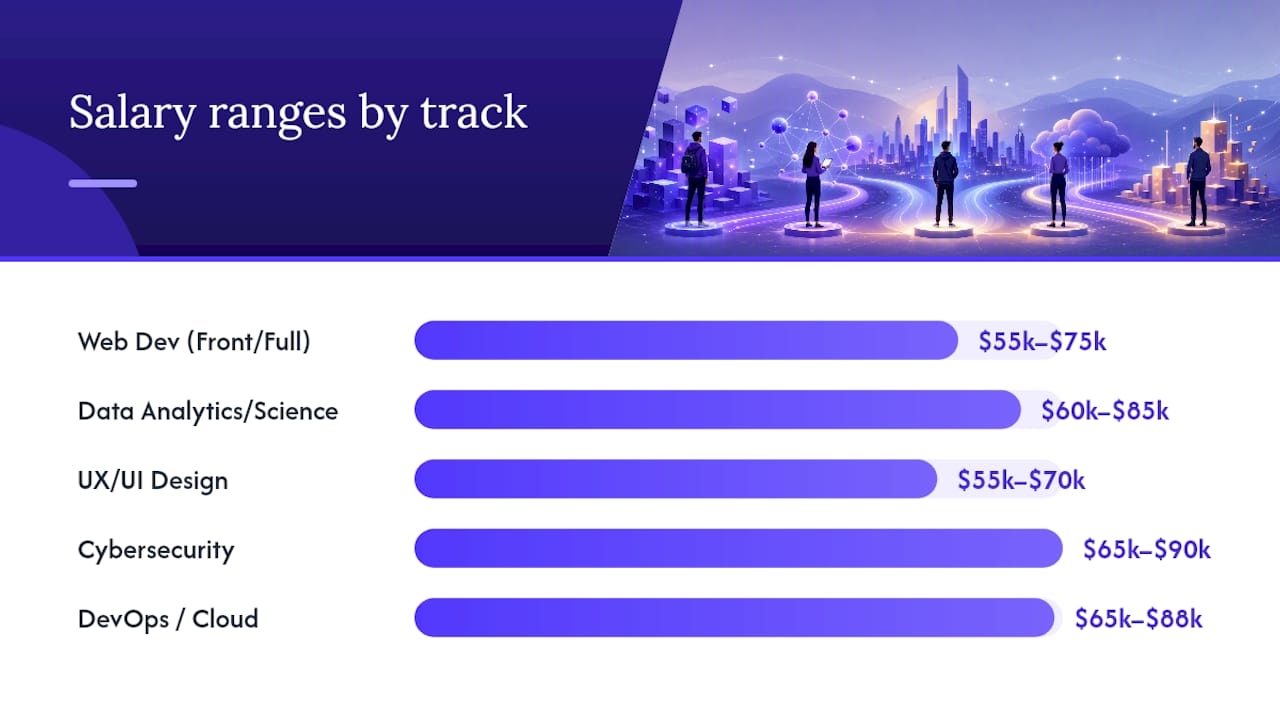
Not all bootcamp tracks pay the same, and the gap shows up fast once you start comparing job offers. Specializations tied to scarcer skills or higher business risk if done wrong, think security, data infrastructure, DevOps, tend to command a premium over general front-end work.
Conservative entry ranges by track, based on TripleTen's analysis of bootcamp grad outcomes and regional wage data:
- Web development (front end/full stack): $55,000 to $75,000. The most common track and the most saturated, which caps early upside.
- Data analytics/data science: $60,000 to $85,000. Demand for people who can clean and interpret data outpaces the supply of junior candidates.
- UX/UI design: $55,000 to $70,000. Pay depends heavily on whether the role is pure design or design plus front-end code.
- Cybersecurity: $65,000 to $90,000. Fewer bootcamp grads enter this track, and employers pay for it.
- DevOps/cloud infrastructure: $65,000 to $88,000. Requires more technical depth going in, which limits the applicant pool and lifts pay.
How Location and Remote Work Change Your Bootcamp Salary
Where you live, or where your employer is based, moves the number more than almost any other factor. A bootcamp grad in San Francisco or the broader Bay Area commonly starts between $85,000 and $110,000, according to Metana's regional breakdown. New York City runs close behind at $80,000 to $100,000. Move to the Midwest or smaller metro areas, and that same skill set often starts at $60,000 to $70,000.
Remote work has scrambled this math. A junior developer working remotely for a company headquartered in Austin or Seattle can sometimes negotiate closer to that company's local pay band, even while living somewhere with a much lower cost of living. It's not automatic. Seniority, a strong portfolio, and interview performance still decide whether you get coastal-adjacent pay or the local rate for wherever the company is based.
Pro Tip: Before you negotiate, pull your state's median software developer salary from a tool like Salary Atlas's state-by-state breakdown, then compare it against the coastal figures above. That gap tells you roughly how much remote-work leverage is worth pursuing in your job search.Coding Bootcamp ROI: Doing the Payback Math Yourself
Tuition for full-time immersive programs typically runs $12,000 to $14,200, per Metana's 2025-2026 data. But tuition isn't the real cost. Course Report's own guide estimates that lost wages and living expenses during a full-time program can add another $20,000 or more in opportunity cost, especially if you're leaving a stable job to attend.
Two scenarios show how differently this plays out:
- Full-time immersive, market-rate outcome: $13,500 tuition, $24,000 income uplift once employed, three months of job search after graduation. Payback lands around 12 to 14 months, consistent with Nucamp's ROI modeling.
- Part-time program while working: Lower tuition (often $8,000 to $10,000), no lost income since you keep your job, smaller but immediate salary bump. Payback often lands under six months because there's no income gap to recover from.
What Actually Improves Your Starting Salary
Prior experience changes your number more than most people expect. Course Report's historical data shows beginners averaging around $66,700 at their first job, self-taught candidates around $69,800, and people with prior IT-adjacent work experience closer to $76,700. The lesson isn't that you need a CS background. It's that you need to show, not tell, whatever technical exposure you already have.
Here's what moves the needle, in order of impact:
- A portfolio with real, deployed projects. Not tutorial clones. Employers can tell the difference immediately.
- Interview practice, specifically technical interviews. Treating your job search as a full-time job for three to six months after graduation is standard advice among independent bootcamp analysts, and it works.
- Networking through alumni networks and local tech meetups. Warm introductions convert to interviews far more often than cold applications.
- Career services quality. Ask specifically how many hours of mock interviews and resume review the program includes.
Where the Salary Numbers in This Guide Come From
Every figure here traces back to a named source, not a guess. Salary Atlas builds its salary pages directly from Bureau of Labor Statistics occupation data, refreshed annually, and links every number back to its BLS origin so you can verify it yourself.
The point of transparent salary data isn't to make bootcamp outcomes look better or worse than they are. It's to give you the same numbers employers already know when they write an offer.
To model your own likely outcome, start with a role page like web developer salary trends, then cross-reference it against your target state's median. Full methodology, including how figures get refreshed and sourced, lives on the Salary Atlas methodology page.
When a Bootcamp Actually Makes Financial Sense
Bootcamps deliver the most reliable ROI for people who already have adjacent experience, IT support, a technical degree in another field, or serious self-taught coding hours, and who can commit to the job search as seriously as the coursework. If you have zero technical background and can't afford three to six months of aggressive job hunting afterward, a slower self-study path or a degree may actually cost you less in total risk. Nobody hands you $70,000. You still have to go get it.
, Joelen Zyoktova
Model Your Own Coding Bootcamp Salary Expectations
Every figure in this guide came from public sources you can check yourself, and that's exactly the approach behind Salary Atlas. Instead of relying on a single bootcamp's marketing page for what you might earn, plug your target role and state into Salary Atlas's tools and see the actual BLS-sourced median for people doing that job where you live.
Start with the average salary by state tool to get a location-adjusted baseline before you compare it against any bootcamp's promised outcomes. If you're leaning toward a data track, the data analyst salary page shows the six-year trend so you can judge whether that specialization's growth trajectory matches the tuition you'd be paying. No paywalls, no email gate, just the numbers, sourced and dated so you know exactly where they came from.
Sources
- Coding Bootcamps in 2026: Your Complete Guide | Course Report
- Is a Coding Bootcamp Worth It in 2026? ROI analysis | Nucamp
- Coding Bootcamp ROI 2026: How Fast You'll Get Hired | Metana
- CIRR (Council on Integrity in Results Reporting)
FAQ
Are Coding Bootcamps Still Worth It in 2026?
For candidates with some technical background who commit to a serious job search, yes.
How Much Can a Beginner Coder Make?
Course Report's historical data shows complete beginners averaging around $66,700 at their first job, compared to roughly $76,700 for candidates with prior IT-adjacent experience. Role and location shift that number substantially in either direction.
Is a Coding Bootcamp Worth the Money?
Tuition typically runs $12,000 to $14,200, and most graduates recover that cost within 12 to 18 months given a median salary uplift of $24,000 to $25,000. Part-time programs that let you keep working shrink that payback window even further since there's no lost income to recover.
Is Coding a Stressful Job?
Like most knowledge work, it varies by employer and role, but tight deadlines, on-call rotations for infrastructure roles, and constant tooling changes are common stress points that bootcamp grads should expect going in. Checking a company's engineering culture during interviews matters as much as checking the salary.
Recommended
Occupation wage figures on Salary Atlas come from the U.S. Bureau of Labor Statistics. Figures in this article that are not linked to a source are estimates. See our methodology.