Exempt vs Nonexempt Salary: What Workers Need to Know
Learn the key differences between exempt and nonexempt salary to understand your pay rights and overtime eligibility under the law.
By the Salary Atlas editorial team · Published

Exempt employees are not entitled to overtime pay under the Fair Labor Standards Act; nonexempt employees are, and they must receive at least 1.5 times their regular rate for every hour worked past 40 in a workweek. That single distinction controls how tens of millions of Americans get paid, and it turns on three tests, not just a job title or a salary.
Here is what matters most right now:
- Overtime eligibility. Nonexempt employees are covered by FLSA minimum wage and overtime protections. Exempt employees are not, provided they pass all three parts of the exemption test.
- The three-part test. To be exempt, an employee must be paid on a salary basis, earn at or above the DOL salary threshold, and perform duties that qualify under a recognized exemption category.
- Current salary thresholds. The DOL updated the standard salary level to $844 per week ($43,888 annually) effective July 1, 2024, and to $1,128 per week ($58,656 annually) effective January 1, 2025. The highly compensated employee (HCE) threshold rose to $132,964 on July 1, 2024, and to $151,164 on January 1, 2025.
- First check. Compare your current weekly pay to the applicable threshold. If you earn less than $1,128 per week, you almost certainly cannot be classified as exempt under federal law, regardless of your title.
Key Takeaways
Exempt status under the FLSA requires passing all three parts of the test: salary basis, salary level at or above $1,128 per week as of January 1, 2025, and qualifying primary duties.
| Point | Details |
|---|---|
| Three-part test controls | Salary basis, salary level, and duties test must all be met; a title or salary alone is not enough. |
| Current federal threshold | $1,128 per week ($58,656/year) as of January 1, 2025; earning less means nonexempt under federal law. |
| State rules may be stricter | Several states set higher salary thresholds or daily overtime rules; employees get whichever standard is more generous. |
| Misclassification has remedies | File a WHD complaint to recover up to three years of back pay plus liquidated damages for willful violations. |
| Salary Atlas for real-dollar context | Search occupation medians and state breakdowns at Salary Atlas to compare your pay to the DOL thresholds. |
Table of Contents
- What are the main FLSA exemption categories?
- How the salary-basis test and thresholds actually work
- How overtime pay works for nonexempt employees
- When state rules give you more than the FLSA does
- Misclassification: what goes wrong and what you can do
- A practical checklist to assess your own classification
- What employers must track and where payroll practices go wrong
- Five job scenarios that show how classification plays out
- How the salary thresholds map to real occupations
- A note on what this data can and cannot tell you
- Salary Atlas puts the thresholds in real-dollar context
- Sources
- FAQ
What are the main FLSA exemption categories?
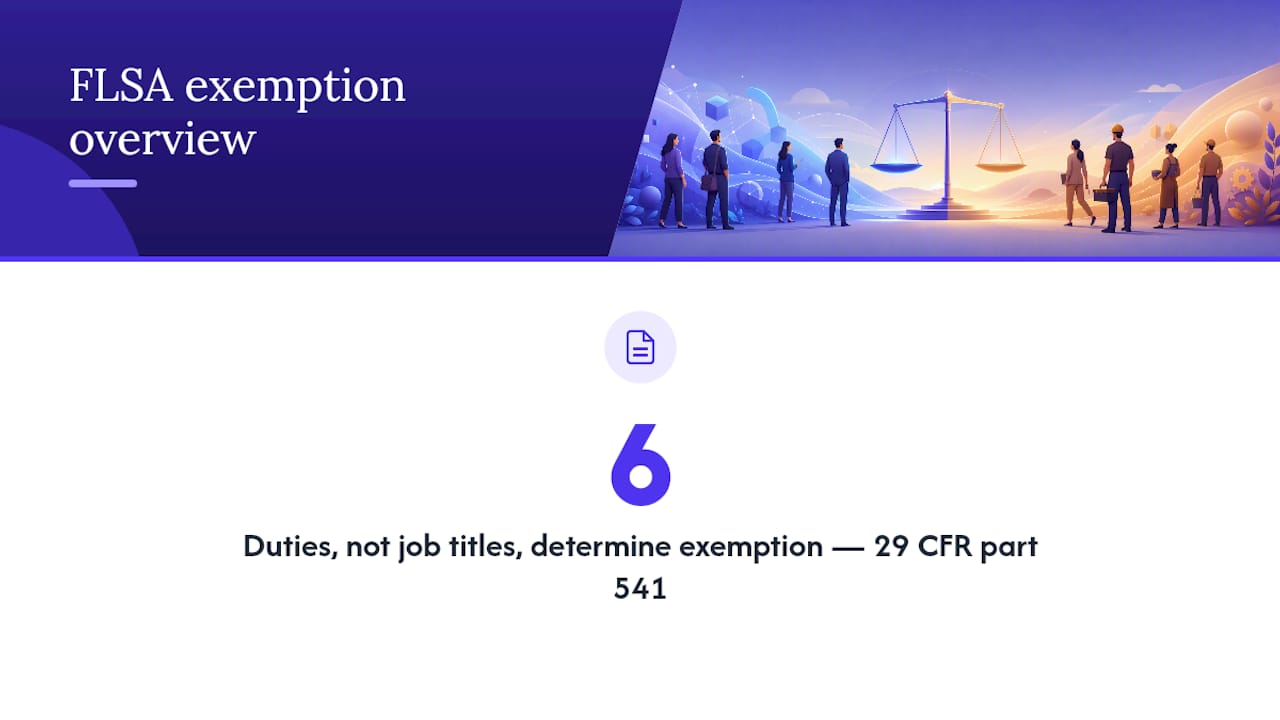
The six recognized exemption categories under the FLSA each carry their own duties test, codified in 29 CFR part 541 and summarized in DOL Fact Sheet #17A. A job title alone never determines exemption status. What matters is what the employee actually does most of the time.
Executive exemption
The employee's primary duty must be managing the enterprise or a department, directing the work of at least two full-time employees, and having real authority over hiring, firing, or advancement. A shift supervisor who schedules workers but has no say in hiring decisions likely does not qualify, even with "manager" in the title.
Administrative exemption
The primary duty must be office or non-manual work directly related to management or general business operations, and it must include the exercise of discretion and independent judgment on significant matters. A billing clerk who follows a fixed process does not meet this test. A compliance analyst who interprets policy and recommends action typically does.
Professional exemption
Two tracks exist here. The learned professional track requires advanced knowledge in a field of science or learning, customarily acquired through a prolonged course of specialized study. The creative professional track requires invention, imagination, or talent in a recognized artistic field. Registered nurses, CPAs, and engineers commonly qualify; data-entry workers do not, regardless of pay.
Computer employee exemption
Systems analysts, software engineers, and programmers can qualify if their primary duty involves applying systems analysis techniques, designing or developing software, or similar high-level work. The exemption does not cover employees who simply operate computers or perform routine IT support.
Outside sales exemption
The employee's primary duty must be making sales or obtaining orders away from the employer's place of business. This is the one exemption with no salary-level requirement. An inside sales rep who works from a call center does not qualify.
Highly compensated employee (HCE)
An employee earning at or above the HCE total annual compensation threshold ($151,164 as of January 1, 2025) who performs at least one exempt duty and is paid on a salary or fee basis qualifies under a streamlined test. The duties bar is lower, but the pay bar is much higher.
Pro Tip: Doctors, lawyers, and teachers in their primary professional roles are exempt from both the salary-basis and salary-level tests entirely. A licensed physician seeing patients does not need to earn $1,128 per week to be exempt; the DOL's salary-level rules carve them out specifically.How the salary-basis test and thresholds actually work
"Paid on a salary basis" means the employee receives a predetermined, fixed amount each pay period that does not drop because of variations in hours worked or the quality of work. Dock an exempt employee's pay for leaving two hours early on a Tuesday, and you may have just destroyed the salary basis for that entire workweek, potentially converting them to nonexempt status for that period.
A fee basis alternative exists for certain professional employees: if the employee is paid an agreed sum for completing a single job regardless of time, the fee may qualify as the equivalent of a salary.
Salary-level thresholds by effective date
Source: DOL Final Rule on Overtime Protections
How bonuses and commissions count
- Nondiscretionary bonuses, incentive pay, and commissions may satisfy up to 10% of the standard salary level, but only for the standard EAP exemption, not the HCE total compensation calculation.
- The employer must pay any shortfall as a "catch-up" payment within one pay period after the end of the 52-week period if the bonus does not cover the 10% portion.
- Discretionary bonuses (those decided at the employer's sole discretion near the time of payment) do not count toward the threshold.
- For HCE employees, total annual compensation includes salary, commissions, nondiscretionary bonuses, and other nondiscretionary compensation, but not fringe benefits or employer retirement contributions.
How overtime pay works for nonexempt employees
The FLSA baseline is straightforward: nonexempt employees must receive at least the federal minimum wage ($7.25 per hour) for all hours worked and overtime at 1.5 times the regular rate for every hour beyond 40 in a single workweek. There is no federal premium for nights, weekends, or holidays unless those hours push the total past 40.
The regular rate is not always the same as the hourly wage. When pay includes commissions, piece rates, or a salary covering fluctuating hours, the regular rate must be recalculated. The DOL Handy Reference Guide walks through the methodology in detail.
Overtime calculation examples
Example 1: Hourly nonexempt worker- Maria earns $18.00 per hour and works 47 hours in a week.
- Regular pay: 40 hours × $18.00 = $720.00
- Overtime rate: $18.00 × 1.5 = $27.00 per hour
- Overtime pay: 7 hours × $27.00 = $189.00
- Total weekly pay: $909.00
Being paid a salary does not automatically make someone exempt. A salaried nonexempt employee is still owed overtime.
- James earns a fixed salary of $800 per week and is classified as nonexempt. He works 50 hours in a week.
- Regular rate: $800 ÷ 50 hours = $16.00 per hour (the fluctuating workweek method, if agreed in advance)
- Overtime premium (half-time, since the salary already covers all hours): 10 overtime hours × $8.00 = $80.00
- Total weekly pay: $880.00
When state rules give you more than the FLSA does
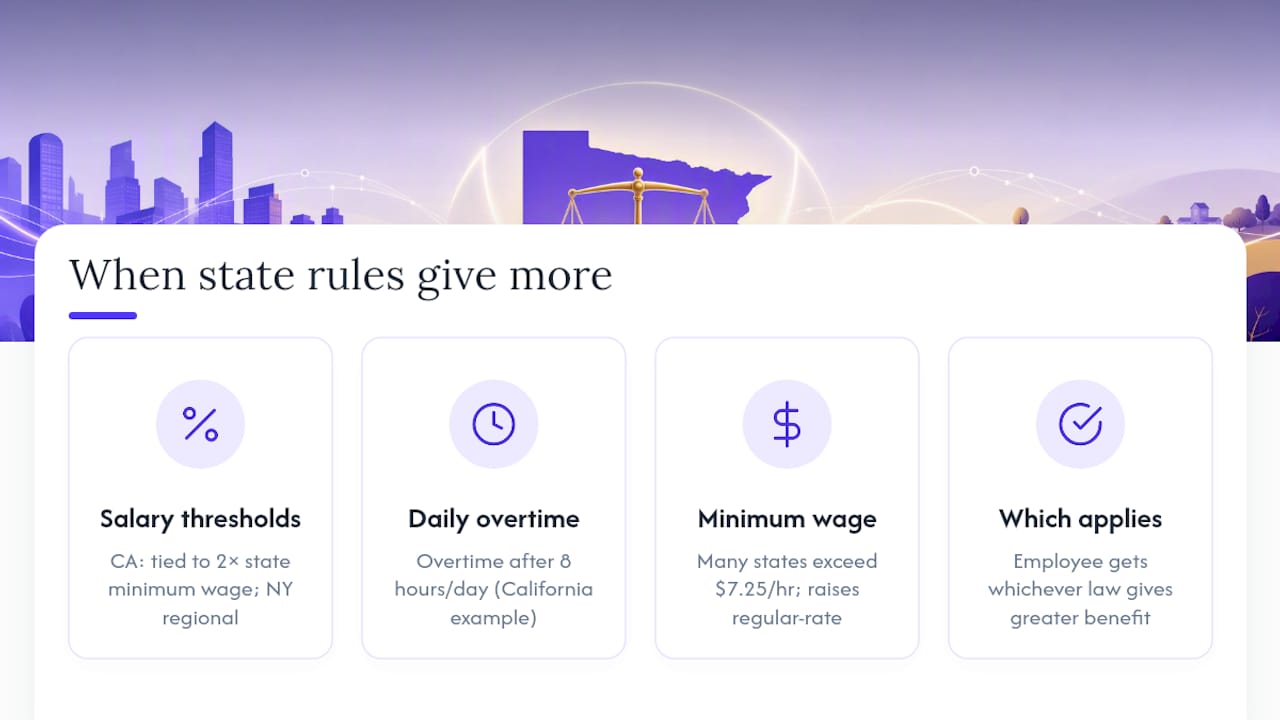
Federal law sets the floor. When a state's overtime or minimum-wage law is more generous, the employee gets the better deal. That principle applies to salary thresholds, minimum wage rates, and overtime triggers.
Several states set their own exempt salary thresholds above the federal level. California, for example, ties its exempt salary minimum to twice the state minimum wage, which currently exceeds the federal $1,128 per week standard. New York similarly maintains its own threshold schedule by region. An employee in those states who earns between the federal and state threshold is nonexempt under state law even if they would be exempt under the FLSA alone.
Some states also require daily overtime, meaning overtime kicks in after eight hours in a single day, not just after 40 hours in a week. California is the most prominent example. An employee who works four 10-hour days and takes Friday off has worked 40 hours total, owes no federal overtime, but owes two hours of daily overtime on each of those four days under California law.
State minimum wages in many jurisdictions now exceed $7.25 per hour by a wide margin, which directly affects the regular-rate calculation for nonexempt workers. The DOL's overtime page confirms that employees are entitled to whichever standard provides the greater benefit when both federal and state law apply.
Check your state labor department's website for the current thresholds and any daily overtime rules. The DOL's Wage and Hour Division also maintains a directory of state labor offices.
Misclassification: what goes wrong and what you can do
Misclassification is one of the most common wage violations in the country, and it usually comes from one of three mistakes.
- Relying on job titles. Calling someone a "manager" or "coordinator" does not make them exempt. The duties test controls, and DOL misclassification guidance is explicit that titles are insufficient.
- Improper salary deductions. Docking an exempt employee's pay for partial-day absences (outside of FMLA or a bona fide sick-leave plan) can destroy the salary basis and expose the employer to back-pay liability for the affected period.
- Misapplying the duties test. An employee who spends most of their time on routine tasks does not qualify for the administrative or executive exemption just because they occasionally make a significant decision.
- Talk to HR first. Ask for a written explanation of your classification and the duties test applied. Document the conversation.
- Preserve your records. Save pay stubs, offer letters, job descriptions, time records, and any emails discussing your hours or duties. Keep copies outside of company systems.
- File a complaint with the WHD. The Wage and Hour Division investigates FLSA violations at no cost to the employee. If a violation is found, you may recover up to two years of back pay (three years for willful violations) plus an equal amount in liquidated damages.
- Consult an employment attorney. Many wage-and-hour attorneys work on contingency for misclassification claims.
A practical checklist to assess your own classification
Use these questions to evaluate whether your job likely meets an exemption. A "no" on any of the first three is a strong signal you are nonexempt.
- Do you receive the same predetermined salary every pay period, regardless of hours worked or quality of work?
- Does your weekly salary currently meet or exceed $1,128 (the January 1, 2025 federal threshold)?
- Is your primary duty one of the recognized exempt categories: managing others, exercising independent judgment on significant business matters, applying advanced professional knowledge, or making outside sales?
- Do you spend the majority of your working time on those exempt duties, not on routine or clerical tasks?
- If you supervise others, do you have genuine authority over hiring, firing, or advancement, or do your recommendations carry real weight?
- Does your employer make deductions from your salary for partial-day absences or variations in workload?
- Has your employer ever told you in writing that you are exempt and explained which category applies?
What employers must track and where payroll practices go wrong
The FLSA imposes recordkeeping obligations on employers for all nonexempt employees. Required records include:
- Employee's full name, address, occupation, and sex
- Hour and day the workweek begins
- Total hours worked each workday and each workweek
- Total daily or weekly straight-time earnings
- Regular hourly pay rate for any week overtime is worked
- Total overtime pay for the workweek
- All additions to or deductions from wages
- Total wages paid each pay period and the date of payment
Two payroll practices that commonly destroy a salary basis:
- Docking pay for partial-day absences. An exempt employee who leaves early due to illness and has their salary reduced for those hours loses exempt status for that workweek under most circumstances.
- Reducing salary during slow periods. Cutting an exempt employee's pay when business is slow, or when they work fewer hours than usual, violates the salary-basis requirement.
Five job scenarios that show how classification plays out
These scenarios illustrate how small differences in duties or pay change the outcome.
- Scenario 1: Office manager, $62,000/year. She manages a team of five, approves time-off requests, and has input on hiring decisions. Her salary exceeds $1,128 per week. She likely qualifies for the executive exemption. Classification: exempt.
- Scenario 2: Customer service lead, $45,000/year. He has "lead" in his title and trains new hires occasionally, but his primary duty is answering customer calls using a scripted process. He does not supervise in any meaningful sense. His salary exceeds the threshold, but he fails the duties test. Classification: nonexempt. Common misunderstanding: the title and salary are not enough.
- Scenario 3: Staff accountant, $55,000/year. She applies accounting principles, exercises judgment on how to categorize transactions, and prepares financial statements. She likely qualifies as a learned professional. Classification: exempt.
- Scenario 4: Salaried warehouse coordinator, $38,000/year. He is paid a fixed salary but earns $730 per week, below the $1,128 federal threshold. Regardless of his duties, he cannot be exempt under current federal law. Classification: nonexempt. Worked overtime example: if he works 48 hours in a week, his regular rate is $730 ÷ 40 = $18.25. Overtime pay = 8 hours × ($18.25 × 1.5) = 8 × $27.38 = $219.00. Total weekly pay: $949.00.
- Scenario 5: Outside sales representative, no salary floor. She visits clients, negotiates contracts, and closes deals away from the office. The outside sales exemption has no salary-level requirement. As long as her primary duty is making sales away from the employer's premises, she qualifies. Classification: exempt.
How the salary thresholds map to real occupations
The abstract threshold of $1,128 per week ($58,656 annually) becomes concrete when you set it against actual occupation medians. The figures below use BLS OEWS data aggregated by Salary Atlas and reflect national medians. Individual pay varies by employer, experience, and location.
A median above the threshold does not mean every worker in that occupation is exempt. An individual earning below $58,656 annually is nonexempt under federal law regardless of occupation. Medians also mask wide ranges: a writer earning $35,000 is nonexempt; one earning $90,000 may qualify as a creative professional if the duties test is met. Use Salary Atlas's state-level salary data to see how medians shift by geography and whether your state's threshold changes the picture.
A note on what this data can and cannot tell you
The salary thresholds and occupation medians in this article give you a solid starting point, but data has limits. A median wage tells you where the middle of a population sits; it says nothing about whether your specific role, duties, and employer practices meet the legal tests. Classification disputes turn on facts, not averages.
Salary Atlas draws on BLS/OEWS data and presents it without paywalls or fabricated figures, but nothing here is legal advice. If you are in a genuine dispute with an employer over classification or back pay, the right next steps are a WHD complaint, a state labor board filing, or a conversation with an employment attorney who knows your state's rules. The DOL's Wage and Hour Division and your state labor department are the authoritative sources for current thresholds and enforcement procedures.
Salary Atlas puts the thresholds in real-dollar context
Knowing the federal threshold is $58,656 per year is useful. Knowing whether your occupation typically pays above or below it, in your state, is more useful.
 Salary Atlas publishes BLS-sourced occupation medians by job title, percentile, and state, with no paywall and no signup required. Search your occupation to see where the median falls relative to the January 2025 DOL threshold, then check the salary-by-state tool to see whether your state's figures shift the picture. If you are comparing a job offer or questioning your current classification, those two pages give you the concrete numbers to start the conversation.
Sources
The sources below are the primary references for the rules and data in this article.
- Final Rule: Restoring and Extending Overtime Protections | U.S. Department of Labor
- nonexempt employee | Wex | US Law | LII / Legal Information Institute
This article is general information, not a substitute for advice from a qualified lawyer. Consult a qualified legal professional about your own circumstances before acting on anything here.
FAQ
Is it better to be salary exempt or nonexempt?
Neither status is universally better. Exempt employees often have more schedule flexibility and higher base pay, but they receive no overtime regardless of hours worked. Nonexempt employees earn overtime for every hour past 40, which can significantly increase total compensation in roles with heavy workloads.
What is the salary threshold for exempt employees in 2026?
The federal threshold is $1,128 per week ($58,656 annually) as of January 1, 2025, per the DOL's final overtime rule. Some states set higher thresholds; employees are entitled to whichever standard is more generous.
Are nonexempt employees hourly or salaried?
Nonexempt employees can be either hourly or salaried. ADP's guidance notes that salaried workers below the DOL threshold are typically nonexempt and owed overtime just like hourly workers.
Do salaried exempt employees get PTO?
PTO is not required by the FLSA for any employee, exempt or nonexempt. Employers generally must pay exempt employees their full salary for any week in which work is performed, but PTO accrual and usage rules are set by employer policy, not federal law.
Can an employer change my classification without telling me?
Employers can reclassify employees, but they cannot do so retroactively to avoid paying overtime already owed. If your classification changes and you believe it is incorrect, request a written explanation of the duties test applied and compare it against the DOL criteria in Fact Sheet #17A.
Recommended
Occupation wage figures on Salary Atlas come from the U.S. Bureau of Labor Statistics. Figures in this article that are not linked to a source are estimates. See our methodology.