What Counts as a Good Salary in Seattle in 2026?
Discover what constitutes a good salary in Seattle by 2026, from living comfortably to supporting a family. Get the insights you need!
By the Salary Atlas editorial team · Published

A good salary for a single adult in Seattle is generally considered to range from a modest comfort level to a figure that allows real discretionary spending and savings, depending on your financial cushion goals. Households need considerably more, especially with kids in the mix.
- Single adult, modest comfort: a moderate income level
- Single adult, real comfort (savings + discretionary spending): a higher income level approaching comfortable benchmarks
- Two-income household, no kids: combined income needs are significantly higher
- Two adults with children: combined household needs increase substantially, particularly with childcare expenses
Key Takeaways
A good salary in Seattle depends on household size and location, but $130,000 to $135,000 is the realistic comfort benchmark for a single adult living alone in the city.
| Point | Details |
|---|---|
| Single-adult comfort range | Expect $130,000 to $135,000 for real comfort, per EPI-backed and Citywage estimates. |
| Median pay falls short | Seattle's median salary sits around $76,147, well below the comfortable-income benchmark. |
| Housing drives the gap | Rent is the single biggest lever; a roommate or suburb move can cut your target salary by a moderate amount. |
| Families need much more | Two adults with children can require substantially more combined income, mostly due to childcare costs. |
| Check your job-level number | Salary Atlas offers free, BLS-sourced percentile data by job title so you can benchmark your specific role. |
Table of Contents
- How Does Seattle Compare to National and Regional Salary Benchmarks?
- What Costs Push Seattle's Comfortable Salary Higher?
- How Much Does Neighborhood and Household Size Change the Number?
- How Do You Know If Your Salary Is Actually Good for You?
- Why Do Salary Estimates for Seattle Vary So Much?
- What Does a Good Salary Look Like by Job and Percentile?
- Is "Comfortable" Really Just a Number?
- Find Your Exact Salary Number, Not Just a City Average
- Sources
- FAQ
How Does Seattle Compare to National and Regional Salary Benchmarks?
The gap between "comfortable" and "typical" is wide in Seattle, and that gap is the whole story. A single adult needs about $135,265 a year to live comfortably in the Seattle metro, according to local reporting on Upgraded Points and Economic Policy Institute analysis, which ranks the city sixth highest in the country for that benchmark. Citywage puts the figure slightly lower, at $130,145, using a 50/30/20 budgeting model instead of the EPI approach.
Compare that to what people actually earn. Gusto's wage data puts the median Seattle salary around $76,147, with 80% of earners falling between $39,150 and $165,300. That means half the workforce earns less than $76,000 while the "comfortable" line sits nearly $60,000 higher.
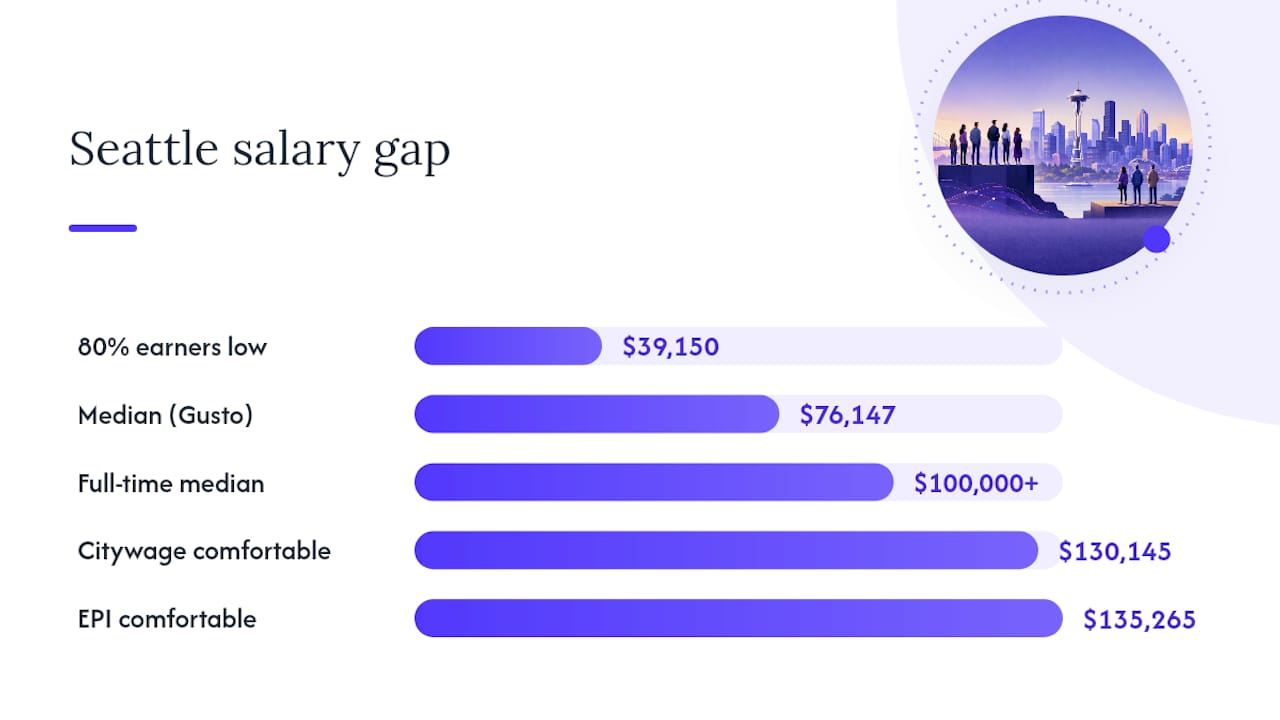
Full-time workers fare better. The Seattle Times reported that median earnings for full-time, year-round workers in the city passed $100,000. That's a meaningfully different population than Gusto's broader median, which includes part-time and entry-level roles.
Why do the numbers disagree? MIT's Living Wage model calculates a survival floor, not a comfort target. It doesn't factor in retirement savings or much discretionary spending. EPI-style comfortable-income estimates build in a 50/30/20 split (needs, wants, savings), which pushes the number up. Citywage's method is similar but weights categories slightly differently, which explains the roughly $5,000 spread between its figure and the EPI-backed number.What Costs Push Seattle's Comfortable Salary Higher?
Housing does more heavy lifting in this equation than any other line item. Rent for a one-bedroom in the city proper often runs $1,900 to $2,400 a month, and that single expense can consume a third of a $100,000 salary before taxes even enter the picture.
Here's what typically drives the comfortable-income number up or down:
- Housing: the single largest cost, varying enormously by neighborhood
- Taxes: Washington has no state income tax, which helps take-home pay stretch further than in states like California or Oregon
- Childcare: among the most expensive line items nationally, and Seattle is no exception; this is a major reason family benchmarks jump so sharply
- Healthcare: premiums and out-of-pocket costs add up even with employer coverage
- Transportation: car ownership, parking, or transit passes, depending on where you live and work
- Groceries: Seattle runs above the national average for food costs
- Savings: the EPI-style comfortable benchmark assumes a real savings rate, not just bare survival

How Much Does Neighborhood and Household Size Change the Number?
The comfortable-salary figure isn't one number. It's a range that moves depending on where you live and who you're supporting.
- Single adult, roommate situation: can reach comfort at a moderately lower income due to shared housing costs
- Single adult, living alone in Seattle proper: typically requires a higher income to achieve comfort
- Single adult on the Eastside (Bellevue, Kirkland): often faces higher housing costs requiring a higher income
- Two-income household, no kids: combined income needs are substantially higher to cover comfort and savings
- Two adults with children: household income requirements rise significantly, especially due to childcare costs
How Do You Know If Your Salary Is Actually Good for You?
Benchmarks are useful, but your personal number depends on your own debts, goals, and household. Run through this quick checklist:
- Housing cost: is rent or mortgage under 30% of your gross income? Above 35% is a warning sign.
- Savings rate: are you saving at least 20% of income toward retirement, emergencies, or goals?
- Emergency fund: do you have three to six months of expenses set aside?
- Debt burden: are student loans, car payments, or credit card balances eating into your ability to save?
- Discretionary room: after fixed costs, do you have money left for things you actually enjoy?
- Rent or mortgage above 35% of gross pay
- No emergency fund after a year of full-time work
- Carrying credit card balances month to month
- Zero progress toward retirement savings
Why Do Salary Estimates for Seattle Vary So Much?
Every headline number comes from a different set of assumptions, and knowing those assumptions matters more than memorizing any single figure.
- MIT Living Wage calculates a bare-minimum survival budget covering housing, food, childcare, and transportation, with little room for savings or discretionary spending.
- EPI/Upgraded Points-style estimates build in a 50/30/20 budget split, which is why their "comfortable" figure runs well above MIT's living-wage floor.
- Citywage's 50/30/20 model uses similar logic but weights certain categories differently, landing at $130,145 instead of $135,265.
The gap between a living wage and a comfortable wage isn't a rounding error. It's the difference between covering your bills and actually building a financial cushion, and that difference alone explains most of why headline numbers vary by $30,000 or more.
Data vintage and geographic boundaries matter too. Some sources model the Seattle-Tacoma-Bellevue metro; others draw a tighter line around city limits, and that boundary choice alone can shift which side of a benchmark you land on. Check Salary Atlas's methodology for how job-level figures get sourced and refreshed.
What Does a Good Salary Look Like by Job and Percentile?
A single number can't tell you whether your specific offer is competitive. That's where percentiles come in: the median (50th percentile) tells you what the middle worker earns, while the 75th and 90th percentiles show what strong performers or senior-level workers make in the same role.
Seattle's tech-heavy job market skews these numbers upward for plenty of occupations, especially anything tied to software, data, or engineering. A data analyst role, for instance, often shows meaningfully higher percentile ranges in Seattle than the national median, thanks to competition from companies like Amazon and Microsoft.

If you're setting a target, aim for the 60th to 75th percentile for your role and experience level rather than the bare median. That range typically reflects solid, competitive pay without requiring you to be the top performer in your field. Salary Atlas's state-by-state BLS data is a good starting point for comparing where Washington roles land against national percentiles.
Is "Comfortable" Really Just a Number?
Every benchmark in this article is a modeled average, not a verdict on your life. What "comfortable" means depends on your debt, your family, and what you're willing to trade for lower rent. The data above gives you a real starting point, not a finish line.
Find Your Exact Salary Number, Not Just a City Average
Every benchmark above is a citywide average. Your actual number depends on your job title, your experience level, and how Seattle pay compares to the rest of Washington. That's the gap Salary Atlas closes.
Salary Atlas pulls occupation-level wage data straight from the U.S. Bureau of Labor Statistics, broken down by percentile and experience, with no paywall and no signup wall between you and the numbers. Instead of guessing whether $130,000 is good for your specific role, you can look up median, 75th percentile, and 90th percentile pay for your exact job title in Washington. Every figure links back to its BLS source, so you can verify it yourself instead of trusting a vague citywide estimate. Search Salary Atlas's job title database to see where your current offer or target salary actually lands.
Sources
- Living Wage Calculation for Seattle-Tacoma-Bellevue, WA
- Single Seattle residents need to make $135K to live comfortably, 6th most in U.S
- Average Salary in Seattle, WA - June 2026
- Median earnings for Seattle full-time workers pass $100000
FAQ
What salary do I need to live comfortably in Seattle?
A single adult typically needs an income level around the low to mid six figures for real comfort, based on credible estimates that include savings and discretionary spending on top of basic costs.
Is $200,000 a good salary in Seattle?
Yes. An income well above the single-adult comfortable benchmark is generally sufficient to comfortably cover a two-income household without children in many Seattle neighborhoods.
Is $100,000 a good salary in Seattle?
It's solid but below the full comfort benchmark. $100,000 is close to median earnings for full-time Seattle workers, per the Seattle Times, but is generally below the comfortable-income levels suggested by cost of living models for full financial breathing room.
Is $135,000 a good salary in Seattle?
Yes, $135,000 aligns with estimates for a comfortable income for a single adult in the Seattle metro, meaning it is intended to cover essentials, savings, and some discretionary spending.
What is considered a high salary in Seattle?
Salaries meaningfully above typical comfortable-income benchmarks for a single person start to qualify as high, given that they clear both median and comfort thresholds with room to spare. Check job-specific percentile data to see what counts as high for your particular occupation.
Recommended
Occupation wage figures on Salary Atlas come from the U.S. Bureau of Labor Statistics. Figures in this article that are not linked to a source are estimates. See our methodology.