How to Set Pay Ranges: A Step-by-Step Guide for Employers
Learn how to set pay ranges: job evaluation, market data, midpoints, range width, equity checks and review cycles, with a worked example and U.S. rules.
By the Salary Atlas editorial team · Published

To set a pay range, you evaluate each job, price it against current market wages, choose a midpoint, decide how wide the range should be, and then calculate the minimum and maximum around that midpoint. After that, you test the result for internal equity and review it on a schedule. This guide walks through each step with a worked example, so you can build ranges you can defend to employees, candidates and auditors.
TL;DR
- A pay range is the base-pay span from a stated minimum to a stated maximum for a job or level. It is not a promise of any particular rate.
- Build it in order: evaluate the job, price it against the market, set the midpoint, choose a width, calculate the minimum and maximum, then test for equity.
- Use one consistent market source for similar jobs. Federal wage data by occupation, percentile and state is a free starting point.
- Set hiring rules before managers make offers. New hires usually land between the minimum and the midpoint, and the maximum is rarely a starting pay.
- Review the structure every year and run a deeper benchmark review every few years.
Table of Contents
- What a pay range is and what it is not
- Step 1: Decide your pay philosophy
- Step 2: Evaluate and group your jobs
- Step 3: Gather market data you can defend
- Step 4: Set the midpoint
- Step 5: Choose the range width
- Step 6: Calculate the minimum and maximum
- Step 7: Decide how the range is used for hiring and for current staff
- Step 8: Check equity and compression
- Step 9: Communicate and review
- Our perspective on setting pay ranges
- Start your market research with sourced wage data
- FAQ
- Sources
What a pay range is and what it is not
A pay range is the span of base pay an employer states for a job or level, from a minimum to a maximum. TCWGlobal's definition makes a useful point: a range is separate from actual pay and from total compensation. It does not promise a specific rate or automatic raises. Where a person falls inside it can depend on experience, skills, job scope, internal pay relationships and employer policy.
That matters for how you build and explain the range. A range is a tool for managing pay: it tells managers how far they can go, tells employees what growth looks like, and tells candidates what to expect. The CIPD notes that pay structures bring order and clarity to managing pay and help communicate expectations about career development.
A salary structure is the full set of ranges, usually grouped into grades or bands. Each job is slotted into a grade. Grades overlap or step upward so that bigger jobs pay more. You can set a single range for one job, but the logic below scales to a whole structure.
Step 1: Decide your pay philosophy
Before any number, decide where you want to pay relative to the market. This is a policy choice, and every later calculation depends on it.
Three common positions:
- Below market (for example, around the 25th percentile): you save on payroll but must compensate with benefits, flexibility or growth, and you will lose some candidates.
- At market (around the median, or 50th percentile): you match what the typical employer pays for the same work.
- Above market (the 75th percentile or higher): you pay more to attract and keep scarce skills.
Step 2: Evaluate and group your jobs
Pay ranges follow job content, not the person currently in the seat. Start with job evaluation: judging the relative worth of positions so pay stays aligned and fair inside your organization. According to an SHRM instructor case study on designing a pay structure, common methods include the point method, ranking and classification.
In practice:
- Write a short, accurate description for each job: duties, decision authority, required skills, and who it reports to.
- Score or rank the jobs against each other on factors such as skill, responsibility, and impact.
- Group jobs of similar value into grades. Jobs in the same grade share a range.
- Pick benchmark jobs: roles common enough in the market that you can find reliable pay data for them.
Step 3: Gather market data you can defend
The same SHRM case study describes market pricing as analyzing salary-survey data from the relevant labor market, in that case regional data from organizations recruiting similar benchmark jobs. The principle holds for any employer: match the job, the geography and the industry as closely as the data allows.
What to look for in a data source:
- Job match: the data should describe the work, not just a similar title.
- Percentiles, not only the average: you need the 25th, 50th and 75th percentile to apply your philosophy from Step 1.
- Geography: pay differs by state and metro area, so use a local cut when you hire locally.
- Transparent method: you should be able to trace every figure to its origin.
- Currency: wage data ages, so check the reference period.
A quick example of a benchmark. Our software developer salary page reports a median of $135,980 from BLS data. If you hire developers and your philosophy is to pay at market, that median is a reasonable starting point for the midpoint of a developer range. You would then adjust for your state, your industry and your level, and compare against any other survey you use. Remember that a national figure is a starting point and not an answer for your city.
Also check how current your data is. If your sources are a few years old, you can note the trend before you finalize numbers; our wage trends overview shows what U.S. pay data says about recent movement.
Step 4: Set the midpoint
The midpoint is the center of the range and the number most closely tied to your market data. It represents what you would pay a fully competent, experienced person in the role.
How to set it:
- Take the market figure that matches your philosophy: the median for an at-market position, the 75th percentile for a lead-the-market position.
- Adjust for location if you hire in places with higher or lower pay. If you have remote employees, decide whether pay follows the person or the company; see how location-based pay works.
- Average across the benchmark jobs in a grade so the grade has one midpoint.
- Round to a clean number so ranges are easy to communicate.
Step 5: Choose the range width
Range width, sometimes called range spread, is the percentage difference between the minimum and maximum, and it signals how much room for progression a role has, per the CIPD factsheet.
How wide? The University of Rochester's pay guidelines say ranges should be wide enough to accommodate a variety of experience levels, balancing hiring flexibility with internal equity. There is no universal right percentage. Use these rules of thumb:
- Narrower ranges suit entry-level and clearly defined jobs where experience adds little value. Pay moves in a tight band, and promotion is the way to earn more.
- Wider ranges suit senior, specialist and professional jobs where a few years of experience change output a lot.
- Too narrow and you cannot hire a stronger candidate without a new grade or an exception.
- Too wide and two people doing the same job can differ in pay by more than you can justify.
Step 6: Calculate the minimum and maximum
There are two ways to build a range around a midpoint, and they give different results. Pick one and use it throughout.
Method A: set the minimum and maximum as equal percentages of the midpoint. With a midpoint of $100,000 and 20% either side, the minimum is $80,000 and the maximum is $120,000. The spread, measured as (maximum minus minimum) divided by minimum, is 50%. Method B: start from a target spread. With a midpoint of $100,000 and a 40% spread, the minimum is the midpoint divided by 1.2, or about $83,333. The maximum is the minimum times 1.4, or about $116,667. Check: $116,667 minus $83,333 is $33,334, which is 40% of $83,333.
These figures are illustrative and are not drawn from any survey. Here is how the two methods compare.
| Item | Method A (±20% of midpoint) | Method B (40% spread) |
|---|---|---|
| Midpoint | $100,000 | $100,000 |
| Minimum | $80,000 | $83,333 |
| Maximum | $120,000 | $116,667 |
| Spread (max minus min, over min) | 50% | 40% |
Examples of salary ranges by level
If you want to see how ranges stack across a job family, here is an illustrative ladder built with Method B at rising spreads. The numbers are invented to show the arithmetic and are not market data.
| Level | Midpoint | Spread | Minimum | Maximum |
|---|---|---|---|---|
| Associate | $60,000 | 30% | $52,174 | $67,826 |
| Specialist | $80,000 | 40% | $66,667 | $93,333 |
| Senior | $105,000 | 50% | $84,000 | $126,000 |
Step 7: Decide how the range is used for hiring and for current staff
A range does two jobs: it guides starting pay and it guides raises. Treat them separately.
For starting pay, many employers set explicit rules. At the University of Arizona, per its guide to compensation, new-hire pay is based on relevant skills, knowledge, expertise and experience, and is evaluated for equity against current employees. Hiring departments can offer University Staff candidates between the range minimum and midpoint, and the maximum is rarely appropriate as a starting salary.
Georgetown's HR office describes the same logic from the candidate's side in its pay transparency guidance: the minimum is the base level for candidates at the entry level of the qualifications, the maximum is attainable but generally reserved for highly qualified and experienced candidates, and most candidates who meet basic qualifications can expect an offer somewhere in the mid-range.
A simple hiring matrix helps managers stay consistent:
| Candidate profile | Typical placement |
|---|---|
| Meets minimum qualifications, still learning the role | Near the minimum |
| Fully qualified, some relevant experience | Between the minimum and the midpoint |
| Strong experience and proven results in similar work | Around the midpoint |
| Exceptional, rare skills and a clear business case | Above the midpoint, with written approval |
- Compa-ratio: an employee's pay divided by the midpoint. With a $100,000 midpoint, someone at $92,000 has a compa-ratio of 0.92.
- Range penetration: how far through the range the pay sits, calculated as (pay minus minimum) divided by (maximum minus minimum). In the $80,000 to $120,000 range, $92,000 is 30% of the way through.
Step 8: Check equity and compression
A range that looks fine on paper can still produce unfair pay. Run two checks before you publish it.
Legal equity. Under federal law, employers must pay equal wages for substantially equal work, work that requires equal skill, effort and responsibility under similar working conditions, regardless of sex, according to the EEOC's compensation guidance. The same guidance says the remedy for a violation should include a raise and back pay for the unlawful difference, with the lower-paid person's pay lifted to match. Two people in the same job with different pay need a documented, job-related reason, such as experience or performance. Talk to employment counsel when a gap lines up with sex, race or another protected characteristic. Compression. Pay compression happens when new hires come in close to, or above, longtime employees in the same job. Check every employee against the range and against peers with similar experience. If a new offer would leapfrog current staff, fix the staff pay in the same budget cycle instead of granting a one-off exception to the new hire. Solving a range problem candidate by candidate makes the structure meaningless over time.Before finalizing, review these questions:
- Does any current employee fall below the new minimum or above the new maximum?
- Do people with similar experience in the same job sit close together?
- Can you explain every difference with a job-related reason?
- Is the maximum realistic, or does it stretch so far that nobody reaches it?
Step 9: Communicate and review
Publish ranges internally, with an explanation of how people move through them. Employees who see how pay works trust it more. Many U.S. states and cities now also require employers to disclose pay ranges in job postings, and rules differ by jurisdiction and employer size. Check your state and local requirements, and ask counsel before you post.
For review, there is no single required schedule. The University of Rochester says it intends to review its compensation structure annually, with a comprehensive assessment of benchmark jobs every three to four years, per its pay guidelines. That is a sensible pattern to copy: a yearly check on whether the market has moved and the ranges still fit, plus a deeper rebuild every few years.
Pay thresholds set by law also change. For example, the Department of Labor lists a standard salary level of $684 per week for certain executive, administrative and professional exemptions under the FLSA as of 2026, in its exemption fact sheet. If you have exempt roles near that line, check that the bottom of your range clears it. Your state may set a higher bar.
Our perspective on setting pay ranges
We publish wage data, not compensation consulting, so we look at this from the data side. The most common mistake we see is starting with a number someone remembers instead of a source someone can trace. A range built on a figure nobody can check turns into an argument the first time an employee or a candidate challenges it.
Our view is simple. Use data you can follow back to its origin, state which percentile you are targeting and why, and never present an estimate as a measured wage. We source our figures only from the Bureau of Labor Statistics, we do not use self-reported or scraped data, and we do not invent trends. Federal data will not replace your own judgment about your jobs, your location and your budget, but it gives you a defensible floor for the conversation.
Finally, treat the range as a communication tool as much as a calculation. A well-built range that managers can explain in two sentences does more for fairness than a perfect spreadsheet nobody understands.
, Joelen Zyoktova
Start your market research with sourced wage data
The hardest part of setting a range is finding market numbers you can trust. Salary Atlas gives you U.S. wage data by job title, percentile, state and experience level, with hourly and annual rates, all sourced from the Bureau of Labor Statistics. There are no paywalls and no signups, and every figure links back to its source.
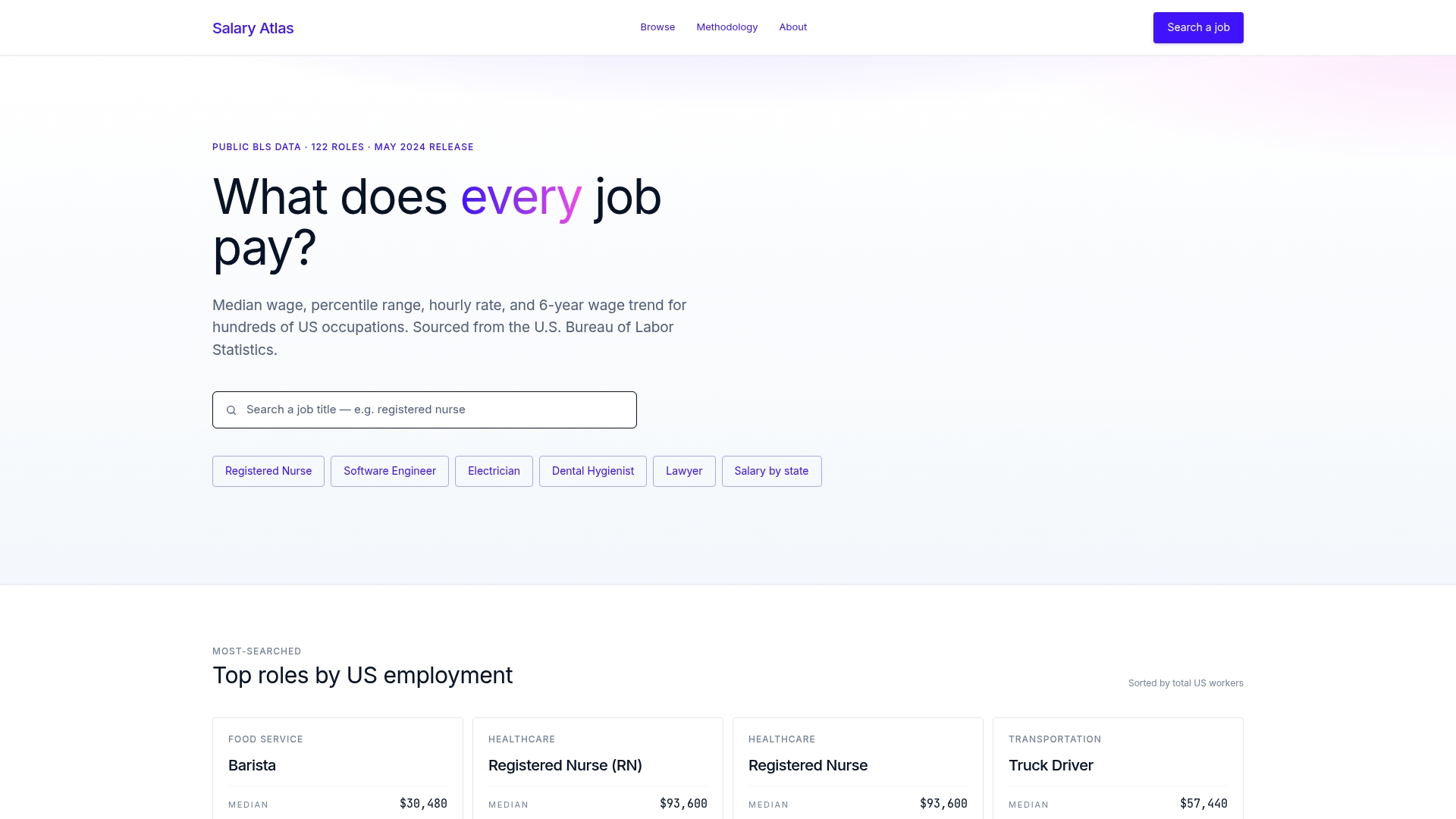
Start with a benchmark role such as our software developer salary page, or browse the rest of the data from the Salary Atlas home page.
FAQ
What is the difference between a pay range and a salary structure?
A pay range is the minimum-to-maximum span for one job or grade. A salary structure is the full set of ranges across all your jobs, arranged so bigger jobs sit higher. You build each range using the same method so the whole structure is consistent.
Where should a new hire start in a pay range?
Most employers start new hires between the minimum and the midpoint, based on relevant skills and experience, and reserve the top of the range for very experienced people. Georgetown's HR guidance says most candidates who meet the basic qualifications can expect an offer in the mid-range. Always check the offer against what current employees in the same job earn.
How wide should a pay range be?
There is no fixed answer. Entry-level jobs usually take narrower ranges, and senior or specialist jobs take wider ones because experience changes more of the output. Pick a spread per grade, apply it consistently, and write it into your compensation policy.
How often should I update pay ranges?
Review them at least once a year against current market data, and run a full benchmark review every few years. Review earlier if you see sudden turnover, hiring difficulty, or legal thresholds change.
Sources
- Pay Range (TCWGlobal)
- Pay structures and pay progression (CIPD)
- Designing A Pay Structure (SHRM)
- Pay administrative guidelines (University of Rochester)
- Applicant's Guide to Compensation (University of Arizona)
- Navigating Pay Transparency (Georgetown University HR)
- Q & A: Compliance Manual Section on Compensation Discrimination (EEOC)
- FLSA Section 541 exemptions fact sheet (U.S. Department of Labor)
Recommended
Occupation wage figures on Salary Atlas come from the U.S. Bureau of Labor Statistics. Figures in this article that are not linked to a source are estimates. See our methodology.