Median Wage: 4 Steps to Calculate It for Job Seekers and HR
Learn what the median wage is, calculate it in four steps, and find BLS sourced state and occupation medians to use when negotiating pay.
By the Salary Atlas editorial team · Published

The median wage is the exact midpoint of every paycheck in a group, ranked from lowest to highest: half the workers earn more, half earn less. Analysts lean on it instead of the average because one CEO's paycheck can't drag it off course. The Bureau of Labor Statistics, the Social Security Administration, and sites like Salary Atlas all report it for that reason: it reflects what a typical worker actually takes home.
TL;DR:
- Median wages remain stable even as bottom-tier pay drops, so always compare median figures with percentile ranks for a full pay distribution picture.
- Median hourly wages are typically published first by the BLS, but annual figures can overstate earning potential for workers with irregular or seasonal hours.
- Relying solely on the median can obscure wage gaps and income inequality, especially if the pay distribution is widely spread.
- Access to up-to-date, occupation- and region-specific median wages is essential for accurate salary negotiations and benchmarking efforts.
- Median wages reported by government sources are refreshed annually and show the most reliable snapshot of typical pay within a specific occupation or area.
Table of Contents
- Median Wage Definition vs. Average Wage: What's the Real Difference?
- How to Calculate Median Wage Step by Step
- Why Median Wage Matters, and What It Can Hide
- Where to Find Reliable Median Wage Data
- How Salary Atlas Sources and Refreshes Its Wage Data
- Turning a Median Wage Number Into Negotiation Leverage
- Look Up Your Own Median Wage in Minutes
- Sources
- FAQ
Median Wage Definition vs. Average Wage: What's the Real Difference?
The mean, what most people call the "average," is calculated by adding every wage in a group and dividing by the number of workers. That single step is also its weakness: a handful of extremely high earners can pull the mean upward until it no longer resembles what anyone typical actually makes.
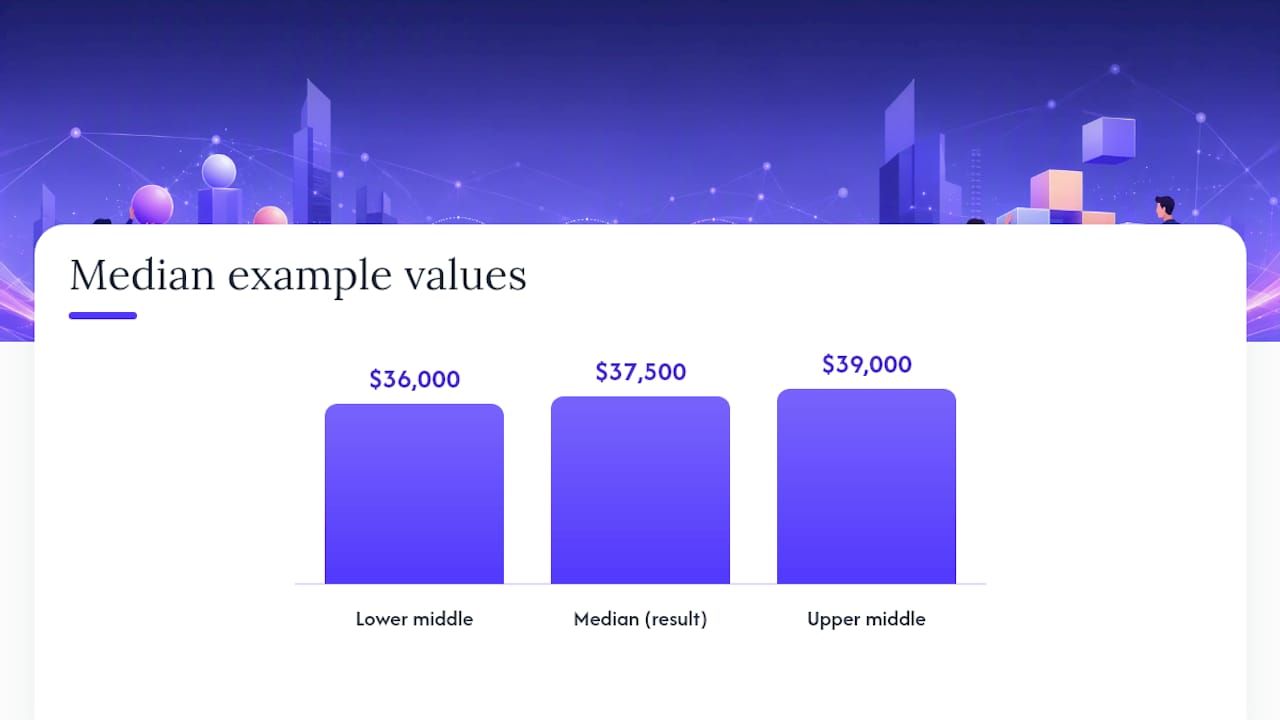
Here's a quick example. Say five workers at a small company earn $40,000, $45,000, $48,000, $52,000, and $300,000 a year. The mean comes out to $97,000, a figure not one of the five people actually earns. The median, the middle value once you sort the list, is $48,000. That number tells a far more honest story about what a typical employee at that company takes home.
The Census Bureau draws this same line in its own income FAQs, distinguishing the value that splits a distribution in half from the value produced by simple arithmetic. Use the median when you want to know what a "typical" worker earns. Use the mean when you need a total, like estimating a company's full payroll cost or an economy's aggregate wage bill.
How to Calculate Median Wage Step by Step
Calculating a median wage takes four steps, whether you're working with five data points or five hundred.
- Sort every wage value from lowest to highest. Skipping this step is the most common source of errors.
- Find the middle position. With an odd number of values, that's the single value sitting dead center.
- Average the two middle values if the count is even. Add them together and divide by two.
- Report that number as your median.
The BLS typically publishes median wages as an hourly figure first, then adds an annualized version calculated by assuming a standard 40 hour week across 52 weeks. That conversion assumes full time, year round work, so it can overstate annual pay for anyone with irregular hours or seasonal gaps.
Why Median Wage Matters, and What It Can Hide
Analysts default to the median because it resists distortion. A single billionaire founder or a handful of executive bonuses barely nudge the midpoint, which is exactly why labor economists treat it as the more honest snapshot of "typical" pay compared with the mean.
But the median has a real blind spot: it says nothing about how spread out wages are above or below that midpoint. Two occupations can share an identical median while one has wages clustered tightly around it and the other stretches from near minimum wage to six figures. The Federal Reserve Bank of Minneapolis has cautioned that a median can hold perfectly steady even while wages at the bottom of the distribution are falling, which means the metric alone can mask real deterioration for the lowest-paid workers.
Pro Tip: Never read a median in isolation. Pair it with the 10th and 90th percentile figures, or the interquartile range, to see whether pay is tightly bunched or wildly spread out beneath that single number.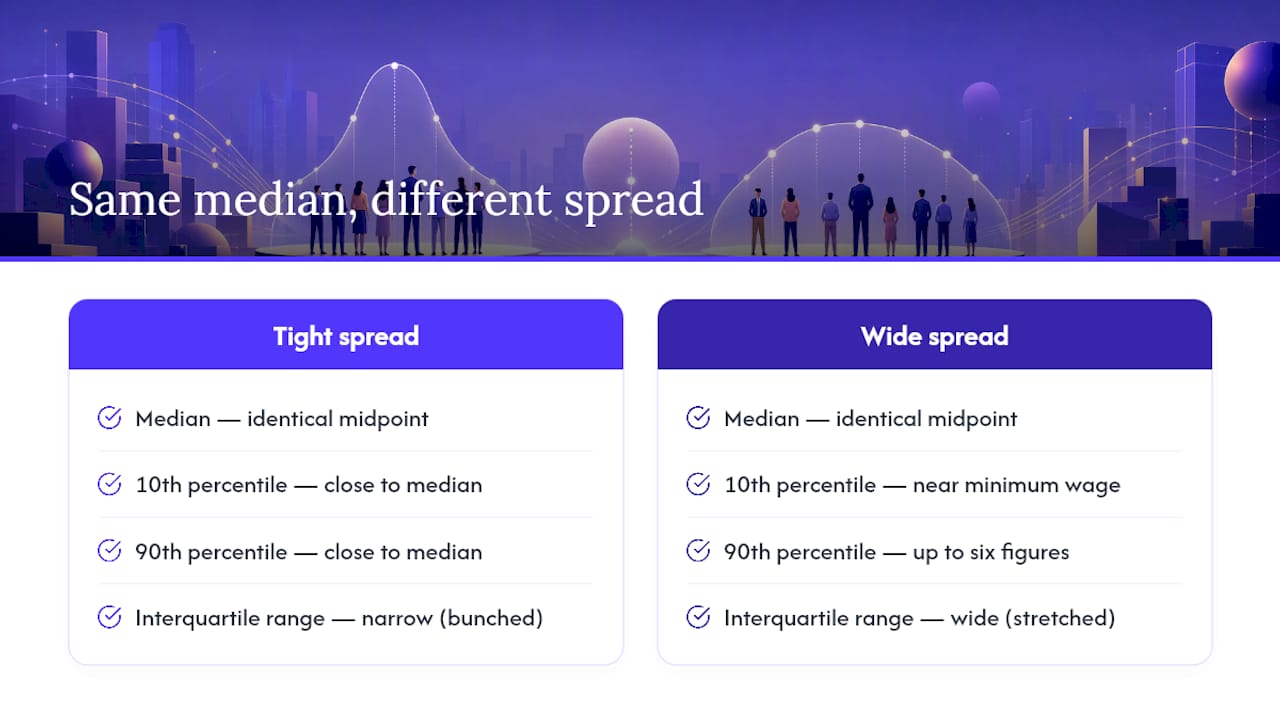
Where to Find Reliable Median Wage Data
Several government agencies track median wages, and each one answers a slightly different question.
- BLS Occupational Employment and Wage Statistics (OEWS): the standard source for median hourly and annual pay broken out by occupation, state, and metro area, offering the granularity most job seekers actually need.
- Social Security Administration: publishes national wage series and measures of central tendency, useful for tracking how median pay has shifted over long historical stretches.
- U.S. Census Bureau: distinguishes median from mean and separates household income from individual earnings, a distinction that matters when comparing family income to personal wage data.
How Salary Atlas Sources and Refreshes Its Wage Data
Data is pulled from BLS OEWS and refreshed annually, so the numbers track the government's update cycle rather than sitting frozen for years. Every wage figure links back to its original BLS source, detailed on the site's methodology page.
Users can look up median and mean pay by job title or state, toggle between hourly and annual figures, and see how each number was compiled before relying on it. That transparency matters most for readers using the data to negotiate a raise or benchmark a hiring budget, where a fabricated or stale figure could cost real money.
Turning a Median Wage Number Into Negotiation Leverage
A national median tells you almost nothing about your actual leverage in a negotiation. What matters is the median for your specific occupation, in your metro area, at your experience level. A national figure for "software developer" can undersell a mid-career hire in a high-cost city, or oversell an entry-level role in a small town.
Before your next salary conversation, cross-check the national number against a state-level breakdown and, where you can find it, an occupation-specific percentile. Official sources plus a second lookup beat guesswork every time.
, Joelen Zyoktova
Look Up Your Own Median Wage in Minutes
The site offers BLS-sourced numbers similar to those government agencies publish, with links to original BLS OEWS sources so users can verify the data themselves.
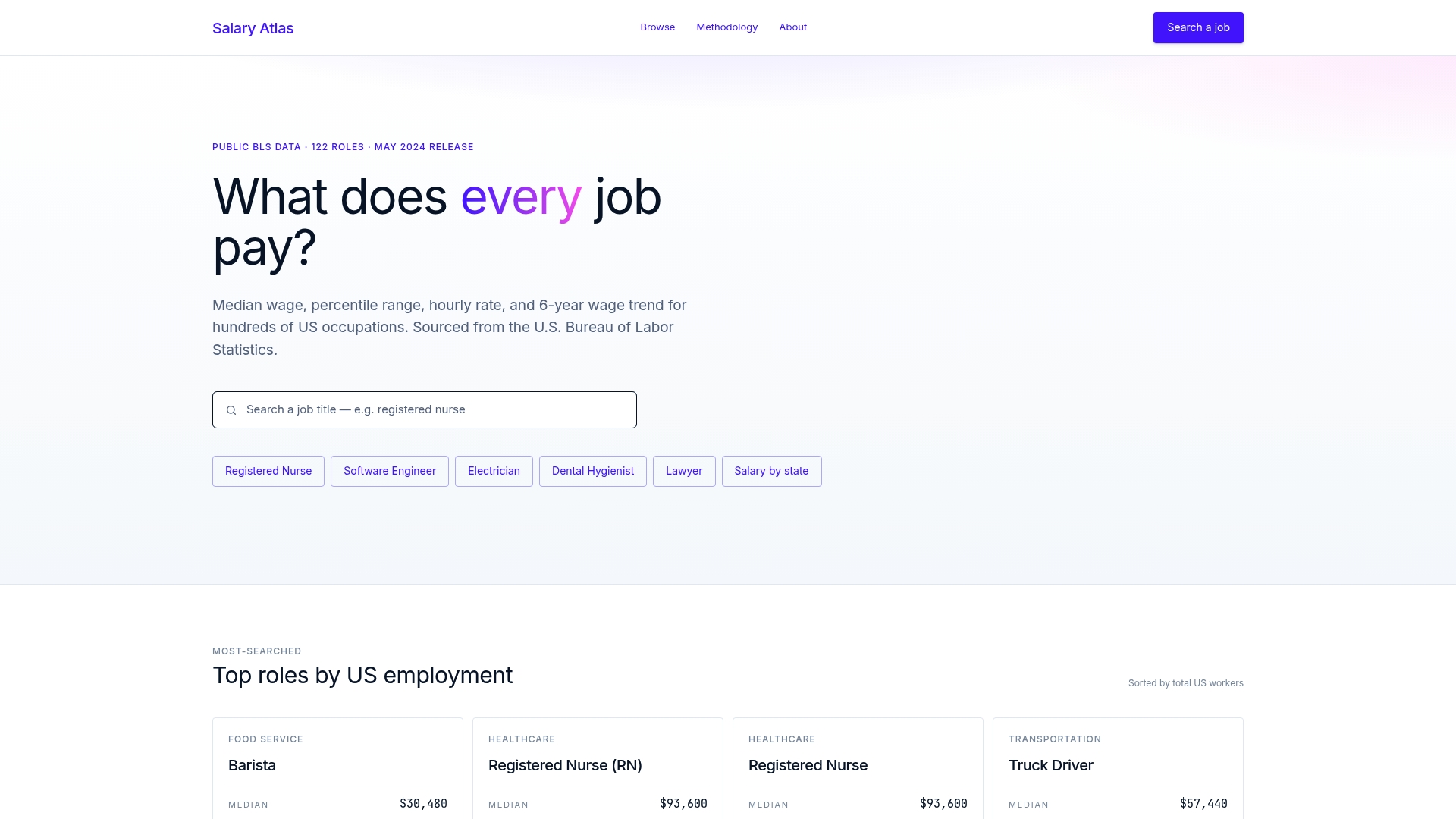
Search your job title on Salary Atlas to see the median and mean pay side by side, then check the state-by-state breakdown to see how your local market compares to the national figure. If you're weighing a specific role, the data analyst salary page shows a full six-year trend alongside the current median, and the methodology page walks through exactly how every number gets refreshed. Once you know where your pay sits against a real median, you'll walk into your next negotiation with a number you can actually defend, and a tool like Alloquy's career tech roundup can help you line up the rest of your job-search stack.
Sources
- Average wages, median wages, and wage dispersion
- What’s in a median?
- Income FAQs, U.S. Census Bureau
FAQ
Is $70,000 a Year Considered Middle Class?
It depends entirely on location and household size, but a typical median individual wage in many occupations lies within a range associated with middle-income status for a single earner in most parts of the country.
Is It Better to Look at Median or Average Salary?
The median is almost always the more reliable figure for understanding typical pay, since it isn't skewed by a small number of very high earners the way the mean can be.
What Percentage of Americans Make Over $150,000 Per Year?
That share is a minority of the workforce; wages far above the median sit well into the upper end of the distribution, which is exactly why the national median usually lands well below that level.
What Is a Good Median Pay?
There's no single "good" number. It depends on your occupation, state, and experience level, which is why checking an occupation-specific median beats comparing yourself to a national headline figure.
Recommended
Occupation wage figures on Salary Atlas come from the U.S. Bureau of Labor Statistics. Figures in this article that are not linked to a source are estimates. See our methodology.