Overtime vs Comp Time: What US Law Actually Allows
Discover the critical differences between overtime and comp time under U.S. law. Learn what your rights are as an employee today!
By the Salary Atlas editorial team · Published

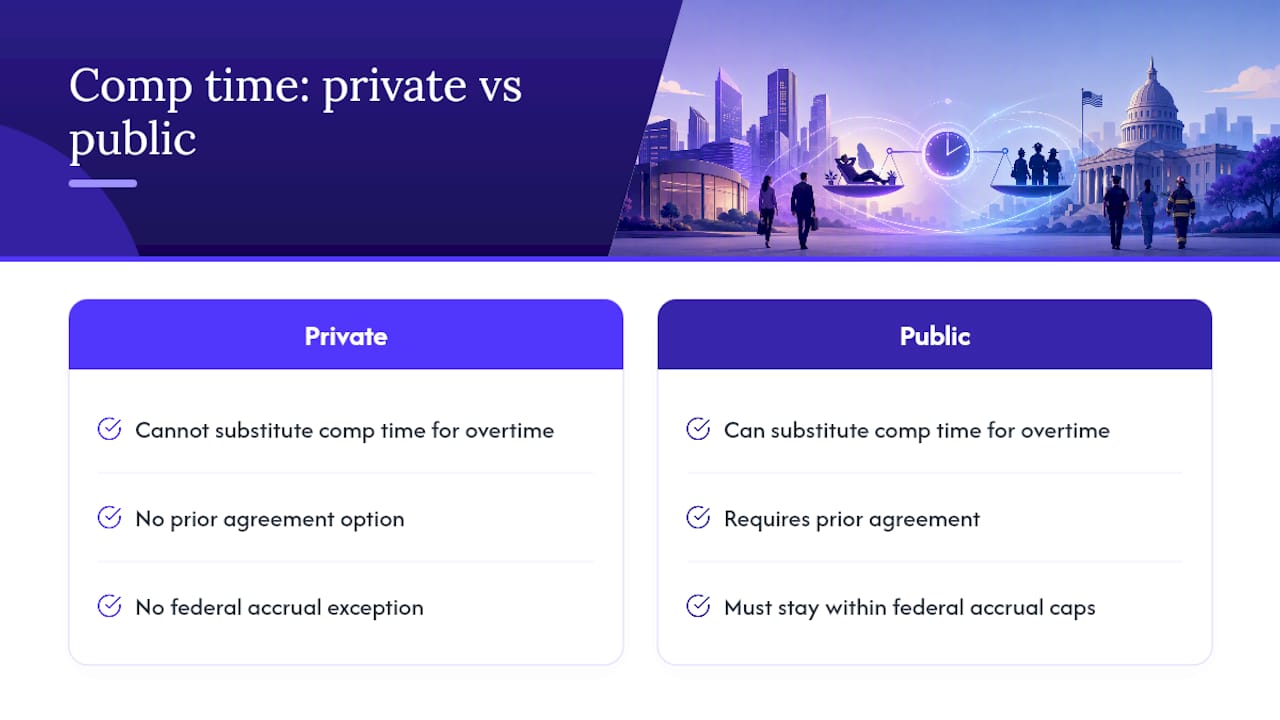
In the United States, private-sector non-exempt employees must be paid cash overtime at time-and-a-half. Comp time in lieu of overtime is generally legal only for public-sector employers, and only under specific conditions.
That's the whole legal answer in one sentence, but the details matter. The controlling rule comes from the Fair Labor Standards Act's overtime provisions: non-exempt employees who work more than 40 hours in a single workweek get 1.5 times their regular rate, in cash, on the next paycheck. There's no substitute for that in the private sector, no matter what an employer or an employee agrees to informally.
- Private employers: must pay cash overtime to non-exempt workers. No exceptions for "flex time" or banked hours across workweeks.
- Public agencies (state, local, and federal): may offer comp time instead of cash, but only with a prior agreement and within statutory caps.
- Federal employees face additional rules from the Office of Personnel Management, including timing limits on when comp time must be used or paid out.
Key Takeaways
Private-sector non-exempt employees are legally entitled to cash overtime at time-and-a-half, and no employee agreement can substitute comp time for that pay.
| Point | Details |
|---|---|
| Private sector rule | Non-exempt employees must receive cash overtime at 1.5 times their regular rate for hours over 40 in a workweek. |
| Public sector exception | Comp time is legal for public agencies only with a prior agreement and accrual caps of 240 or 480 hours. |
| Federal timing rule | Some federal employees must use comp time within 26 pay periods or receive mandatory cash payout. |
| Employer liability | Illegal comp time or unpaid overtime can trigger back wages plus liquidated damages equal to that amount. |
| Verify your rate | Compare your hourly pay against BLS-sourced median wages before assuming an overtime miscalculation. |
Table of Contents
- Overtime Pay vs Comp Time: The Basic Definitions
- Can an Employer Give Comp Time Instead of Overtime?
- How Does Comp Time Accrual and Payout Work in Public Agencies?
- What Happens When an Employer Illegally Substitutes Comp Time?
- Overtime Pay vs Comp Time: Which Is Better for You?
- Where to Verify Your Overtime Pay Is Correct
- Not All Public Employees Get the Same Comp Time Rules
- How Comp Time Policies Go Wrong in Practice
- What to Do If You're Not Getting Paid Correctly
- Do State Laws Change Overtime and Comp Time Rules?
- Why the Comp Time Debate Misses the Real Question
- Sources
- FAQ
Overtime Pay vs Comp Time: The Basic Definitions
Before you can apply the rules, you need the vocabulary straight, because the terms get thrown around loosely in break rooms and HR meetings alike.
Overtime pay is cash compensation at 1.5 times an employee's regular hourly rate for every hour worked beyond 40 in a single workweek. It applies to non-exempt employees, and it's paid on the regular payroll schedule, not deferred. Compensatory time, or comp time, is paid time off that substitutes for that cash overtime, banked at the same 1.5 multiplier where it's legally permitted. An hour of overtime work earns 1.5 hours of time off later instead of 1.5 hours of pay now.Whether either option applies to you comes down to classification:
- Non-exempt employees are covered by the FLSA's overtime rules and must receive overtime pay (or, in public-sector jobs, comp time) for hours over 40.
- Exempt employees, typically salaried workers meeting specific duties and salary-level tests, aren't entitled to overtime pay or comp time under FLSA, though some employers offer informal time off anyway.
Can an Employer Give Comp Time Instead of Overtime?
The short answer depends entirely on who signs your paycheck. Private employers cannot. Public agencies sometimes can.
The Department of Labor's overtime fact sheet is unambiguous: private-sector employers may not substitute comp time for cash overtime owed to non-exempt employees. It doesn't matter if the employee would rather have the afternoon off than the extra $45 on their check. It doesn't matter if it's a small business with a friendly, informal culture. The FLSA treats overtime pay as a right that can't be traded away.
Public-sector agencies get a specific carve-out. Under DOL guidance for state and local government employers, a state, county, city, or federal agency may offer comp time instead of cash, provided it meets three conditions:
- There's a prior agreement or understanding between the employer and employee (often through a union contract or a written policy the employee accepted before working the overtime).
- Comp time accrues at not less than 1.5 hours for every overtime hour worked, matching the cash rate it replaces.
- The agency stays within federal accrual caps, which the next section breaks down.
The practical test: if you're a non-exempt worker at a private company and your boss says "take Friday off instead of overtime pay," that's not a legal option. The employer owes you 1.5 times your hourly rate for every hour over 40, paid the same way as your regular wages.
How Does Comp Time Accrual and Payout Work in Public Agencies?
Once an agency has a valid comp time agreement in place, the mechanics follow a fairly rigid federal framework.
- Accrual rate: comp time accumulates at 1.5 hours for every overtime hour worked, per DOL rules for state and local government employers. Work four extra hours, bank six hours of time off.
- Accrual caps: most public employees can bank comp time up to federally set limits. Public safety, emergency response, or seasonal employees have higher allowable accrual caps.
- Use rights: employees generally have the right to use accrued comp time within a "reasonable period" after requesting it, unless doing so would unduly disrupt agency operations.
- Payout on separation: any unused comp time must be paid out in cash, at the applicable overtime rate, when an employee transfers agencies or leaves the job.
- Federal timing rule: OPM guidance sets a 26-pay-period window for some federal employees to use accrued comp time before it converts to a mandatory cash payment.
What Happens When an Employer Illegally Substitutes Comp Time?
Getting this wrong is expensive, and the Department of Labor's overtime fact sheet spells out exactly how expensive.
- Back wages: the employer owes every dollar of unpaid overtime, retroactively, for the full violation period.
- Liquidated damages: courts can add an amount equal to the back wages owed, effectively doubling the liability.
- Civil penalties: repeat or willful violations can trigger separate civil money penalties on top of back pay.
- Criminal exposure: willful, repeated violations can, in rare cases, bring criminal charges against the employer.
What's actually lawful for a private employer to do: adjust an employee's schedule within the same workweek so total hours don't exceed 40, per DOL scheduling guidance, pay the overtime and move on, or offer exempt salaried employees informal flexibility since they aren't covered by these rules anyway. Accurate timekeeping ties all three together, because you can't defend a scheduling decision you didn't record.
Pro Tip: If you run payroll for a small business, audit your time records quarterly against actual hours worked, not just scheduled shifts. Most illegal comp time arrangements start as a scheduling favor that nobody wrote down.Overtime Pay vs Comp Time: Which Is Better for You?
Where comp time is legally on the table, mostly public-sector jobs, the choice between cash and time off comes down to your immediate finances versus your future schedule flexibility.
- Calculate the actual dollar value. If your regular rate is $28 an hour, five overtime hours pays you $210 in cash now, or banks 7.5 hours of paid time off later. Neither is "worth more"; they're different forms of the same value.
- Weigh the opportunity cost. Cash now covers this month's bills. Comp time saved is time off later that doesn't eat into your vacation balance, useful if you already have a trip planned.
- Check the tax treatment. Overtime pay is taxed as regular wages through normal withholding. A lump-sum comp time payout at separation is often treated as supplemental wages, which can mean a different withholding rate up front (though your actual tax liability evens out at filing).
Where to Verify Your Overtime Pay Is Correct
Getting the legal rules right doesn't help much if you don't know what your regular rate should actually be.
Salary Atlas publishes median and percentile wage data by job title and state, sourced directly from Bureau of Labor Statistics figures, without paywalls. Comparing your hourly rate against the BLS-derived median for your occupation and location is the fastest way to spot a mismatch before it becomes a wage dispute.
- Look up your job title's hourly wage range to confirm your base rate is being calculated correctly before overtime is applied.
- Use state-level data if you work in a state with wage floors above the federal minimum, since that affects your overtime baseline too.
- Walk through how to calculate overtime pay step by step, using your actual hourly rate, to confirm your last paycheck matches what the math says you're owed.
Not All Public Employees Get the Same Comp Time Rules
"Public sector" isn't one category with one comp time policy, and treating it that way is where a lot of agencies go wrong.
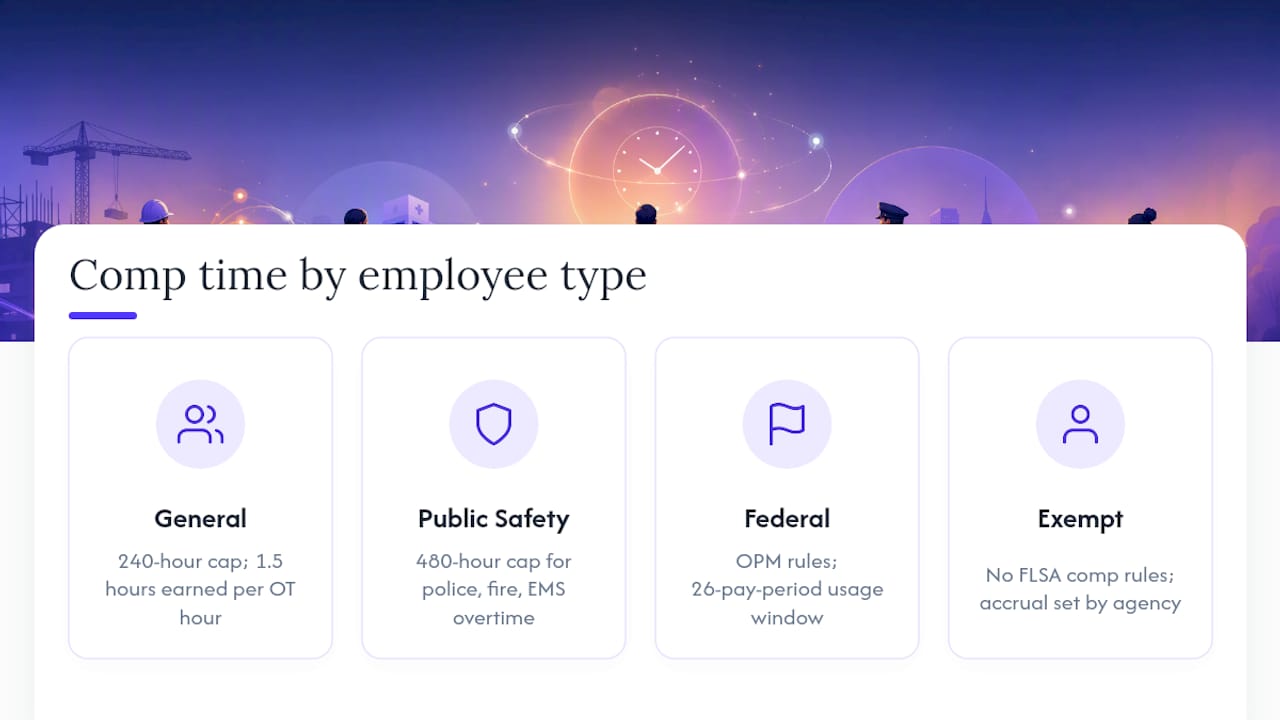 General government employees, clerks, administrative staff, most municipal workers, fall under the standard 240-hour accrual cap and the baseline 1.5 hour-per-hour comp time rate. Once they hit that cap, any additional overtime worked must be paid in cash, not banked.
Public safety, emergency response, and seasonal workers get the higher 480-hour cap, recognizing that police officers, firefighters, and emergency medical staff often work irregular, high-volume overtime that's harder to schedule around. A firefighter working back-to-back shifts during a wildfire season could plausibly bank hundreds of hours that an office worker never would.
Federal employees face an entirely separate layer of rules from OPM, including the 26-pay-period usage window mentioned earlier. Some federal employees earning above a certain rate threshold can, under specific agency policies, be required to take comp time rather than cash for certain overtime hours, a nuance that doesn't exist anywhere in the private-sector rules.
Exempt public employees occupy a gray area. Because FLSA overtime rules don't apply to them in the first place, any comp time they receive is a matter of agency policy rather than federal mandate, which means the accrual caps and payout guarantees that protect non-exempt public workers don't automatically apply.
General government employees, clerks, administrative staff, most municipal workers, fall under the standard 240-hour accrual cap and the baseline 1.5 hour-per-hour comp time rate. Once they hit that cap, any additional overtime worked must be paid in cash, not banked.
Public safety, emergency response, and seasonal workers get the higher 480-hour cap, recognizing that police officers, firefighters, and emergency medical staff often work irregular, high-volume overtime that's harder to schedule around. A firefighter working back-to-back shifts during a wildfire season could plausibly bank hundreds of hours that an office worker never would.
Federal employees face an entirely separate layer of rules from OPM, including the 26-pay-period usage window mentioned earlier. Some federal employees earning above a certain rate threshold can, under specific agency policies, be required to take comp time rather than cash for certain overtime hours, a nuance that doesn't exist anywhere in the private-sector rules.
Exempt public employees occupy a gray area. Because FLSA overtime rules don't apply to them in the first place, any comp time they receive is a matter of agency policy rather than federal mandate, which means the accrual caps and payout guarantees that protect non-exempt public workers don't automatically apply.
The practical takeaway: if you work for a public agency, don't assume your comp time rights match a coworker's in a different department. A city's parks department and its police department can run under materially different accrual caps and usage rules, even though both fall under the same municipal employer.
How Comp Time Policies Go Wrong in Practice
Most illegal or non-compliant comp time arrangements aren't malicious. They're the result of a manager improvising a solution that sounds reasonable in the moment and violates federal law on paper.
The most common misapplication: a private employer offers "comp time" to an hourly employee as a goodwill gesture. A retail manager tells a non-exempt employee, "you worked six hours of overtime this week, take a half day next week instead of the overtime pay." That arrangement, however well-intentioned, is illegal. The employee is still legally owed cash overtime for those six hours, and "take it as time off" doesn't satisfy that obligation.
A second common error: treating comp time as interchangeable with vacation or PTO accrual for tracking purposes. Some payroll systems lump comp time into a generic "time off bank" without distinguishing it from earned vacation. That gets messy fast when an employee separates, because comp time has specific payout rules that vacation time often doesn't, and blending the two categories can mean either overpaying or underpaying at exit.
A third: public agencies letting comp time balances exceed the statutory cap without redirecting the excess to cash pay. Once a general government employee's balance hits 240 hours (480 for public safety), any further overtime must be paid in cash. An agency that keeps informally "banking" hours past that point, often because nobody's actively monitoring balances, is quietly accumulating unpaid wage liability.
A fourth, more subtle problem: assuming a verbal agreement satisfies the "prior agreement" requirement for public-sector comp time. DOL guidance expects a documented understanding, frequently a union contract or written policy, not an informal conversation. Agencies that rely on verbal understandings are exposed if that arrangement is ever challenged.
What to Do If You're Not Getting Paid Correctly
If you suspect your employer is misapplying comp time or shorting you on overtime, you have real, enforceable options, not just a complaint to file and hope for the best.
Start with your own records. Track your actual hours worked, not just scheduled shifts, including any time you clocked in early or stayed late off the books. Compare that against your pay stubs. A discrepancy between hours worked and hours paid at time-and-a-half is the core evidence in almost every wage claim. Raise it internally first, in writing. Email your manager or HR, not just a hallway conversation, describing the specific weeks and hours in question. This creates a paper trail and often resolves honest payroll errors quickly, since many violations come from bad timekeeping systems rather than deliberate underpayment. File a complaint with the Wage and Hour Division if the internal route doesn't resolve it. The Department of Labor's Wage and Hour Division investigates unpaid overtime claims and can recover back wages plus liquidated damages on your behalf, at no cost to file. Know that retaliation for filing a wage complaint is itself illegal. An employer that fires, demotes, or cuts hours for a worker who raised a wage concern is committing a separate FLSA violation, which strengthens rather than weakens your position. Consult an employment attorney for larger claims, especially if multiple coworkers are affected, since collective or class action wage claims can recover damages for an entire team at once rather than one paycheck at a time.Do State Laws Change Overtime and Comp Time Rules?
Federal law sets the floor, not the ceiling, and a fair number of states build stricter rules on top of it.
Daily overtime requirements are the biggest state-level departure. Federal law only counts overtime after 40 hours in a workweek. California requires overtime pay after 8 hours in a single workday, regardless of the weekly total, plus double-time after 12 hours in a day. That's a meaningfully different calculation than the federal standard, and employers operating in multiple states need separate compliance logic for each one. State minimum wage differences affect the overtime baseline itself, since your overtime rate is 1.5 times your regular rate, and that regular rate can't fall below your state's minimum wage even if it's higher than the federal floor. Some states restrict comp time even for public agencies more tightly than federal law requires, or set lower accrual caps than the federal 240/480-hour maximums. A state government job in one state isn't guaranteed the same comp time terms as an equivalent role in another. Local ordinances in some cities add another layer, particularly around scheduling predictability laws that affect how and when overtime can be assigned in the first place.The practical rule: federal FLSA guidance is the baseline everywhere, but always check your specific state's labor department for daily overtime thresholds, minimum wage interactions, and any state-specific comp time restrictions before assuming the federal rules are the whole story.
Why the Comp Time Debate Misses the Real Question
Most discussions about overtime versus comp time get stuck on which one is "better," as if it's a personal preference question. It mostly isn't. For the overwhelming majority of US workers, private-sector, non-exempt, hourly, there is no choice to make. The law already decided it: you get paid in cash, on schedule, at 1.5 times your rate.
The more useful question is whether you're being paid correctly at all, and that's where I think most advice on this topic falls short. Articles love to explain the theoretical trade-offs between cash and time off, but they skip the far more common problem: employees who don't actually know their correct regular rate, which makes it impossible to verify whether the overtime math on their paycheck is right in the first place.
If you take one thing from this, it's not "choose cash if you need money." It's this: pull your job title and state, find the median hourly wage from a source like the Bureau of Labor Statistics, and check that figure against your own pay stub before you worry about comp time policy nuances that likely don't even apply to your job. The legal framework matters, but it only protects you if you know what number you're supposed to be seeing on your check.
Sources
- Fact Sheet #23: Overtime Pay (United States Department of Labor)
- Fact Sheet: Compensatory Time (U.S. Department of Labor - State and Local Government Employers)
- Compensatory Time Off (U.S. Office of Personnel Management)
FAQ
Can an Employer Give Comp Time Instead of Overtime?
Private employers cannot substitute comp time for cash overtime owed to non-exempt employees. Public agencies can, but only with a prior agreement and within federal accrual caps.
Should I Take Comp Time or Overtime Pay?
It depends on whether you need cash now or have room to use paid time off later; comp time only becomes an option in the first place if you work for a public agency.
Does Comp Time Qualify as Overtime?
Comp time is a substitute for overtime pay, not a separate category. It accrues at the same 1.5 hour-per-hour rate that cash overtime would pay, where it's legally permitted.
What Is the Difference Between OT and Comp Time?
Overtime pay is cash compensation paid immediately at 1.5 times your regular rate; comp time is paid time off banked at the same rate instead of cash, and it's only legal for most public-sector employers.
Recommended
Occupation wage figures on Salary Atlas come from the U.S. Bureau of Labor Statistics. Figures in this article that are not linked to a source are estimates. See our methodology.