Shift Differential Pay: What Employers and HR Need to Know
Discover how shift differential pay impacts wages and overtime calculations. Employers must ensure compliance to avoid costly errors.
By the Salary Atlas editorial team · Published

Shift differential pay is extra compensation employers add to a worker's base wage for working undesirable hours: nights, weekends, holidays, or split shifts. The single most important compliance rule attached to it: if you pay a differential, that money almost always has to be folded into the regular rate of pay before you calculate overtime for nonexempt employees under the Fair Labor Standards Act. Skip that step and your overtime math is wrong, even if the differential itself was never legally required in the first place.
- Employees get paid more for inconvenient hours, but should know how that extra pay flows into their overtime rate.
- Employers and payroll teams must configure systems so differentials feed correctly into the regular-rate calculation, not just sit as a flat add-on.
- Three sources worth bookmarking: the Department of Labor, the Office of Personnel Management for federal employees, and payroll platforms like ADP or guidance from SHRM.
Key Takeaways
Shift differential pay is optional under federal law, but once offered, it must be folded into the regular rate for overtime calculations on nonexempt employees.
| Point | Details |
|---|---|
| No federal mandate | The FLSA doesn't require night, weekend, or holiday pay; differentials are employer or contract choices. |
| Overtime math is not optional | Any existing differential must be included in the regular rate before applying the 1.5x overtime multiplier. |
| Two structures dominate | Percentage-of-base scales with wages; flat-dollar-per-hour is simpler to budget but loses value over time. |
| Federal employees follow OPM rules | Federal Wage System staff often get fixed 7.5% or 10% night differentials under specific conditions. |
| Benchmark before setting rates | Salary Atlas provides free, BLS-sourced wage data by job title and state to validate differential competitiveness. |
Table of Contents
- What Counts as Shift Differential Pay?
- How Do You Calculate Shift Differential Pay?
- Is Shift Differential Pay Required by Law?
- What Are Typical Shift Differential Rates by Industry?
- How Do You Write and Configure a Compliant Shift Differential Policy?
- What Actually Matters Here
- Benchmark Your Rates Before You Set Them
- Sources
- FAQ
What Counts as Shift Differential Pay?
Shift differential covers several distinct categories, and most companies mix and match depending on staffing needs. Evening shifts (often 3 p.m. to 11 p.m.) typically carry a smaller bump than night shifts (roughly 11 p.m. to 7 a.m.), which see the highest premiums because recruiting for graveyard hours is genuinely harder. Weekend differentials apply to Saturday and Sunday coverage regardless of time of day. Holiday differentials stack on top of whatever shift an employee is already working. Split-shift pay compensates workers whose schedule is broken into two disconnected blocks in the same day, common in transit and food service.
Employers structure the payment in one of two ways:
- Percentage-of-base: a $20/hour employee earns a 10% night differential, bringing the rate to $22/hour. Scales automatically as base pay rises.
- Flat-dollar-per-hour: the same employee gets a flat $2/hour add-on regardless of their base rate. Cheaper to predict, but loses purchasing power over time as wages climb.
How Do You Calculate Shift Differential Pay?
The math is straightforward until overtime enters the picture, which is where most payroll errors happen. Here's the process:
- Identify the base method. Confirm whether the differential is a percentage of base pay or a flat dollar amount, and check whether it applies per hour worked or as a flat shift bonus.
- Calculate straight-time pay for differential hours. Percentage example: a $18/hour nurse working an 8-hour night shift with a 15% differential earns $18 × 1.15 = $20.70/hour, or $165.60 for the shift. Flat example: a $15/hour warehouse worker with a $2/hour night differential earns $17/hour, or $136 for an 8-hour shift.
- Build the blended week when overtime applies. Say that same warehouse worker logs 32 regular hours at $15 and 8 night-differential hours at $17 in a 40-hour week, then works 4 hours of overtime on a night shift. Total straight-time earnings: (32 × $15) + (8 × $17) = $480 + $136 = $616 for 40 hours. That gives a weighted regular rate of $616 ÷ 40 = $15.40/hour.
- Apply the overtime multiplier to the blended rate, not the base rate. The 4 overtime hours, worked at night, first earn straight-time night pay of 4 × $17 = $68, plus an overtime premium of 0.5 × $15.40 × 4 = $30.80. Total overtime pay: $98.80.
- Add it all up. Total weekly pay: $616 + $98.80 = $714.80. This is the number the DOL's overtime fact sheet requires. It is why the regular rate must include differentials before you multiply by 1.5.
One carve-out worth knowing: FLSA-exempt salaried employees generally aren't entitled to overtime at all, so the blended-rate exercise above applies only to nonexempt workers. Employers sometimes still offer a differential to exempt staff as a retention perk, but it isn't subject to the same regular-rate recalculation because there's no overtime premium to compute.
Is Shift Differential Pay Required by Law?
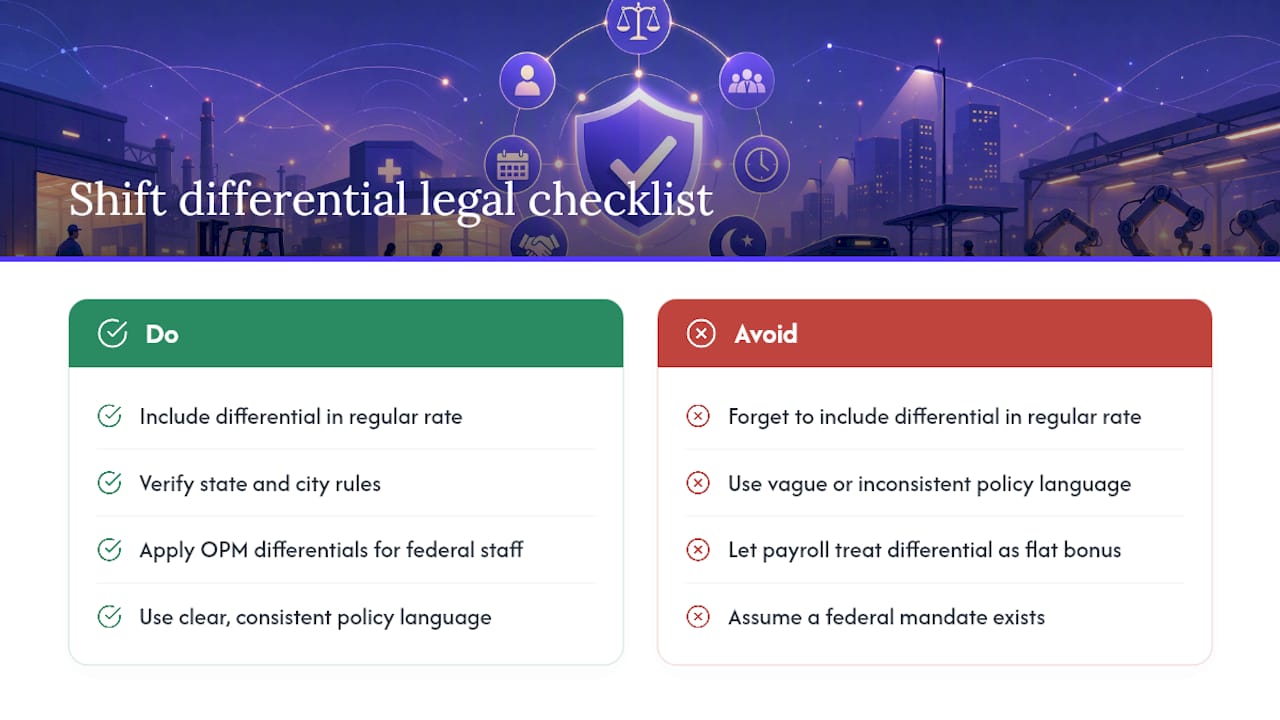
No federal law requires employers to pay a shift differential. The Department of Labor is explicit that night, weekend, and holiday premiums are a matter of employer policy or collective bargaining agreements, not a statutory mandate. Where the law does step in is overtime math: once a differential exists, the FLSA requires it be baked into the regular rate for any nonexempt employee's overtime calculation.
A significant portion of full-time wage and salary workers in the U.S. work a schedule other than a fixed daytime shift, which is part of why differential pay has become embedded in payroll practice even without a federal requirement.
Federal employees are the exception to the "no mandate" rule. The Office of Personnel Management sets fixed night differentials for Federal Wage System employees, commonly 7.5% or 10% of basic pay, applied under specific majority-of-hours rules. The Commerce Department's own premium pay guidance shows how these percentages interact with base pay for wage-grade staff.
The pitfalls SHRM flags most often: employers who forget to fold the differential into the regular rate, policies with vague or inconsistent language across departments, and payroll systems misconfigured to treat differentials as a flat bonus instead of an hourly rate adjustment. Before rolling out any policy, verify state and city rules too. Several states impose their own split-shift or reporting-time pay requirements that stack on top of federal law.
What Are Typical Shift Differential Rates by Industry?
Rates vary considerably by sector, shift type, and local labor conditions. ADP's data on common differential structures shows percentage and flat-rate models both remain in wide use, and the ranges below reflect what shows up most often across HR benchmarking sources.
- Healthcare: often the highest premiums, with a range of differentials for night or weekend nursing shifts, reflecting acute staffing shortages.
- Manufacturing: frequently moderate premiums or flat rates for second and third shifts.
- Hospitality and retail: typically lower, often small flat-dollar amounts or single-digit percentages, since off-hours work is closer to the industry norm.
- Public safety and 24/7 operations: night and weekend premiums are standard practice, often layered with holiday pay on top.
How Do You Write and Configure a Compliant Shift Differential Policy?
A policy that only lives in an employee handbook and never gets mirrored in payroll configuration is where most compliance gaps start. Build both at the same time.
Policy language should nail down:
- Eligibility, which job titles or departments qualify, and whether part-time staff are included.
- Qualifying time windows, exact start and end times for evening, night, and weekend differentials, since ambiguity here causes disputes.
- Stacking rules, whether a holiday differential stacks with a night differential, and how both interact with overtime.
- Payment timing, same pay period as hours worked, no delayed reconciliation.
- Documentation and exceptions, how managers approve differential hours and how disputes get resolved.
Before go-live, reconcile a handful of real employee schedules by hand against system output. Focus on the messy weeks: mixed shifts, split shifts, a holiday landing on a night shift.
 Pro Tip: Keep your policy's wording and your payroll system's field names in sync. If HR calls it "night differential" and payroll codes it as "shift premium 2," someone auditing the two side by side will assume they're different things.
What Actually Matters Here
Get the regular-rate math right before you worry about anything else. Most disputes over shift differential pay aren't about whether the rate itself is fair. They're about whether payroll quietly shortchanged someone's overtime because the system treated the differential as an afterthought instead of part of the base for that week.
Verify your obligations directly against the Department of Labor and, for federal staff, OPM. When state rules or stacking scenarios get complicated, loop in employment counsel or your payroll vendor before you guess.
Benchmark Your Rates Before You Set Them
Setting a competitive shift differential starts with knowing what the local market actually pays, not just what a national average suggests. Salary Atlas pulls wage data straight from the Bureau of Labor Statistics by job title and state, with every figure linked back to its source and no paywall in the way.
- Employers can check regional wage levels for a role before deciding whether a 10% night differential or a flat $2/hour add-on makes more competitive sense in their market.
- Employees can compare their base pay against state-level averages to see whether a differential offer is actually generous or just standard for the area.
Sources
- OPM, Night Shift Differential for Federal Wage System Employees
- ADP, Shift differential: What it means and how to calculate it
- SHRM, Shift differentials
FAQ
What Is Normal Shift Differential Pay?
What Is a $2 Shift Differential?
A $2 shift differential means an employee earns a flat $2 more per hour worked during the qualifying shift, on top of their normal base wage, regardless of what that base rate is.
How Much Is a 20% Night Differential?
Does Shift Differential Pay Count Toward Overtime?
Yes. Under the FLSA, any shift differential paid to a nonexempt employee must be included when calculating the regular rate of pay used for overtime, not treated as a separate bonus outside that math.
Where Can I Check Competitive Shift Differential Rates for My State?
Salary Atlas publishes free, BLS-sourced wage data by job title and state that employers and employees can use to see how local pay compares before setting or accepting a differential rate.
Recommended
Occupation wage figures on Salary Atlas come from the U.S. Bureau of Labor Statistics. Figures in this article that are not linked to a source are estimates. See our methodology.