How to Calculate Overtime Pay Under U.S. Law
Learn how to calculate overtime pay accurately under U.S. law, ensuring you receive fair compensation for every extra hour worked.
By the Salary Atlas editorial team · Published

Under the Fair Labor Standards Act, most nonexempt employees must receive overtime pay at 1.5 times their regular rate for every hour worked beyond 40 in a single workweek. The core formula is:
Overtime pay = regular rate × 1.5 × overtime hoursThe "regular rate" is not simply your stated hourly wage. It is the total weekly compensation (excluding a short list of statutory exclusions) divided by total hours worked that week. So if you earned $500 in base pay plus a $50 nondiscretionary bonus and worked 50 hours, your regular rate is $550 ÷ 50 = $11.00/hr, and your overtime premium is $11.00 × 1.5 × 10 hours = $165.
- For a quick check, run your numbers through the DOL elaws Overtime Calculator Advisor before finalizing payroll.
- The formula applies to most nonexempt hourly and salaried workers in the private sector and many federal employees.
- State rules can add additional thresholds on top of the federal baseline.
Key Takeaways
Under the FLSA, overtime pay equals the regular rate times 1.5 times overtime hours, computed separately for each workweek, with the regular rate including all nondiscretionary compensation divided by total hours worked.
| Point | Details |
|---|---|
| Core overtime formula | Regular rate × 1.5 × hours over 40 in a workweek; compute each workweek independently. |
| Regular rate includes more than base pay | Add nondiscretionary bonuses, shift differentials, and commissions before dividing by total hours. |
| Salary does not mean exempt | Exemption requires both a salary above the DOL threshold and passing the relevant duties test. |
| State rules can be stricter | California and other states add daily thresholds; always apply the standard most favorable to the employee. |
| Salary Atlas for benchmarking | BLS-sourced median hourly wages on Salary Atlas help verify that a computed regular rate is realistic for the role. |
Table of Contents
- What "overtime" means under U.S. law and who is eligible
- Core overtime pay formulas and when each applies
- Step-by-step calculations with three worked examples
- Who is exempt and common edge cases to watch for
- Practical payroll notes: recordkeeping and correcting underpayments
- How overtime affects take-home pay across common occupations
- What the overtime rules get wrong, and what actually matters
- Salary Atlas makes it easier to verify your regular rate
- Sources
- FAQ
What "overtime" means under U.S. law and who is eligible
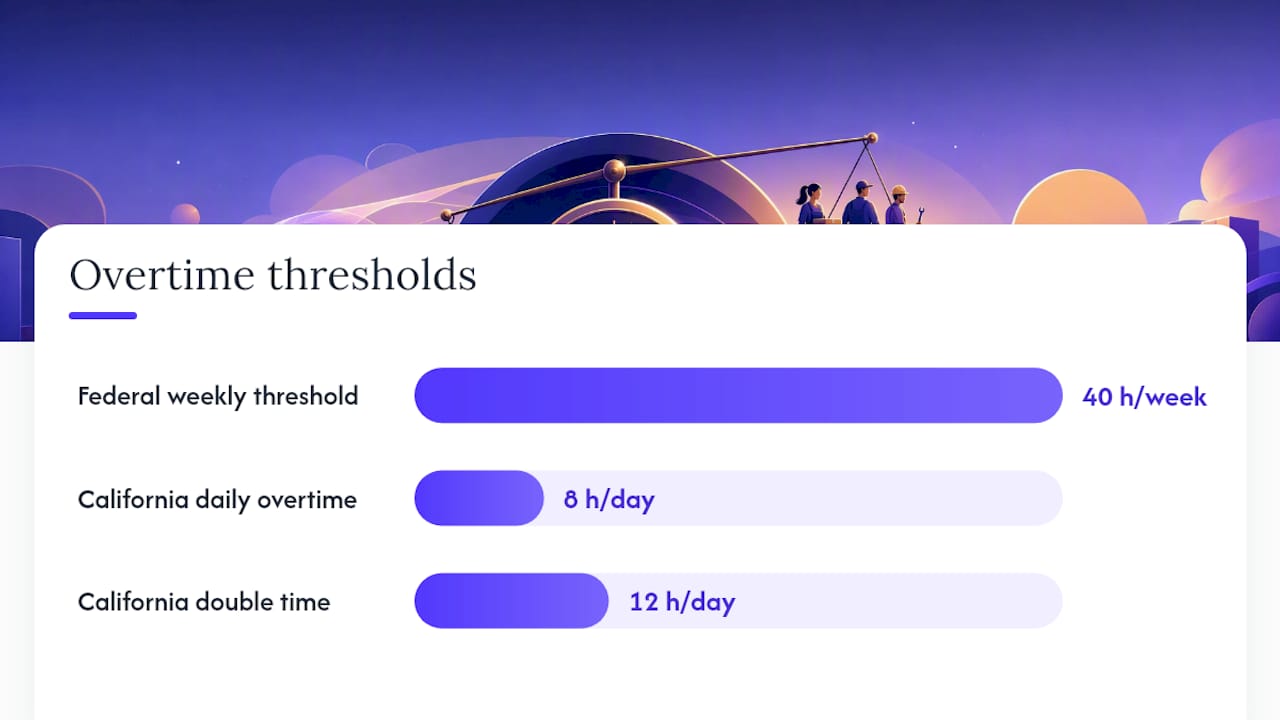
The FLSA sets a single, clear trigger: hours worked past 40 in a workweek. There is no federal daily overtime threshold. A workweek is a fixed, regularly recurring 168-hour period, seven consecutive 24-hour days, and it does not have to align with a calendar week. An employer can set a workweek from Wednesday noon to the following Wednesday noon, for example.
One rule trips up employers constantly: you cannot average hours across two workweeks to avoid overtime. If an employee works 50 hours one week and 30 the next, the first week generates 10 overtime hours regardless of the second week's total.
Who is covered:- Nonexempt hourly workers in the private sector
- Nonexempt salaried workers whose duties and pay do not meet exemption tests
- Many federal employees (with OPM-specific computation rules)
- Part-time workers who cross the 40-hour threshold in a given week
Core overtime pay formulas and when each applies
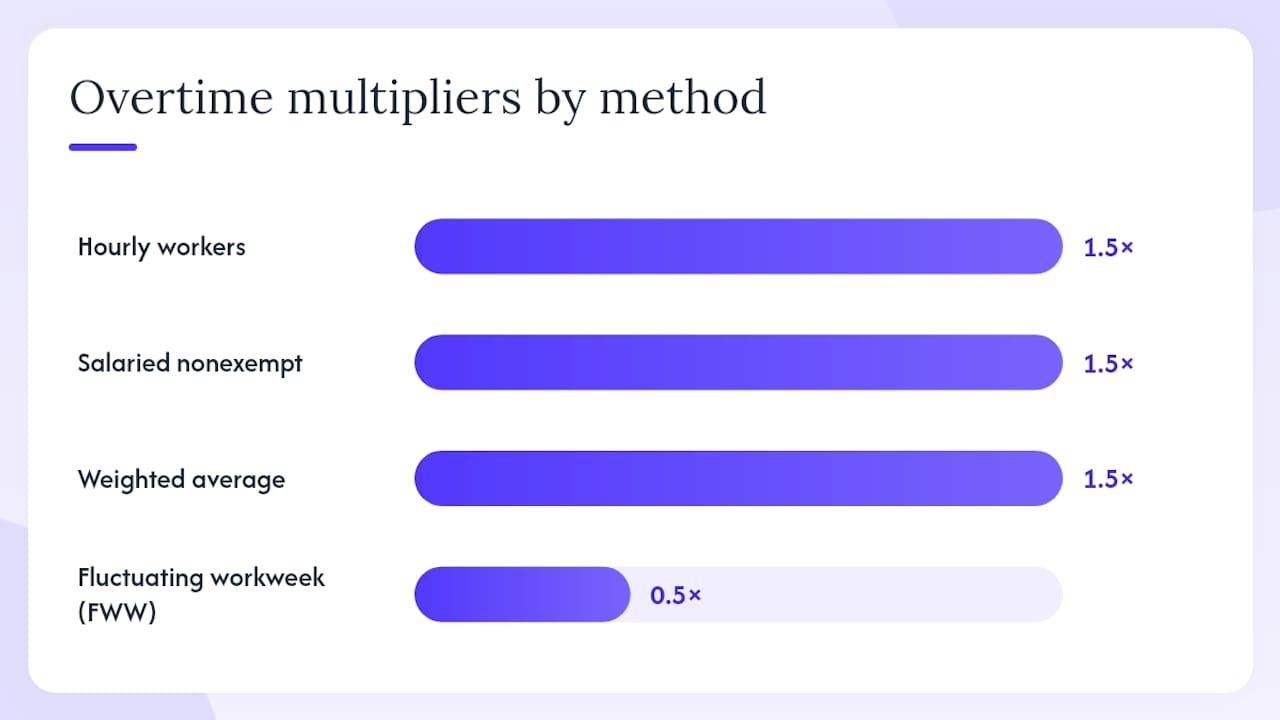
The right formula depends on how the employee is paid. Three situations cover the vast majority of cases.
Hourly workers (single rate)Regular rate = stated hourly wage (assuming no other compensation that week)
Overtime pay = hourly rate × 1.5 × overtime hours
Convert the weekly salary to an hourly equivalent first. If the salary covers a standard 40-hour week, divide by 40. If the salary is annual, divide by 2,080 (52 weeks × 40 hours). Then apply 1.5× to overtime hours on top of the straight-time pay already embedded in the salary.
Weighted average (multiple pay rates in one week)When an employee works at two or more different rates in the same workweek, the FLSA requires a weighted average:
Weighted regular rate = (Rate₁ × Hours₁ + Rate₂ × Hours₂) ÷ Total Hours
Apply 1.5× to that blended rate for overtime hours.
Fluctuating workweek (FWW)The FWW method is a specific arrangement where the employer pays a fixed weekly salary regardless of hours, and the overtime premium is only 0.5× (not 1.5×) because the salary already covers straight time. Five conditions must be met under DOL guidance:
- Hours genuinely fluctuate week to week.
- The employee receives a fixed salary covering all hours worked.
- The salary is sufficient to keep the regular rate at or above minimum wage.
- The employee clearly understands the arrangement.
- A written agreement documents the terms.
The regular rate formula applies across all methods: total weekly compensation (excluding statutory exclusions) ÷ total hours worked = regular rate.
Step-by-step calculations with three worked examples
Follow these steps for any workweek:
- Add up all compensable pay components for the week (base pay, nondiscretionary bonuses, shift differentials, commissions).
- Divide total compensation by total hours worked to get the regular rate.
- Count hours worked beyond 40, those are overtime hours.
- Multiply: regular rate × 0.5 × overtime hours to get the overtime premium (the extra half).
- Add the premium to the straight-time pay already computed in step 1.
An employee earns $20.00/hr and works 50 hours in a week.
- Regular rate: $20.00
- Straight-time pay: $20.00 × 50 = $1,000.00
- Overtime premium: $20.00 × 0.5 × 10 = $100.00
- Total weekly pay: $1,100
Weekly salary: $800 (covers 40 hours). Employee works 48 hours.
- Regular rate: $800 ÷ 40 = $20.00/hr
- Straight-time pay: $800.00 (salary already covers all 48 hours at straight time under the half-time method)
- Overtime premium: $20.00 × 0.5 × 8 = $80.00
- Total weekly pay: $880.00
Employee works 25 hours at $18.00/hr (Task A) and 20 hours at $22.00/hr (Task B), 45 hours total.
- Weighted regular rate: ($18 × 25 + $22 × 20) ÷ 45 = ($450 + $440) ÷ 45 = $890 ÷ 45 = $19.78/hr
- Straight-time pay: $890.00
- Overtime premium: $19.78 × 0.5 × 5 = $49.44
- Total weekly pay: $939.44
| Example | Hours Worked | Regular Rate | Overtime Hours | OT Premium | Total Pay |
|---|---|---|---|---|---|
| A: Hourly | 50 | $20.00 | 10 | $100.00 | $1,100 |
| B: Salaried nonexempt | 48 | $20.00 | 8 | $80.00 | $880.00 |
| C: Blended rates | 45 | $19.78 | 5 | $49.44 | $939.44 |
Who is exempt and common edge cases to watch for
Exemption status is the most litigated area of overtime law. The main categories under the FLSA white-collar exemptions are executive, administrative, and professional employees. Independent contractors fall outside the FLSA entirely. Certain public-sector employees have separate rules.
Key exemption tests:- The employee must be paid on a salary basis (not docked for partial-day absences in most cases).
- The salary must meet the current DOL minimum threshold.
- The employee's primary duties must meet the specific duties test for the claimed exemption.
Practical payroll notes: recordkeeping and correcting underpayments
Per-workweek computation is non-negotiable. Each workweek stands alone. Different workweek definitions can be used for different employee groups, but once set, a workweek definition must be applied consistently and cannot be shifted to avoid overtime. What records to keep:- Employee name, address, occupation, and pay rate
- Total hours worked each workday and each workweek
- Total straight-time and overtime earnings per workweek
- Date of payment and pay period covered
- Nondiscretionary bonuses (production bonuses, attendance bonuses, shift differentials)
- Commissions earned during the workweek
- On-call pay and certain other premiums
- Identify the affected workweeks and recalculate the correct regular rate for each.
- Compute the overtime shortfall per week.
- Pay the difference promptly.
- Document the correction with a written record.
How overtime affects take-home pay across common occupations
The table below uses BLS-sourced median hourly wages from Salary Atlas to show what a standard 48-hour week (8 overtime hours at 1.5×) looks like in dollar terms across six occupations. These figures give both employees and employers a realistic sanity check before finalizing payroll.
| Occupation | Median Hourly Wage | Straight-Time Pay (40 hrs) | OT Premium (8 hrs × 0.5×) | Total Weekly Pay (48 hrs) |
|---|---|---|---|---|
| Correctional Officer | $27 | $1,080 | $108 | $1,188 |
| Occupational Therapist | $43 | $1,720 | $172 | $1,892 |
| School Counselor | $32 | $1,280 | $128 | $1,408 |
| Auditor | $38 | $1,520 | $152 | $1,672 |
| Editor | $34 | $1,360 | $136 | $1,496 |
| High School Teacher | $31 | $1,240 | $124 | $1,364.00 |
Employers can use these benchmarks to spot-check whether a computed regular rate looks reasonable for a given role. An employee whose computed regular rate falls significantly below the BLS median for their occupation warrants a second look at whether all pay components were included.
What the overtime rules get wrong, and what actually matters
Most articles about overtime focus on the formula and stop there. The formula is the easy part. The hard part is the regular rate, and it is where most compliance failures actually live.
Employers routinely exclude nondiscretionary bonuses from the regular rate because they were not thinking of them as "wages" in the traditional sense. A quarterly production bonus paid to all employees who hit a target is nondiscretionary. It goes into the regular rate. A discretionary holiday bonus handed out at the manager's whim does not. The distinction sounds simple until you are looking at a bonus plan that mixes both types, which is more common than most HR teams realize.
The second overlooked issue is the salaried nonexempt employee. Many small businesses assume that paying someone a salary ends the overtime conversation. It does not. The duties test is what determines exemption, not the pay structure. A salaried bookkeeper who does not exercise independent judgment on matters of significance is probably nonexempt, regardless of what the offer letter says.
The third trap is state law. Federal FLSA compliance is the floor. California's daily overtime rules, for instance, apply to any employee working in California, even for an out-of-state employer. Assuming federal compliance equals full compliance is a mistake that generates real liability.
Salary Atlas makes it easier to verify your regular rate
Accurate overtime pay calculation starts with an accurate regular rate, and that starts with knowing what a realistic hourly wage looks like for a given role. Salary Atlas publishes BLS-sourced median hourly wages by occupation, updated annually, with no paywall and no signup required.
Pull the median hourly rate for any occupation directly from Salary Atlas, then use it as a benchmark when reviewing payroll. If a computed regular rate looks unusually low for the role, that is a signal to check whether all pay components were captured. For state-level comparisons, the average salary by state page lets you cross-reference local wage norms before running overtime numbers. Every figure links back to its BLS source, so you can trace the data yourself.
Sources
Bookmark these primary sources for regulation text and quick calculations:
This article is general information, not a substitute for advice from a qualified lawyer. Consult a qualified legal professional about your own circumstances before acting on anything here.FAQ
How do I calculate my overtime pay?
Multiply your regular rate by 1.5, then multiply that result by the number of hours you worked over 40 in the workweek. Your regular rate is your total weekly compensation (including nondiscretionary bonuses) divided by total hours worked, per DOL Fact Sheet #56A.
Is overtime triggered at 35 or 40 hours under federal law?
Federal law sets the threshold at 40 hours per workweek under the FLSA. Some states or union agreements may set a lower threshold, but the federal floor is 40 hours.
What is the overtime pay for someone earning $22.50 an hour who works 48 hours in a week?
Straight-time pay is $22.50 × 48 = $1,080. The overtime premium is $22.50 × 0.5 × 8 = $90.00. Total weekly pay is $1,170.00.
What is the formula for calculating overtime pay?
The standard formula is: regular rate × 1.5 × overtime hours, where overtime hours are those worked beyond 40 in a single workweek, as established by the FLSA.
Does a salary mean an employee is exempt from overtime?
No. A salary alone does not create an exemption. The employee must also meet the relevant duties test and earn above the DOL salary threshold; a salaried worker who fails either test is nonexempt and entitled to overtime pay.
Recommended
Occupation wage figures on Salary Atlas come from the U.S. Bureau of Labor Statistics. Figures in this article that are not linked to a source are estimates. See our methodology.