Salary Range vs Pay Grade: What Each Term Means
A pay grade is the level a job is placed in. A salary range is the pay span attached to it. See how they differ, connect and affect your offer.
By the Salary Atlas editorial team · Published

A pay grade is the level a job is assigned to. A salary range is the span of pay, from a minimum to a maximum, that an employer attaches to that level or to a single job. The grade says where the job sits. The range says what the job can pay. People mix the two up because most employers publish them together, and a number like "Grade 7" tells you nothing about dollars until you see the range behind it.
This guide explains how the two terms differ, how employers connect them, what decides where a person lands inside a range, and how to use both when you read a job posting or build a pay structure.
TL;DR
- A pay grade classifies a job by its level of work. A salary range is the minimum-to-maximum pay linked to a job or grade.
- Jobs are placed in a grade based on the work itself, not on who holds the job. Pay inside the range depends on the person.
- A grade number has no universal dollar value. Grade 7 at one employer can pay far more or less than Grade 7 at another.
- A pay scale is the whole ladder of grades. A salary band is usually a wider range that covers several jobs or levels.
- As a job seeker, treat a posted range as a starting point and check it against government wage data for your occupation and state.
Table of Contents
- The short answer: level versus dollars
- How employers assign a job to a pay grade
- How a salary range is built
- Pay scale, pay grade, salary band and salary range
- What decides where you land inside the range
- Why Grade 7 has no single dollar value
- The other types of pay around a range
- How to use a posted salary range as a job seeker
- How to use both terms as an employer or HR professional
- Our perspective
- Check a range against real wage data
- FAQ
- Sources
The short answer: level versus dollars
Think of a pay grade as a shelf and a salary range as the price tag on that shelf.
The grade is a label, usually a number or a letter, that groups jobs of similar size and difficulty. An accounting clerk and an administrative coordinator might both sit in Grade 4 because the employer judged their work to be comparable in responsibility, complexity and required qualifications.
The salary range is the money. It sets a floor (minimum), a ceiling (maximum) and often a midpoint that represents the typical market pay for a fully competent person in the job. Every grade has one range. A job without a grade system can still have a range, which is why you will see a range on a posting even when the company never mentions grades.
| Pay grade | Salary range | |
|---|---|---|
| What it is | A classification of the job's level | The pay span from minimum to maximum |
| Expressed as | A number or letter (Grade 5, Level L3) | Two or three dollar figures (minimum, midpoint, maximum) |
| Depends on | Job content and responsibility | The grade, plus market pay and budget |
| Applies to | A group of similar jobs | One job or one grade |
| Tells you the pay? | No, not without the range | Yes, as a span, not as your exact pay |
How employers assign a job to a pay grade
The grade follows the job, not the person. Lehigh University's HR office describes its job evaluation process in these terms: the content and role of a position determine the appropriate salary grade, regardless of who is in the position. That principle runs through most formal pay systems in the U.S.
In practice, an employer does three things:
- Describes the job. Duties, decision-making authority, who the role supervises, what education or experience it needs.
- Evaluates it. The employer scores or compares the job against others using factors such as skill, effort, responsibility and working conditions, often cross-checked against market pay for similar roles.
- Slots it into a grade. Jobs of similar value land in the same grade, even when the titles differ.
The federal government as a worked example
The clearest public example is the federal General Schedule (GS). The Office of Personnel Management explains that a GS grade identifies a rate of basic pay based on the level, difficulty, responsibility and qualifications of the work, and that the GS has 15 grades with 10 steps in each grade. Salary varies by step within the grade.

So even in the most standardized system in the country, a grade is not one salary. It is a level, and the actual pay depends on where in the grade you sit and, for federal jobs, other adjustments. That is the pattern in private companies too, just with less public detail.
The federal government also shows that not every job is paid the same way. OPM notes that GS positions generally get annual salaries, while Federal Wage System trade, craft and laboring jobs are hourly and tied to local prevailing rates. Some other agencies run their own pay plans. The grade vocabulary is common. The details are not.
How a salary range is built
A range has a few standard parts.
- Minimum: the lowest pay the employer will normally offer for the job. People new to the role, or still learning it, usually start here.
- Midpoint: the reference point, typically set close to what the market pays a fully proficient person in the job.
- Maximum: the top of the range. Reaching it usually means long service, strong performance, or deep skill in the role.
- Range spread: the distance between minimum and maximum, shown as a percentage of the minimum.
| Grade | Minimum | Midpoint | Maximum | Spread |
|---|---|---|---|---|
| Grade 4 | $44,000 | $55,000 | $66,000 | 50% |
| Grade 5 | $52,000 | $65,000 | $78,000 | 50% |
| Grade 6 | $61,000 | $76,000 | $91,000 | 49% |
A common way to see where a person sits is the compa-ratio, which is salary divided by the midpoint. An employee earning $58,500 in Grade 5 has a compa-ratio of $58,500 divided by $65,000, or 0.90. That puts them below the midpoint, which is normal for someone still growing into the role.
For a step-by-step method to build ranges from market data, see our guide on how to set pay ranges.

Pay scale, pay grade, salary band and salary range
These four terms get used loosely, so here is a clean set of definitions.
- Pay scale (or pay structure): the complete framework. It holds all the grades and their ranges, the ladder as a whole.
- Pay grade: one rung on that ladder.
- Salary range: the pay span for one grade or one job.
- Salary band: a broad range that groups several jobs or several traditional grades. Bands are wider and give managers more room to set pay, but they offer less built-in control over fairness between similar jobs.
Some employers use only a pay scale with grades and steps, as the federal GS does. Others use open ranges by job with no grade labels. Many startups and smaller firms use neither and set a range per posting. All of these are legitimate, and the posting you are reading may not tell you which one you are looking at.
What decides where you land inside the range
The grade is fixed by the job. Your position inside the range is about you. The usual factors are:
- Experience and skill. Employers generally expect people with less experience, knowledge or skill to be paid in the lower part of the range, and people who are fully proficient closer to the middle or higher.
- Performance over time. The CIPD, the UK professional body for HR, describes pay progression, the movement of an employee's salary within a range, as a tool to reward performance, competence or service while keeping pay competitive. Though it is a UK source, the mechanism is the same one U.S. employers use.
- Internal equity. What current employees in the same job earn limits how far an offer can go.
- Market and location. If the market pays more for a skill, or the job is in a high-cost metro, the employer may position the range higher.
- Budget and negotiation. The approved budget caps an offer, and your negotiation can move you within it.
Why Grade 7 has no single dollar value
The People Also Ask results for this topic include questions like "what is pay level 9 salary" and "how much is level 17 salary." The honest answer is that a level number alone has no dollar value. It only means something inside one organization's structure.
Three reasons:
- Each employer sets its own ladder. One company may have 10 grades, another 25. Grade 9 at the first is near the top. At the second it is the middle.
- Each employer sets its own dollars. Ranges reflect that employer's budget, industry and location.
- Even the shared system varies. In the federal GS, the same grade pays differently by step and by locality, as OPM's pay system explanation shows.
The other types of pay around a range
A range usually describes base pay. Compensation in total is broader. A university press text on compensation lists base pay (an hourly wage or salary), wage and salary add-ons, incentive pay such as sales commissions, and benefits as the main components.
That matters when you compare two offers. A lower base range with a bonus plan and strong benefits can beat a higher base with neither. The Bureau of Labor Statistics tracks this split nationally, and its numbers show benefits are a meaningful share of what employers spend on staff, so a range on its own is only part of the picture.
Owners who pay themselves a salary face a special version of this question. For S corporation owners, setting a salary that holds up under scrutiny is its own topic, covered in this piece on a defensible S corp owner salary.
How to use a posted salary range as a job seeker
More job postings now show ranges, and the ranges are often wide. Harvard's career services advise candidates to research market rates for similar roles and companies at your experience level and location, because posted ranges are often very broad. The same guidance suggests working out your minimum acceptable salary, your target and your ideal, asking about the employer's budgeted range, and weighing the whole compensation package.
Here is a practical routine.
- Read the range as the employer's, not as yours. The maximum is often reserved for the most experienced candidate. Do not assume you will be offered it.
- Ask where the range sits in the grade. "Is this the full grade range, and where do you typically hire?" is a fair question.
- Check an independent benchmark. Look up the median and percentiles for the occupation and state. If the posted minimum is below the 25th percentile for your job, the employer may be hiring for an entry-level version of it.
- Set three numbers. Walk-away, target, and stretch. Base your target on evidence, not on the top of the range.
- Negotiate the package. If base pay is capped by the grade, bonus, start date, title, review timing and benefits may still move.
How to use both terms as an employer or HR professional
If you are building pay structure, keep the two ideas separate in your process.
- Decide the grade first, from the job. Evaluate the role, not the candidate in front of you. This keeps pay decisions defensible and consistent.
- Set the range second, from the market. Use reliable wage data for the occupation, place and level. Anchor the midpoint to a market reference point, then pick a spread that fits how quickly people grow in the role.
- Let overlap do its job. Adjacent ranges overlapping lets strong performers stay in their grade without being stuck below newer hires in the next one.
- Watch compression. If new hires start near the pay of long-serving staff, widen the range or review where current employees sit.
- Publish what you can. A posted range that is honest and specific reduces wasted interviews on both sides.
Our perspective
The confusion between a salary range and a pay grade is really a confusion between a policy and a fact. A pay grade and its range are policy: choices an employer makes about structure and budget. What the labor market actually pays for an occupation is a measured fact, and the two should be compared, not blended.
That is why we build Salary Atlas around one source, the U.S. Bureau of Labor Statistics, and link every figure back to its origin. We do not estimate wages, use self-reported entries or scrape postings, and we refresh figures annually. When you hold a posted range in one hand and a sourced percentile breakdown in the other, you can see whether an offer sits where the market does.
We keep this free of paywalls and signups because pay information is a basic tool for anyone making a career decision or a hiring decision. Job seekers, advisors, students and HR teams should all be able to check the same numbers.
Joelen Zyoktova
Check a range against real wage data
When you have a posted range or a grade in front of you, the quickest sanity check is the occupation's published wage distribution. Salary Atlas shows BLS-sourced median pay, percentiles, state figures and trends by job title, with every figure linked to its source and no signup. Start from our salary data by job title, or compare locations with average salary by state.
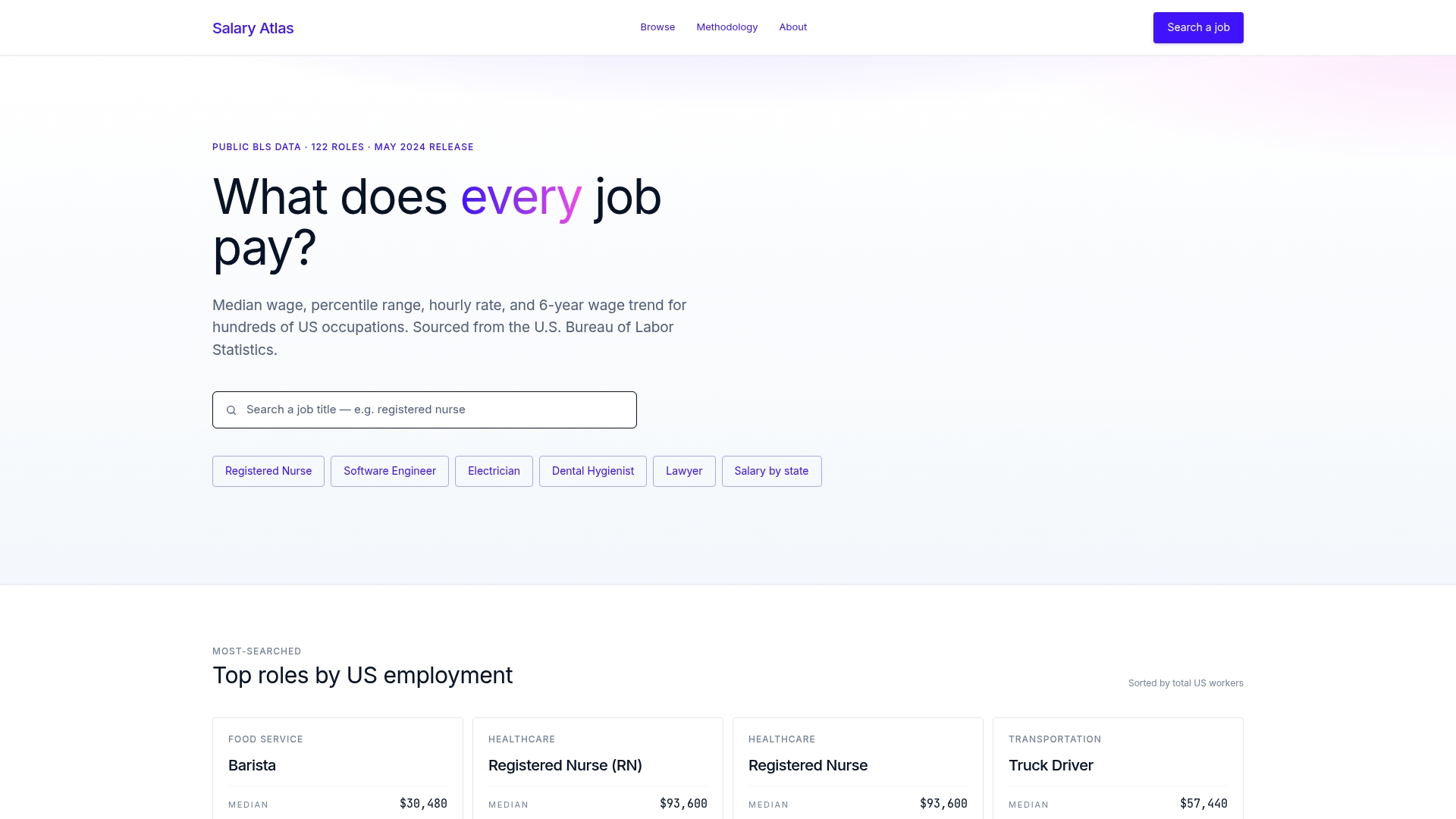
If you want to see how we source and calculate figures, our methodology page lays it out. For tools beyond ours, see our roundup of salary research tools and resources.
FAQ
Is a pay grade the same as a salary range?
No. A pay grade is a classification of a job's level, while a salary range is the minimum-to-maximum pay linked to it. Each grade normally has its own range, so people often speak of them as one thing. The grade tells you where the job sits, and the range tells you what it can pay.
What is the difference between a salary range and a salary band?
A salary range usually applies to one job or one grade. A salary band is broader and groups several jobs or levels into a wider span of pay. Bands give managers more flexibility in setting pay, but they can make it harder to keep similar jobs consistent.
Can two employees in the same pay grade earn different amounts?
Yes. The grade fixes the range, not the exact pay. Experience, performance, time in role, location and negotiation place each person differently inside it. In the federal GS, the same grade pays differently by step, which shows the same idea in a public system.
Does a higher pay grade always mean higher pay?
Within one employer's structure, a higher grade generally carries a higher range, though neighboring ranges often overlap. Across employers, grade numbers cannot be compared at all, because each company designs its own ladder and sets its own dollar amounts.
Sources
- Market Referenced Job Evaluation Process, Lehigh University Human Resources
- How does the Federal pay system work? OPM
- The Classifier's Handbook, OPM
- Pay structures and pay progression, CIPD
- Compensation components, SAGE
- Evaluating and Negotiating Job Offers, Harvard FAS Mignone Center
Recommended
Occupation wage figures on Salary Atlas come from the U.S. Bureau of Labor Statistics. Figures in this article that are not linked to a source are estimates. See our methodology.