U.S. Fastest Growing Jobs in 2026: Healthcare Adds 2.0M by 2034
Use BLS 2024–34 projections to see which U.S. jobs grow fastest in 2026, and compare projected openings, pay, and required training for top roles.
By the Salary Atlas editorial team · Published

Nurse practitioners, wind turbine service technicians, and data scientists top the list of fastest growing jobs for 2026, with healthcare and social assistance leading all sectors at a projected 8.4% growth rate through 2034. The U.S. Bureau of Labor Statistics projects healthcare will add roughly 2.0 million jobs over that decade, more than any other sector tracked. Solar installers, home health aides, and information security analysts round out a list dominated by care work, clean energy, and digital security.
TL;DR:
- Healthcare roles, especially nurse practitioners and home health aides, will continue to dominate job growth with high demand and large numbers of openings.
- Renewable energy positions like wind turbine service technicians and solar photovoltaic installers are forecasted to grow rapidly, though they have lower median salaries.
- Data science and cybersecurity jobs will see steep percentage increases, driven by AI, cloud technology, and increasing digital security threats.
- Credential requirements vary from short certificates for trades to advanced degrees for healthcare roles, impacting how quickly one can enter these high-growth fields.
- Regional demand and local salary differences are critical to consider before choosing a career path or enrolling in related training programs.
Table of Contents
- What Are the Fastest Growing Jobs for 2026?
- How Should You Read BLS Job Growth Projections?
- How Do You Turn This Data Into a Career Plan?
- Why Are These Sectors Driving Job Growth Right Now?
- Where Does This Wage Data Actually Come From?
- A Publisher's Take on Chasing Growth Numbers
- Check Your Exact Numbers Before You Commit
- Sources
- FAQ
What Are the Fastest Growing Jobs for 2026?
The BLS employment projections cover 2024 through 2034, and the pattern is unmistakable: healthcare occupations fill most of the top slots, but a handful of tech and energy roles post even steeper percentage gains. Below is a ranked view combining projected growth rate, typical pay, and the credential you'd actually need to get hired.
Wage figures reflect median annual pay reported through BLS Occupational Employment and Wage Statistics; growth percentages reflect the 2024–34 projection window unless noted.
- Wind turbine service technicians, Projected growth is among the highest of any occupation tracked, driven by expanding wind capacity. Median pay sits in the low $60,000s. Entry typically requires a technical certificate from a community college, often under two years.
- Solar photovoltaic installers, Growth here outpaces almost every occupation on the list, though renewable-energy roles add relatively few raw jobs compared with healthcare because the base is so much smaller. Median pay lands around $48,000, and most installers train on the job or through a short certificate program.
- Nurse practitioners, Consistently ranked among the very fastest growing occupations in BLS data and widely cited by major outlets as a top-growth healthcare role. Median pay tops $126,000, but the pathway requires a master's degree and RN licensure first, so plan on several years of schooling.
- Data scientists, Demand keeps climbing as companies build out AI and analytics teams. Median pay is roughly $108,000, and most employers want at least a bachelor's degree, often in statistics, computer science, or a related field.
- Information security analysts, Cybersecurity hiring has become a permanent fixture of IT budgets. Median pay is around $124,000, with a bachelor's degree the typical minimum.
- Physician assistants, Growth here rivals nurse practitioners, and pay is similarly strong at a median above $120,000. The catch is a master's-level PA program plus clinical hours, usually a two- to three-year commitment after your bachelor's degree.
- Occupational therapy assistants, This role offers one of the shortest paths to solid healthcare pay: an associate degree for median pay near $67,000.
- Home health aides, The largest raw job growth on this list. Median pay is modest, around $33,000, but entry requires little more than a short training program and certification, making it one of the fastest on-ramps into healthcare.
- Cardiac medical technicians, Forbes' analysis of Indeed data flags this role as a standout when you weight pay against demand, with median pay in the $60,000+ range and entry through a certificate or associate program detailed by lab technician salary guides.
- Ophthalmic medical technicians, A growing allied-health role tied to an aging population needing more eye care. Median pay is around $45,000, typically reached through a certificate program of a year or less.
The healthcare and social assistance sector alone is projected to add close to 2.0 million jobs by 2034, more raw openings than tech and energy combined.
How Should You Read BLS Job Growth Projections?
BLS builds its 2024–34 projections from current employment data, expected retirements, industry output forecasts, and historical hiring patterns. The numbers aren't predictions of certainty. They're the agency's best statistical estimate given the trends visible right now.
Two figures matter more than the headline growth percentage:
- Percent growth tells you how fast an occupation is expanding relative to its current size.
- Raw job openings tell you how many actual positions will exist to compete for.
- A tiny occupation growing 40% might add fewer jobs than a huge one growing 5%.
- Regional labor markets vary widely, so a national projection won't always hold true in your city or state.
- Economic shocks, policy shifts, and technology changes can bend a ten-year forecast in ways no model fully captures.
How Do You Turn This Data Into a Career Plan?
Growth rate is only one input. Matching a fast-growing occupation to your actual life circumstances takes a few more filters.
- Rank by openings, not just percentage. Home health aide and nurse practitioner roles both show strong growth, but the sheer number of home health openings makes that path easier to break into quickly.
- Check credential time against your budget and timeline. An occupational therapy assistant role takes about two years of school; a physician assistant role takes closer to six years total including your bachelor's degree.
- Weigh pay against training length. Cardiac medical technician and ophthalmic medical technician roles offer respectable pay for a certificate-length commitment, which is why Forbes highlighted several allied-health roles as strong value picks.
- Look up your own state. National projections mask local demand; a state with heavy solar buildout will need far more installers than one without.
- Verify licensing requirements before enrolling anywhere. Healthcare roles especially carry state-specific licensing rules that affect how fast you can actually start earning.
Why Are These Sectors Driving Job Growth Right Now?
Healthcare dominates this list for a straightforward demographic reason: the U.S. population is aging, chronic disease management has expanded, and care has shifted into more settings, from home health to outpatient clinics to specialty practices. That combination explains why nurse practitioners, physician assistants, home health aides, and several medical technician roles all appear near the top.
Technology's push comes from a different direction. Artificial intelligence, cloud infrastructure, and mounting cybersecurity threats have made data scientists and information security analysts nearly essential hires across industries, not just tech companies.
- Healthcare growth: aging population, expanded mental health access, more care settings
- Tech growth: AI adoption, cloud migration, rising cybersecurity risk
- Clean energy and trades growth: renewable capacity build-out and skilled-trade retirements creating openings, though at a smaller absolute scale than healthcare or tech
Where Does This Wage Data Actually Come From?
Every wage figure in this article traces back to BLS Occupational Employment and Wage Statistics and BLS employment projections, the same primary tables Salary Atlas republishes without a paywall.
- Salary Atlas pulls wage data directly from BLS OEWS and links each occupation figure back to its original government table.
- This piece was written by Joelen Zyoktova, drawing on BLS's 2024–34 projections and cross-checked against independent reporting from Forbes, CNBC, and Monster.
- You can verify any figure here by comparing it against Salary Atlas's own salary by state tool or the underlying BLS release.
A Publisher's Take on Chasing Growth Numbers
The smartest move isn't picking the occupation with the flashiest growth percentage. It's matching a short credential to strong regional demand, then checking your own state's numbers before enrolling anywhere. A national ranking is a starting point, not a decision. Explore Salary Atlas's own tools before you commit a year of tuition to a projection.
, Joelen Zyoktova
Check Your Exact Numbers Before You Commit
Growth projections tell you where the jobs are headed. They don't tell you what a nurse practitioner earns in Ohio versus California, or how a solar installer's pay stacks up in a state with heavy incentive programs. That gap is addressed by a freely accessible site where every wage figure traces back to BLS OEWS tables, broken out by state and percentile, with no signup wall and no paywall between users and the data they need.
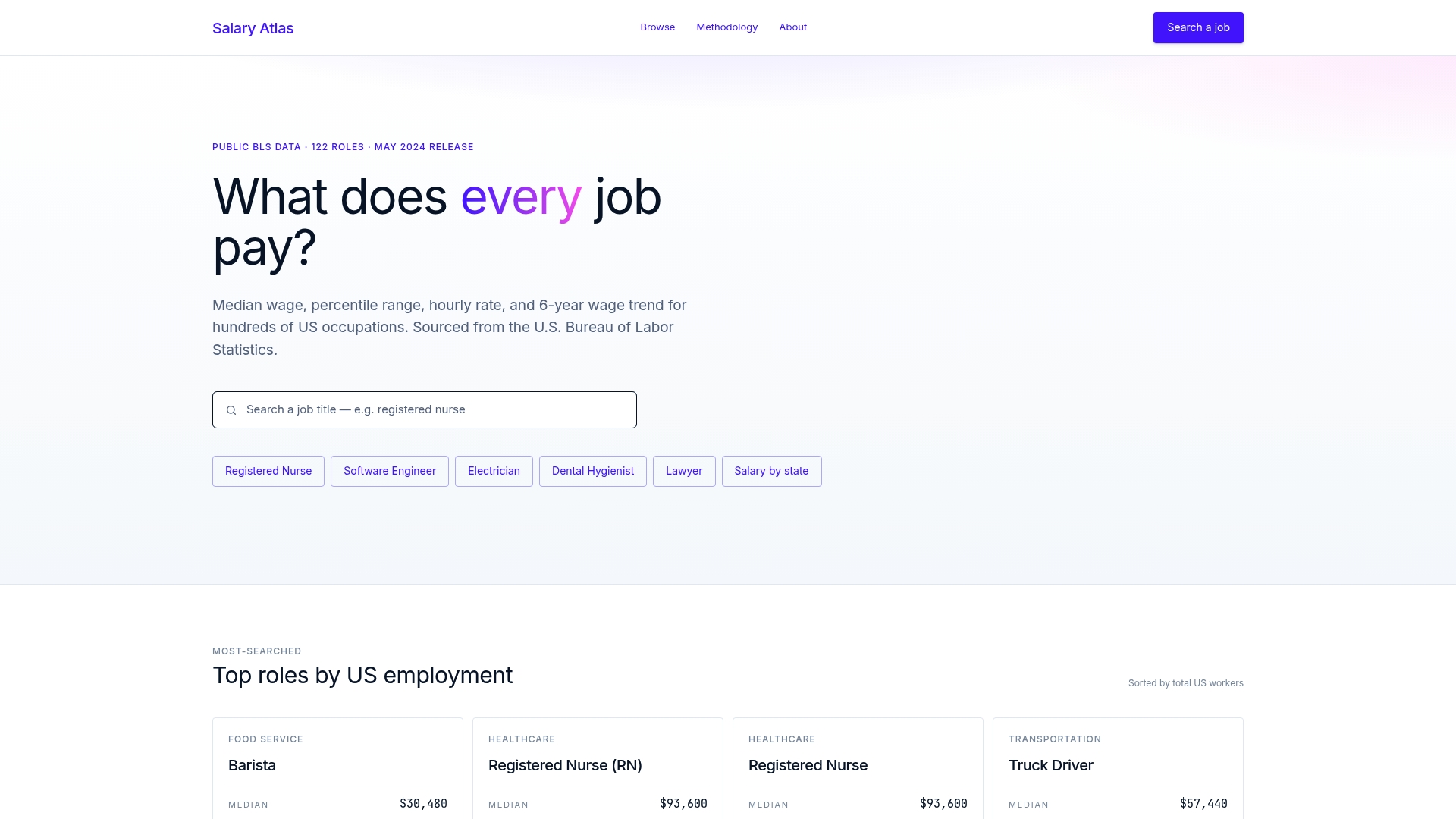
If any occupation on this list caught your eye, the next move is simple. Pull up average salary by state and see what that role actually pays where you live, not just the national median. Considering the data path? Compare regional pay on the data analyst salary page before you enroll in a bootcamp or degree program. Start at Salary Atlas and search your target occupation directly.
Sources
- Industry and occupational employment projections overview and highlights, 2024–34 : Monthly Labor Review : U.S. Bureau of Labor Statistics
- Fastest-Growing Careers In 2026: 10 Six-Figure Jobs, Forbes
- The fastest-growing jobs of the next decade in the U.S., according to BLS, CNBC
- 2026 Job Market Outlook, Monster
FAQ
What Are the Fastest Growing Career Fields in the U.S. for 2026?
Healthcare and social assistance leads all sectors, projected to grow 8.4% and add about 2.0 million jobs through 2034, with renewable energy and data/cybersecurity roles posting the steepest individual growth rates.
What Job Pays $400,000 a Year Without a Degree?
No occupation on established BLS or major-outlet fastest-growing lists reaches six-figure median pay without advanced credentials; roles at that income level are almost always tied to specialized licensure, business ownership, or commission-based sales rather than a typical no-degree career path.
What Jobs Will Be in Demand in 2026?
Nurse practitioners, physician assistants, data scientists, information security analysts, and solar photovoltaic installers all show strong demand in 2026, alongside high-volume roles like home health aides that add the most raw openings.
What Are the Top 10 Fastest Growing Jobs in the U.S.?
The top tier includes wind turbine service technicians, solar photovoltaic installers, nurse practitioners, data scientists, information security analysts, physician assistants, occupational therapy assistants, home health aides, cardiac medical technicians, and ophthalmic medical technicians, based on BLS 2024–34 projections.
Recommended
Occupation wage figures on Salary Atlas come from the U.S. Bureau of Labor Statistics. Figures in this article that are not linked to a source are estimates. See our methodology.