Chicago Job Market 2026: Hiring, Wages and Top Sectors
The Chicago job market in late 2026: unemployment, which industries are hiring or cutting, what typical jobs pay, and whether $70,000 is a good salary.
By the Salary Atlas editorial team · Published

The Chicago job market is steady but soft. Unemployment in the metro area sits above the national rate, payroll growth has hovered around zero in 2026, and the work is concentrated in healthcare, manufacturing and logistics rather than finance and office jobs. Pay is still higher than the U.S. average. Below you will find the latest figures, the sectors that are growing or shrinking, what typical Chicago jobs pay, and how to judge an offer.
TL;DR
- Illinois unemployment was 4.6% in September 2026, and the Chicago metro division was 4.5%, up 0.4 points from a year earlier. The city itself was 4.9%.
- Job growth is flat. Healthcare, education, manufacturing and logistics hold up better than finance, information and professional services.
- The average hourly wage in the metro was $35.28 in May 2025, against $33.54 nationally.
- $70,000 is a comfortable single-adult salary in Chicago by most estimates. $120,000 a year, or $10,000 a month, takes a specialized or senior role.
- Check any wage you are weighing against official BLS-based figures for your exact job title and state.
Table of Contents
- How the Chicago job market looks right now
- Which Chicago industries are hiring and which are cutting
- Major employers in Chicago
- What jobs pay in Chicago
- Is $70,000 a good salary in Chicago?
- Perspective
- Check your own number on Salary Atlas
- How to use this in your search
- FAQ
- Sources
How the Chicago job market looks right now
Start with unemployment, because the sources differ and the difference matters. The Illinois Department of Employment Security reported a statewide rate of 4.6% for September 2026, down 0.1 point from August and up 0.1 point from a year earlier, with 297,700 people unemployed.
The local picture is a little weaker. IDES' September release puts the Chicago-Naperville-Schaumburg metro division at 4.5% (not seasonally adjusted), and Cook County at 4.7%, DuPage at 3.8%, Will at 4.2% and Chicago City at 4.9%. A year earlier the city was at 4.5%. If you live in the suburbs, your odds of finding work look better than the city average suggests. If you live in the city, they look a little worse.
PNC's economists use a different series and see a higher rate. Their October 2026 analysis shows the metro unemployment rate at 5.1%, above the state's 4.7% and the national 4.1%, and above the U.S. rate for nine months in a row. The exact number depends on the series and the geography, but all of them point the same way: Chicago is running somewhat behind the nation.
Job growth tells the same story. PNC reports Chicago-area payrolls changed by -0.1% in August 2026, after +0.1% in July, and describes 2026 growth as alternating between slightly positive and slightly negative with no clear trend. The Federal Reserve's October 2026 Beige Book for the region says employment rose slightly and that contacts expect a similar pace of hiring over the next 12 months.
Scale still matters. The Chicago metro is the third largest in the country by nonfarm employment, at about 4.76 million jobs. A flat market in a region this big still means a great many openings every month, driven by turnover rather than growth.

Which Chicago industries are hiring and which are cutting
Chicago's strength is that no single industry runs it. World Business Chicago's framing, as summarized in a 2026 city profile, is that diversification cushions shocks but can mean slower headline growth than in a metro built around one boom sector. That fits what the data show.
Here are the five largest sectors by nonfarm employment in August 2026, using BLS payroll data as reported by ATS Mako:
| Sector | Jobs | Share of total | Change over the year |
|---|---|---|---|
| Trade, transportation and utilities | 931,700 | 19.5% | -1.0% |
| Professional and business services | 820,200 | 17.1% | +0.4% |
| Private education and health services | 802,300 | 16.8% | +1.0% |
| Leisure and hospitality | 498,400 | 10.4% | +0.4% |
| Manufacturing | 410,300 | 8.6% | +0.8% |
Where the growth is
Private education and health services is the largest source of net new demand among the big sectors, up 1.0% over the year. PNC also points to strong gains of 3.6% in government and in mining, logging and construction. For anyone planning a move into a health-related role, these employer healthcare trends show what benefits leaders are preparing for, which tells you a lot about where healthcare employers are putting their money.

Manufacturing is also holding up, up 0.8% over the year. The Beige Book's manufacturing contacts reported difficulty finding skilled workers, which is good news for welders, machinists and technicians. If that is your path, our welder salary page and industrial engineer salary page show the BLS median, range and six-year trend.
Leisure and hospitality grew 0.4%, and these jobs often require a state alcohol server credential. Illinois' BASSET certification is a typical example of a small, fast step that makes a candidate hireable for bar and restaurant work.
Where it is shrinking
PNC reports year-earlier drops of 3.8% in information and 5.1% in financial activities. Its economists expect weakness in financial and professional services to more than offset gains from manufacturing and logistics. Wells Fargo earlier attributed the cooler pace of hiring mostly to retrenchment in professional and business services and financial services, which together make up about 27% of employment.
The Beige Book adds two details worth knowing. A business services contact said AI-driven productivity gains let the firm reduce headcount through attrition, meaning fewer new openings rather than layoffs. A retail contact expected holiday hiring at or below last year's level. Trade, transportation and utilities, the biggest sector, is down 1.0%, so warehouse and retail seasonal work may be harder to land than in past years.
Major employers in Chicago
The region's employers match its mix of industries. Finexus Research's reading of BLS data describes a base of manufacturing, transportation and logistics, financial services, healthcare and professional services, with O'Hare and the intermodal rail network anchoring logistics and CME Group anchoring the exchanges.
By employer type, the largest names are:
- Government: federal agencies and the City of Chicago, which hires across police, fire, parks and other departments.
- Healthcare systems: Advocate Health is Illinois' leading healthcare provider, alongside academic medical centers.
- Finance: JPMorgan Chase's Chicago operations employ roughly 14,500 people, according to the same list.
- Education: the University of Chicago and other large universities.
- Transportation: United Airlines and the logistics firms around O'Hare and the rail yards.
What jobs pay in Chicago
Chicago pays more than the national average. BLS data cited in a 2026 city profile show an average hourly wage of $35.28 in the Chicago-Naperville-Elgin area in May 2025, above the U.S. average of $33.54. Averages are pulled up by high-wage professional clusters, while retail, hospitality and service jobs keep the median lower, so look at your own occupation instead.
Median hourly wages for common Chicago-area jobs from May 2025 BLS data, as compiled by ATS Mako:
| Occupation | Median hourly wage | Employed in the area |
|---|---|---|
| Sales managers | $76.29 | 25,390 |
| Sales representatives of services | $34.00 | 55,730 |
| Customer service representatives | $22.65 | 75,240 |
| Laborers and freight, stock and material movers | $19.50 | 157,920 |
| Janitors and cleaners | $18.49 | 70,000 |
| Retail salespersons | $17.22 | 96,950 |
| Cashiers | $16.83 | 99,240 |
| Fast food and counter workers | $16.65 | 97,280 |
Jobs that pay $25 an hour without a degree
The table shows the pattern. Entry-level retail and food service in Chicago sit between about $16 and $18 an hour at the median. Customer service reaches $22.65, and sales representatives of services reach $34.00. Reaching $25 an hour without a degree usually means moving from entry-level work to one of these paths:
- sales, where pay depends on product knowledge and experience;
- skilled trades such as welding, where a certificate or apprenticeship replaces a degree;
- supervisory roles in logistics, warehousing and customer service.
Jobs that pay $10,000 a month without a degree
$10,000 a month is $120,000 a year, or about $57.70 an hour at 2,080 hours. That is well above every median in the table except sales managers at $76.29. Roles at this level usually come from years of experience, commissions, management responsibility or specialized licensing. A degree is not the only route, but experience in a high-demand field normally is. Look up your target title by experience level and percentile to see whether the 75th or 90th percentile reaches that figure.
Is $70,000 a good salary in Chicago?
For a single adult, yes. Uhomes' 2026 analysis calls $70,000 or more a good salary for one person in Chicago and $100,000 or more for a household aiming for stability. It estimates a single adult needs about $51,000 a year for basic living standards in the metro.
Costs support that. One Chicago relocation guide puts total monthly expenses at about $2,700 in the city center, including $1,800 rent for a one-bedroom, and about $2,100 outside the center. A cost-of-living index of 102.5 against a U.S. baseline of 100 means Chicago costs only slightly more than the national average, according to CompareLiving.us, which also lists median rent at $1,440 a month.
On $70,000 a year, rent in the city center takes a large share of your take-home pay, so neighborhood choice matters more than the headline salary. A household with children or one earner will need more.
Perspective
Most Chicago job market coverage gives you a mood: tough, thawing, uneven. A job seeker needs a number for a specific job. The useful question is what your occupation pays in this metro area, at what percentile, and how that compares with the state and the nation.
That is why we publish BLS wage data by job title, percentile, state and experience level, with every figure linked to its source. We don't estimate, scrape or use self-reported numbers, and we don't make up trends. In a market where hiring is flat, a negotiation backed by a cited median is worth more than a guess from a forum.
If you are choosing between careers, look at the six-year trend on the occupation page as well as today's median. A sector adding jobs in Chicago, such as healthcare or skilled manufacturing, often shows up in the data before it shows up in the headlines.
Joelen Zyoktova
Check your own number on Salary Atlas
Whether you are weighing an offer, setting a pay band or choosing a major, you need a wage figure you can trace. Salary Atlas gives you U.S. salary and wage data by job title, percentile, state and experience level, from the Bureau of Labor Statistics, with no paywall and no signup.
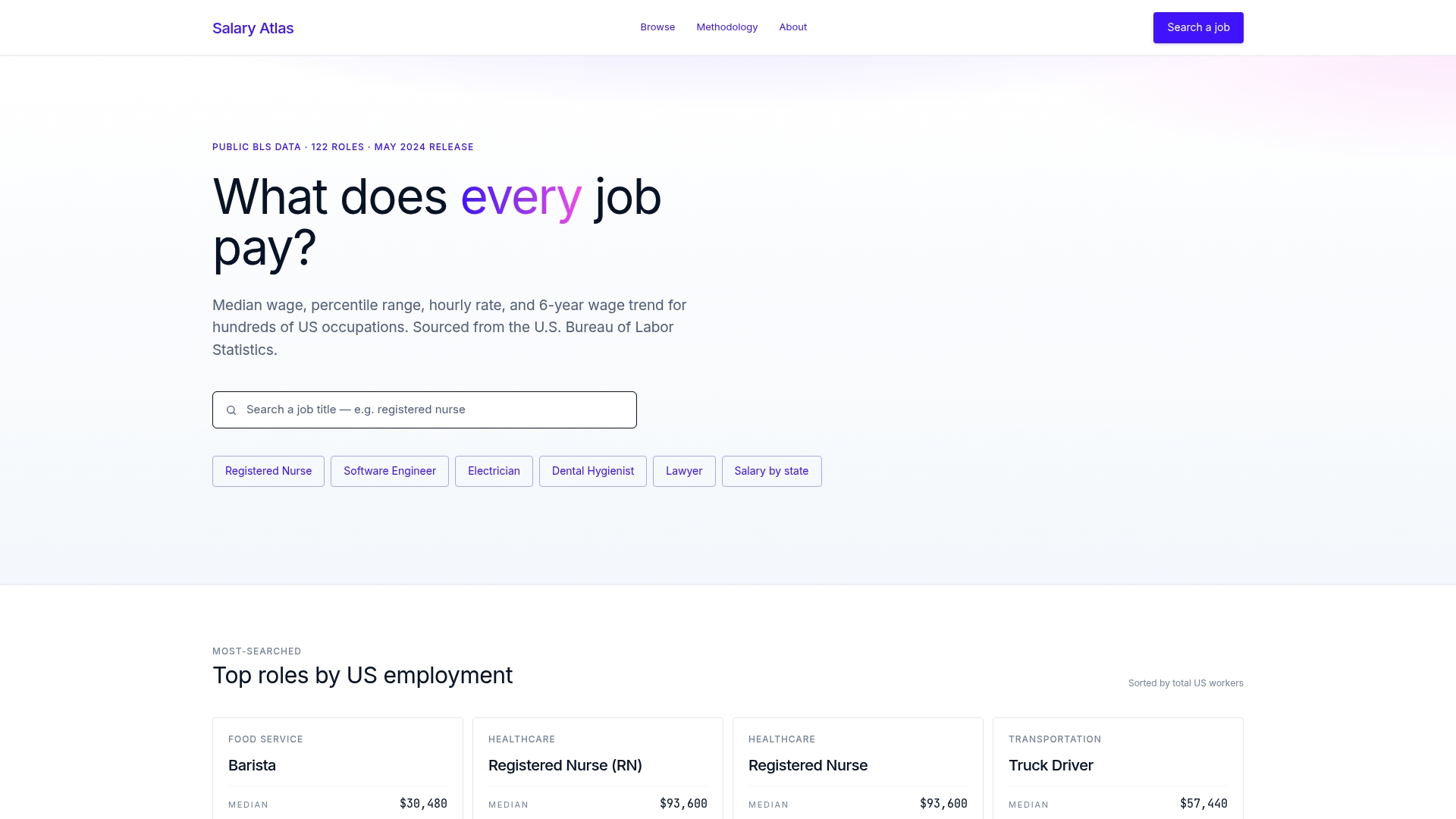
Start on the Salary Atlas homepage to search a job title, or use the average salary by state page to compare Illinois with other states. Our methodology page explains where each figure comes from and how often it is refreshed.
How to use this in your search
- Pick your occupation, not just "Chicago". Sector trends differ enough that a nurse and a financial analyst face different markets.
- Compare the median with the range. Use the entry-level and experienced figures from IDES' OEWS tables or the Salary Atlas page for your title.
- Apply broadly in the suburbs. DuPage, McHenry and Will counties have lower unemployment than the city.
- Target sectors with demand. Healthcare, skilled manufacturing and logistics look steadier than finance and information right now. Our fastest growing jobs article covers the national picture.
- Read the wider outlook. Our job outlook for U.S. job seekers places the Chicago numbers in a national context, and our Dallas job market article shows how another large metro compares.
FAQ
Is the Chicago job market good right now?
It is stable but slow. Metro unemployment is between 4.5% and 5.1% depending on the series, above the U.S. rate, and payroll growth is near zero. Healthcare, education, manufacturing and logistics are doing better than finance and information.
What are the biggest industries in Chicago?
By August 2026 payrolls, they are trade, transportation and utilities (931,700 jobs), professional and business services (820,200), and private education and health services (802,300). Leisure and hospitality and manufacturing follow.
Is $70,000 a good salary in Chicago?
For a single adult, it is generally considered good, since estimates put the basic living threshold near $51,000. It is tighter for a household with children, where estimates rise toward $100,000. Housing costs, especially in the city center, are the main factor.
How do Chicago wages compare with the national average?
They run higher. The average hourly wage in the Chicago area was $35.28 in May 2025, against $33.54 nationally. Individual occupations vary, so check your job title on Salary Atlas or IDES' OEWS tables.
Sources
- IDES: Unemployment Rate Down for Third Consecutive Month
- IDES: Chicago area unemployment news release, September 2026
- PNC: Chicago Regional Economics Analysis, October 2026
- Wells Fargo: Chicago economic update
- Federal Reserve Bank of Minneapolis: Beige Book, Chicago, October 2026
- Finexus Research: The 30 Giants
- ATS Mako: Hiring in Chicago, IL
- The American Newspaper: Chicago, Illinois profile
- IDES: Occupational Employment and Wage Statistics
- IDES: Labor Market Information
- Uhomes: Median Income in Chicago
- Executive Moving Concierge: Moving to Chicago guide
- CompareLiving.us: Cost of Living in Chicago
- Fulton Grace: The Largest Employers in Chicago
- Employer Healthcare Trends 2026
- Illinois BASSET certification training guide
Recommended
Occupation wage figures on Salary Atlas come from the U.S. Bureau of Labor Statistics. Figures in this article that are not linked to a source are estimates. See our methodology.