Six Digit SOC Codes HR Teams Must Assign Correctly for Accurate Pay
HR explainer: read six digit SOC codes, assign the correct code for state reporting, and use SOC wage tables to benchmark pay.
By the Salary Atlas editorial team · Published

SOC codes are the six-digit federal standard for classifying occupations, maintained by the U.S. Bureau of Labor Statistics (BLS). Employers, HR teams, and workforce analysts use them for wage surveys, state reporting requirements, and compensation benchmarking. The BLS and O*NET both anchor their occupational data to this system, and resources like Salary Atlas map it directly to real wage figures.
TL;DR:
- Accurately matching duties and responsibilities ensures the correct SOC code, preventing misclassification that could affect wage and reporting accuracy.
- The six-digit SOC code structure allows quick decoding of the occupation's major group, minor group, broad occupation, and specific role, aiding precise classification.
- State reporting requirements for SOC codes vary, with some states like South Carolina and Washington mandating filings; verify current rules with local agencies.
- Proper documentation of the decision process, including the duties considered and sources used, safeguards against errors during audits or revisions.
- Salary Atlas provides accessible, SOC-linked wage data by state and percentile, supporting defensible pay benchmarking aligned with official BLS classifications.
Table of Contents
- What Is an SOC Code and Who Maintains It?
- How to Read a Six-Digit SOC Code
- Who Actually Uses SOC Codes and Why It Matters to HR
- How to Find and Assign the Right SOC Code
- Common SOC Coding Mistakes and Which States Require Reporting
- Real Examples: Mapping Job Titles to SOC Codes
- How Salary Atlas Maps SOC Codes to Real Wage Data
- What Actually Matters When You Apply SOC Codes to Pay Strategy
- Get SOC-Mapped Wage Tables From Salary Atlas
- Where to Verify SOC Codes and Wage Data
- Sources
- FAQ
What Is an SOC Code and Who Maintains It?
The Standard Occupational Classification system is a federal statistical standard, not a state-by-state invention or a private vendor's shorthand. The BLS owns and updates it, running a full revision roughly once every decade to keep pace with how work actually changes, adding codes for roles like wind turbine technicians when they didn't exist a generation ago and retiring ones that faded out.
SOC classifies occupations by the work performed, which is a distinct concept from NAICS, the system that classifies the industry an establishment operates in. A payroll clerk gets the same SOC code whether she works at a hospital or a law firm; NAICS is what tells you which industry that hospital or firm belongs to.
That distinction matters for a few reasons:
- SOC answers "what does this person do," while NAICS answers "what does this business do."
- O*NET builds its detailed occupational profiles directly on top of SOC codes, adding skills, tasks, and education data.
- Census occupation codes are cross-walked to SOC, so federal survey data lines up across agencies.
How to Read a Six-Digit SOC Code
Every SOC code follows the same structure, and once you know the pattern, decoding any occupation on the list takes seconds. The CDC's overview of federal classification systems breaks the six digits into four levels of detail, moving from broad category down to a specific job.
- First two digits identify the major group, such as "29" for healthcare practitioners.
- Third digit narrows it to a minor group, like healthcare diagnosing or treating practitioners.
- Fourth and fifth digits define the broad occupation, such as physicians generally.
- Sixth digit pins down the detailed occupation, the most specific level BLS tracks.
Take that code, 29-1215, Family Medicine Physicians. "29" places it in healthcare practitioners and technical occupations. The "1" as the third digit marks it as a diagnosing/treating practitioner. "21" identifies physicians as the broad occupation. The final "5" specifies family medicine within that group. Each detailed occupation entry also carries a formal definition, example duties, and explicit "includes" and "excludes" notes, which matter more than most HR teams realize when a role sits close to two similar codes.
Who Actually Uses SOC Codes and Why It Matters to HR
SOC codes show up across three distinct layers of the system, and HR teams typically only encounter one before they need all three.
At the federal level, SOC drives the Occupational Employment and Wage Statistics (OES) survey, feeds broader labor statistics, and appears in some federal grant and contract reporting requirements. State workforce agencies use it for unemployment insurance reporting and to build state-level labor market information. HR and compensation teams lean on it for a third purpose entirely: benchmarking pay and standardizing job classification across a company that might use ten different internal titles for what's functionally one SOC-coded job.
- Federal: OES wage surveys, BLS labor statistics, some grant compliance filings.
- State: quarterly UI wage reporting, state labor market analysis.
- Employer: compensation benchmarking, job architecture, pay equity audits.
How to Find and Assign the Right SOC Code
Get the duties right first, and the code follows. The BLS is direct about this: workers are classified by what they actually do, not by what their business card says, and two people with the identical job title can land in different SOC codes depending on their real day-to-day responsibilities, according to BLS guidance on finding your SOC code.
- Gather the duties first. Write down the actual tasks, the rough percentage of time on each, and any credential or skill requirements before you touch a lookup tool. A "marketing coordinator" who spends 70% of her week writing code for the company website needs a very different code than one running social calendars.
- Search the BLS SOC system and ONET. Match on duties, not title, and read the full occupation definition along with its includes and excludes notes. ONET's occupational taxonomy is particularly useful when a role's duties span two adjacent codes.
- Cross-check with a state lookup tool if you're filing state reports. Tools like North Carolina's SOC Lookup service or Washington's Employment Security Department resources let you confirm the code your state agency expects, which sometimes differs slightly from a pure federal read.
- Document the code and your reasoning in the job record. Note which duties drove the decision and which BLS or O*NET definition you matched against. This step gets skipped constantly, and it's the one that saves you when an auditor or a new HR hire questions a classification two years later.
When in doubt on a state filing, call the state workforce agency directly. A five-minute phone call beats guessing on a quarterly report you'll have to amend later.
Common SOC Coding Mistakes and Which States Require Reporting
Most SOC misclassifications trace back to the same handful of shortcuts. Mapping by job title alone is the biggest one. Ignoring the includes/excludes notes on a detailed occupation entry is the second, and it's an easy trap when two codes look nearly identical on the surface. The third is simply never writing down why a particular code was chosen, which leaves the next HR analyst reverse-engineering a decision with no paper trail.
- Coding by title instead of actual duties performed.
- Skipping the includes/excludes language in the occupation definition.
- Leaving no documentation of the rationale behind the chosen code.
- Reusing an outdated code after a BLS revision without rechecking it.
Real Examples: Mapping Job Titles to SOC Codes
Seeing the method applied to actual roles clarifies it faster than any abstract explanation.
- Software Developer: Duties center on designing, writing, and testing applications. That maps to SOC 15-1252, Software Developers, sourced directly from the BLS occupational database.
- School Counselor: Duties involve academic and college counseling for K-12 students, which lands at SOC 21-1012, Educational, Guidance, and Career Counselors and Advisors. Salary Atlas breaks down school counselor pay using this exact code.
- Occupational Therapist: Clinical duties treating patients through therapeutic activities map to SOC 29-1122, Occupational Therapists, reflected in Salary Atlas's occupational therapist salary data.
- Customer Service Representative in a technical support role: This is where includes/excludes notes matter most. A rep who primarily troubleshoots software issues may belong under a computer support code rather than the general customer service category, depending on the percentage of time spent on technical diagnosis versus general account service.
How Salary Atlas Maps SOC Codes to Real Wage Data
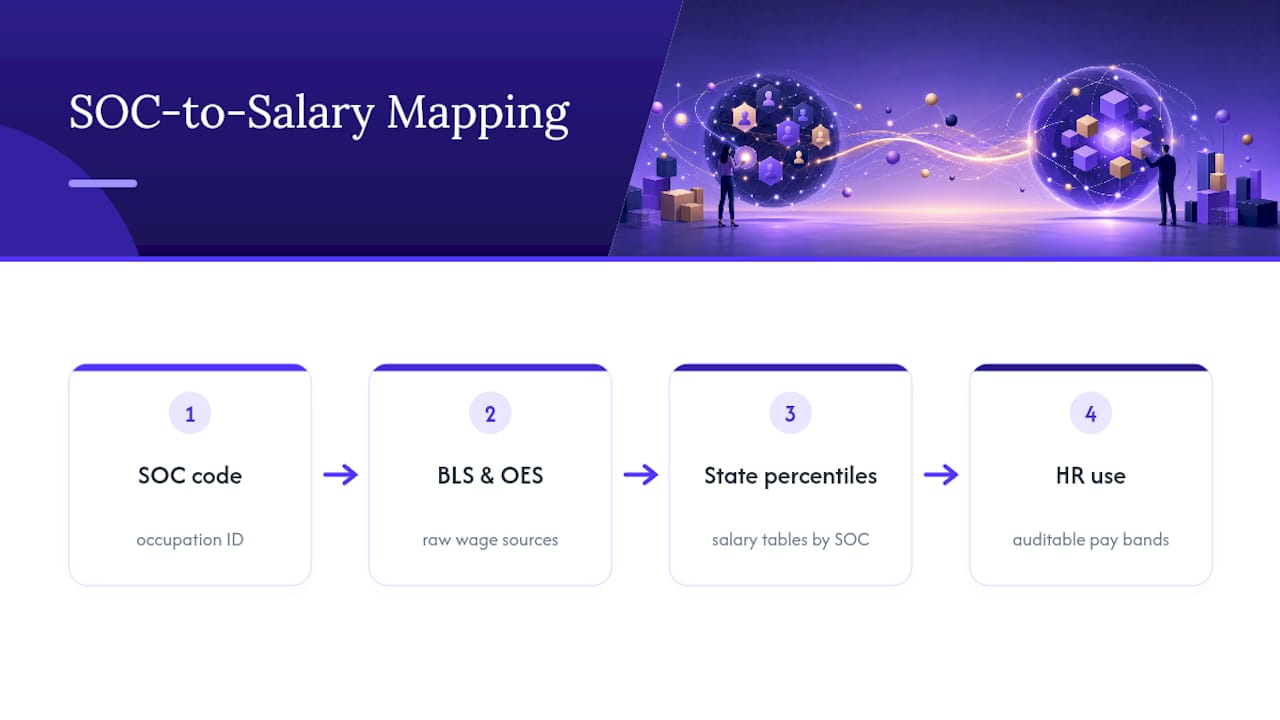
Salary Atlas pulls BLS and OES wage data and organizes it by SOC code, producing state-level and percentile-level salary tables for specific occupations rather than vague industry averages. Every figure links back to its original BLS source, which is what makes the numbers auditable instead of just asserted, a process detailed in the Salary Atlas methodology.
That SOC-based structure is what makes compensation comparisons defensible in an audit or a pay equity review: you're comparing apples to apples at the detailed occupation level, not a loosely-defined job family. HR teams building or refreshing pay bands can pull SOC-linked figures directly rather than reconstructing a wage table from scratch.
What Actually Matters When You Apply SOC Codes to Pay Strategy
Duties-first mapping beats title-matching every time, and the teams that skip documentation are the ones scrambling during an audit. Treat SOC benchmarks as a starting point for your own leveling framework, not a replacement for it, and revisit assignments whenever a role's responsibilities shift or BLS issues a revision.
, Joelen Zyoktova
Get SOC-Mapped Wage Tables From Salary Atlas
Salary Atlas turns the BLS occupational database into something you can actually use for pay decisions: state-level and percentile-level wage tables organized by SOC code, with every number linked back to its BLS source. There's no paywall and no signup wall between you and the figure you need, which matters when you're building a comp band on a deadline and can't wait for a vendor demo.
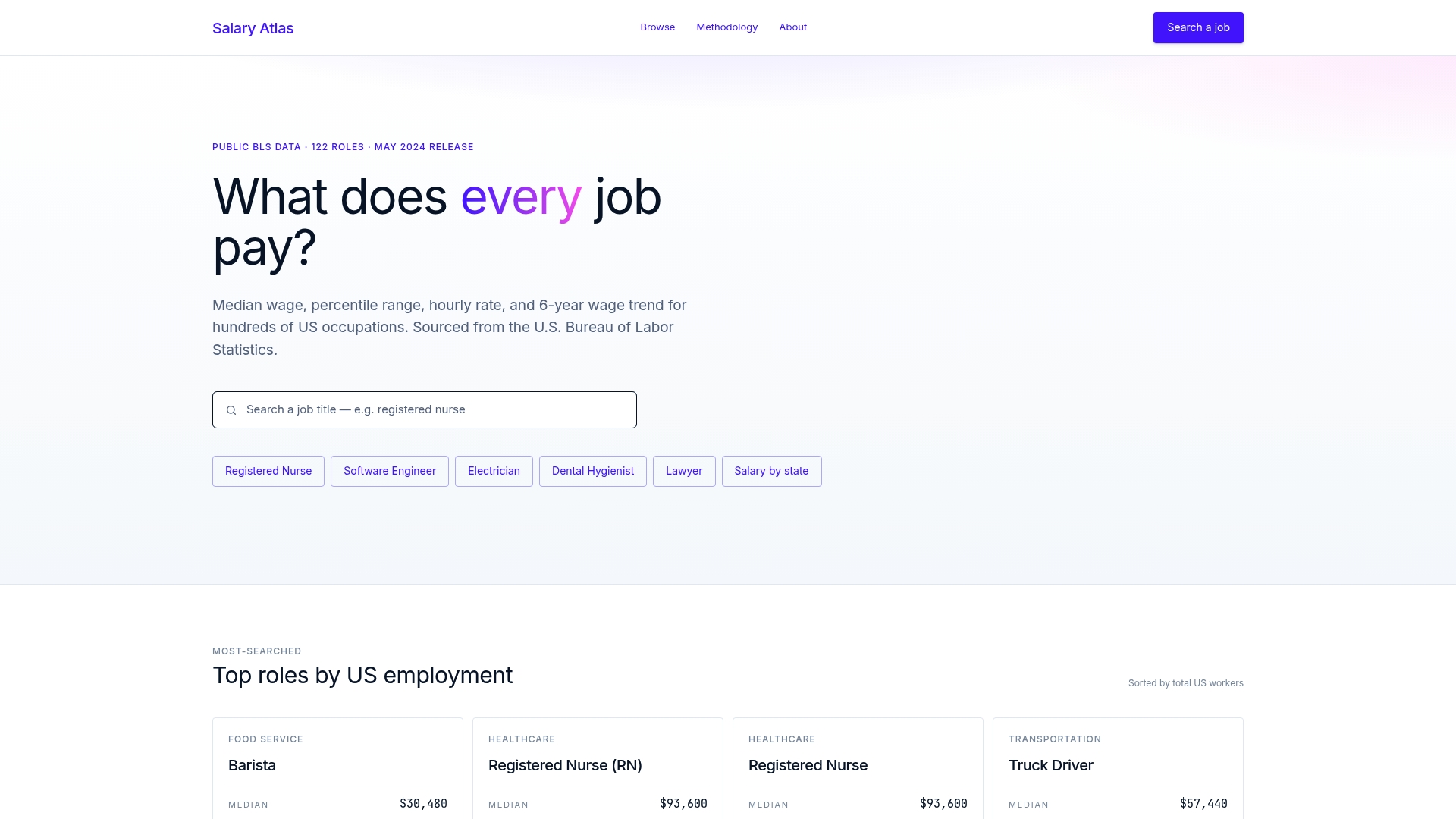
If you're benchmarking a role right now, start with average salary by state to see how a given SOC-coded occupation's pay shifts across markets, or check the methodology page to see exactly how the mapping works before you cite a figure in a compensation review. For roles in data-heavy functions, the Data Analyst Salary page shows the same SOC-linked format in action.
Where to Verify SOC Codes and Wage Data
Go straight to the source rather than a secondhand summary: the BLS SOC homepage for official code definitions, O*NET resources for detailed occupational profiles, and your state workforce agency for reporting rules. For occupational distinctions within specialized fields like tech, guides such as this cybersecurity career roles overview show how granular SOC-adjacent classification can get.
Sources
- About Classification Systems | Occupation and Industry Data | CDC
- Standard Occupational Classification (SOC) Codes - SC DEW
FAQ
What Is the SOC Code System in the USA?
It's the federal statistical standard the Bureau of Labor Statistics maintains to classify every occupation in the U.S. economy by the work performed, used for wage surveys, labor statistics, and employer reporting.
Which States Currently Require SOC Codes?
Requirements vary and change over time; South Carolina and Washington are among the states with active SOC reporting components, but you should confirm current rules with your specific state workforce agency before filing.
How Do I Know What SOC Code to Use?
Match the role's actual duties, not its job title, against the official BLS occupation definitions and includes/excludes notes, cross-checking with O*NET when a role spans multiple potential codes.
What Are Common SOC Code Mistakes?
The most frequent errors are coding by title instead of duties, skipping the includes/excludes language on similar codes, and failing to document the reasoning behind the chosen classification.
Recommended
Occupation wage figures on Salary Atlas come from the U.S. Bureau of Labor Statistics. Figures in this article that are not linked to a source are estimates. See our methodology.