Underpaid at Work? How to Check and What to Do
Learn the signs you're underpaid, how to check your pay against BLS wage data, and how to tell a market gap from a wage violation, plus next steps.
By the Salary Atlas editorial team · Published

You are underpaid when reliable wage data for your occupation, location and experience level shows you earning less than the typical range, or when your employer pays you less than the law or your contract requires. Those are two different problems with two different fixes. The first is a negotiation. The second is a legal complaint. This guide shows you the signs, how to check your number against government wage data, and what to do next.
TL;DR
- Being paid below the market rate is legal. Being paid below minimum wage, owed overtime, or short of your contract is a wage violation you can report.
- Compare your pay with Bureau of Labor Statistics (BLS) figures for your exact job title and state, not with a single coworker.
- Strong signs include a higher-paid job posting for your own role, raises of only 1 to 3%, and newer hires earning more than you.
- If the data supports you, bring several sources and your results to a dedicated meeting with your manager.
- If your pay stub looks wrong, check hours, overtime and deductions first. That is a legal matter, not a negotiation.
Table of Contents
- Market gap or legal violation: sort this out first
- Signs you may be underpaid
- How to check your pay against real wage data
- Check your pay stub for legal problems
- What to do if the data says you are underpaid
- Our perspective
- Check your occupation's pay range now
- FAQ
- Sources
Market gap or legal violation: sort this out first
Most people who search this phrase mean one of two things, and the first step is knowing which one you have.
A market gap means your pay is lower than what comparable workers earn. It can be frustrating and expensive, but it is generally not illegal. Employers may weigh experience, education and skills when setting pay. Working America notes that unequal pay may be unfair without being unlawful, unless the difference is tied to a protected factor such as race, religion or gender. A wage violation means you are not receiving pay the law or your agreement guarantees. Examples include pay under the minimum wage, unpaid legally required overtime, or less than your employment contract specifies. These can be reported to the Department of Labor's Wage and Hour Division, according to CareerPayLab's overview of the topic.The distinction matters because it decides your strategy. A market gap is solved with evidence and a conversation. A violation is solved by documenting hours and pay and contacting the agency or an employment attorney.

Signs you may be underpaid
No single sign proves anything. Look for a pattern. Business Insider's list of signs includes several that hold up well:
- A similar job posting pays more. If your company advertises your own role at a higher rate, that is about as direct as evidence gets.
- Your responsibilities grew, but your pay did not. You manage more, train people or cover a vacancy, and the salary stayed flat.
- Raises are negligible. Annual increases in the 1 to 3% range may not keep up with the market.
- Your first job paid below market. Later offers and raises often build on the previous number, so a low start can follow you for years.
- Colleagues with similar experience and education earn more. Treat this as a prompt to check the data, not as proof.
- The company is doing well, but your pay is not. Revenue has taken off and your salary has barely moved.
- You are in a high-demand specialty. Scarce skills tend to command more in the market.
- You have never negotiated. People who accept the first number often leave money behind.
One caution from the same CNBC piece: career expert Sho Dewan says "underpaid" should be measured against you and the market, not against a colleague, and the market always has a range. That is why the next step matters.
How to check your pay against real wage data
Guessing from a coworker's comment or a salary-chat thread gives you an anecdote. A defensible answer starts with government wage data collected through the Occupational Employment and Wage Statistics (OEWS) program run by BLS.
Step 1: Pin down your occupation, not just your title
Company titles are creative. "Growth Associate" may map to a marketing or sales occupation in federal data. Read the duties on the occupation page and choose the closest match. If two fit, check both.
Step 2: Look up percentiles for your state
A national average hides large gaps. A job that pays well in one state can pay far less in another, so start with your own state. Our average salary by state page shows BLS OEWS figures by location, and each occupation page on Salary Atlas lists the median and the range from the lower to the upper percentiles.
You can cross-check with CareerOneStop's Salary Finder. You enter an occupation and location and see low, median and high hourly and yearly wages, with state and national comparisons. It covers 800 occupations, built from the OEWS data states collect, with estimates for May 2025 as of its June 2026 update.
Step 3: Read the fine print on what the numbers include
Per the same help page, yearly figures apply to full-time, year-round workers, while hourly figures include part-time and part-year workers. The estimates include base rate, guaranteed pay, incentive pay and on-call pay. They exclude overtime, shift differentials and nonproduction bonuses. So compare like with like: set your base pay and any guaranteed or incentive pay against the figure, and leave your overtime out of it.
Step 4: Place yourself inside the range
The median is the middle, not the target for everyone. Your position depends on experience, education, special skills or certifications, plus the company's size, industry and location, as CNBC's guide to your market value puts it. In another CNBC piece, compensation consultant Machado says pay is not a simple formula of years plus degree plus location, and that most people land somewhere in the middle of the range for their position.
A practical way to read it:
| Where you land | What it usually suggests |
|---|---|
| Below the 25th percentile with several years of experience | A strong case for a raise or a market check |
| Between the 25th percentile and the median | Possibly below market, depending on skills and tenure |
| Around the median with average experience | Probably in line with the market |
| Above the median | Competitive for most profiles |
Step 5: Add a second and third source
One number is a data point. Two or three independent sources pointing the same way is a case. Use BLS-based figures as your anchor, then add the salary range from a current job posting. Several states and cities now require employers to list pay ranges in postings. CNBC reported that at least 10 states and cities had passed such laws, including Colorado. Postings in those places are a free, current comparison.
Some roles have narrow pay structures of their own. Public school teachers, for example, are paid on set schedules, and our high school teacher salary page shows the median and range. If your employer uses grades or bands, our explainer on salary range versus pay grade helps you work out where you sit in the structure. Childcare work has calculators of its own too, such as an au pair salary calculator that shows how pay for that role is put together.
Check your pay stub for legal problems
If the gap is not about the market but about what lands in your account, look at the paperwork before you open a negotiation.
Minimum wage. Covered, nonexempt workers are entitled to the federal minimum wage of $7.25 per hour, in effect since July 24, 2009, according to the Department of Labor's FLSA guide. Many states and cities set higher rates, so check your own. The FLSA allows lower pay only for narrow categories, such as certain student-learners and workers with disabilities, and only under certificates issued by the Wage and Hour Division. Overtime. Nonexempt employees must receive at least one and a half times their regular rate for hours over 40 in a workweek. Our guide on how to calculate overtime pay walks through the math so you can check a pay stub line by line. Exempt or not. Salaried does not automatically mean exempt. For white-collar overtime exemption, the federal salary threshold is $684 per week ($35,568 a year) in 2026, after a 2024 rule raising it was vacated by a federal court, per Nimble's compliance summary. That summary also notes that Alaska, California, Colorado, Maine, New York and Washington set higher thresholds. If you are paid a salary near those levels and work long hours, find out whether you are correctly classified. Deductions. Under the DOL guide, deductions for cash shortages, required uniforms or tools of the trade are not legal to the extent they push pay below minimum wage or cut into overtime owed. Records. Employers must keep payroll records for at least three years and wage computation records for at least two, according to NFIB's guide to federal employment law. Keep your own log of hours and copies of every pay stub, because it makes any later claim far easier. Pay discrimination. The Equal Pay Act prohibits pay differences between men and women in substantially equal jobs at the same establishment, unless the employer can show a legitimate reason such as seniority, merit or experience, per NFIB. Title VII covers employers with 15 or more employees and bars discrimination based on race, color, religion, sex or national origin, as Nimble's summary explains. If you think a pay gap tracks one of those factors, speak with an employment attorney or the Equal Employment Opportunity Commission.State law adds more. Practical Law's toolkit notes that state and local rules can differ on minimum wage, overtime exemptions, pay periods, breaks and contractor classification, and that remote employees fall under the law of the state where they work. Look up your own state's labor department.

What to do if the data says you are underpaid
1. Build the case in writing
Save your wage data from at least two or three sources, the dates and ranges, and a short list of what you have delivered: projects, revenue, savings, new duties. Facts persuade more than frustration does.
2. Ask for a dedicated meeting
Do not raise it in a hallway or a weekly check-in. Request a meeting on compensation and lead with the market data, then connect it to your contributions. Name a target figure inside the range for your experience.
3. Have a fallback ready
If base salary cannot move right away, ask about a one-time bonus, extra vacation, remote work, professional development funding or an earlier review date, as CareerPayLab suggests.
4. Use outside offers honestly
The same source argues that a real competing offer is the strongest lever for resetting pay, and that a bluff is easy for experienced managers to spot. Only mention an offer you hold or are prepared to take seriously.
5. Consider acting as a group
Working America advises that approaching your boss together with coworkers puts you in a stronger position, and that group action carries more legal protection. Where you have no union, it suggests considering forming one. The group says union workers earned a median of $943 a week against $742 for nonunion workers, citing BLS, which is roughly 27% more.
6. Report violations
If your problem is unpaid overtime, sub-minimum pay or a contract breach, contact the Wage and Hour Division or your state labor agency. Wage protections apply regardless of immigration status or employment type, per CareerPayLab.
Our perspective
Underpaid is a claim about a number, so it should rest on a number. Too many people decide they are underpaid based on a chat with a friend, a screenshot or a hunch, and then walk into a meeting with nothing to show.
That is why we built Salary Atlas on one source: the Bureau of Labor Statistics. We do not estimate wages, we do not use self-reported or scraped figures, and every number links back to where it came from. When you bring that kind of figure to your manager, nobody can wave it off as an anonymous guess.
We also think this information should be free. You should not need an account or a subscription to learn what your own job typically pays in your own state. Our figures are by job title, percentile, state and experience level, and we refresh them annually.
Our advice: look up your occupation, find your state's range, and decide where you honestly sit in it. If the gap is real, you now have the one thing a negotiation needs.
Joelen Zyoktova
Check your occupation's pay range now
Salary Atlas gives you US wage data by job title, percentile, state and experience level, with hourly and annual rates, all sourced from BLS and with no paywall or signup. Start with the Salary Atlas home page to find your occupation, or open the state-by-state salary data to see how your location compares.
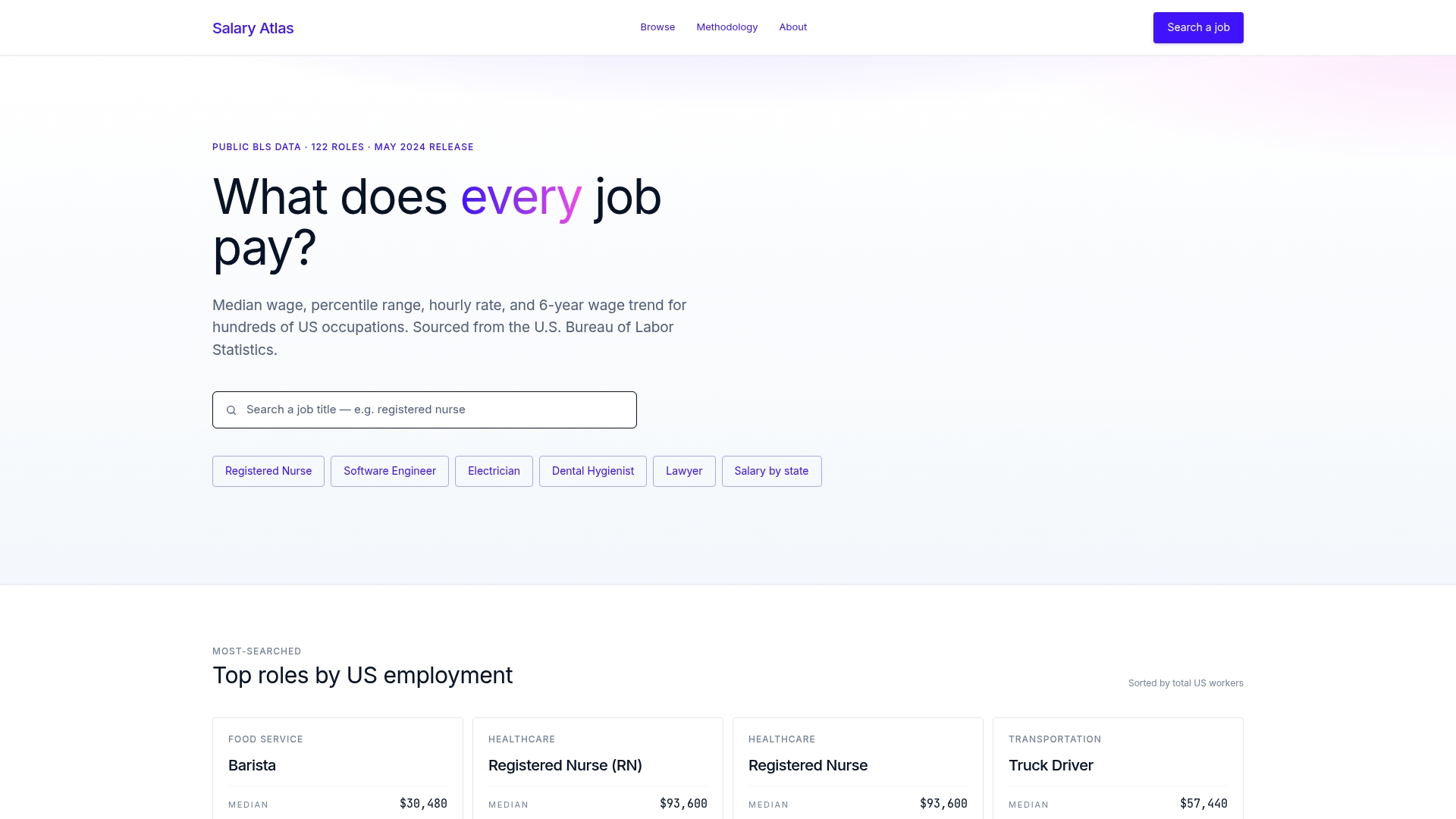
Bring the median and the range for your state to your next pay conversation, along with the source link.
FAQ
How do I know if I'm underpaid?
Compare your base pay with BLS wage data for your occupation, state and experience level, then confirm with one or two independent sources. If your pay sits consistently below the middle of the range for your experience, you have a data-backed case. Job postings for your own role at your own company are another strong signal.
Is it illegal to be underpaid?
Not if you are paid more than the minimum wage and what your contract promises. Pay below the market rate is legal, but pay below the minimum wage, unpaid required overtime or pay that breaks your contract can be reported to the Department of Labor. Pay gaps tied to a protected characteristic can also be unlawful.
Should I compare my salary with a coworker's?
It can raise a question, but it is a weak basis for a raise request. Differences in experience, education and skills can explain a gap legitimately. Market data for your occupation and location gives you a stronger argument and holds up in a conversation.
What if my employer says there is no room in the budget?
Ask what else can move: a one-time bonus, extra vacation, remote work, training funds or an earlier review. Ask for a date for the next compensation review and what you need to achieve before it. A written follow-up keeps the conversation on record.
Sources
- Handy Reference Guide to the Fair Labor Standards Act, U.S. Department of Labor
- Fix My Job: Not Being Paid Fairly, Working America
- Underpaid at Work? Here's What to Do About It, CareerPayLab
- Signs You're Not Paid Enough, Business Insider
- Underpaid? How to figure it out and what to do about it, CNBC
- Salary Finder Help Page, CareerOneStop
- 6 ways to figure out how much you should be getting paid, CNBC
- HR Compliance for Small and Mid-Sized Businesses, Nimble Advisors
- Federal Employment Law guide, NFIB
- State Wage and Hour Claims Toolkit, Practical Law
Recommended
Occupation wage figures on Salary Atlas come from the U.S. Bureau of Labor Statistics. Figures in this article that are not linked to a source are estimates. See our methodology.